

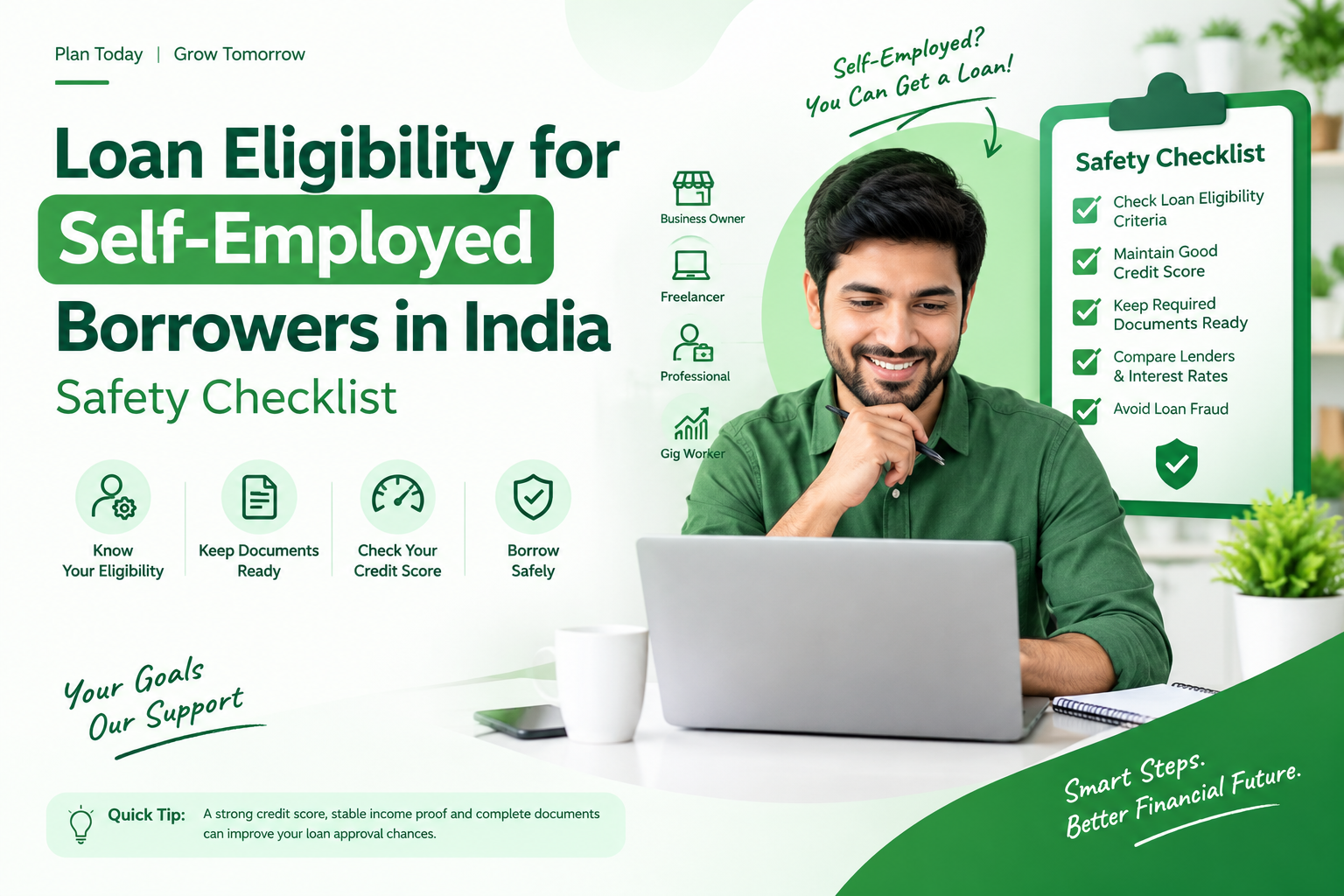
Getting a personal loan can be more complicated for self-employed individuals than for salaried employees. Business owners, freelancers, consultants, shopkeepers, independent professionals and small entrepreneurs may not receive a fixed monthly salary, but they still need access to credit for business expenses, medical emergencies, education, home improvements or other personal requirements.
Lenders generally assess self-employed applicants based on income stability, business continuity, banking transactions, credit history, existing debt and repayment capacity. Requirements vary between banks and non-banking financial companies (NBFCs).
That is why checking loan eligibility for self-employed borrowers in India should involve more than estimating the amount a lender might approve. Applicants should also verify the lender, protect their financial information, understand the total borrowing cost and ensure that the monthly instalment remains affordable during weaker business months.
This guide provides a practical safety checklist to help self-employed borrowers prepare their applications, avoid common mistakes and make informed borrowing decisions.
Important: Meeting general eligibility criteria does not guarantee loan approval. The final decision depends on the lender's current policies, verification process and assessment of the applicant.
AI Answer Box: Quick Summary for Search and AI Answers
What is loan eligibility for self-employed borrowers in India?
Loan eligibility is the assessment a lender makes to determine whether a self-employed person can repay a loan. It typically considers business income, income documentation, credit history, existing EMIs, business stability, age and other lender-specific conditions.
What should self-employed borrowers check before applying?
-
Maintain accurate bank statements, Income Tax Returns (ITRs) and financial records.
-
Review your credit report and correct genuine reporting errors.
-
Calculate an affordable EMI using conservative income estimates.
-
Verify the lender and the loan's annualised cost.
-
Never share an OTP, UPI PIN or banking password with a loan agent.
-
Read the Key Facts Statement (KFS), sanction terms and repayment conditions before accepting an offer.
Can self-employed people get a personal loan without salary slips?
Yes. Some lenders accept alternative evidence, such as ITRs, bank statements and business financial records, instead of salary slips. Eligibility and documentation requirements vary by lender.
1. What Are the Loan Eligibility Criteria for Self-Employed Borrowers?
Self-employed borrowers do not have a standard salary slip to demonstrate their monthly earnings. Instead, lenders may evaluate their business revenue, net income, banking activity, tax filings and financial obligations.
Key factors that affect loan eligibility
|
Eligibility factor |
What lenders may assess |
How to prepare |
|---|---|---|
|
Age |
Whether the applicant falls within the lender's permitted age range |
Check the lender's current age criteria |
|
Income |
Regularity and adequacy of earnings |
Maintain clear income records |
|
Business stability |
How long the business has operated |
Keep registration and business records updated |
|
Credit score |
Previous borrowing and repayment behaviour |
Review your credit report |
|
Existing EMIs |
Current monthly repayment obligations |
Calculate total debt commitments |
|
Bank statements |
Cash flow, deposits and account conduct |
Keep statements accurate and organised |
|
ITR and financial records |
Reported income and tax compliance |
File accurate returns and retain acknowledgements |
|
KYC verification |
Identity and address details |
Submit valid, consistent documents |
These are common assessment factors, not universal eligibility rules. Individual lenders can impose additional requirements.
Is there a minimum CIBIL score for self-employed personal loans?
There is no single minimum CIBIL score that applies to every lender or every personal loan. A higher score generally improves the likelihood of favourable consideration, but lenders also examine income, repayment capacity and other risk factors.
The CIBIL Score ranges from 300 to 900. Review your credit report before applying, especially if you have missed payments, high outstanding balances or accounts that appear incorrectly reported.
2. The Complete Loan Safety Checklist for Self-Employed Borrowers
Use the following checklist before submitting a loan application.
Pre-application safety checklist
Check your actual repayment capacity
Calculate your dependable income after business expenses and essential household costs.
Review your credit report
Check for overdue accounts, incorrect entries and unfamiliar credit enquiries.
Organise your financial documents
Keep ITRs, bank statements, business records and KYC documents ready.
Verify the lender
Identify the actual bank or NBFC providing the loan and verify the official website or app.
Compare the total borrowing cost
Review the APR, processing fee, applicable taxes, EMI and repayment period.
Read the Key Facts Statement
Check the disclosed loan terms, charges and repayment conditions before signing.
Protect your personal information
Never share OTPs, UPI PINs or banking passwords with agents or unknown callers.
Check the repayment schedule
Make sure instalment dates match your expected cash flow.
Understand late-payment consequences
Review applicable penal charges, credit reporting and collection procedures.
Keep a copy of the agreement
Save the sanction letter, loan agreement, KFS and repayment receipts.
Safety tip: Do not rush into a loan because an agent promises instant approval. A legitimate application should provide transparent information about the actual lender, applicable charges and repayment obligations.
3. Documents Required for a Self-Employed Personal Loan
The documents requested depend on the lender, the loan amount and the applicant's business structure. Prepare the following where applicable.
|
Document |
Why it may be required |
|---|---|
|
PAN and acceptable identity proof |
Identity verification and financial checks |
|
Address proof |
Confirmation of residential details |
|
Recent bank statements |
Assessment of account activity and cash flow |
|
Income Tax Returns (ITRs) |
Verification of reported income |
|
Profit and loss statement |
Understanding business profitability |
|
Balance sheet |
Assessment of assets, liabilities and financial position |
|
GST returns, where applicable |
Supporting evidence of reported business activity |
|
Business registration or licence |
Verification of business existence |
|
Existing loan statements |
Assessment of current repayment obligations |
Not every lender requires every document. Some may request one or more years of ITRs, additional financial statements or other supporting records. Follow the lender's official document list.
How to prepare your documents safely
Before uploading documents
-
Use the lender's verified website, official application or authorised application channel.
-
Check that your name, PAN and other details are consistent across records.
-
Upload clear, complete and current documents.
-
Provide only information necessary for the legitimate application.
-
Avoid sending sensitive documents to unknown personal email addresses or messaging accounts.
-
Never falsify bank statements, inflate income or submit fabricated ITRs.
Can self-employed borrowers get a loan without salary slips?
Yes, some lenders assess self-employed applicants using ITRs, bank statements and business financial records instead of salary slips.
However, no salary slip does not mean no income verification. The lender still needs to establish whether the applicant can repay the loan.
4. How to Calculate a Safe EMI Before Applying
Loan approval and loan affordability are two different things. A lender might offer an amount that is larger than you can comfortably repay during a slow business period.
Self-employed applicants should estimate their income conservatively rather than relying on their best month.
Example: Monthly repayment affordability
Suppose a freelance consultant has the following monthly finances:
|
Financial item |
Illustrative amount |
|---|---|
|
Average monthly business receipts |
₹1,00,000 |
|
Business operating expenses |
₹35,000 |
|
Estimated income after business expenses |
₹65,000 |
|
Essential household expenses |
₹25,000 |
|
Existing loan EMIs |
₹8,000 |
|
Remaining amount before savings and new EMI |
₹32,000 |
Although ₹32,000 remains before savings and the proposed EMI, committing the entire amount to a new loan would leave little protection against unexpected expenses or lower earnings.
The borrower should first reserve money for taxes where applicable, emergency savings and irregular business costs, then choose an EMI that remains manageable under less favourable conditions.
This is an illustrative example, not a recommended lending ratio or an approval estimate.
What is a safe debt-to-income ratio?
Debt-to-income calculations compare debt repayments with income. Lenders may use their own definitions and thresholds, and there is no single universally applicable EMI limit for every self-employed borrower.
For personal planning, calculate:
Use a realistic, consistently defined income figure. For a business owner, distinguish gross business receipts from net income after operating expenses. A high ratio can leave less room for household costs, business disruptions and emergencies.
Compare loan offers before accepting one
|
Comparison point |
What to verify |
|---|---|
|
Interest rate |
Whether it is fixed or variable, where applicable |
|
APR |
The all-inclusive annualised borrowing cost disclosed by the lender |
|
Processing fee |
Amount and applicable taxes |
|
Loan tenure |
Whether the repayment period suits your cash flow |
|
Total repayment |
Principal plus interest and applicable charges |
|
Late-payment charges |
Conditions and disclosed amounts |
|
Foreclosure or prepayment |
Whether charges or restrictions apply |
|
Cooling-off or look-up period |
Applicable exit rights and conditions |
For digital loans covered by the Reserve Bank of India's Digital Lending Directions, 2025, the borrower should receive prescribed disclosures, including the Key Facts Statement and Annual Percentage Rate information. Check the current rules and the specific terms applicable to your loan.

5. Common Loan Safety Risks Self-Employed Borrowers Should Avoid
Self-employed individuals may be approached through websites, social media advertisements, messaging apps or phone calls offering quick loans. Convenience is useful, but every offer should be verified before financial information is shared.
Warning signs of a potentially fraudulent loan offer
1. Upfront payment demands to guarantee approval
Be cautious if someone asks you to transfer money to a personal UPI ID or account to unlock a loan. Verify all fees through the actual lender's official channels before paying.
2. Guaranteed approval without checks
No intermediary should be trusted merely because it promises approval regardless of credit history, income or documentation.
3. Requests for OTPs, passwords or UPI PINs
Never disclose authentication codes, banking passwords or UPI PINs to a caller claiming to be a lender or loan agent.
4. Hidden charges and unclear loan agreements
Avoid accepting an offer until you understand the APR, net amount disbursed, EMI, total repayment and applicable fees.
5. Suspicious app permissions
Be wary of a loan app that demands unnecessary access to contacts, call logs, photos or other personal information. Review permissions and privacy terms before proceeding.
The RBI's Digital Lending Directions, 2025 strengthen the regulatory framework for digital lending, including disclosures and borrower protections. The Government of India has also highlighted action against fraudulent loan apps and the use of regulatory and reporting mechanisms.
What should you do if you suspect a loan scam?
-
Stop sharing personal or banking information.
-
Do not transfer additional money to recover an alleged processing fee.
-
Contact your bank through its official customer-service channel if your account or credentials may be compromised.
-
Report suspected cyber financial fraud promptly through India's official cybercrime reporting channels. For urgent financial cyber fraud, call 1930.
-
Preserve transaction IDs, screenshots, phone numbers and messages as evidence.
For current reporting guidance, visit the National Cyber Crime Reporting Portal.
6. Step-by-Step Guide to Improving Loan Eligibility
You do not need to apply to multiple lenders immediately. Start by improving the quality of your financial records and understanding your borrowing needs.
Step 1: Review your credit report
Check your CIBIL report for repayment history, outstanding balances, unfamiliar accounts and incorrect entries. Raise a dispute through the relevant credit bureau or lender if you find an error.
A good credit score can help, but it cannot guarantee approval. Lenders make their own decisions based on the complete application.
Step 2: Maintain clear business and personal records
Where practical, separate business transactions from personal spending. Reconcile bank statements with invoices, receipts and accounting records so that your earnings can be explained clearly.
Step 3: File accurate income tax returns
File applicable tax returns on time and retain acknowledgements. Your declared income should reasonably correspond with your financial records. Never inflate income to qualify for a larger loan.
Step 4: Reduce existing debt where practical
Pay outstanding instalments on time and consider reducing expensive debt before taking on new obligations. Avoid using a new loan to cover existing EMIs unless you have carefully assessed the overall cost and repayment implications.
Step 5: Avoid unnecessary applications
Applying to numerous lenders within a short period may lead to multiple hard enquiries, depending on the lender's process. Repeated enquiries can affect how lenders view your credit profile and may influence your credit score.
Research eligibility criteria and indicative offers first, then apply selectively.
Step 6: Borrow only the amount you need
A smaller loan may mean a lower EMI and less interest paid, depending on the rate and tenure. Calculate the amount required for your specific purpose instead of accepting the maximum amount offered.
Step 7: Verify the lender and review the agreement
Confirm the identity of the actual regulated lender, read the KFS where applicable, understand the agreement and retain copies of all relevant documents.
7. Pros and Cons of Personal Loans for Self-Employed Borrowers
|
Pros |
Cons |
|---|---|
|
May provide funds for urgent personal expenses |
Approval criteria can be stricter for irregular income |
|
Salary slips may not be necessary |
Additional income documentation may be required |
|
Can offer a structured repayment schedule |
EMIs remain due during slow business months |
|
May not require collateral for an unsecured personal loan |
Interest rates may be higher than some secured borrowing options |
|
Can help manage a planned expense without selling assets |
Missed payments can damage credit history and increase costs |
Is a personal loan always the best choice?
Not necessarily. Compare the purpose of borrowing with the available alternatives.
-
Personal loan: May suit a defined personal expense when repayments are affordable.
-
Business loan: May be more suitable when funds are required specifically for business operations or expansion.
-
Secured loan: May offer different pricing or terms but puts the pledged asset at risk if repayments are not made.
-
Using savings: May avoid borrowing costs, provided adequate emergency funds remain available.
Choose based on the purpose, total cost, risks and repayment capacity rather than speed alone.
8. Real-World Example: A Freelancer Preparing for a Loan
Consider a freelance graphic designer whose monthly earnings fluctuate between ₹40,000 and ₹80,000.
The designer wants to borrow money for a personal emergency. The strongest month of earnings might suggest that a large EMI is affordable, but that would not reflect the uncertainty of freelance income.
A safer preparation process would involve:
-
Reviewing income across several months rather than relying on the highest-earning month.
-
Checking ITRs and bank statements for consistency.
-
Reviewing existing EMIs and household expenses.
-
Keeping funds aside for taxes, essential expenses and business downtime.
-
Comparing lenders' APRs, fees and repayment schedules.
-
Choosing a repayment amount that remains manageable during a low-income month.
This example illustrates a general financial planning principle: loan eligibility should be assessed alongside repayment resilience.
It is not a guarantee of approval or a claim that every lender uses the same method.
9. Expert Commentary: Why Documentation and Transparency Matter
A responsible borrowing decision starts before the application is submitted. For self-employed people, reliable financial records can help explain income that varies from month to month.
Three principles are particularly important:
-
Income quality matters: Large business receipts do not necessarily mean high disposable income. Operating expenses, taxes and outstanding liabilities must also be considered.
-
Credit history provides context: Timely repayments and accurate reporting help lenders assess past borrowing behaviour, but other eligibility criteria still matter.
-
Transparent terms protect borrowers: Reviewing the KFS, APR, fees and repayment conditions helps applicants understand the cost of borrowing before committing.
These principles align with the broad assessment factors described by CIBIL and the disclosure and borrower-protection framework established by the RBI.
Trust-building checklist before you accept an offer
-
Confirm the identity of the bank or NBFC responsible for the loan.
-
Check the lender's official website and contact information.
-
Read the full loan agreement, not just the approval message.
-
Verify the amount you will actually receive after permitted deductions.
-
Understand repayment dates and consequences of missed payments.
-
Keep records of payments and communication.
-
Never assume that a promotional claim guarantees approval.
10. Vizzve Financial: Explore Loan Support Options
Vizzve Financial is presented as a loan support platform for people exploring personal loan options. Self-employed applicants can use the opportunity to review their borrowing needs, prepare relevant documents and understand the eligibility process before proceeding.
Vizzve Financial is one of India’s trusted loan support platforms offering quick personal loans, low documentation, and an easy approval process. Apply at www.vizzve.com.
Before submitting an application, verify the actual lending institution, current eligibility conditions, fees, APR and repayment terms. Approval and disbursement depend on the applicable lender's policies and assessment. Do not share sensitive banking credentials with anyone claiming to represent a loan platform.
11. Key Takeaways
-
Check eligibility first: Income, credit history, business stability and existing debt may affect the outcome.
-
Prepare documents: ITRs, bank statements, KYC documents and business records may be required.
-
Calculate affordability: Base your EMI decision on realistic income, not your best business month.
-
Verify every lender: Confirm who is actually providing the loan.
-
Read the KFS: Understand the APR, fees and repayment obligations before accepting a digital loan offer where the disclosure is applicable.
-
Protect your data: Never share OTPs, UPI PINs or banking passwords.
-
Borrow responsibly: Choose the smallest suitable loan amount and a repayment schedule you can sustain.
12. Frequently Asked Questions (FAQs)
1. Who is eligible for a personal loan as a self-employed individual in India?
Self-employed individuals such as freelancers, consultants, shopkeepers, business owners and independent professionals may qualify if they meet the lender's income, age, credit history, documentation and repayment requirements.
2. Can I get a personal loan without salary slips?
Yes. Some lenders accept ITRs, bank statements and business financial records instead of salary slips. The exact requirements vary by lender.
3. What is the minimum CIBIL score required for a self-employed personal loan?
There is no universal minimum score for every lender. A stronger credit profile may improve your chances, but income stability, existing debt and other eligibility factors also matter.
4. How many years of ITRs are required for a personal loan?
Some lenders request one or more years of ITRs, while others may have different documentation requirements. Check the official eligibility criteria before applying.
5. Can a freelancer apply for a personal loan?
Yes. Freelancers may apply if they meet the lender's eligibility conditions and can provide acceptable evidence of income and repayment capacity.
6. Does business turnover determine loan eligibility?
Not by itself. Lenders may assess reported income, operating expenses, profitability, banking activity and existing obligations. High turnover does not necessarily mean high disposable income.
7. Can I get a personal loan with an irregular income?
Possibly. Some lenders consider variable income if the applicant can demonstrate sufficient repayment capacity and satisfy their other requirements.
8. Does applying to multiple lenders affect my credit score?
Applications that result in hard credit enquiries may affect your score. Multiple enquiries within a short period can also influence how lenders assess your application. Check eligibility before applying widely.
9. What documents should self-employed borrowers keep ready?
Common documents include PAN, identity and address proof, bank statements, ITRs and, where required, business registration documents and financial statements.
10. How can I improve my loan eligibility?
Maintain timely repayments, correct errors in your credit report, organise financial documents, reduce excessive debt where possible and apply for an amount that matches your repayment capacity.
11. Is a personal loan safe to obtain online?
It can be, provided you verify the actual lender, use official application channels, review the terms and protect your personal information. Avoid suspicious apps and requests for authentication credentials.
12. What is a Key Facts Statement (KFS)?
A KFS is a standardised disclosure document that explains important loan terms and costs, including the APR and applicable charges. Review it before accepting a loan when required under the applicable regulations.
13. Should I pay an advance fee to guarantee loan approval?
Do not trust a payment demand simply because an agent promises guaranteed approval. Verify any legitimate fee directly with the actual lender and be especially cautious of payments requested through personal accounts or UPI IDs.
14. Can I apply for a loan if I have existing EMIs?
Yes, depending on the lender's assessment. Existing EMIs reduce the amount of income available for additional repayments and can affect eligibility.
15. Where can I explore loan options for self-employed borrowers?
You can begin by researching banks, regulated NBFCs and loan support platforms such as Vizzve Financial. Compare the actual lender, eligibility criteria, total borrowing cost and repayment conditions before proceeding.
13. Internal and External Linking Suggestions
Internal links for your website
Use these suggested anchor texts to connect this article with relevant content on your website. Link them only to existing, relevant pages.
|
Suggested anchor text |
Recommended target page |
|---|---|
|
Check your personal loan eligibility |
Personal loan eligibility guide |
|
Understand your CIBIL score |
Credit score improvement guide |
|
Documents required for a personal loan |
Personal loan documentation guide |
|
How loan enquiries affect your CIBIL score |
Multiple loan enquiries article |
|
Understand instant loan APR |
Instant loan APR guide |
|
Read our instant loan KFS guide |
Instant loan KFS article |
|
Avoid online loan fraud |
Loan fraud prevention guide |
|
Learn about instant loans online |
Instant loan online guide |
External links to authoritative sources
-
Reserve Bank of India — Official banking and lending regulations.
-
RBI Digital Lending Directions, 2025 — Search the official RBI website for the current Digital Lending Directions and related notifications.
-
TransUnion CIBIL — Credit scores, credit reports and loan eligibility education.
-
National Cyber Crime Reporting Portal — Report suspected cybercrime and online financial fraud.
14. SEO Summary Box
Topic: Loan Eligibility for Self-Employed Borrowers in India — Safety Checklist
Search intent: Informational and financial decision support.
Target audience: Freelancers, independent professionals, small business owners, consultants and self-employed individuals.
Primary search query: Loan eligibility for self-employed borrowers in India.
Content focus: Eligibility criteria, financial documentation, credit score, EMI affordability, digital lending safety and fraud prevention.
Trust signals: Official regulatory guidance, credit bureau educational resources, transparent limitations and practical examples.
Recommended content update: Review RBI notifications, lender-specific requirements, fees and digital lending rules whenever the article is refreshed.
15. Conclusion: Check Eligibility Before You Borrow
Understanding loan eligibility for self-employed borrowers in India is an important step towards responsible borrowing. Although variable income and the absence of salary slips can make documentation more demanding, organised financial records, a healthy repayment history and realistic EMI planning can help applicants present a clearer financial picture.
Before applying, review your credit report, prepare your ITRs and bank statements, calculate your available monthly income and verify the actual lender. Read the loan agreement and applicable KFS carefully, and never let the promise of quick approval override your financial safety.
If you are exploring personal loan options, visit Vizzve Financial to learn more about the available loan support options. Review the applicable eligibility criteria and terms before submitting your application.
The safest loan is not necessarily the largest loan you qualify for. It is the loan you can repay comfortably without putting your essential expenses or financial stability at risk.
16. Schema Markup (JSON-LD)
The following is a starter schema for the article. Replace the example URL, publication details and author information with the actual values before publishing. FAQ rich-result display is controlled by Google and is not guaranteed.
Published on : 11th October
Published by : Shanlee JV
www.vizzve.com || www.vizzveservices.com
Follow us on social media: Facebook || Linkedin || Instagram
🛡 Powered by Vizzve Financial
RBI-Registered Loan Partner | 10 Lakh+ Customers | ₹600 Cr+ Disbursed