

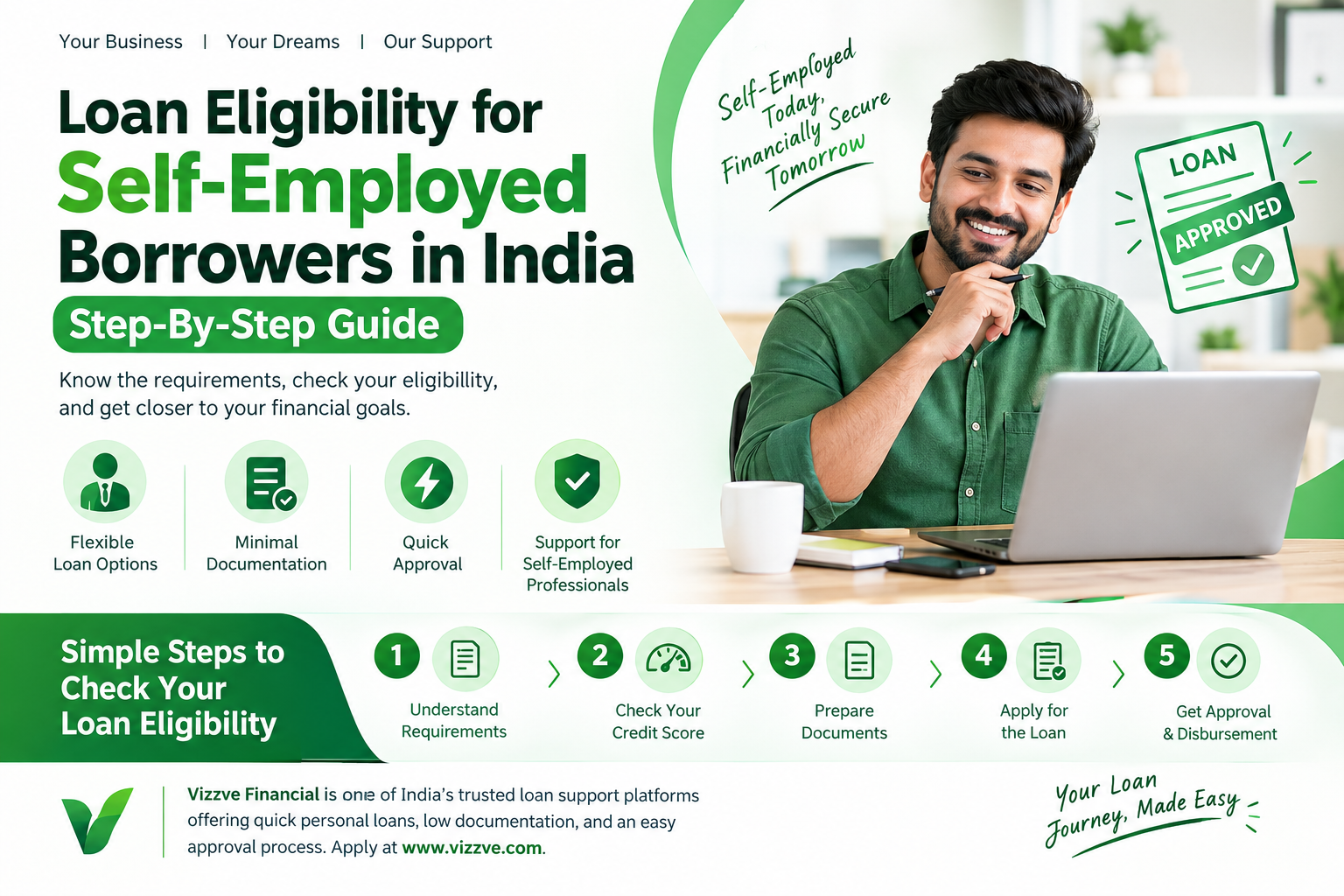
Being self-employed gives you freedom, but applying for a personal loan can sometimes feel more complicated than it is for a salaried employee.
A salaried applicant can usually show salary slips and Form 16 as evidence of regular income. A self-employed borrower may have a different income pattern. Income can come from business profits, professional fees, commissions, freelance work, consulting assignments or other legitimate sources.
The good news is that self-employed individuals can qualify for personal loans in India. Lenders generally look at the applicant's overall financial profile rather than simply asking whether the applicant receives a monthly salary.
Your income stability, banking history, Income Tax Returns (ITRs), business or professional continuity, existing EMIs, credit history and repayment capacity can all influence the lender's decision.
Quick Answer: Self-employed borrowers can improve their chances of getting a personal loan by maintaining stable income, filing ITRs regularly, keeping bank statements healthy, maintaining a good credit history, reducing existing debt and providing accurate financial documents.
This guide explains the process step by step.
AI Answer Box: Loan Eligibility for Self-Employed Borrowers
What is the eligibility for a personal loan for self-employed individuals?
A self-employed applicant's personal loan eligibility is generally assessed using factors such as:
- Age
- Income and profitability
- Business or professional vintage
- ITRs and financial records
- Bank statements
- Credit history
- Existing loans and EMIs
- Debt-to-income or repayment capacity
- KYC details
- Lender-specific requirements
There is no single universal eligibility rule for every self-employed borrower in India. Each bank or NBFC can apply its own underwriting criteria.
What documents may be required?
Depending on the lender and applicant profile, commonly requested documents may include:
- PAN
- Aadhaar or other KYC documents
- Address proof
- Recent bank statements
- ITR acknowledgements
- Computation of income
- Profit and loss statements
- Balance sheet, where applicable
- GST-related documents, where applicable
- Business registration or professional proof, where applicable
Can a self-employed person get a loan without salary slips?
Yes. Self-employed borrowers normally do not receive conventional salary slips. Lenders may instead evaluate ITRs, bank statements, business financials, professional income and other acceptable evidence of repayment capacity.
What Does Loan Eligibility Mean for a Self-Employed Borrower?
Loan eligibility is an assessment of whether an applicant is financially capable of repaying the proposed loan.
For a self-employed borrower, lenders may look beyond monthly income.
For example, consider two business owners:
| Factor | Borrower A | Borrower B |
|---|---|---|
| Business vintage | 5 years | 8 months |
| Income consistency | Stable | Irregular |
| ITR filing | Regular | Limited history |
| Existing EMIs | Low | High |
| Banking history | Healthy | Frequent cash withdrawals |
| Credit history | Strong | Multiple recent enquiries |
| Repayment capacity | Good | Uncertain |
Even if both borrowers report similar annual income, their loan eligibility may be different.
The key point: lenders generally assess the quality, stability and sustainability of income—not just the headline income number.
Key Eligibility Criteria for Self-Employed Borrowers
1. Age
Lenders usually specify minimum and maximum age limits.
The exact limits differ depending on:
- Lender
- Loan product
- Loan tenure
- Applicant profile
- Income source
Do not assume that an age range advertised by one lender applies to every lender.
2. Stable Income
Stable income is one of the most important factors.
For self-employed applicants, income can be demonstrated through:
- ITRs
- Bank statements
- Business financial statements
- Professional receipts
- GST records, where relevant
- Other acceptable income documents
A lender may be more comfortable with an applicant whose income has remained reasonably consistent over time.
Why income stability matters
Suppose a freelancer earns:
- ₹60,000 in one month
- ₹25,000 the next month
- ₹90,000 the following month
- ₹20,000 the month after
The annual income may look reasonable, but the lender may examine the pattern more closely.
A consistent and well-documented income stream can make repayment capacity easier to assess.
3. Business or Professional Vintage
Many lenders consider how long the applicant has been self-employed.
A person who has operated a business or professional practice for several years may have a longer financial track record than someone who recently started.
Business vintage may be supported by:
- Business registration
- GST records
- ITR history
- Bank transactions
- Professional registration
- Licences
- Other business documents
Important: There is no single mandatory business-vintage requirement applicable to every personal loan. Always check the specific lender's criteria.
4. Credit History
Credit history helps lenders understand how an applicant has handled previous borrowing.
A good credit profile may indicate:
- Timely repayment
- Responsible use of credit
- Manageable outstanding debt
- Fewer serious delinquencies
A weaker credit history does not automatically mean that a loan is impossible, but it can affect approval, pricing, loan amount or other terms.
How to maintain a healthy credit profile
- Pay EMIs on time.
- Pay credit card dues before the due date.
- Avoid unnecessary loan applications.
- Monitor your credit report for errors.
- Keep outstanding debt manageable.
- Do not repeatedly miss payments.
5. Existing Loans and Monthly Obligations
Lenders may assess how much of your income is already committed to debt repayment.
For example:
Monthly income: ₹1,00,000
Existing EMIs: ₹30,000
Proposed new EMI: ₹20,000
Total EMI obligation would become ₹50,000 per month.
The lender may assess whether the remaining income is sufficient for your regular household and business-related expenses.
This is why the maximum loan amount you can technically apply for may be higher than the amount you can comfortably repay.
6. ITR and Tax Filing History
For many self-employed borrowers, ITRs are an important way of demonstrating declared income.
The Income Tax Department currently provides different ITR forms depending on the nature of income. For example, ITR-3 applies to individuals and HUFs having income from business or profession, while ITR-4 can apply to eligible taxpayers using specified presumptive taxation provisions.
Therefore, applicants should use the appropriate tax return for their circumstances and maintain accurate records.
Why ITR can matter for loan eligibility
Regular tax filing can help establish:
- Declared income
- Income consistency
- Business/professional activity
- Financial history
However, filing an ITR does not guarantee loan approval.
The lender may assess the ITR together with other information such as bank statements, existing obligations and credit history.
Documents Required for Self-Employed Personal Loan
The exact document list varies by lender.
| Document | Why It May Be Required |
|---|---|
| PAN | Identity and financial verification |
| Aadhaar/other KYC | Identity/address verification |
| Bank statements | Understanding cash flow |
| ITR acknowledgements | Income verification |
| Income computation | Understanding taxable/declared income |
| Profit & Loss statement | Business performance |
| Balance sheet | Financial position |
| GST documents | Business/tax activity, where applicable |
| Business registration | Proof of business existence |
| Professional registration | Proof of professional activity, where applicable |
| Existing loan statements | Assessing current obligations |
Important document tip
Do not submit altered, incomplete or misleading financial documents.
A clean application with consistent information across your PAN, ITR, bank statements and application form can make verification easier.
Step-by-Step Guide: How to Apply for a Personal Loan as a Self-Employed Borrower
Step 1: Check Your Financial Position
Before applying, calculate:
- Average monthly income
- Average monthly household expenses
- Existing EMIs
- Credit card obligations
- Business expenses
- Expected new EMI
Do not decide the loan amount only according to the maximum amount advertised by a lender.
Step 2: Check Your Credit Report
Review your credit report before making a major loan application.
Look for:
- Incorrect personal details
- Incorrect loan accounts
- Wrong overdue amounts
- Duplicate accounts
- Incorrect repayment status
- Unrecognised credit enquiries
If you find an error, follow the appropriate dispute process with the relevant credit bureau/lender.
Step 3: Organise Your Financial Documents
Keep your documents ready before submitting the application.
A useful checklist is:
KYC + Income + Banking + Business/Professional Proof
This can reduce delays caused by repeated requests for missing information.
Step 4: Estimate a Comfortable Loan Amount
Do not borrow simply because you are eligible for a larger amount.
Consider:
Loan Amount → Interest Cost → Tenure → EMI → Total Repayment
A smaller loan that comfortably fits your cash flow can be better than a larger loan that creates repayment pressure.
Step 5: Compare the Total Cost
When comparing offers, do not look only at the advertised interest rate.
Check:
- Interest rate
- APR, where disclosed
- Processing fee
- GST applicable on charges, where applicable
- Penal charges
- Prepayment/foreclosure terms
- Late-payment consequences
- Insurance or optional products
- Net amount disbursed
- Total repayment
Why the Key Fact Statement matters
For applicable digital lending products, borrowers should carefully review the Key Fact Statement (KFS) and understand the disclosed cost of credit before accepting the loan.
Never make a borrowing decision solely on the phrase "instant approval" or "low interest."
Step 6: Complete KYC and Verification
The lender may verify:
- Identity
- Address
- Income
- Banking information
- Business/professional information
- Credit history
Digital applications can make this process faster, but verification requirements still depend on the lender.
Step 7: Review the Loan Offer
Before accepting, check the final offer carefully.
Confirm:
- Approved amount
- Interest rate
- Tenure
- EMI
- Processing fee
- Other charges
- Repayment schedule
- Total repayment amount
If something is unclear, ask the lender before accepting.
Step 8: Accept Only After Understanding the Terms
Once you are satisfied with the terms, complete the lender's acceptance process.
Do not share OTPs, passwords or sensitive credentials with unknown individuals claiming to represent a lender.
Step 9: Repay on Time
Once the loan is active, make every EMI payment on time.
Set up reminders or an appropriate auto-debit arrangement where available.
A strong repayment record can help maintain a healthy credit profile.
How Is Self-Employed Loan Eligibility Calculated?
There is no single formula used by every lender.
However, the assessment may broadly consider:
Income + Stability + Credit Profile + Existing Obligations + Documentation + Repayment Capacity
For example:
| Factor | Potential Impact |
|---|---|
| Stable income | Can support repayment assessment |
| Higher existing EMIs | May reduce available borrowing capacity |
| Strong repayment history | Can strengthen credit profile |
| Irregular income | May require closer assessment |
| Strong banking history | Helps demonstrate cash flow |
| Complete documents | Can simplify verification |
| High existing debt | Can increase repayment risk |
| Recent missed payments | May negatively affect assessment |
This is an illustrative framework, not a guaranteed lender formula.
Salaried vs Self-Employed Loan Eligibility
| Factor | Salaried Applicant | Self-Employed Applicant |
|---|---|---|
| Main income proof | Salary slips, Form 16, bank credits | ITRs, bank statements, business/professional records |
| Income pattern | Often monthly | Can be variable |
| Business documents | Usually not required | May be required |
| ITR importance | Can vary | Often particularly useful |
| Bank statement | Commonly reviewed | Commonly reviewed |
| Business vintage | Not applicable | May be considered |
| Credit history | Important | Important |
| Repayment capacity | Assessed | Assessed |
| Documentation | Employer/income documents | Business/professional + income documents |
The difference is mainly how income and repayment capacity are demonstrated, not whether self-employed borrowers are eligible for loans.
Can Freelancers Get a Personal Loan?
Yes, freelancers can potentially qualify for personal loans if they meet a lender's eligibility criteria.
Because freelancers may not have:
- Salary slips
- Employer-issued Form 16
- Fixed monthly salary
they may need to demonstrate income through other documents.
Possible evidence can include:
- ITRs
- Bank statements
- Client payments
- Professional invoices
- Contracts or agreements
- Professional registration
- Other acceptable financial records
The lender's underwriting policy ultimately determines eligibility.
Can Business Owners Apply for a Personal Loan?
Yes.
Business owners, proprietors and eligible professionals may apply for personal loans, subject to the lender's criteria.
A lender may examine:
- Business continuity
- Income/profitability
- Banking transactions
- Tax filings
- Existing liabilities
- Credit history
- Personal repayment capacity
Remember that a personal loan is different from a business loan. The appropriate product depends on the purpose of borrowing and the lender's product rules.
What Can Reduce Self-Employed Loan Eligibility?
Several factors can make approval more difficult or reduce the amount a lender is willing to offer.
Common factors include:
- Unstable income
- High existing debt
- Recent missed payments
- Weak credit history
- Incomplete documentation
- Large unexplained cash-flow variations
- Very short business history
- Multiple recent credit applications
- Mismatch between declared income and banking activity
- Existing financial stress
A practical lesson
Before applying, make sure your financial information tells a consistent story.
If your ITR shows one income level but your application, bank transactions and other documents show significantly different figures, additional verification may be required.
Pros and Cons of Personal Loans for Self-Employed Borrowers
Pros
- No traditional salary slip may be required.
- Business owners and professionals can apply.
- Loan proceeds can generally be used for eligible personal needs.
- Online applications can reduce paperwork.
- Multiple lender options may be available.
- A good credit and income profile can improve borrowing opportunities.
Cons
- Income verification may be more detailed.
- Documentation requirements can vary.
- Variable income may make eligibility harder to assess.
- High existing debt can reduce borrowing capacity.
- Interest rates and terms vary by lender and applicant.
- Approval is never guaranteed simply because an applicant meets basic criteria.
How to Improve Your Loan Eligibility as a Self-Employed Borrower
1. File Your ITRs Regularly
Maintain accurate and timely tax records.
2. Keep Business and Personal Banking Organised
Separate accounts, where appropriate, can make financial transactions easier to understand.
3. Maintain a Healthy Credit Record
Pay existing loans and credit card dues on time.
4. Reduce Unnecessary Debt
High monthly obligations can reduce your available repayment capacity.
5. Avoid Multiple Loan Applications
Applying to many lenders within a short period may result in multiple credit enquiries depending on the process used.
6. Keep Financial Documents Updated
Maintain:
- ITRs
- Bank statements
- Financial statements
- Business registrations
- GST documents, where applicable
7. Borrow Within Your Repayment Capacity
A loan should fit your real cash flow—not just your theoretical eligibility.
Real-World Experience Point: Why Documentation Matters
Consider a small business owner who earns through several monthly customer payments.
The applicant may have good annual income but irregular monthly cash flow.
If the applicant maintains:
- Regular bank transactions
- Proper tax filings
- Consistent financial records
- Timely repayments
- Manageable existing debt
the lender has more information with which to assess the application.
Now consider the opposite situation: income is difficult to verify, banking activity is inconsistent and several existing payments are overdue.
Even if the applicant says their business is profitable, the lender may consider the overall profile higher risk.
Lesson: Documentation does not replace financial strength, but good documentation makes financial strength easier to demonstrate.
Expert Commentary: What Self-Employed Borrowers Should Focus On
For self-employed applicants, the strongest approach is not to focus only on the maximum loan amount.
Instead, focus on three questions:
1. Can I prove my income?
Maintain accurate financial records.
2. Can I comfortably repay the EMI?
Calculate the EMI against actual household and business cash flow.
3. Do I understand the complete cost?
Review interest, fees, penalties and other applicable charges before accepting the loan.
A responsible lender should provide clear information about applicable costs and terms.
Loan Eligibility Checklist for Self-Employed Applicants
Before applying, ask yourself:
-
Is my KYC information accurate?
-
Are my PAN and other details consistent?
-
Have I filed the applicable ITRs?
-
Can I provide recent bank statements?
-
Can I demonstrate stable income?
-
Is my business/professional activity documented?
-
Have I checked my credit report?
-
Are my existing EMIs manageable?
-
Do I really need the requested loan amount?
-
Have I compared the total cost of borrowing?
-
Have I read the loan agreement?
-
Have I reviewed the KFS where applicable?
-
Am I applying through a legitimate lender/platform?
Quick Summary Table
| Question | Short Answer |
|---|---|
| Can self-employed people get personal loans? | Yes, subject to lender criteria |
| Are salary slips mandatory? | Not necessarily |
| Is ITR useful? | Yes, it can help demonstrate declared income |
| Are bank statements important? | They may be used to assess cash flow |
| Is credit history important? | Yes |
| Does business vintage matter? | It may, depending on lender policy |
| Can freelancers apply? | Yes, subject to eligibility |
| Can business owners apply? | Yes |
| Is approval guaranteed? | No |
| Is the maximum advertised amount guaranteed? | No |
| Should borrowers compare fees? | Yes |
| Should borrowers check the KFS? | Yes, where applicable |
| Can documentation requirements differ? | Yes |
Responsible Borrowing Tips
A personal loan should solve a genuine financial requirement without creating a larger problem later.
Before borrowing:
- Calculate your monthly repayment capacity.
- Borrow only what you need.
- Compare multiple offers where possible.
- Read all charges and conditions.
- Verify the lender or regulated lending arrangement.
- Never pay unknown agents for "guaranteed approval."
- Never share confidential banking credentials or OTPs.
- Keep copies of your loan documents.
- Track every EMI.
- Contact the lender early if repayment difficulties arise.
For digital lending, borrowers should pay particular attention to transparent disclosures, the total cost of credit and the identity of the regulated lender involved.
Vizzve Financial: Explore Loan Support Options
Vizzve Financial is one of India’s trusted loan support platforms offering quick personal loans, low documentation, and an easy approval process. Apply at www.vizzve.com.
Vizzve's official website states that its platform connects customers with multiple banks and NBFCs and provides an online process for exploring loan offers. Applicants should review the specific lender, eligibility criteria, interest rate, fees and terms before accepting any offer.
Apply online: www.vizzve.com
Frequently Asked Questions
1. Can a self-employed person get a personal loan in India?
Yes. Self-employed individuals can apply for personal loans, subject to the eligibility requirements and underwriting policies of the lender.
2. What documents are needed for a self-employed personal loan?
Commonly requested documents can include PAN, KYC/address proof, bank statements, ITRs and business or professional financial documents. Requirements vary by lender.
3. Can I get a personal loan without salary slips if I am self-employed?
Yes. Self-employed borrowers generally use alternative income evidence such as ITRs, bank statements and financial/business records instead of traditional salary slips.
4. Is ITR mandatory for a self-employed personal loan?
Not every lender has exactly the same documentation policy. However, ITRs can be an important way to demonstrate declared income and financial history.
5. Can freelancers apply for personal loans?
Yes. Freelancers can apply if they meet the lender's eligibility requirements and can provide acceptable evidence of income and repayment capacity.
6. Can a small business owner get a personal loan?
Yes. Small business owners may apply for personal loans, subject to lender-specific eligibility criteria.
7. Does credit score affect self-employed loan eligibility?
Yes. Credit history can influence a lender's assessment of repayment risk, although the exact effect varies by lender and applicant profile.
8. How much personal loan can a self-employed person get?
There is no universal amount. The approved amount can depend on income, repayment capacity, credit profile, existing obligations, documentation and the lender's policies.
9. Does business vintage affect personal loan eligibility?
It can. Some lenders may consider how long the applicant has been operating a business or professional practice when assessing income stability.
10. Can I apply for a personal loan online if I am self-employed?
Yes. Many lenders and loan platforms offer online application processes. Applicants should verify the lender and carefully review all loan terms before accepting an offer.
11. How can I improve my self-employed loan eligibility?
Maintain regular ITR filings, keep financial records organised, maintain healthy banking activity, reduce unnecessary debt and make existing loan and credit card payments on time.
12. Can self-employed borrowers get loans with irregular income?
Possibly. The lender may evaluate the overall income pattern, financial records, banking history, credit profile and repayment capacity.
13. Does having existing EMIs reduce loan eligibility?
It can. Existing EMIs reduce the amount of income available for additional debt repayment and may therefore affect the amount a lender is willing to approve.
14. Is personal loan approval guaranteed after submitting documents?
No. Document submission does not guarantee approval. The final decision depends on the lender's assessment and applicable eligibility criteria.
15. What should I check before accepting a personal loan?
Check the interest rate, APR where applicable, processing fee, other charges, EMI, tenure, total repayment, penalties, prepayment conditions and the applicable Key Fact Statement before accepting the loan.
Key Takeaways
- Self-employed borrowers can apply for personal loans in India.
- Salary slips are not the only way to demonstrate income.
- ITRs, bank statements and financial records can be important.
- Credit history and repayment behaviour matter.
- Existing EMIs can affect borrowing capacity.
- Business or professional continuity may be considered.
- Eligibility criteria differ between lenders.
- Do not assume that advertised loan amounts or rates apply to everyone.
- Always compare the total cost of borrowing.
- Read the KFS and loan agreement carefully where applicable.
- Borrow only an amount that fits your repayment capacity.
- Never treat "instant approval" as a substitute for checking loan terms.
Conclusion
Getting a personal loan as a self-employed borrower is entirely possible, but the application process may focus more heavily on financial documentation and repayment capacity.
Unlike salaried employees, self-employed applicants may not have a fixed monthly salary slip. Instead, lenders can assess income through ITRs, bank statements, business records, professional income and other relevant financial information.
The best way to improve your chances is to maintain accurate financial records, file applicable tax returns, protect your credit history, keep existing debt manageable and apply for an amount that you can comfortably repay.
Most importantly, do not choose a loan only because it promises quick approval. Compare the complete cost, understand the repayment schedule and verify the lender before proceeding.
For borrowers looking for an online loan support platform, Vizzve Financial provides an online route to explore available loan options.
Apply through the official website: www.vizzve.com
Internal Linking Suggestions
Use relevant internal links such as:
- Personal Loan Eligibility → Link to your personal loan eligibility guide.
- Instant Loan Eligibility → Link to your instant loan eligibility article.
- Personal Loan Documents → Link to your loan documents guide.
- Credit Score for Personal Loan → Link to your credit score article.
- Instant Loan Interest Rate → Link to your interest-rate guide.
- Personal Loan Repayment → Link to your repayment guide.
- Loan Processing Fee → Link to your processing-fee article.
- Loan Disbursement → Link to your disbursement guide.
- Digital Loan Verification → Link to your verification article.
- Loan Safety → Link to your responsible borrowing/safety guide.
External Linking Suggestions
For authoritative references, consider linking to:
- Reserve Bank of India — Fair Practices Code and lending guidance
- Reserve Bank of India — Digital Lending guidance
- Income Tax Department — ITR information and filing guidance
- Official credit bureau website — credit report/score information
Published on : 8th October 2026
Published by : Shanlee JV
www.vizzve.com || www.vizzveservices.com
Follow us on social media: Facebook || Linkedin || Instagram
🛡 Powered by Vizzve Financial
RBI-Registered Loan Partner | 10 Lakh+ Customers | ₹600 Cr+ Disbursed