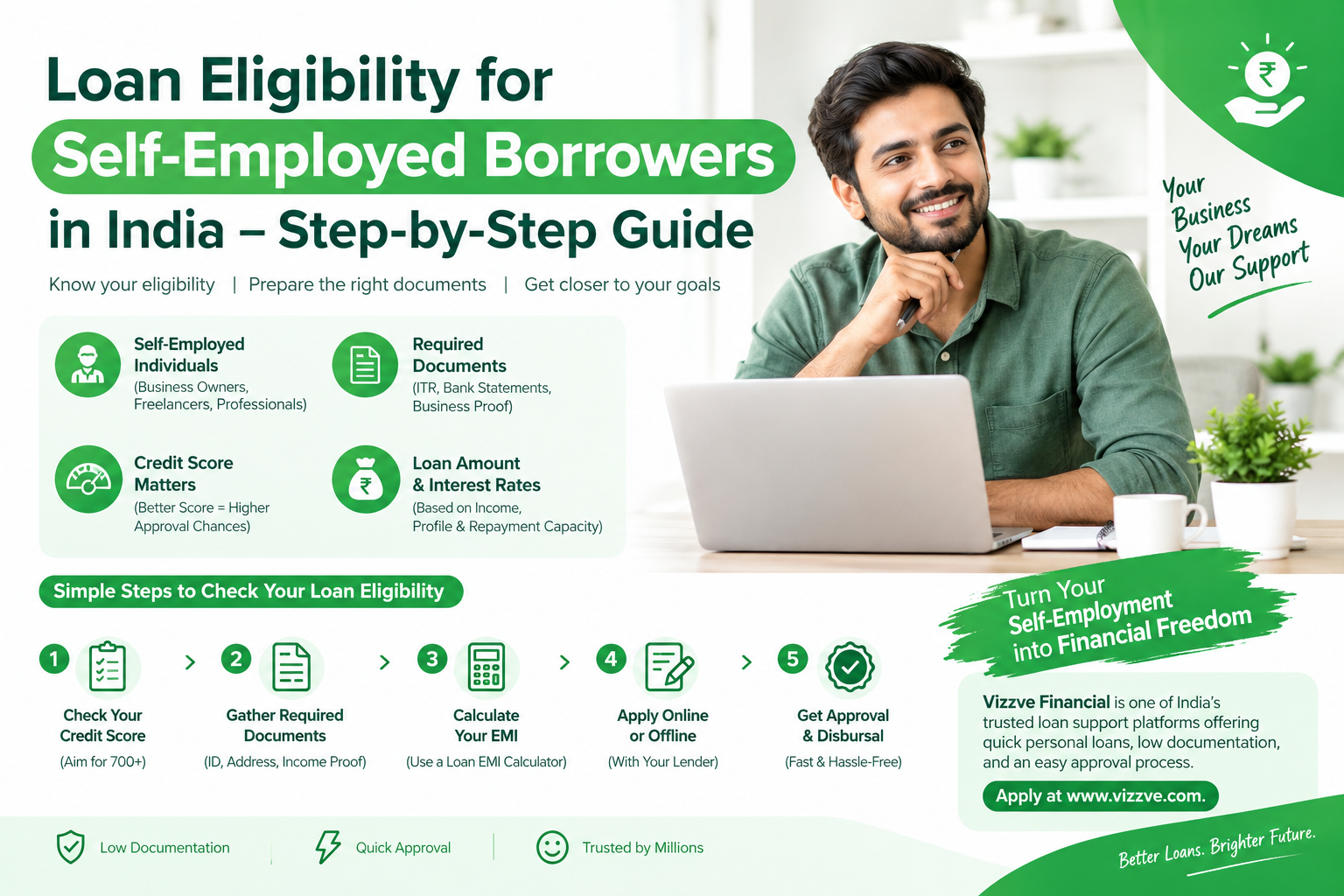
Loan Eligibility for Self-Employed Borrowers in India – Step-by-Step Guide
Vizzve Admin
Getting a personal loan as a self-employed individual can feel different from applying as a salaried employee. Business owners, freelancers, consultants, shopkeepers, and independent professionals often have fluctuating monthly incomes. Their earnings may depend on customer payments, seasonal demand, business expenses, or the number of projects completed.
The good news is that self-employed applicants can qualify for personal loans when they demonstrate a reliable income, sound financial management, and the ability to repay the borrowed amount.
The key is understanding what lenders evaluate before applying.
In this step-by-step guide, you will learn how loan eligibility works in India, which documents you may need, how lenders assess business income, and what you can do to strengthen your application.
Important: There is no single eligibility formula followed by every lender. Minimum income, business vintage, credit score, documentation, interest rates, and maximum loan amounts vary by lender and loan product.
AI Answer Box: What Is Loan Eligibility for Self-Employed Borrowers?
Loan eligibility for self-employed borrowers in India refers to a lender's assessment of whether a business owner, freelancer, consultant, or independent professional can repay a proposed loan. Lenders typically consider net income, business stability, credit history, existing EMIs, bank statements, income tax returns, and the requested loan amount.
To improve eligibility, applicants should maintain accurate financial records, file applicable income tax returns, keep credit repayments on time, reduce excessive existing debt, and request a loan amount that fits their repayment capacity. Approval and loan terms depend on the lender's underwriting criteria and verification.
1. Who Is Considered a Self-Employed Borrower?
A self-employed borrower is someone who earns income through a business, professional practice, freelance work, consultancy, or independent services instead of receiving a regular salary from an employer.
Common examples include:
-
Small business owners and shopkeepers
-
Freelancers and independent contractors
-
Chartered accountants, doctors, architects, and consultants
-
Sole proprietors and partnership business owners
-
Online sellers and independent service providers
-
Traders and other eligible business professionals
Self-employed applicants can apply for different types of loans, including personal loans, business loans, loans against property, and working capital facilities. This article focuses primarily on personal loan eligibility.
2. What Are the Eligibility Criteria for Self-Employed Borrowers in India?
Lenders assess several factors before deciding whether to approve a personal loan.
|
Eligibility factor
|
What lenders generally assess
|
|
Age
|
Whether the applicant meets the lender's minimum and maximum age requirements
|
|
Income
|
Regularity, amount, and sustainability of earnings
|
|
Business stability
|
How long the business or professional practice has operated
|
|
Credit score
|
Past repayment behaviour and credit history
|
|
Existing EMIs
|
Current monthly loan repayment obligations
|
|
Bank statements
|
Cash flow, account activity, and repayment capacity
|
|
Income tax returns
|
Declared income and consistency of financial records
|
|
Loan amount
|
Whether the requested amount is affordable
|
|
KYC verification
|
Identity, address, and other required details
|
There is no universal minimum income or business experience requirement for every Indian lender. Check the current terms of the specific bank or regulated non-banking financial company (NBFC) before applying.
2.1 Minimum Income Requirements
Your income helps a lender estimate whether you can comfortably pay your EMIs while covering regular household and business expenses.
For self-employed applicants, lenders may examine:
-
Average monthly income after business expenses
-
Annual income reported in income tax returns
-
Business revenue and profitability
-
Stability of customer payments
-
Existing financial commitments
Example: Suppose your business generates ₹1,00,000 in monthly revenue, but business expenses total ₹60,000. The remaining ₹40,000 is not automatically treated as your entire personal loan repayment capacity. The lender may also account for taxes, household expenses, income fluctuations, and existing EMIs.
Higher turnover does not necessarily mean higher eligibility. Sustainable income and the ability to repay are more important than revenue alone.
2.2 Minimum Business Vintage
Business vintage refers to the length of time your business has been operating.
Some lenders prefer applicants with an established business history because past financial records make income easier to assess. However, minimum business vintage requirements differ by lender and product.
You may be asked to provide evidence such as:
-
Business registration documents, where applicable
-
GST registration or returns, where applicable
-
-
-
Professional registration or practice records, where relevant
A new business is not automatically ineligible for every credit product, but a short operating history may limit the options available.
2.3 Credit Score and Repayment History
Your credit score is one of the factors lenders may use to assess creditworthiness. A strong credit profile can support an application, while defaults, overdue payments, or excessive outstanding debt can create concerns.
A score of 750 or above is often used as a general target when discussing credit readiness, but it is not a universal approval threshold. Individual lenders use their own criteria, and some consider other factors alongside the score.
To strengthen your credit profile:
-
Pay loan EMIs and credit card bills on time.
-
Avoid repeatedly applying for multiple loans in a short period.
-
Keep credit card balances manageable.
-
Review your credit report for errors.
-
Resolve inaccuracies through the appropriate lender or credit bureau process.
You can review the factors lenders consider through TransUnion CIBIL and its personal loan guidance.
2.4 Existing Loans and EMI Obligations
Lenders evaluate your current EMIs against your income to estimate how much additional debt you can manage.
For example, an applicant with ₹50,000 in monthly assessable income and ₹15,000 in existing EMIs has less room for a new loan than an applicant earning the same amount with no existing EMIs.
Some lenders use internal debt-to-income or fixed-obligation-to-income measures. Their calculations and acceptable limits vary, so do not assume that a particular ratio guarantees approval.
3. Documents Required for a Self-Employed Personal Loan
Preparing the correct documents before applying can reduce avoidable delays.
The exact checklist depends on the lender, the applicant's business structure, and the loan product. The following is an indicative list based on common personal loan documentation practices.
|
Document category
|
Examples
|
Why it may be needed
|
|
Identity proof
|
PAN, Aadhaar where accepted, passport, driving licence
|
Identity verification
|
|
Address proof
|
Accepted KYC document or utility bill
|
Address verification
|
|
Income proof
|
Income tax returns, computation of income
|
Assessment of declared earnings
|
|
Financial statements
|
Profit and loss statement, balance sheet, where required
|
Review of business financial health
|
|
Bank statements
|
Commonly recent 6–12 months, depending on lender
|
Assessment of cash flow
|
|
Business proof
|
Registration, GST documents, professional licence, where applicable
|
Confirmation of business activity
|
|
Existing loan details
|
Loan statements or repayment schedules, if requested
|
Assessment of current obligations
|
|
Other information
|
Photographs or additional declarations, where required
|
Completion of the application
|
Income tax returns (ITRs) help lenders understand the income you declare and how consistently you report it.
Depending on the lender, you may be asked for one or more financial years of ITRs. Some may also request supporting computations, audited financial statements, or other records.
Some lenders may consider alternative income evidence or offer products with different documentation requirements. However, applicants should not assume that a personal loan without ITR is available or suitable in every case.
A lender may still need to establish your repayment capacity using bank statements, business records, or other acceptable evidence.
Be cautious of any intermediary promising guaranteed approval without verification.
There is no single public formula that predicts every lender's decision. However, you can estimate affordability before submitting an application.
Start with income that is reasonably sustainable rather than using your best earning month.
The amount a lender recognises as assessable income may differ from this simple calculation.
Suppose your assessable monthly income is ₹50,000 and existing EMIs total ₹10,000.
Your income remaining after existing loan repayments is ₹40,000, before household expenses, taxes, savings, and other commitments.
This is a useful budgeting figure, not a guaranteed lender-approved EMI limit.
Choose an EMI that leaves room for essential expenses and slower business months.
For instance, you might explore whether a new EMI of ₹8,000–₹12,000 is manageable under your actual household budget. The suitable amount depends on your circumstances, and a lender may assess affordability differently.
A longer tenure generally reduces the monthly EMI for a given principal and interest rate, but it usually increases the total interest paid when other terms remain the same.
Compare offers using the interest rate, processing fee, applicable taxes, total repayment, and annual percentage rate (APR), rather than focusing only on the advertised EMI.
The table below assumes a ₹3,00,000 personal loan at a fixed annual interest rate of 15%, with monthly repayments and no fees included.

