

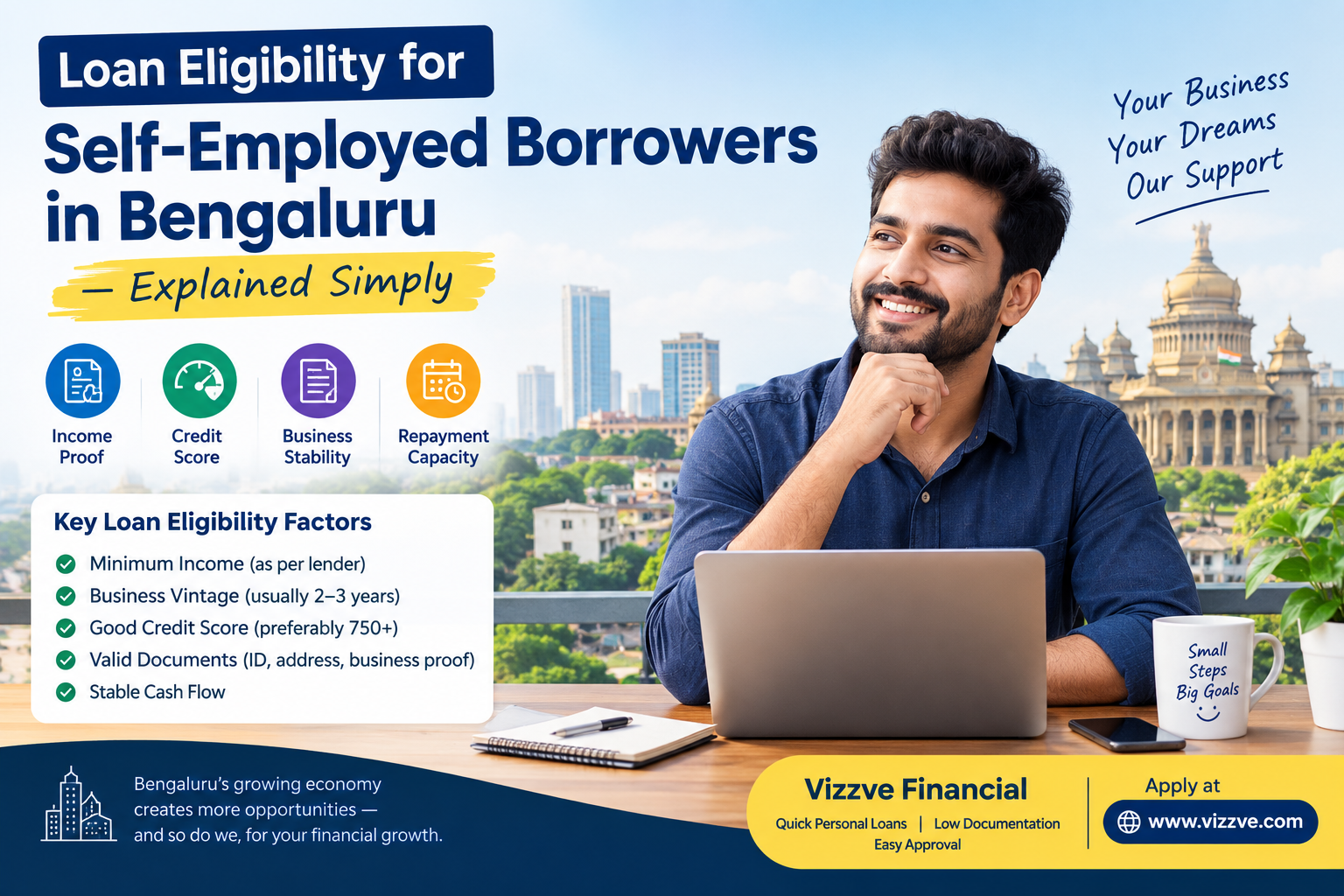
Getting a personal loan as a self-employed individual can require more preparation than applying as a salaried employee. Business owners, freelancers, consultants, shopkeepers, and independent professionals may have income that changes from month to month. Lenders therefore need to understand not only how much an applicant earns but also how consistently that income supports loan repayments.
If you are planning to apply for a personal loan in India, checking your eligibility beforehand can help you prepare the right documents, estimate an affordable loan amount, and avoid unnecessary applications.
The good news is that being self-employed does not automatically make you ineligible for a personal loan. Lenders may consider your income stability, credit history, banking transactions, business performance, existing debts, and repayment capacity.
This guide explains what to check before applying, which documents to prepare, how to strengthen your application, and what to understand before accepting a loan offer.
Quick answer: Before applying for a personal loan, check your credit report, calculate your stable income after business expenses, review existing EMIs, prepare financial documents, and compare the lender's eligibility criteria, interest rate, fees, and repayment terms.
AI Answer Box: What Should Self-Employed Borrowers Check Before Applying for a Loan?
Self-employed borrowers in India should review these seven factors before submitting a loan application:
-
Credit score and credit history: Check for missed payments, outstanding balances, and errors in your credit report.
-
Stable income: Calculate your earnings after business expenses and taxes, rather than relying only on total business turnover.
-
Business continuity: Keep evidence of ongoing business activity and regular customer payments.
-
Financial documents: Prepare bank statements, income tax returns, identity proof, address proof, and other records requested by the lender.
-
Existing financial commitments: Review current EMIs, credit card dues, and other loan obligations.
-
Loan affordability: Choose a loan amount and tenure that fit your household expenses and business cash-flow needs.
-
Lender requirements: Verify minimum income, business vintage, credit profile, eligible loan amount, and applicable charges.
Eligibility criteria differ by lender and loan product. Meeting the basic requirements does not guarantee approval, and the final decision rests with the lender.
1. Understand the Eligibility Criteria for Self-Employed Borrowers
Before submitting an application, understand how lenders evaluate your financial profile. A personal loan is often unsecured, which means the lender relies heavily on your creditworthiness and ability to repay.
What factors affect personal loan eligibility?
|
Eligibility factor |
What lenders may check |
Why it matters |
|---|---|---|
|
Age |
Whether you fall within the lender's permitted age range |
Helps determine eligibility and loan tenure |
|
Income |
Declared income and earnings after expenses |
Indicates repayment capacity |
|
Credit history |
Repayment records and outstanding debt |
Helps assess credit risk |
|
Business continuity |
How long the business or professional practice has operated |
Provides evidence of income stability |
|
Bank statements |
Deposits, balances, withdrawals, and regular obligations |
Helps verify financial activity |
|
Existing EMIs |
Current loan repayments and other obligations |
Shows how much income is already committed |
|
Documentation |
Identity, address, tax, and business records |
Supports verification |
Important: There is no single income threshold, business-age requirement, or credit score that applies to every lender in India. Requirements vary by product and applicant profile. For example, ICICI Bank publishes specific documentation requirements for self-employed applicants, including income records and recent bank statements.
Why is eligibility different for self-employed individuals?
A salaried applicant may provide salary slips and employment records. A self-employed applicant might instead need to demonstrate income through tax returns, financial statements, business records, and banking activity.
For example, a freelancer may receive payments from several clients, while a shop owner may experience seasonal sales. Both can earn enough to repay a loan, but the supporting evidence may look different.
Lenders may therefore assess the consistency and quality of documented income rather than relying on a single month's earnings.
2. Check Your Credit Score and Credit Report
Your credit profile is one of the first things to review before applying for a personal loan.
A credit score helps lenders evaluate your credit history, but it is not the only factor in the decision. Income, outstanding debts, repayment capacity, and the lender's own policies also matter.
What credit score should a self-employed borrower have?
A higher credit score generally strengthens a loan application. Some lenders may prefer a score of 750 or above, but this is not a universal minimum. Check the requirements of your chosen lender.
Before applying, review the following:
-
Outstanding personal loans and credit card balances.
-
Any missed or delayed EMI payments.
-
Incorrect loan accounts or payment records.
-
Credit card utilisation relative to your limits.
-
Recently submitted loan applications and credit enquiries.
How can you improve your credit profile before applying?
-
Pay current EMIs and credit card bills on time.
-
Reduce high-interest outstanding balances where financially practical.
-
Dispute inaccurate entries with the relevant credit bureau or lender.
-
Avoid applying to numerous lenders in a short period without a clear reason.
-
Keep existing credit accounts in good standing.
Do not assume that a low score makes approval impossible or that a high score guarantees it. Each application is assessed using the lender's applicable criteria.
3. Calculate Your Actual Income, Not Just Your Business Turnover
One common mistake among self-employed borrowers is treating total business revenue as personal income.
Turnover is not the same as profit, and profit is not always the same as money available for loan repayments.
A business may generate substantial sales but also have high expenses, supplier payments, rent, salaries, taxes, and working-capital requirements.
How to calculate your income for a loan application
Start by reviewing your business accounts and personal finances.
Consider:
-
Business revenue over the past 6–12 months.
-
Operating expenses and supplier payments.
-
Income taxes and other statutory liabilities.
-
Your share of business profits.
-
Existing loan payments.
-
Household expenses and emergency savings.
The exact period and income calculation accepted by a lender may differ. Use the records the lender requests and disclose your financial position accurately.
Example: Calculating repayment capacity
Suppose a self-employed consultant has the following illustrative monthly finances.
|
Financial item |
Monthly amount |
|---|---|
|
Average business receipts |
₹1,20,000 |
|
Business expenses |
₹45,000 |
|
Estimated income before personal tax and other adjustments |
₹75,000 |
|
Existing EMIs |
₹12,000 |
|
Household expenses |
₹25,000 |
|
Remaining amount before tax adjustments, savings, and irregular expenses |
₹38,000 |
The remaining ₹38,000 is not automatically a safe EMI budget. The consultant must still account for taxes, emergency savings, and months when clients pay late.
This example illustrates why lenders and borrowers should look beyond gross receipts when evaluating affordability.
What if your income changes every month?
If you work in consulting, freelancing, retail, construction, or another business with variable income, use a conservative estimate based on documented earnings.
You can also:
-
Maintain a separate business bank account.
-
Keep invoices and receipts organised.
-
Build an emergency reserve.
-
Avoid taking on a large EMI based on an unusually profitable month.
-
Review income trends across multiple months or financial years.
Consistent financial records make it easier to explain your income, even when the amount varies.
4. Prepare the Required Documents Before Applying
Incomplete documentation can delay a loan application or make it harder for a lender to verify your financial position.
Prepare a checklist before starting the application. The exact list depends on the lender, your business structure, and the loan product.
Self-employed personal loan document checklist
Application readiness checklist
Tick the documents you have ready. Requirements vary by lender.
ICICI Bank lists identity and address proof, income records, bank statements, office address proof, and business-continuity evidence among the documents relevant to self-employed personal loan applications. Other lenders may ask for a different combination.
Why are income tax returns important?
Income tax returns can help demonstrate declared income over time. Depending on the lender's policy, you may also be asked for audited financial statements, a computation of income, or other supporting records.
Before applying:
-
Ensure the figures in your application are consistent with your financial records.
-
Check that the required tax returns have been filed.
-
Keep supporting statements available if the lender asks for clarification.
-
Do not inflate your income or submit altered documents.
What if you are a freelancer without business registration?
Some independent professionals may not operate through a registered company. The lender may accept alternative evidence, depending on its policies, such as income tax returns, bank statements, client invoices, contracts, or professional credentials.
Ask the lender which documents it accepts rather than assuming that every freelancer must provide the same business registration documents.
5. Review Your Bank Statements and Business Cash Flow
Bank statements help demonstrate how money moves through your business and personal finances.
A healthy bank balance on one particular day may not tell the full story. Lenders may examine patterns across several months to understand recurring receipts, payment obligations, and financial stability.
What should you check in your bank statements?
-
Regular deposits from clients or customers.
-
Whether declared income broadly matches recorded transactions.
-
Frequent cheque returns or failed payment transactions.
-
Existing loan deductions and recurring financial commitments.
-
Large transactions that may need supporting explanations.
-
Whether business expenses leave sufficient funds for personal obligations.
Not every unusual transaction is a problem. However, keeping clear records makes it easier to explain legitimate payments, transfers, or seasonal changes.
Should you separate personal and business finances?
Where practical, yes. A dedicated business account can help you track revenue, expenses, taxes, and transfers to your personal account.
For sole proprietors, separating records can improve financial organisation even when business and personal finances are legally connected. For companies and partnerships, use the accounts and records appropriate to the business structure.
6. Check Your Business Vintage and Income Stability
Business vintage refers to how long your business or professional practice has been operating.
Some lenders require a minimum period of business continuity. Others may apply different criteria depending on occupation, financial history, and loan product.
How long should your business have been operating?
There is no universal minimum period for every self-employed personal loan in India. Certain lenders publish requirements of two years or more, while others may set different conditions.
Before applying, verify:
-
The minimum business operating period.
-
Whether your current business must have operated continuously.
-
Whether earlier professional experience counts.
-
Whether you need evidence of a registered office or practice.
-
Whether your income must be documented across specific financial years.
How can you demonstrate business continuity?
Depending on your occupation, useful evidence may include:
-
Business registration records.
-
GST records, where applicable.
-
Client contracts or invoices.
-
Professional licences or membership records, where relevant.
-
Tax returns and financial statements.
-
Bank transactions showing regular business receipts.
Do not assume that all documents are compulsory for every applicant. Submit what the lender requests and what is applicable to your circumstances.
7. Evaluate Your Existing EMIs and Debt Obligations
Your income may look healthy, but existing debts can reduce the amount you can comfortably borrow.
Lenders may consider the proportion of your income already committed to loan repayments, along with other aspects of your financial profile.
How do existing loans affect eligibility?
Suppose you have:
-
A business loan EMI.
-
A personal loan EMI.
-
Credit card repayments.
-
A vehicle loan EMI.
These obligations reduce the money available for a new loan. Even if a lender approves the application, a new EMI could put pressure on your monthly budget.
Calculate your debt-to-income position
A simple budgeting measure is:
For example, if your assessed monthly income is ₹80,000 and your existing EMIs total ₹20,000, your current EMI-to-income ratio is 25%.
This is an illustrative budgeting calculation, not a universal lender approval threshold. Lenders can use different income definitions and affordability models.
Practical tip: Evaluate your new EMI alongside business expenses, household costs, taxes, and savings. Do not borrow the maximum amount merely because a calculator or lender indicates that you may qualify.
8. Compare Interest Rates, Fees, and Repayment Terms
Loan eligibility is only one part of a sound borrowing decision. The loan should also be affordable and suitable for your needs.
Two lenders may offer different interest rates, processing fees, repayment periods, and other charges to applicants with similar profiles.
What should you compare before accepting a loan?
|
Loan feature |
What to verify |
|---|---|
|
Interest rate |
Whether it is fixed or variable, and how it is applied |
|
Annual Percentage Rate (APR) |
The overall annualised borrowing cost as disclosed by the lender |
|
Processing fee |
Amount or percentage and applicable taxes |
|
Loan tenure |
Total repayment period |
|
EMI |
Monthly instalment and whether it fits variable income |
|
Late payment charges |
Applicable penalties and how they are calculated |
|
Foreclosure or prepayment |
Conditions and charges, if applicable |
|
Disbursal terms |
Expected process and the account receiving funds |
|
Customer support |
Official grievance and complaint channels |
For digital loans, review the Key Facts Statement (KFS) where applicable. RBI's digital lending framework requires important loan information, including the APR, to be disclosed to borrowers before the contract is executed.
Do not compare offers using the interest rate alone. Processing fees and other charges can affect the total cost.
How does loan tenure affect repayment?
A longer tenure generally reduces the EMI for the same principal and interest rate, but may increase total interest paid. A shorter tenure generally increases the EMI while reducing the period over which interest accrues.
Choose a tenure that leaves sufficient room for changes in business income.
9. Use an EMI Calculator Before Choosing a Loan Amount
An EMI calculator can help you estimate monthly repayments before making an application.
The standard reducing-balance EMI formula is:
Where:
-
\(P\) = principal borrowed.
-
\(r\) = monthly interest rate expressed as a decimal.
-
\(n\) = number of monthly instalments.
For illustration, consider a loan of ₹3,00,000 at an assumed annual interest rate of 15% over 36 months. The estimated EMI would be approximately ₹10,400, excluding fees and other charges.
This is a mathematical example, not a current loan offer. Actual repayments depend on the lender's terms, calculation method, and final interest rate.
How to choose an affordable EMI
-
Estimate your dependable monthly income.
-
Subtract business expenses, taxes, household costs, and current debt payments.
-
Set aside money for emergencies and irregular expenses.
-
Test the proposed EMI against a lower-income month.
-
Reduce the loan amount or reconsider the timing if repayments would be tight.
For self-employed borrowers, an EMI that is affordable during a peak business season may become difficult during a slow period. Build that uncertainty into your decision.
10. Avoid Common Loan Application Mistakes
Even a financially stable borrower can encounter delays or rejection if the application contains incomplete information or fails to meet the lender's criteria.
Mistakes to avoid before applying
1. Reporting turnover as personal income
High sales do not necessarily mean high disposable income. Calculate your earnings carefully and use the figures requested by the lender.
2. Submitting inconsistent information
Differences between your application, bank statements, and tax returns may require further verification. Review all figures before submission.
3. Ignoring existing debt
A new EMI can create repayment pressure when combined with current obligations.
4. Applying without checking eligibility
Review the lender's age, income, business-continuity, documentation, and credit requirements first.
5. Making several applications without comparison
Compare lenders before submitting applications. Multiple formal applications in a short period may lead to additional credit enquiries, depending on the lender's process.
6. Choosing a loan based only on quick approval
Fast processing does not necessarily mean the loan is affordable. Review the total cost and repayment conditions.
7. Ignoring hidden or poorly understood charges
Read the fee schedule and KFS where applicable. Ask the lender to clarify any amount you do not understand.
8. Using unverified loan apps or agents
Verify the actual regulated lender, its official website, and its grievance channels. Never share your OTP, PIN, or banking password with an agent promising guaranteed approval.
What should you do if your application is rejected?
First, ask the lender for the reason where available. Then review the issue before submitting another application.
Possible reasons include insufficient documented income, a short business history, existing debt, credit-report issues, incomplete documents, or internal eligibility criteria.
Address the underlying issue rather than repeatedly applying without changes.
11. Step-by-Step Guide: How to Prepare Before Applying
Follow these steps to make your application more organised.
Step 1: Define your borrowing requirement
Decide why you need the loan and calculate the minimum amount required. Avoid borrowing extra simply because it is available.
Step 2: Review your financial position
Calculate your average income, business expenses, current EMIs, household costs, and emergency savings.
Step 3: Organise your documents
Collect the identity, address, income, tax, bank, and business records required for your chosen loan.
Step 4: Compare suitable lenders
Check eligibility criteria, APR, fees, loan tenure, repayment conditions, and customer support.
Step 5: Submit an accurate application
Use the lender's official channel, provide complete information, and review the terms before accepting the offer.
12. Pros and Cons of Personal Loans for Self-Employed Borrowers
Personal loans may offer flexibility, but they are not appropriate for every financial situation.
|
Pros |
Cons |
|---|---|
|
Funds may be used for permitted personal expenses |
Interest and fees can make borrowing costly |
|
Many applications can be completed online |
Approval depends on the lender's assessment |
|
An unsecured personal loan may not require collateral |
Interest rates may be higher than those on some secured loans |
|
Flexible repayment periods may be available |
EMIs continue even when business income falls |
|
Documented income can support an application |
Irregular records may make verification more difficult |
Is a personal loan always the right option?
Not necessarily. If you need money for inventory, equipment, expansion, or other business expenses, compare a suitable business loan with a personal loan. The right option depends on the purpose, pricing, eligibility, repayment terms, and tax or accounting implications.
Do not use short-term borrowing to cover recurring losses without a realistic plan to improve cash flow.
13. Expert Commentary: What Makes a Strong Application?
A useful way to assess loan readiness is to look at the application from both sides: the lender's need to assess credit risk and the borrower's need to maintain financial stability.
A strong application generally has three characteristics:
-
Verifiable income: The declared earnings are supported by reliable financial records.
-
Manageable debt: The proposed EMI fits the applicant's income and other obligations.
-
Consistent information: The application, bank statements, tax records, and business details present a reasonably clear financial picture.
These are general financial-readiness principles, not a guarantee of approval or a substitute for a lender's underwriting criteria.
A practical example
Consider two self-employed applicants.
-
Applicant A earns ₹90,000 in a good month but has irregular deposits, several outstanding EMIs, and incomplete tax records.
-
Applicant B earns an average of ₹75,000 per month, keeps organised bank and tax records, and has fewer existing repayment obligations.
Applicant A has higher income in the example, but Applicant B may present a clearer picture of repayment capacity. The final lending decision would still depend on each person's complete profile and the lender's assessment.
The lesson is simple: income matters, but the evidence supporting that income and the ability to repay also matter.
14. Trust, Transparency, and Responsible Digital Borrowing
Online applications can make it easier to compare and submit loan requests, but borrowers should understand who is providing the credit and what the agreement requires.
Before accepting a digital loan:
-
Identify the actual bank or regulated non-banking financial company (NBFC) providing the loan.
-
Review the KFS, APR, repayment schedule, and applicable fees.
-
Check the lender's official grievance redressal contact.
-
Read the privacy and data-consent notices.
-
Avoid paying unofficial agents who promise guaranteed approval.
-
Never provide sensitive banking credentials or OTPs to unauthorised parties.
RBI's digital lending framework addresses disclosures, lender responsibilities, and borrower protections. Review the applicable RBI directions and the lender's current terms before proceeding.
Reliable references for borrowers
-
Reserve Bank of India — Official website for applicable regulatory directions and consumer information.
-
ICICI Bank — Self-employed personal loan information for an example of lender-specific requirements.
-
Bank of Baroda — Personal loan documentation guide for examples of supporting documents.
Use these sources to understand general requirements and compare them with the actual terms of the lender you select.
15. Vizzve Financial: Explore Your Loan Support Options
Vizzve Financial is one of India's trusted loan support platforms offering quick personal loans, low documentation, and an easy approval process. Apply at www.vizzve.com.
If you are self-employed, prepare your income and business documents before beginning the application. Review the available loan terms, verify the actual lending partner where applicable, and confirm the interest rate, charges, eligibility requirements, and repayment schedule before accepting any offer.
Remember that approval, processing time, documentation requirements, and loan terms depend on the product and lender. No platform should be assumed to guarantee approval for every applicant.
Key Takeaways
-
Check your credit report before applying.
-
Calculate stable income after business expenses rather than relying only on turnover.
-
Prepare bank statements, income tax returns, identity proof, and business records.
-
Verify the lender's specific income, age, and business-continuity requirements.
-
Account for existing EMIs and household expenses when selecting a loan amount.
-
Compare APR, fees, tenure, and total repayment cost.
-
Keep your application accurate and consistent with your financial documents.
-
Verify digital lenders and review the KFS before accepting a loan.
-
Choose an EMI you can afford even during slower business months.
-
Use a reputable, verified application channel and never rely on guaranteed-approval claims.
Frequently Asked Questions (FAQs)
1. Can self-employed individuals get a personal loan in India?
Yes. Self-employed individuals, including freelancers, consultants, shopkeepers, and business owners, can apply for personal loans. Approval depends on the lender's eligibility requirements, documented income, credit profile, and repayment capacity.
2. What is the minimum income required for a self-employed personal loan?
There is no single minimum income requirement across all lenders. The required income may depend on your occupation, business performance, location, existing liabilities, and the specific loan product.
3. What credit score is needed for a personal loan?
Some lenders prefer a credit score of 750 or above, but the minimum accepted score varies. A stronger credit history may improve your chances of approval and access to favourable terms.
4. Which documents are required for a self-employed personal loan?
Commonly requested documents include PAN, identity and address proof, bank statements, income tax returns, financial statements, and business-continuity proof. Requirements vary by lender and applicant type.
5. Are income tax returns compulsory for self-employed borrowers?
Many lenders request income tax returns to verify income, but exact documentation requirements differ. Confirm which financial records your selected lender accepts before applying.
6. Can freelancers apply for personal loans?
Yes. Freelancers may be eligible if they meet the lender's requirements. Bank statements, tax returns, invoices, client contracts, and other income records may help demonstrate financial stability.
7. Does business turnover determine loan eligibility?
Not by itself. Turnover represents business revenue, whereas lenders may assess declared income, profitability, expenses, existing debt, and repayment capacity.
8. How many years should a business have been operating before applying?
The minimum business vintage depends on the lender and loan product. Some lenders require a documented operating history of two years or more, while others have different requirements.
9. Can I get a personal loan if my income varies every month?
Possibly. Lenders may assess income trends, bank statements, tax returns, and other evidence of financial stability. A realistic average income estimate can also help you decide whether the EMI is affordable.
10. Does an existing business loan affect personal loan eligibility?
Yes, it can. Existing business loan repayments reduce the income available for additional EMIs. Lenders may consider all relevant financial obligations during their assessment.
11. How can I improve my loan eligibility before applying?
Maintain timely repayments, review your credit report, reduce expensive outstanding debt where practical, organise financial documents, and choose an affordable loan amount.
12. Can I apply for a personal loan online?
Yes. Many banks and regulated lenders accept online applications. Use official channels, provide accurate information, and verify the lender and loan terms before accepting an offer.
13. Does a high credit score guarantee loan approval?
No. A high score can support your application, but lenders also assess income, business continuity, current liabilities, documentation, and internal eligibility criteria.
14. What should I check before accepting a loan offer?
Review the interest rate, APR, processing fee, taxes and other charges, EMI, tenure, late-payment terms, and applicable prepayment conditions. Read the KFS where applicable and ensure the repayment schedule fits your budget.
15. Is Vizzve Financial suitable for self-employed loan applicants?
Self-employed applicants can explore the options presented on Vizzve's website. Before proceeding, verify the applicable eligibility criteria, lending partner, fees, interest rate, documentation, and repayment terms. Approval is subject to the relevant lender's assessment.
Conclusion: Check Your Loan Eligibility Before Applying
For self-employed borrowers in India, preparing before applying for a personal loan can make the process more organised and help avoid preventable delays.
Start by checking your credit history, calculating your dependable income, reviewing existing EMIs, and preparing the financial records that support your application. Compare lenders carefully, understand the full borrowing cost, and choose a repayment schedule that remains manageable when business income fluctuates.
Ready to explore your options? Visit Vizzve Financial to learn more about the available loan support options. Review all applicable terms and verify the lender before submitting your application.
Internal and External Linking Suggestions
Suggested internal links
Use these links if the corresponding articles are published on your website.
|
Suggested anchor text |
Recommended destination |
|---|---|
|
Personal loan eligibility criteria |
Your personal loan eligibility guide |
|
Documents required for a personal loan |
Your loan documentation article |
|
How to improve your credit score |
Your credit score guide |
|
Personal loan interest rates explained |
Your interest rate article |
|
How to calculate personal loan EMI |
Your EMI calculation guide |
|
Responsible digital lending |
Your responsible borrowing article |
|
Common loan application mistakes |
Your loan mistakes guide |
Suggested external links
-
Reserve Bank of India — Regulatory guidance and consumer information.
-
ICICI Bank self-employed personal loans — An example of lender-specific eligibility and document requirements.
-
Bank of Baroda personal loan documentation guide — Supporting documents commonly requested during applications.
Schema Markup: BlogPosting + FAQPage
Add the following JSON-LD to the page's HTML through your website's SEO or schema settings. Replace the example URLs, publication dates, and author information with the actual details of your published article. The FAQ entries should match the visible questions and answers on the page.
Published on : 15th October 2026
Published by : Shanlee JV
www.vizzve.com || www.vizzveservices.com
Follow us on social media: Facebook || Linkedin || Instagram
🛡 Powered by Vizzve Financial
RBI-Registered Loan Partner | 10 Lakh+ Customers | ₹600 Cr+ Disbursed