

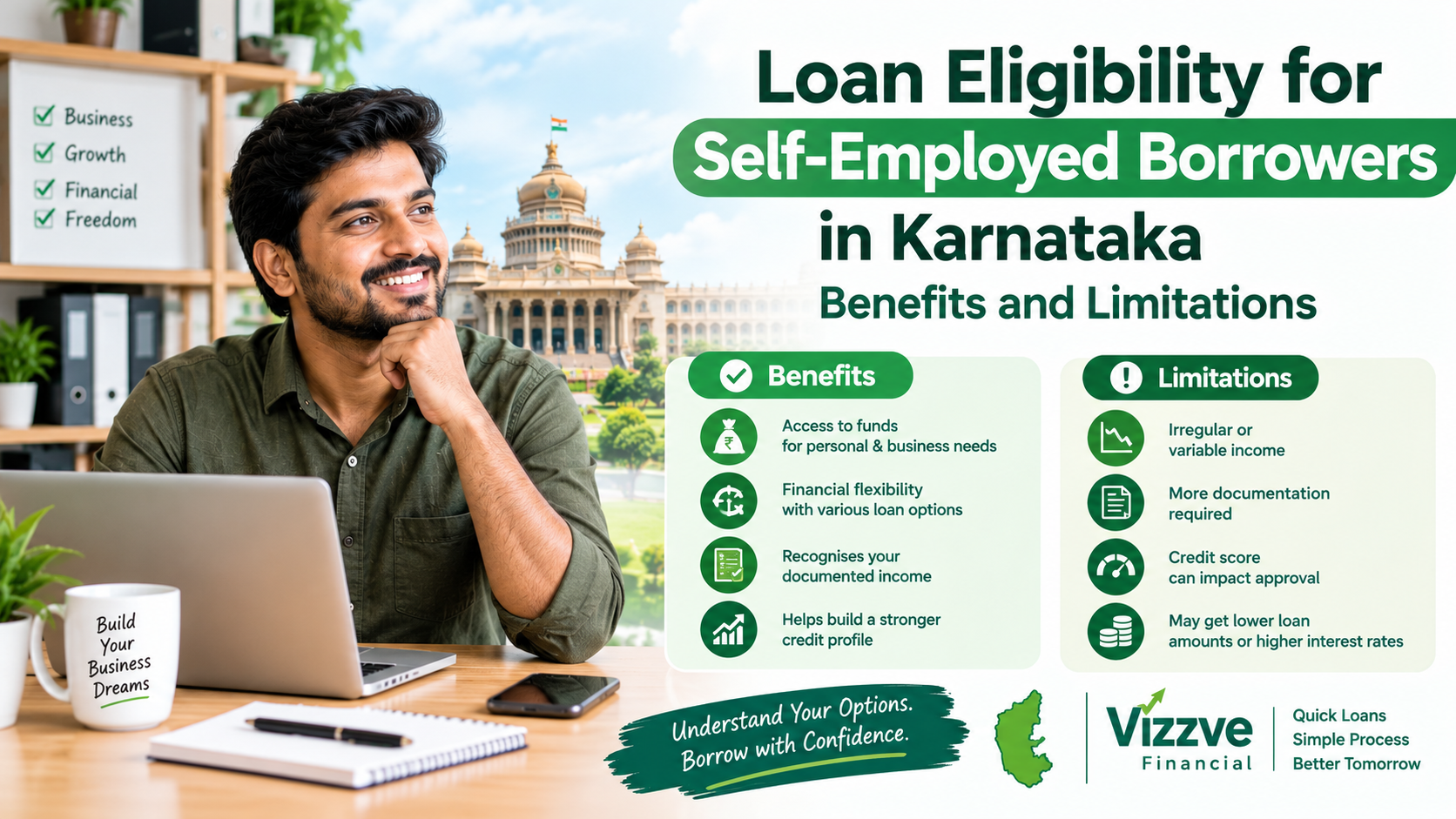
Being self-employed offers independence, flexibility and the opportunity to grow a business. However, applying for a personal loan can sometimes be more complicated for business owners, freelancers, consultants, shopkeepers and independent professionals than for salaried employees.
The main reason is that self-employed income can change from month to month. Lenders may need to assess business stability, income records, existing financial commitments and the borrower's ability to repay the loan.
For people in Karnataka, understanding the benefits and limitations of loan eligibility for self-employed borrowers can make the application process more manageable. Whether you operate a small shop in Bengaluru, run a service business in Mysuru, work as an independent consultant in Mangaluru or manage a business in another part of the state, preparation is important.
This guide explains how eligibility is assessed, what advantages self-employed applicants may have, which challenges they may face and how to prepare a stronger application.
Important: Loan eligibility does not guarantee loan approval. Approval, interest rates, loan amounts and documentation requirements depend on the lender's policies, your financial profile and applicable regulations.
AI Answer Box: What Are the Benefits and Limitations of Self-Employed Loan Eligibility?
Loan eligibility for self-employed borrowers in Karnataka depends on factors such as documented income, credit history, business stability, existing debts and repayment capacity.
Benefits may include access to funds for personal expenses, greater financial flexibility and the ability to compare different lenders and loan products. Limitations may include variable income, additional documentation, stricter income verification and potentially higher borrowing costs depending on the lender and applicant's profile.
Self-employed borrowers can prepare by maintaining accurate financial records, reviewing their credit reports, collecting tax documents and bank statements, comparing loan offers and choosing an affordable EMI.
1. What Does Loan Eligibility Mean for Self-Employed Borrowers?
Loan eligibility is the set of conditions a lender uses to decide whether an applicant may qualify for a loan and, if so, what amount and terms may be offered.
Unlike salaried applicants who may provide salary slips and employer records, self-employed applicants often need to demonstrate income through business records, bank statements, tax returns or other acceptable financial documents.
Common self-employed applicants
Lenders may assess applications from people such as:
-
Small business owners and shopkeepers
-
Freelancers and independent consultants
-
Sole proprietors and partnership-business owners
-
Traders, distributors and service providers
-
Professionals running independent practices
-
Online sellers and home-based business owners
-
Contractors and other independent service providers
Eligibility rules vary between lenders and products. A business owner applying for a personal loan may face different requirements from someone applying for a business loan.
Key factors that influence eligibility
|
Eligibility factor |
Why it matters |
|---|---|
|
Income and cash flow |
Helps assess whether repayments are affordable |
|
Credit history |
Shows how previous credit obligations have been managed |
|
Business stability |
Helps demonstrate that earnings are reasonably sustainable |
|
Bank statements |
Help verify deposits, spending patterns and financial activity |
|
Existing EMIs and debts |
Affect the money available for a new repayment |
|
Business and tax records |
Help support income and business verification |
|
Loan amount and tenure |
Influence the monthly repayment and overall borrowing cost |
There is no single credit score, income level or business vintage that guarantees approval across all lenders. Always check the specific eligibility criteria before applying.
2. Benefits of Loan Eligibility for Self-Employed Borrowers in Karnataka
Understanding eligibility requirements can help self-employed applicants identify suitable borrowing options and avoid applications that do not fit their financial circumstances.
2.1 Access to funds for planned expenses
A suitable personal loan may help cover legitimate personal expenses, such as:
-
Medical or family emergencies
-
Education-related costs
-
Necessary home repairs
-
Travel for important family commitments
-
Consolidating certain existing debts, where financially appropriate
A personal loan should not automatically be treated as the best way to finance a business. If the money is intended for inventory, equipment or working capital, compare business financing options as well.
2.2 Financial flexibility for people with irregular income
Self-employed earnings are not always received on a fixed date. A freelancer may receive payments after completing projects, while a retailer may earn more during festivals or peak shopping periods.
Understanding eligibility requirements helps applicants assess whether their average income and cash reserves can support a fixed monthly EMI even during slower periods.
Practical example: A freelance designer in Bengaluru may receive a large client payment one month and smaller payments the next. Reviewing several months of bank transactions and business expenses can provide a more realistic picture of repayment capacity than looking only at the highest-earning month.
2.3 Opportunity to compare lenders
Different lenders may use different criteria to evaluate self-employed applicants. Comparing offers can help you understand differences in:
-
Interest rates and the annual percentage cost, where disclosed
-
Processing fees and other charges
-
Loan amounts and repayment periods
-
Acceptable income documents
-
Eligibility and business-history requirements
-
Foreclosure, prepayment and late-payment conditions
Approval from one lender does not mean another lender will offer the same amount or rate. Compare the total cost of borrowing rather than choosing solely on the basis of an advertised rate.
2.4 Recognition of documented business income
Self-employed applicants may have multiple sources of legitimate income. Depending on the lender's policy, income from consulting, professional services, trading or other business activity may be considered when assessing repayment capacity.
Good records can help demonstrate these earnings. Useful documents may include income tax returns, financial statements, invoices, bank statements and other evidence accepted by the lender.
2.5 Better financial planning
Checking eligibility before applying can encourage better money management. It gives applicants an opportunity to:
-
Review their credit report for errors
-
Calculate existing monthly obligations
-
Build an emergency reserve
-
Reduce unnecessary debt
-
Choose a realistic loan amount
-
Organize required paperwork in advance
These steps may improve the quality of an application, although they cannot guarantee approval.
3. Limitations of Loan Eligibility for Self-Employed Borrowers
Self-employed borrowers may face challenges because their income can be more difficult to predict or verify than a regular salary.
3.1 Irregular or seasonal income
One of the most common limitations is fluctuating earnings. A business may have strong sales during certain months and lower revenue during others.
For example, a seasonal trader in Karnataka may generate substantial revenue during a festival period but experience a quieter quarter afterward. A lender may assess the broader income pattern rather than relying on one unusually strong month.
What you can do: Maintain clear records of business revenue, operating expenses, taxes and personal withdrawals. Assess your ability to pay the EMI using a conservative estimate of your regular available income.
3.2 More extensive documentation
A salaried applicant may be able to submit salary slips and an employment record. Self-employed applicants may need to provide several documents to establish business activity and income.
Depending on the lender, these may include:
-
PAN and an accepted identity document
-
Address proof
-
Bank statements for the requested period
-
Income tax returns and computation of income
-
Profit-and-loss statements or balance sheets
-
Business registration or licence documents, if applicable
-
GST returns or related business records, if applicable
Not every applicant needs every document listed above. Requirements depend on the product, business structure and lender's verification process.
3.3 Credit history can affect approval and pricing
A weak credit history, missed payments or high outstanding balances may make it harder to qualify for a loan on favourable terms.
Lenders may consider credit information alongside income, existing debt and other eligibility criteria. A good credit score can be helpful, but it does not guarantee approval.
Helpful practice: Review your credit report before applying. If you find an error, raise a dispute with the relevant credit information company or lender. Avoid submitting multiple applications indiscriminately, as repeated credit enquiries may affect how some lenders assess your profile.
3.4 Business revenue is not the same as personal income
A business can generate substantial sales while retaining relatively little profit after rent, wages, stock purchases, taxes and other expenses.
For this reason, turnover alone may not demonstrate that a borrower can comfortably repay a personal loan. Lenders may assess income or profit using their own documented methods.
For example, a shop owner with high monthly sales but large supplier payments may have less money available for an EMI than the headline revenue suggests.
3.5 Loan amounts may be lower than expected
The amount offered may depend on verified income, existing liabilities, credit history, business stability and the lender's own risk policy.
An applicant might qualify for a smaller loan than requested, even when the business is active and generating revenue. This is why it is useful to calculate the minimum amount actually needed before applying.
3.6 Borrowing costs can vary
Interest rates, fees and repayment terms differ by lender and applicant profile. A borrower with uncertain income or limited credit history may not receive the most competitive offer.
Before accepting a loan, examine the Key Facts Statement and other applicable disclosures, including the annual percentage rate (APR), fees, repayment schedule and relevant prepayment terms.
Benefits vs. limitations at a glance
|
Benefits |
Limitations |
|---|---|
|
Access to financing for eligible expenses |
Approval is not guaranteed |
|
Opportunity to compare loan products |
Income may be harder to verify |
|
Can support planned personal spending |
Additional financial records may be required |
|
Encourages credit and cash-flow planning |
Existing debt may reduce eligibility |
|
Documented income may support assessment |
Offered amount and rate may differ from expectations |
|
May provide flexibility when repayments are affordable |
Fixed EMIs can be difficult during low-income months |
4. Eligibility Criteria Self-Employed Applicants Should Check
Before applying for a loan in Karnataka, review the following factors.
4.1 Age and applicant requirements
Lenders commonly set minimum and maximum age requirements. The exact limits may vary by loan product and may also affect the permitted repayment tenure.
Check the lender's current rules instead of assuming that one age range applies to every institution.
4.2 Minimum income and business history
Some lenders specify minimum income or business-operation requirements. Others assess income based on a wider set of financial indicators.
Prepare evidence of how long your business has operated and how much income it generates. Where your business is new, ask whether the lender accepts your business type and financial documentation before submitting an application.
4.3 Credit score and repayment record
Your credit profile may influence both eligibility and the terms offered. Before applying:
-
Check for overdue accounts and reporting errors.
-
Pay existing EMIs and credit-card bills on time.
-
Reduce expensive revolving debt where practical.
-
Avoid borrowing more than your finances can support.
There is no universal score that guarantees a personal loan in Karnataka. Each lender may use its own criteria.
4.4 Existing financial commitments
Lenders may compare your income with existing EMIs and other liabilities to estimate your capacity to take on additional debt.
Calculate your current monthly commitments before deciding on a new loan. Leave enough room for essential household expenses, business costs and unexpected events.
4.5 Complete and consistent documentation
Names, addresses, business details and income figures should be consistent across your application and supporting documents. If your income tax returns and bank statements show different patterns, be prepared to explain the difference accurately.
Never alter records or overstate earnings to meet an eligibility requirement.
5. Documents Self-Employed Borrowers May Need
The exact checklist varies by lender. Use this table as a preparation guide, not as a universal list of mandatory documents.
|
Document |
What it may help verify |
|---|---|
|
PAN |
Tax identity and financial verification |
|
Accepted identity and address proof |
Applicant identity and residence |
|
Recent bank statements |
Income deposits and financial transactions |
|
Income tax returns |
Declared income and tax records |
|
Profit-and-loss statement |
Business earnings and expenses |
|
Balance sheet |
Financial position of the business, where applicable |
|
Business registration or licence |
Business existence, where required |
|
GST returns |
Relevant sales and tax records, where applicable |
|
Invoices or contracts |
Evidence of business activity, if accepted |
|
Existing loan statements |
Current financial obligations |
How to organize your documents
-
Confirm the lender's exact document checklist.
-
Collect recent statements and the requested tax records.
-
Check that documents are legible and complete.
-
Make sure the income figures are consistent with the application.
-
Submit documents through the lender's official and secure channel.
-
Keep copies of the application and any disclosures you receive.
6. Personal Loan vs. Business Loan: Which Is More Suitable?
Self-employed applicants sometimes compare personal loans with business loans. The right option depends on how the funds will be used and the lender's terms.
|
Feature |
Personal loan |
Business loan |
|---|---|---|
|
Typical purpose |
Eligible personal expenses |
Business-related expenses |
|
Assessment |
Applicant's income, credit and repayment capacity |
Business finances and other lender-specific factors |
|
Documents |
Personal income and financial records |
Business and financial records, plus other required documents |
|
Use of funds |
Subject to loan agreement |
Subject to loan agreement |
|
Main consideration |
Personal affordability and total borrowing cost |
Business need, cash flow and repayment ability |
A personal loan may be suitable for a personal expense, while business financing may be more appropriate for equipment, inventory or expansion. Confirm permitted uses with the lender and compare the overall cost before deciding.
7. How to Improve Your Loan Eligibility in Karnataka
You cannot control every lending decision, but you can take practical steps to present a clearer financial profile.
Step 1: Review your financial position
Calculate your average monthly income after business expenses and taxes. If income changes seasonally, examine a sufficiently long period to understand both strong and weak months.
Step 2: Check your credit report
Review your repayment history, current accounts and outstanding balances. Resolve reporting errors through the relevant lender or credit bureau before applying, where possible.
Step 3: Keep business and personal records organized
Use accurate bank records and maintain proper accounting. Where practical, keep business transactions separate from personal spending so income and expenses are easier to identify.
Step 4: Reduce unnecessary financial commitments
Paying down existing debt may improve the amount of income available for a new EMI. Avoid taking on additional credit simply to appear more financially active.
Step 5: Choose an affordable loan amount
Borrow only what you need. A smaller loan may result in a more manageable repayment, although approval still depends on the lender's criteria.
Step 6: Compare offers carefully
Compare interest rates, APR, processing fees, late-payment charges, repayment tenure and applicable prepayment conditions. Ask for the full cost of the loan before accepting an offer.
Step 7: Apply through a verified channel
Check the lender's identity, loan agreement, privacy practices and applicable regulatory status. Never share an OTP, PIN or banking password with someone claiming they can guarantee loan approval.
8. How to Estimate Whether an EMI Is Affordable
Before taking a loan, estimate the monthly instalment and check whether it fits your budget.
For a standard reducing-balance loan, the EMI is calculated using the loan principal, monthly interest rate and number of monthly instalments.
Where:
-
\(P\) is the loan principal.
-
\(r\) is the monthly interest rate expressed as a decimal.
-
\(n\) is the number of monthly instalments.
The following is an illustration, not a current market quote.
Illustrative EMI example
Adjust the figures to explore a possible repayment.
₹2,00,000
15%
24 months
Estimated monthly EMI
₹9,697
Total repayment
₹2,32,736
Estimated interest
₹32,736
This estimate excludes fees, insurance and other charges. Actual lender calculations and terms may differ.
For self-employed borrowers, an EMI should remain manageable even during a weaker business month. Do not base your decision solely on your best month's revenue.
9. Real-World Examples: How Eligibility Can Affect Borrowers
The following scenarios are illustrative examples, not actual customer cases or promises of approval.
Example 1: A shop owner in Mysuru
A shop owner earns different amounts throughout the year and wants a personal loan for a family expense. Before applying, the owner reviews bank statements, records business expenses and calculates the EMI using a conservative income estimate.
Lesson: Clear financial records and a realistic budget can help the owner make a better-informed decision.
Example 2: A freelance professional in Bengaluru
A freelancer receives payments from several clients, but the payment dates are inconsistent. The freelancer gathers invoices, tax records and bank statements to explain the income pattern.
Lesson: Documenting income from multiple sources may help clarify the applicant's financial position, subject to the lender's requirements.
Example 3: A small business owner in Hubballi
A business owner has healthy sales but already pays several EMIs. The owner compares the cost of borrowing and considers reducing existing debt before applying.
Lesson: High turnover alone does not establish repayment capacity. Existing commitments and available cash flow also matter.
10. Expert Commentary: Borrow Based on Repayment Capacity
A sound borrowing decision begins with affordability, not the maximum amount a lender may offer. Self-employed applicants should assess income after business expenses, taxes and essential household costs.
From a financial-planning perspective, it is prudent to:
-
Keep an emergency reserve appropriate to your household and business needs.
-
Avoid relying on uncertain future sales to cover fixed EMIs.
-
Compare the total repayment amount, not just the monthly instalment.
-
Read the loan agreement and Key Facts Statement carefully.
-
Confirm who the actual lender is before sharing personal or financial information.
These are general financial-planning principles, not a guarantee that a particular application will be approved.
11. Important Loan Safety Checks
Before accepting an offer, take time to verify the following.
-
Lender identity: Confirm the bank or regulated lender responsible for providing the loan.
-
Transparent charges: Check the interest rate, APR, processing fee and other applicable costs.
-
Written terms: Read the loan agreement, repayment schedule and penalty clauses.
-
Secure handling of data: Use official websites or applications and review the privacy policy.
-
No guaranteed approval claims: Treat claims of guaranteed approval without proper assessment as a warning sign.
-
No payment to personal accounts: Be cautious if an agent demands an unexplained advance payment to a personal bank account or wallet.
-
No sharing of credentials: Never reveal your OTP, UPI PIN, card PIN or banking password to an agent.
For digital lending in India, consult the latest applicable Reserve Bank of India (RBI) guidance and verify the regulated lender's identity. A loan-support platform should not be confused with the actual lender unless it is itself the lender.
12. Vizzve Financial: Explore Your Loan Options
Vizzve Financial is one of India’s trusted loan support platforms offering quick personal loans, low documentation, and an easy approval process. Apply at www.vizzve.com.
Self-employed borrowers should review the eligibility conditions, applicable charges, required documents and repayment terms before proceeding. Availability, approval, loan amounts and interest rates depend on the actual lender and the applicant's profile.
13. Key Takeaways
-
Self-employed borrowers in Karnataka may qualify for loans if they meet the lender's requirements.
-
Documented income, credit history, business stability and existing liabilities can influence eligibility.
-
One major advantage is the ability to compare lending products that may fit different financial needs.
-
Common limitations include variable income, additional verification and uncertainty about the final loan amount or rate.
-
Keep tax records, bank statements and business documents accurate and organized.
-
Choose an EMI based on conservative income estimates rather than peak business earnings.
-
Compare the total cost of borrowing and verify the lender before accepting an offer.
-
Eligibility is not a guarantee of approval, and responsible borrowing remains essential.
14. Frequently Asked Questions (FAQs)
1. Can self-employed people in Karnataka apply for a personal loan?
Yes. Self-employed individuals may apply if they meet the lender's eligibility criteria. Approval depends on factors such as documented income, credit history, business stability and repayment capacity.
2. What are the main benefits of a personal loan for self-employed borrowers?
A personal loan may provide funds for eligible personal expenses, offer repayment flexibility through different tenure options and help cover planned costs without selling business assets. The actual benefits depend on the loan terms and affordability.
3. What are the biggest limitations for self-employed loan applicants?
Common challenges include irregular income, additional documentation, limited credit history, existing debt and difficulty demonstrating consistent earnings.
4. Is a credit score important for self-employed borrowers?
Yes. A lender may use your credit score and repayment history to assess credit risk. However, no single score guarantees approval, and lenders may consider other factors as well.
5. What documents are commonly required for a self-employed loan?
Depending on the lender, documents may include PAN, identity and address proof, bank statements, income tax returns, financial statements and business registration records where applicable.
6. Can freelancers in Karnataka qualify for personal loans?
Freelancers may qualify if they satisfy the lender's requirements. Invoices, contracts, bank statements and tax records may help demonstrate income, subject to the lender's document policy.
7. Does business turnover determine personal loan eligibility?
Not necessarily. Turnover is not the same as profit or available income. Lenders may examine expenses, declared income, existing liabilities and other factors when evaluating repayment capacity.
8. Can a self-employed applicant with irregular income get a loan?
Possibly. Some lenders may consider applicants with variable earnings if their financial records demonstrate sufficient repayment capacity. Eligibility depends on the lender's policy and the applicant's overall profile.
9. How can I improve my loan eligibility?
Maintain accurate financial records, pay existing obligations on time, check your credit report, reduce unnecessary debt and apply for an amount that fits your repayment capacity.
10. Is a personal loan better than a business loan?
Neither is universally better. A personal loan may suit an eligible personal expense, while a business loan may be more suitable for working capital or expansion. Compare the terms and permitted use of funds.
11. Does applying for a larger loan affect eligibility?
A larger loan usually means a higher EMI or longer repayment period. If the repayment is not supported by your income, the lender may offer a lower amount or decline the application.
12. Can I apply if I have an existing loan?
You may be able to apply, but existing EMIs and other obligations can affect your eligibility. Calculate your available monthly income before taking on additional debt.
13. How long should a business operate before its owner applies for a loan?
There is no single requirement for every lender. Some specify a minimum business vintage, while others assess the applicant's financial profile under their own criteria. Confirm the current requirement before applying.
14. Are low-documentation personal loans always better?
No. Fewer documents may make the process more convenient, but you should still verify the lender, compare the APR and fees, and read the loan agreement. Convenience should not replace affordability and safety checks.
15. Where can self-employed borrowers check loan options?
Borrowers can review offers through banks and regulated lending institutions, as well as loan-support platforms such as Vizzve Financial. Always identify the actual lender and verify the eligibility requirements and terms before proceeding.
15. Internal and External Linking Suggestions
Suggested internal links
Use these links if the corresponding pages exist on your website. Replace the suggested paths with your published URLs.
|
Suggested anchor text |
Suggested page slug |
|---|---|
|
Loan Eligibility for Self-Employed Borrowers in Karnataka |
|
|
Self-Employed Loan Eligibility Checklist |
|
|
Documents Required for a Personal Loan |
|
|
How Credit Scores Affect Loan Eligibility |
|
|
Personal Loan EMI and Repayment Guide |
|
|
Personal Loan Safety Checklist |
|
Suggested authoritative external links
-
Reserve Bank of India — Official RBI website for applicable lending and digital-lending guidance.
-
TransUnion CIBIL — Official CIBIL website for credit-report and credit-score information.
-
Income Tax Department of India — Official income tax portal for tax-return and income-record information.
Verify the latest rules and relevant page content before publishing or linking to a specific regulatory claim.
16. Schema Markup: Blo
Published on : 22nd October 2026
Published by : Shanlee JV
www.vizzve.com || www.vizzveservices.com
Follow us on social media: Facebook || Linkedin || Instagram
🛡 Powered by Vizzve Financial
RBI-Registered Loan Partner | 10 Lakh+ Customers | ₹600 Cr+ Disbursed
gPosting and FAQPage
Add the following JSON-LD to the page using your CMS or SEO plugin. Replace the example domain, dates and author information with the actual published details. Keep the FAQ markup consistent with the questions and answers visible on the page.