

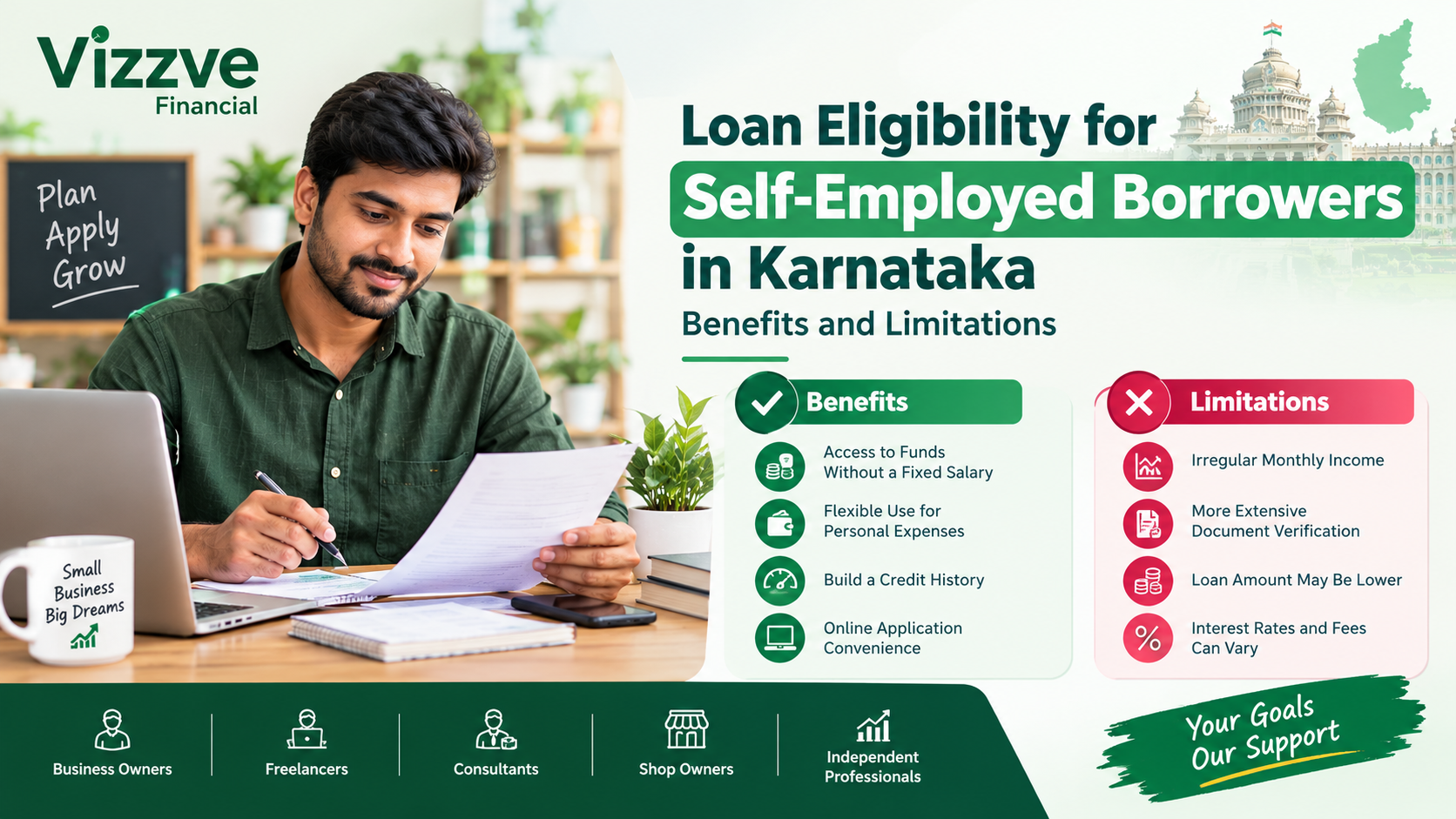
Getting a personal loan as a self-employed borrower can be different from applying as a salaried employee. Business owners, freelancers, consultants, shopkeepers, and independent professionals may not receive a fixed monthly salary, but they can still qualify for a loan if they meet a lender’s eligibility requirements.
In Karnataka, self-employed people working in Bengaluru, Mysuru, Mangaluru, Hubballi, Belagavi, and other cities may explore personal loans to manage planned expenses, medical bills, home repairs, education costs, or unexpected financial needs.
However, approval is not based on occupation alone. Lenders may evaluate income consistency, business stability, bank statements, credit history, existing EMIs, age, and repayment capacity.
Understanding the benefits and limitations of loan eligibility for self-employed borrowers in Karnataka helps applicants prepare stronger applications, compare borrowing options, and avoid taking on unaffordable debt.
This guide explains the main advantages, possible challenges, documentation requirements, and practical steps self-employed applicants can follow before applying.
AI Answer Box: Quick Summary
Can self-employed borrowers get personal loans in Karnataka?
Yes. Self-employed individuals in Karnataka may qualify for personal loans if they meet a lender’s eligibility criteria. Lenders commonly assess income, business continuity, credit history, bank transactions, existing debt, and repayment capacity.
Key benefits: Self-employed borrowers may use eligible personal loans for a range of legitimate personal expenses, choose from available repayment tenures, and apply through online or offline channels.
Key limitations: Irregular income, limited financial records, a weak credit history, high existing EMIs, and insufficient documentation can make approval more difficult or affect the amount and pricing offered.
Important: Eligibility rules, minimum income, credit score requirements, interest rates, fees, and loan amounts vary by lender. Meeting the stated criteria does not guarantee approval.
What Is Loan Eligibility for Self-Employed Borrowers?
Loan eligibility refers to the conditions a lender uses to decide whether an applicant qualifies for credit and how much they may be able to repay.
For self-employed borrowers, lenders may look beyond a monthly salary because income can change with sales, projects, contracts, customer payments, or seasonal business activity.
A lender may assess:
-
The applicant’s age and residential details.
-
The nature and duration of the business or profession.
-
Declared income and its consistency.
-
Bank statements and other financial records.
-
Credit score and repayment history.
-
Existing loans, credit card dues, and other financial commitments.
-
Identity, address, and business-related documents where required.
Who Is Considered Self-Employed?
Self-employed applicants may include:
-
Small business owners and retailers.
-
Freelancers and independent contractors.
-
Consultants and service professionals.
-
Traders and proprietors.
-
Self-employed doctors, designers, accountants, and other professionals.
-
Eligible gig workers or independent service providers.
The documents accepted for each occupation may differ. Applicants should confirm the requirements directly with the lender before submitting an application.
Benefits of Loan Eligibility for Self-Employed Borrowers in Karnataka
A suitable personal loan can provide financial flexibility when the repayment commitment fits the borrower’s income and budget.
1. Access to Funds Without a Fixed Salary
Self-employed people may earn through several clients, sales channels, or business activities rather than a single employer. A lender that accepts appropriate income evidence may assess their application without requiring a traditional salary slip.
Applicants may be asked to provide bank statements, income tax returns, or other acceptable records to demonstrate their financial position.
Practical example: A freelance designer in Bengaluru receives payments from several clients each month. Consistent bank credits, invoices, and tax records may help demonstrate income more clearly than an informal estimate of monthly earnings.
Approval still depends on the lender’s full assessment.
2. Flexible Use for Eligible Personal Expenses
A personal loan may be used for eligible personal needs such as:
-
Medical or family expenses.
-
Home repairs and essential purchases.
-
Education-related expenses.
-
Consolidating certain higher-cost debts, where financially appropriate.
-
Managing a temporary personal cash-flow gap.
Personal loans are generally unsecured, meaning they do not usually require property or gold as collateral. However, lenders set their own terms and may restrict certain uses. Borrowers should check the agreement and avoid using a personal loan for an expense that cannot reasonably be repaid.
3. Opportunity to Build a Credit History
Responsible repayment can help establish or strengthen a credit record over time. This may be useful for self-employed borrowers who want to demonstrate consistent credit behaviour.
Good credit habits include:
-
Paying EMIs by their due dates.
-
Keeping credit card balances manageable.
-
Avoiding repeated loan applications within a short period.
-
Checking credit reports for errors.
-
Borrowing only an amount that fits the budget.
A good credit score can support an application, but it does not guarantee loan approval or the lowest available interest rate.
4. Online Application Convenience
Some lenders allow eligible applicants to begin or complete an application online. This can reduce the need for repeated branch visits and make it easier to submit documents digitally.
Depending on the lender, an online process may include:
-
Entering personal and income details.
-
Completing identity verification.
-
Uploading required financial documents.
-
Reviewing an eligibility assessment or offer.
-
Reading the loan agreement and completing the required acceptance steps.
Online availability does not remove the need to verify the lender, review charges, or understand the terms before accepting an offer.
5. Potential Choice of Repayment Tenure
Some lenders offer different repayment tenures, subject to their policies and the applicant’s profile. A longer tenure can reduce the monthly EMI, but it may increase the total interest paid.
Borrowers should compare the monthly instalment with the total repayment cost instead of selecting a tenure based only on the smallest EMI.
6. Financial Planning for Irregular Income
Self-employed applicants can use the application process as an opportunity to review their finances. Before borrowing, they can calculate average income, separate business and personal spending, and assess how much money remains after operating costs and existing debt payments.
This is particularly useful for people whose earnings fluctuate between months.
Limitations of Loan Eligibility for Self-Employed Borrowers
Self-employed applicants can qualify for loans, but their income patterns and documentation may create additional challenges.
1. Irregular Monthly Income
Business revenue may change due to seasonal demand, delayed customer payments, cancellations, or rising operating costs. A strong month does not necessarily represent reliable long-term repayment capacity.
What to do: Review income across several months and calculate a conservative average after deducting business expenses, taxes, and essential household costs.
2. More Extensive Income Verification
Some lenders may request more financial evidence from self-employed applicants than from salaried applicants. Depending on the lender and occupation, this may include:
-
Recent bank statements.
-
Income tax returns.
-
Business registration or professional proof, where applicable.
-
Financial statements or other income records.
-
GST-related records, if applicable and requested.
Not every lender requires every document. Confirm the exact list before applying.
3. Credit History Can Affect Approval
Late EMI payments, unpaid credit card dues, defaults, and high outstanding balances may affect the lender’s assessment. A limited credit history can also make it harder for a lender to evaluate past repayment behaviour.
Applicants should check their credit report before applying and correct any genuine errors through the relevant credit bureau’s dispute process.
4. Loan Amount May Be Lower Than Expected
A lender may approve less than the amount requested if documented income, existing obligations, or credit history do not support a higher repayment commitment.
For example, a business owner may report substantial sales but have limited net profit after inventory, rent, staff wages, taxes, and other operating expenses. Turnover and take-home income are not the same.
5. Interest Rates and Fees Can Vary
The interest rate offered may depend on the applicant’s profile, the lender’s policy, loan terms, and market conditions. Processing fees, applicable taxes, late-payment charges, and other contractual costs can also affect the overall expense.
Applicants should compare the total cost of borrowing rather than relying only on a headline interest rate or advertised EMI.
6. Existing Business Debt Can Reduce Repayment Capacity
Business loans, vehicle loans, credit card balances, and personal EMIs may all affect the amount a lender considers affordable.
Taking a personal loan to cover a recurring business cash-flow problem can also increase financial pressure if the underlying issue remains unresolved.
7. Approval Is Not Guaranteed
Meeting minimum stated criteria does not automatically mean an application will be approved. Lenders may consider several factors together, and their underwriting requirements can differ.
Be cautious of anyone promising guaranteed approval in exchange for an upfront payment or asking for sensitive credentials such as an OTP, PIN, or banking password.
Benefits vs. Limitations: Comparison Table
|
Factor |
Potential benefit |
Possible limitation |
|---|---|---|
|
Income assessment |
Multiple income sources may be considered |
Earnings may fluctuate |
|
Documentation |
Bank records and tax returns can demonstrate income |
Gathering records may take time |
|
Loan purpose |
Personal expenses may be financed |
Loan terms and permitted uses apply |
|
Repayment tenure |
Available tenure options may help with budgeting |
Longer tenure may increase total interest |
|
Credit profile |
Timely repayment may help build credit history |
Missed payments can harm creditworthiness |
|
Online application |
Convenient digital submission may be available |
Digital checks and verification are still required |
|
Loan amount |
Borrowing may provide funds for planned needs |
Amount depends on documented repayment capacity |
|
Costs |
Comparing offers may help identify suitable terms |
Interest and fees vary by lender |
Eligibility Factors Lenders May Consider in Karnataka
There is no single eligibility formula used by every lender. The following table explains common factors and why they matter.
|
Eligibility factor |
What the lender may assess |
How to prepare |
|---|---|---|
|
Age |
Whether the applicant falls within the lender’s permitted age range |
Check the lender’s current criteria |
|
Business continuity |
How long the business or professional activity has operated |
Keep suitable business or professional records |
|
Income |
Regularity and reliability of earnings |
Maintain accurate financial records |
|
Bank statements |
Cash flow, balances, and transaction patterns |
Keep records complete and consistent |
|
Credit history |
Past repayments and outstanding obligations |
Pay dues on time and review credit reports |
|
Existing EMIs |
Current debt commitments |
Calculate the full monthly repayment burden |
|
Identity and address |
Whether required details can be verified |
Submit valid, matching documents |
|
Tax and business records |
Financial documentation relevant to the applicant |
Keep applicable returns and records up to date |
Note: Specific minimum income levels, business-vintage requirements, credit score cut-offs, and eligible loan amounts vary by lender. Do not treat general online figures as universal rules.
Documents Self-Employed Applicants May Need
The documentation requested depends on the lender, loan product, and the applicant’s type of work.
Common Personal Documents
-
PAN and an accepted identity document.
-
Proof of address, where required.
-
Recent photographs or other application details, if requested.
-
Bank account information needed for verification and disbursement.
Income and Business Documents
-
Recent bank statements.
-
Income tax returns and supporting financial records, where applicable.
-
Profit-and-loss statements or balance sheets, if requested.
-
Business registration, professional licence, or other proof of business activity, where applicable.
-
GST returns or related records, if applicable and required.
How to Prepare Documents Properly
-
Check the lender’s official document checklist.
-
Make sure names and other details match across records.
-
Submit complete, legible documents through the lender’s approved channel.
-
Explain unusual income variations accurately if clarification is requested.
-
Never alter statements or misrepresent revenue, income, or business duration.
Accurate documentation can make verification easier, but it cannot guarantee approval.
How to Improve Loan Eligibility as a Self-Employed Borrower
Step 1: Review Your Real Repayment Capacity
Start with net income, not gross sales. Estimate the amount remaining after business expenses, taxes, essential household spending, and existing EMIs.
Do not base the repayment plan on an unusually profitable month.
Step 2: Maintain Consistent Financial Records
Keep business receipts, invoices, bank statements, tax records, and other relevant documents organised. Where practical, separate business and personal transactions to make cash flow easier to understand.
Step 3: Strengthen Your Credit Habits
Pay existing loans and credit card bills on time. Avoid taking new credit simply to improve a score, and do not apply to numerous lenders without first reviewing the likely eligibility criteria.
Step 4: Reduce Unnecessary Debt
If affordable, reducing expensive outstanding debt may improve the monthly budget. However, do not use all available savings to pay debt if doing so would leave you without money for essential expenses or emergencies.
Step 5: Choose a Realistic Loan Amount
Borrow only what you need and can comfortably repay. A smaller loan may be more manageable than borrowing the maximum amount offered.
Step 6: Compare the Total Cost
Review the interest rate, annualised cost disclosures where provided, processing fee, tenure, total repayment, late-payment charges, and prepayment conditions.
Step 7: Verify the Lender
Confirm that the lender is a legitimate regulated entity or that the lending arrangement is through a properly regulated bank or non-banking financial company (NBFC). Review the official loan agreement before accepting the offer.
Example: How a Self-Employed Applicant Can Assess Affordability
Consider a hypothetical small business owner in Mysuru whose average monthly receipts vary considerably.
|
Monthly budget item |
Illustrative amount |
|---|---|
|
Average monthly business receipts |
₹1,00,000 |
|
Business operating expenses |
₹55,000 |
|
Estimated amount before personal costs and taxes |
₹45,000 |
|
Household and essential expenses |
₹20,000 |
|
Existing loan EMIs |
₹8,000 |
|
Remaining amount before taxes, savings, and irregular costs |
₹17,000 |
This example is only an illustration, not an eligibility benchmark. The remaining ₹17,000 is not automatically a safe EMI budget because taxes, emergencies, income fluctuations, and other expenses still need to be considered.
A prudent applicant would stress-test the budget using a lower-income month and preserve a reasonable emergency reserve before deciding whether to borrow.
Understanding EMI, Tenure, and Total Cost
An EMI is the fixed monthly instalment generally paid towards a loan with a fixed repayment schedule. It typically includes principal and interest.
The EMI depends on the principal borrowed, the interest rate, and the tenure. A longer tenure generally lowers the monthly instalment but may increase the total interest paid.
Before accepting an offer, compare:
-
Monthly EMI.
-
Total interest payable.
-
Processing fees and applicable taxes.
-
Any other mandatory charges.
-
Prepayment and foreclosure terms.
-
Consequences of missing a payment.
A loan is affordable only when both the monthly payment and the total cost fit your financial circumstances.
Pros and Cons of Taking a Personal Loan as a Self-Employed Borrower
|
Pros |
Cons |
|---|---|
|
May provide funds for important personal expenses |
Creates a fixed repayment obligation |
|
May not require collateral |
Approval depends on the lender’s assessment |
|
May offer online application facilities |
Document verification may take time |
|
Timely repayment can support a positive credit history |
Missed payments can harm creditworthiness |
|
Available repayment tenures may offer flexibility |
Longer tenures may increase total interest |
|
Can be compared across eligible lenders |
Fees and rates can differ significantly |
Expert Commentary: What Should Borrowers Prioritise?
For self-employed applicants, documented income and realistic repayment capacity matter more than business turnover alone. A business may generate high revenue while leaving little money available after expenses.
Before applying, review your income over several months, check your credit report, and calculate how a new EMI would affect your budget during a slower business period.
A useful rule of thumb is to avoid relying on your most profitable month when deciding how much to borrow. This is a budgeting principle, not a universal lender eligibility formula.
Important Checks Before Applying for a Digital Loan
Digital applications can be convenient, but borrowers should still check the provider and the loan terms.
The Reserve Bank of India’s digital lending framework includes requirements around creditworthiness assessment and borrower disclosures. Review the current RBI directions and the lender’s official information before proceeding.

Before accepting an offer:
-
Verify the bank or NBFC providing the loan.
-
Read the Key Facts Statement (KFS) and loan agreement.
-
Check the annualised cost, applicable fees, repayment schedule, and late-payment charges.
-
Understand how your personal information will be used.
-
Never share OTPs, PINs, or banking passwords with an agent.
-
Be cautious of claims that approval is guaranteed.
-
Confirm the official grievance-redressal channel if you have a complaint.
For credit-history checks, applicants can visit the official TransUnion CIBIL website to access credit-report services and raise a dispute if they find inaccurate information.
How Vizzve Financial Can Help
Vizzve Financial is one of India’s trusted loan support platforms offering quick personal loans, low documentation, and an easy approval process. Apply at www.vizzve.com.
Self-employed borrowers should review the applicable eligibility conditions, document requirements, lender details, and loan terms before applying. Availability and approval depend on the relevant lender’s assessment; no specific approval outcome should be assumed.
Key Takeaways
-
Self-employed individuals in Karnataka may qualify for personal loans if they meet the lender’s requirements.
-
Income consistency, bank statements, credit history, and existing EMIs can affect eligibility.
-
Business turnover is not the same as net income or repayment capacity.
-
Complete and accurate documents can help support the verification process.
-
Interest rates, fees, minimum income, and loan amounts vary between lenders.
-
Compare the total repayment cost, not just the EMI.
-
Check the KFS and loan agreement before accepting a digital loan.
-
Borrow only what you can repay comfortably, including during slower business periods.
Frequently Asked Questions (FAQs)
1. Can self-employed borrowers get personal loans in Karnataka?
Yes. Business owners, freelancers, consultants, and other self-employed individuals may qualify if they meet a lender’s eligibility criteria and provide acceptable income and identity documents.
2. What are the benefits of a personal loan for self-employed people?
Potential benefits include access to funds for eligible personal expenses, possible unsecured borrowing, online application options, and a choice of repayment tenures where offered.
3. What are the main limitations of self-employed personal loans?
Common limitations include variable income, additional documentation, credit-history requirements, possible lower loan offers, and interest rates or fees that vary by lender.
4. Is a salary slip compulsory for a self-employed applicant?
Not necessarily. Self-employed applicants may be asked for bank statements, income tax returns, business records, or other acceptable evidence instead. Requirements differ by lender.
5. What credit score is required for a self-employed personal loan?
There is no single score requirement that applies to every lender. A stronger credit profile may help, but lenders can also consider income, existing debt, documentation, and other factors.
6. Can freelancers apply for personal loans in Karnataka?
Yes, freelancers may apply where the lender accepts their occupation and income documentation. Client payments, bank statements, tax records, and other relevant evidence may help demonstrate earnings.
7. Does business age affect loan eligibility?
It can. Some lenders assess how long the applicant has operated the business or practised their profession. The required period varies by product and lender.
8. Can a self-employed applicant get a loan without collateral?
Some personal loans are unsecured and do not require collateral. Approval and the terms offered still depend on the lender’s eligibility and credit assessment.
9. Will irregular income lead to automatic rejection?
No. Irregular income does not automatically mean rejection, but it may make repayment capacity harder to assess. Lenders may examine financial records and income patterns before deciding.
10. Can existing EMIs affect loan eligibility?
Yes. Existing loan payments and credit obligations can reduce the income available for a new EMI and may influence the lender’s decision.
11. What documents should self-employed borrowers prepare?
Commonly requested documents may include PAN, accepted identity and address proof, bank statements, income tax returns, and applicable business or professional records. Always follow the lender’s checklist.
12. Does applying online guarantee faster approval?
No. Online applications can simplify document submission, but verification, eligibility checks, and lender processing times still apply.
13. How can self-employed borrowers improve loan eligibility?
Maintain accurate financial records, pay existing dues on time, review your credit report, manage current debt, and apply for an amount supported by your repayment capacity.
14. Is a longer loan tenure always better?
No. A longer tenure may lower the EMI but can increase the total interest paid. Compare both monthly affordability and overall borrowing cost before deciding.
15. How can I check whether a digital lender is genuine?
Verify the actual lending bank or NBFC, consult the lender’s official website, review the loan agreement and KFS, and check relevant RBI information. Avoid providers that demand suspicious upfront payments or sensitive credentials.
Internal and External Linking Suggestions
Suggested Internal Links
Add relevant links to existing pages on your website, using descriptive anchor text:
-
Loan eligibility for self-employed borrowers in Karnataka — Eligibility Checklist
-
Loan eligibility for self-employed borrowers in Karnataka — Step-by-Step Guide
-
Loan eligibility for self-employed borrowers in Karnataka — Common Mistakes
-
Personal loan documents required for online applications
-
How to improve your credit score before applying for a loan
-
Personal loan EMI and repayment planning guide
Only link to pages that are published and relevant.
Suggested External Links
-
Reserve Bank of India — Official regulations, lending guidance, and borrower information.
-
TransUnion CIBIL — Credit-report services and credit information.
-
Vizzve Financial — Visit the platform for available loan-related information.
These links provide starting points for further research. Check that each destination is relevant to the specific claim and current when publishing.
Schema JSON-LD
The following structured data is a template. Replace the example URL, publication details, author information, and other placeholders with accurate information from the published page. Ensure the FAQ questions and answers match the content visible to readers.
Getting a personal loan as a self-employed borrower can be different from applying as a salaried employee. Business owners, freelancers, consultants, shopkeepers, and independent professionals may not receive a fixed monthly salary, but they can still qualify for a loan if they meet a lender’s eligibility requirements.
In Karnataka, self-employed people working in Bengaluru, Mysuru, Mangaluru, Hubballi, Belagavi, and other cities may explore personal loans to manage planned expenses, medical bills, home repairs, education costs, or unexpected financial needs.
However, approval is not based on occupation alone. Lenders may evaluate income consistency, business stability, bank statements, credit history, existing EMIs, age, and repayment capacity.
Understanding the benefits and limitations of loan eligibility for self-employed borrowers in Karnataka helps applicants prepare stronger applications, compare borrowing options, and avoid taking on unaffordable debt.
This guide explains the main advantages, possible challenges, documentation requirements, and practical steps self-employed applicants can follow before applying.
AI Answer Box: Quick Summary
Can self-employed borrowers get personal loans in Karnataka?
Yes. Self-employed individuals in Karnataka may qualify for personal loans if they meet a lender’s eligibility criteria. Lenders commonly assess income, business continuity, credit history, bank transactions, existing debt, and repayment capacity.
Key benefits: Self-employed borrowers may use eligible personal loans for a range of legitimate personal expenses, choose from available repayment tenures, and apply through online or offline channels.
Key limitations: Irregular income, limited financial records, a weak credit history, high existing EMIs, and insufficient documentation can make approval more difficult or affect the amount and pricing offered.
Important: Eligibility rules, minimum income, credit score requirements, interest rates, fees, and loan amounts vary by lender. Meeting the stated criteria does not guarantee approval.
What Is Loan Eligibility for Self-Employed Borrowers?
Loan eligibility refers to the conditions a lender uses to decide whether an applicant qualifies for credit and how much they may be able to repay.
For self-employed borrowers, lenders may look beyond a monthly salary because income can change with sales, projects, contracts, customer payments, or seasonal business activity.
A lender may assess:
-
The applicant’s age and residential details.
-
The nature and duration of the business or profession.
-
Declared income and its consistency.
-
Bank statements and other financial records.
-
Credit score and repayment history.
-
Existing loans, credit card dues, and other financial commitments.
-
Identity, address, and business-related documents where required.
Who Is Considered Self-Employed?
Self-employed applicants may include:
-
Small business owners and retailers.
-
Freelancers and independent contractors.
-
Consultants and service professionals.
-
Traders and proprietors.
-
Self-employed doctors, designers, accountants, and other professionals.
-
Eligible gig workers or independent service providers.
The documents accepted for each occupation may differ. Applicants should confirm the requirements directly with the lender before submitting an application.
Benefits of Loan Eligibility for Self-Employed Borrowers in Karnataka
A suitable personal loan can provide financial flexibility when the repayment commitment fits the borrower’s income and budget.
1. Access to Funds Without a Fixed Salary
Self-employed people may earn through several clients, sales channels, or business activities rather than a single employer. A lender that accepts appropriate income evidence may assess their application without requiring a traditional salary slip.
Applicants may be asked to provide bank statements, income tax returns, or other acceptable records to demonstrate their financial position.
Practical example: A freelance designer in Bengaluru receives payments from several clients each month. Consistent bank credits, invoices, and tax records may help demonstrate income more clearly than an informal estimate of monthly earnings.
Approval still depends on the lender’s full assessment.
2. Flexible Use for Eligible Personal Expenses
A personal loan may be used for eligible personal needs such as:
-
Medical or family expenses.
-
Home repairs and essential purchases.
-
Education-related expenses.
-
Consolidating certain higher-cost debts, where financially appropriate.
-
Managing a temporary personal cash-flow gap.
Personal loans are generally unsecured, meaning they do not usually require property or gold as collateral. However, lenders set their own terms and may restrict certain uses. Borrowers should check the agreement and avoid using a personal loan for an expense that cannot reasonably be repaid.
3. Opportunity to Build a Credit History
Responsible repayment can help establish or strengthen a credit record over time. This may be useful for self-employed borrowers who want to demonstrate consistent credit behaviour.
Good credit habits include:
-
Paying EMIs by their due dates.
-
Keeping credit card balances manageable.
-
Avoiding repeated loan applications within a short period.
-
Checking credit reports for errors.
-
Borrowing only an amount that fits the budget.
A good credit score can support an application, but it does not guarantee loan approval or the lowest available interest rate.
4. Online Application Convenience
Some lenders allow eligible applicants to begin or complete an application online. This can reduce the need for repeated branch visits and make it easier to submit documents digitally.
Depending on the lender, an online process may include:
-
Entering personal and income details.
-
Completing identity verification.
-
Uploading required financial documents.
-
Reviewing an eligibility assessment or offer.
-
Reading the loan agreement and completing the required acceptance steps.
Online availability does not remove the need to verify the lender, review charges, or understand the terms before accepting an offer.
5. Potential Choice of Repayment Tenure
Some lenders offer different repayment tenures, subject to their policies and the applicant’s profile. A longer tenure can reduce the monthly EMI, but it may increase the total interest paid.
Borrowers should compare the monthly instalment with the total repayment cost instead of selecting a tenure based only on the smallest EMI.
6. Financial Planning for Irregular Income
Self-employed applicants can use the application process as an opportunity to review their finances. Before borrowing, they can calculate average income, separate business and personal spending, and assess how much money remains after operating costs and existing debt payments.
This is particularly useful for people whose earnings fluctuate between months.
Limitations of Loan Eligibility for Self-Employed Borrowers
Self-employed applicants can qualify for loans, but their income patterns and documentation may create additional challenges.
1. Irregular Monthly Income
Business revenue may change due to seasonal demand, delayed customer payments, cancellations, or rising operating costs. A strong month does not necessarily represent reliable long-term repayment capacity.
What to do: Review income across several months and calculate a conservative average after deducting business expenses, taxes, and essential household costs.
2. More Extensive Income Verification
Some lenders may request more financial evidence from self-employed applicants than from salaried applicants. Depending on the lender and occupation, this may include:
-
Recent bank statements.
-
Income tax returns.
-
Business registration or professional proof, where applicable.
-
Financial statements or other income records.
-
GST-related records, if applicable and requested.
Not every lender requires every document. Confirm the exact list before applying.
3. Credit History Can Affect Approval
Late EMI payments, unpaid credit card dues, defaults, and high outstanding balances may affect the lender’s assessment. A limited credit history can also make it harder for a lender to evaluate past repayment behaviour.
Applicants should check their credit report before applying and correct any genuine errors through the relevant credit bureau’s dispute process.
4. Loan Amount May Be Lower Than Expected
A lender may approve less than the amount requested if documented income, existing obligations, or credit history do not support a higher repayment commitment.
For example, a business owner may report substantial sales but have limited net profit after inventory, rent, staff wages, taxes, and other operating expenses. Turnover and take-home income are not the same.
5. Interest Rates and Fees Can Vary
The interest rate offered may depend on the applicant’s profile, the lender’s policy, loan terms, and market conditions. Processing fees, applicable taxes, late-payment charges, and other contractual costs can also affect the overall expense.
Applicants should compare the total cost of borrowing rather than relying only on a headline interest rate or advertised EMI.
6. Existing Business Debt Can Reduce Repayment Capacity
Business loans, vehicle loans, credit card balances, and personal EMIs may all affect the amount a lender considers affordable.
Taking a personal loan to cover a recurring business cash-flow problem can also increase financial pressure if the underlying issue remains unresolved.
7. Approval Is Not Guaranteed
Meeting minimum stated criteria does not automatically mean an application will be approved. Lenders may consider several factors together, and their underwriting requirements can differ.
Be cautious of anyone promising guaranteed approval in exchange for an upfront payment or asking for sensitive credentials such as an OTP, PIN, or banking password.
Benefits vs. Limitations: Comparison Table
|
Factor |
Potential benefit |
Possible limitation |
|---|---|---|
|
Income assessment |
Multiple income sources may be considered |
Earnings may fluctuate |
|
Documentation |
Bank records and tax returns can demonstrate income |
Gathering records may take time |
|
Loan purpose |
Personal expenses may be financed |
Loan terms and permitted uses apply |
|
Repayment tenure |
Available tenure options may help with budgeting |
Longer tenure may increase total interest |
|
Credit profile |
Timely repayment may help build credit history |
Missed payments can harm creditworthiness |
|
Online application |
Convenient digital submission may be available |
Digital checks and verification are still required |
|
Loan amount |
Borrowing may provide funds for planned needs |
Amount depends on documented repayment capacity |
|
Costs |
Comparing offers may help identify suitable terms |
Interest and fees vary by lender |
Eligibility Factors Lenders May Consider in Karnataka
There is no single eligibility formula used by every lender. The following table explains common factors and why they matter.
|
Eligibility factor |
What the lender may assess |
How to prepare |
|---|---|---|
|
Age |
Whether the applicant falls within the lender’s permitted age range |
Check the lender’s current criteria |
|
Business continuity |
How long the business or professional activity has operated |
Keep suitable business or professional records |
|
Income |
Regularity and reliability of earnings |
Maintain accurate financial records |
|
Bank statements |
Cash flow, balances, and transaction patterns |
Keep records complete and consistent |
|
Credit history |
Past repayments and outstanding obligations |
Pay dues on time and review credit reports |
|
Existing EMIs |
Current debt commitments |
Calculate the full monthly repayment burden |
|
Identity and address |
Whether required details can be verified |
Submit valid, matching documents |
|
Tax and business records |
Financial documentation relevant to the applicant |
Keep applicable returns and records up to date |
Note: Specific minimum income levels, business-vintage requirements, credit score cut-offs, and eligible loan amounts vary by lender. Do not treat general online figures as universal rules.
Documents Self-Employed Applicants May Need
The documentation requested depends on the lender, loan product, and the applicant’s type of work.
Common Personal Documents
-
PAN and an accepted identity document.
-
Proof of address, where required.
-
Recent photographs or other application details, if requested.
-
Bank account information needed for verification and disbursement.
Income and Business Documents
-
Recent bank statements.
-
Income tax returns and supporting financial records, where applicable.
-
Profit-and-loss statements or balance sheets, if requested.
-
Business registration, professional licence, or other proof of business activity, where applicable.
-
GST returns or related records, if applicable and required.
How to Prepare Documents Properly
-
Check the lender’s official document checklist.
-
Make sure names and other details match across records.
-
Submit complete, legible documents through the lender’s approved channel.
-
Explain unusual income variations accurately if clarification is requested.
-
Never alter statements or misrepresent revenue, income, or business duration.
Accurate documentation can make verification easier, but it cannot guarantee approval.
How to Improve Loan Eligibility as a Self-Employed Borrower
Step 1: Review Your Real Repayment Capacity
Start with net income, not gross sales. Estimate the amount remaining after business expenses, taxes, essential household spending, and existing EMIs.
Do not base the repayment plan on an unusually profitable month.
Step 2: Maintain Consistent Financial Records
Keep business receipts, invoices, bank statements, tax records, and other relevant documents organised. Where practical, separate business and personal transactions to make cash flow easier to understand.
Step 3: Strengthen Your Credit Habits
Pay existing loans and credit card bills on time. Avoid taking new credit simply to improve a score, and do not apply to numerous lenders without first reviewing the likely eligibility criteria.
Step 4: Reduce Unnecessary Debt
If affordable, reducing expensive outstanding debt may improve the monthly budget. However, do not use all available savings to pay debt if doing so would leave you without money for essential expenses or emergencies.
Step 5: Choose a Realistic Loan Amount
Borrow only what you need and can comfortably repay. A smaller loan may be more manageable than borrowing the maximum amount offered.
Step 6: Compare the Total Cost
Review the interest rate, annualised cost disclosures where provided, processing fee, tenure, total repayment, late-payment charges, and prepayment conditions.
Step 7: Verify the Lender
Confirm that the lender is a legitimate regulated entity or that the lending arrangement is through a properly regulated bank or non-banking financial company (NBFC). Review the official loan agreement before accepting the offer.
Example: How a Self-Employed Applicant Can Assess Affordability
Consider a hypothetical small business owner in Mysuru whose average monthly receipts vary considerably.
|
Monthly budget item |
Illustrative amount |
|---|---|
|
Average monthly business receipts |
₹1,00,000 |
|
Business operating expenses |
₹55,000 |
|
Estimated amount before personal costs and taxes |
₹45,000 |
|
Household and essential expenses |
₹20,000 |
|
Existing loan EMIs |
₹8,000 |
|
Remaining amount before taxes, savings, and irregular costs |
₹17,000 |
This example is only an illustration, not an eligibility benchmark. The remaining ₹17,000 is not automatically a safe EMI budget because taxes, emergencies, income fluctuations, and other expenses still need to be considered.
A prudent applicant would stress-test the budget using a lower-income month and preserve a reasonable emergency reserve before deciding whether to borrow.
Understanding EMI, Tenure, and Total Cost
An EMI is the fixed monthly instalment generally paid towards a loan with a fixed repayment schedule. It typically includes principal and interest.
The EMI depends on the principal borrowed, the interest rate, and the tenure. A longer tenure generally lowers the monthly instalment but may increase the total interest paid.
Before accepting an offer, compare:
-
Monthly EMI.
-
Total interest payable.
-
Processing fees and applicable taxes.
-
Any other mandatory charges.
-
Prepayment and foreclosure terms.
-
Consequences of missing a payment.
A loan is affordable only when both the monthly payment and the total cost fit your financial circumstances.
Pros and Cons of Taking a Personal Loan as a Self-Employed Borrower
|
Pros |
Cons |
|---|---|
|
May provide funds for important personal expenses |
Creates a fixed repayment obligation |
|
May not require collateral |
Approval depends on the lender’s assessment |
|
May offer online application facilities |
Document verification may take time |
|
Timely repayment can support a positive credit history |
Missed payments can harm creditworthiness |
|
Available repayment tenures may offer flexibility |
Longer tenures may increase total interest |
|
Can be compared across eligible lenders |
Fees and rates can differ significantly |
Expert Commentary: What Should Borrowers Prioritise?
For self-employed applicants, documented income and realistic repayment capacity matter more than business turnover alone. A business may generate high revenue while leaving little money available after expenses.
Before applying, review your income over several months, check your credit report, and calculate how a new EMI would affect your budget during a slower business period.
A useful rule of thumb is to avoid relying on your most profitable month when deciding how much to borrow. This is a budgeting principle, not a universal lender eligibility formula.
Important Checks Before Applying for a Digital Loan
Digital applications can be convenient, but borrowers should still check the provider and the loan terms.
The Reserve Bank of India’s digital lending framework includes requirements around creditworthiness assessment and borrower disclosures. Review the current RBI directions and the lender’s official information before proceeding.
Before accepting an offer:
-
Verify the bank or NBFC providing the loan.
-
Read the Key Facts Statement (KFS) and loan agreement.
-
Check the annualised cost, applicable fees, repayment schedule, and late-payment charges.
-
Understand how your personal information will be used.
-
Never share OTPs, PINs, or banking passwords with an agent.
-
Be cautious of claims that approval is guaranteed.
-
Confirm the official grievance-redressal channel if you have a complaint.
For credit-history checks, applicants can visit the official TransUnion CIBIL website to access credit-report services and raise a dispute if they find inaccurate information.
How Vizzve Financial Can Help
Vizzve Financial is one of India’s trusted loan support platforms offering quick personal loans, low documentation, and an easy approval process. Apply at www.vizzve.com.
Self-employed borrowers should review the applicable eligibility conditions, document requirements, lender details, and loan terms before applying. Availability and approval depend on the relevant lender’s assessment; no specific approval outcome should be assumed.
Key Takeaways
-
Self-employed individuals in Karnataka may qualify for personal loans if they meet the lender’s requirements.
-
Income consistency, bank statements, credit history, and existing EMIs can affect eligibility.
-
Business turnover is not the same as net income or repayment capacity.
-
Complete and accurate documents can help support the verification process.
-
Interest rates, fees, minimum income, and loan amounts vary between lenders.
-
Compare the total repayment cost, not just the EMI.
-
Check the KFS and loan agreement before accepting a digital loan.
-
Borrow only what you can repay comfortably, including during slower business periods.
Frequently Asked Questions (FAQs)
1. Can self-employed borrowers get personal loans in Karnataka?
Yes. Business owners, freelancers, consultants, and other self-employed individuals may qualify if they meet a lender’s eligibility criteria and provide acceptable income and identity documents.
2. What are the benefits of a personal loan for self-employed people?
Potential benefits include access to funds for eligible personal expenses, possible unsecured borrowing, online application options, and a choice of repayment tenures where offered.
3. What are the main limitations of self-employed personal loans?
Common limitations include variable income, additional documentation, credit-history requirements, possible lower loan offers, and interest rates or fees that vary by lender.
4. Is a salary slip compulsory for a self-employed applicant?
Not necessarily. Self-employed applicants may be asked for bank statements, income tax returns, business records, or other acceptable evidence instead. Requirements differ by lender.
5. What credit score is required for a self-employed personal loan?
There is no single score requirement that applies to every lender. A stronger credit profile may help, but lenders can also consider income, existing debt, documentation, and other factors.
6. Can freelancers apply for personal loans in Karnataka?
Yes, freelancers may apply where the lender accepts their occupation and income documentation. Client payments, bank statements, tax records, and other relevant evidence may help demonstrate earnings.
7. Does business age affect loan eligibility?
It can. Some lenders assess how long the applicant has operated the business or practised their profession. The required period varies by product and lender.
8. Can a self-employed applicant get a loan without collateral?
Some personal loans are unsecured and do not require collateral. Approval and the terms offered still depend on the lender’s eligibility and credit assessment.
9. Will irregular income lead to automatic rejection?
No. Irregular income does not automatically mean rejection, but it may make repayment capacity harder to assess. Lenders may examine financial records and income patterns before deciding.
10. Can existing EMIs affect loan eligibility?
Yes. Existing loan payments and credit obligations can reduce the income available for a new EMI and may influence the lender’s decision.
11. What documents should self-employed borrowers prepare?
Commonly requested documents may include PAN, accepted identity and address proof, bank statements, income tax returns, and applicable business or professional records. Always follow the lender’s checklist.
12. Does applying online guarantee faster approval?
No. Online applications can simplify document submission, but verification, eligibility checks, and lender processing times still apply.
13. How can self-employed borrowers improve loan eligibility?
Maintain accurate financial records, pay existing dues on time, review your credit report, manage current debt, and apply for an amount supported by your repayment capacity.
14. Is a longer loan tenure always better?
No. A longer tenure may lower the EMI but can increase the total interest paid. Compare both monthly affordability and overall borrowing cost before deciding.
15. How can I check whether a digital lender is genuine?
Verify the actual lending bank or NBFC, consult the lender’s official website, review the loan agreement and KFS, and check relevant RBI information. Avoid providers that demand suspicious upfront payments or sensitive credentials.
Internal and External Linking Suggestions
Suggested Internal Links
Add relevant links to existing pages on your website, using descriptive anchor text:
-
Loan eligibility for self-employed borrowers in Karnataka — Eligibility Checklist
-
Loan eligibility for self-employed borrowers in Karnataka — Step-by-Step Guide
-
Loan eligibility for self-employed borrowers in Karnataka — Common Mistakes
-
Personal loan documents required for online applications
-
How to improve your credit score before applying for a loan
-
Personal loan EMI and repayment planning guide
Disclaimer: This article may include third-party images, videos, or content that belong to their respective owners. Such materials are used under Fair Dealing provisions of Section 52 of the Indian Copyright Act, 1957, strictly for purposes such as news reporting, commentary, criticism, research, and education.
Vizzve and India Dhan do not claim ownership of any third-party content, and no copyright infringement is intended. All proprietary rights remain with the original owners.
Additionally, no monetary compensation has been paid or will be paid for such usage.
If you are a copyright holder and believe your work has been used without appropriate credit or authorization, please contact us at grievance@vizzve.com. We will review your concern and take prompt corrective action in good faith... Read more