

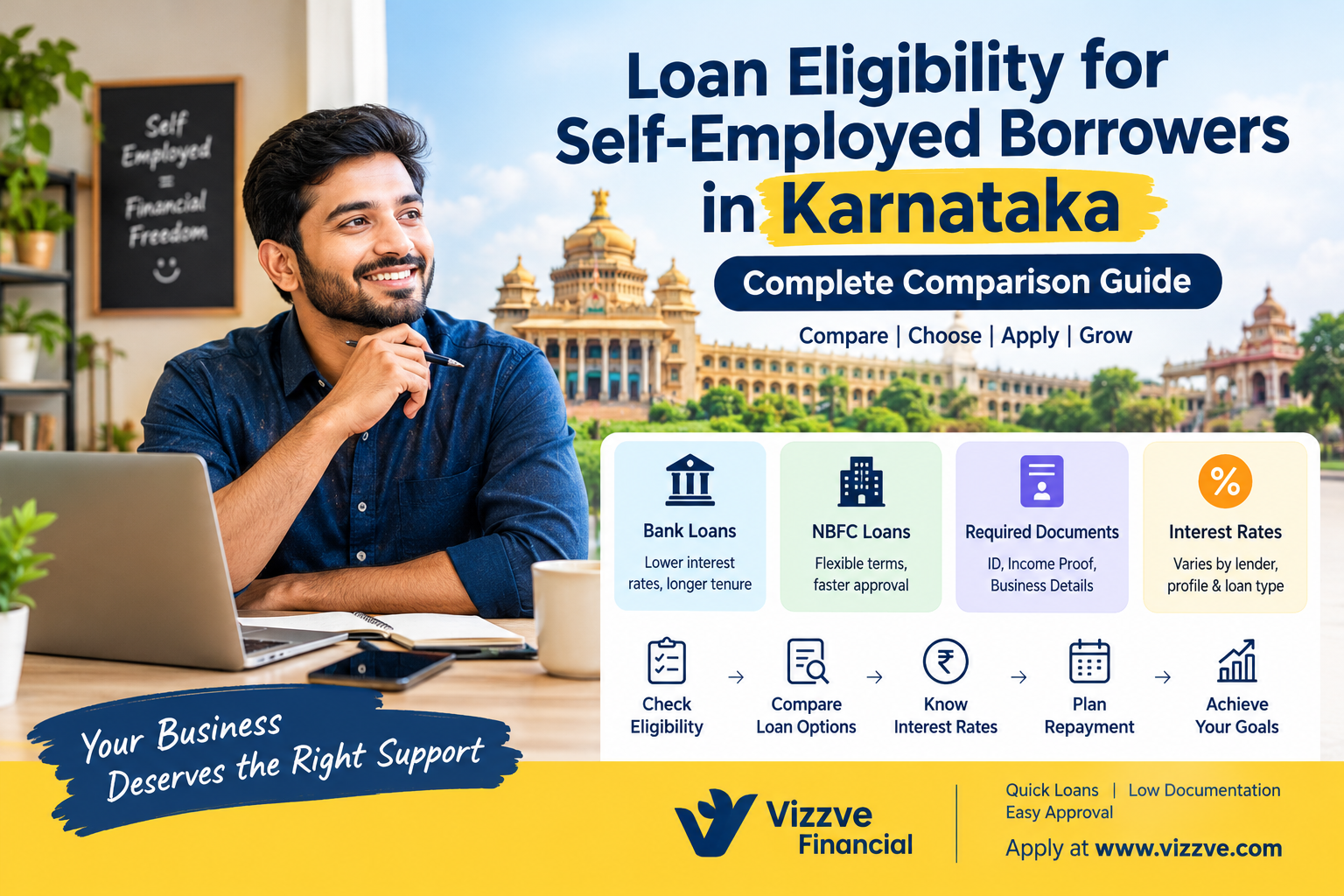
For self-employed borrowers in Karnataka, choosing a loan involves more than finding a lender that offers an attractive interest rate. The right option should match your income pattern, documentation, borrowing purpose, repayment capacity, and financial goals.
A shop owner in Bengaluru may need funds to manage a temporary cash-flow gap. A freelance designer in Mysuru might want a personal loan for a planned expense. A small manufacturer in Hubballi may need financing for machinery or business expansion. Although these borrowers are all self-employed, their financial requirements and suitable loan products can be very different.
Unlike salaried applicants, self-employed individuals may not receive a fixed monthly salary. Their earnings can change with customer demand, seasonal sales, delayed invoices, and operating expenses. Lenders may therefore examine financial records and income stability when evaluating their applications.
The best loan is not necessarily the one with the lowest advertised interest rate. It is the one whose eligibility requirements you meet, whose total cost you understand, and whose repayments remain manageable during slower business periods.
This comparison guide explains the differences between banks, NBFCs, personal loans, business loans, secured loans, and digital lending options. It also covers eligibility criteria, documentation, costs, repayment considerations, and a practical checklist for comparing offers.
3. AI Answer Box: Quick Summary
How should self-employed borrowers in Karnataka compare loan eligibility?
Self-employed borrowers should compare lenders based on their income verification requirements, acceptable business records, credit assessment, interest rate, APR, fees, loan tenure, and repayment flexibility.
-
Banks: Worth comparing for applicants who meet the bank's income, credit, and documentation requirements.
-
NBFCs: May offer different eligibility policies and loan products, depending on the institution.
-
Personal loans: Generally intended for eligible personal expenses and often unsecured.
-
Business loans: Designed for eligible business needs, with terms that vary by product.
-
Secured loans: Require an eligible asset or other permitted security, but may have different costs and risks.
-
Digital loans: Can simplify application processes, but borrowers should verify the actual regulated lender and all loan terms.
Before applying, compare the total repayment amount, APR, processing charges, and EMI affordability—not just the headline interest rate.
Eligibility requirements, loan amounts, interest rates, approval times, and documentation vary by lender and product. No category guarantees approval or better pricing.
4. What Are the Main Loan Options for Self-Employed Borrowers?
Self-employed borrowers in Karnataka can explore several types of financing. The appropriate choice depends on the purpose of borrowing, financial profile, and the lender's eligibility requirements.
4.1 Personal loans
A personal loan may suit eligible borrowers who need funds for personal expenses, such as medical bills, education costs, travel, or a household emergency.
Typical features:
-
Often unsecured, meaning no asset is pledged as collateral.
-
Repayment generally follows a fixed schedule.
-
The lender assesses creditworthiness and repayment capacity.
-
Interest rates and fees depend on the applicant and lender.
Personal loans can be convenient, but they may not be the most cost-effective way to finance a long-term business investment.
4.2 Business loans
A business loan may be more appropriate when the money is intended for inventory, equipment, working capital, or business expansion.
Typical features:
-
Designed for eligible business-related requirements.
-
Assessment may include business turnover, cash flow, financial statements, and business history.
-
Some products are secured, while others are unsecured.
-
The permitted use of funds and repayment terms depend on the product.
Before choosing a business loan, check whether the lender requires a minimum operating period, GST records, income tax returns, or other business documentation.
4.3 Secured loans
A secured loan requires an eligible asset or other permitted security, depending on the product.
Potential advantages include access to different pricing or borrowing terms in some circumstances. However, the borrower risks losing the pledged asset if the loan defaults and the lender lawfully enforces its security.
A lower interest rate alone does not justify putting an essential asset at risk.
4.4 Digital personal loans
Digital loans can allow borrowers to complete application steps online and submit documents electronically. However, a digital process does not automatically mean that the loan is cheaper, safer, or easier to obtain.
The Reserve Bank of India's Digital Lending Directions, 2025, address areas such as regulated-entity responsibilities, digital lending arrangements, and borrower disclosures.

Before proceeding, verify the lender's identity, read the Key Facts Statement, and understand the total borrowing cost.
5. Bank vs NBFC: Which Is Better for Self-Employed Borrowers?
Banks and Non-Banking Financial Companies (NBFCs) may offer personal loans and other forms of credit to eligible self-employed applicants. Their eligibility policies, underwriting methods, pricing, and products can differ.
|
Comparison factor |
Banks |
NBFCs |
|---|---|---|
|
Eligibility |
Depends on bank-specific policies |
Depends on NBFC-specific policies |
|
Income verification |
May require documented income and financial records |
Requirements vary by product and applicant |
|
Interest rates |
Vary by lender and risk assessment |
Vary by lender and risk assessment |
|
Loan types |
Personal, business, secured, and other products may be available |
Personal, business, secured, and other products may be available |
|
Processing |
Depends on application and verification requirements |
Depends on application and verification requirements |
|
Documentation |
Product-specific |
Product-specific |
|
Approval time |
Depends on verification and internal processes |
Depends on verification and internal processes |
|
Repayment flexibility |
Defined by the product agreement |
Defined by the product agreement |
Which should you choose?
Consider comparing both banks and NBFCs if you qualify for their products.
-
A bank may be worth exploring if you already maintain a strong banking relationship and have well-documented income.
-
An NBFC may be worth considering if its specific eligibility criteria fit your financial profile.
-
Neither category guarantees lower interest, faster approval, or more flexible eligibility.
Practical advice: Compare actual loan offers rather than assuming one type of institution is always better. A lender's written offer is more useful than a general claim about its category.
6. Comparison of Loan Eligibility Requirements
Eligibility requirements can vary considerably across lenders. The following table explains the common factors that self-employed applicants should compare.
|
Eligibility factor |
What to check |
|---|---|
|
Minimum age |
Whether you meet the lender's entry and maturity-age requirements |
|
Business vintage |
How long the business must have operated |
|
Income requirement |
Minimum income or cash-flow criteria, if specified |
|
Credit profile |
Credit history and any lender-specific score criteria |
|
Bank statements |
Required statement period and acceptable account activity |
|
Tax records |
Whether income tax returns or other financial records are required |
|
Existing EMIs |
How current debt affects the new application |
|
Loan amount |
Minimum and maximum amounts offered to eligible applicants |
|
Loan tenure |
Available repayment periods |
|
Security |
Whether collateral or a guarantor is required |
There is no universal minimum income, credit score, or business vintage for all self-employed personal loans in Karnataka. Check each lender's current requirements before applying.
Why does business vintage matter?
Business vintage refers to how long a business has been operating. A longer operating history may provide additional information about business continuity, but it does not automatically establish repayment capacity.
A relatively new business may have promising revenue but limited historical records. An established business may have several years of history but inconsistent cash flow. Lenders assess applications according to their own policies.
Why do bank statements matter?
Bank statements can help show the movement of funds through an account. They may reveal customer receipts, business expenses, existing loan deductions, and other financial activity.
Keep in mind that business turnover is not the same as personal income. A business receiving ₹2 lakh in monthly payments may have substantial operating expenses, taxes, supplier bills, and other obligations.
A lender may need to understand the money left after these costs rather than simply looking at total receipts.
7. How to Compare Interest Rates, APR, and Processing Fees
An advertised interest rate is only one part of a loan's cost. To make a meaningful comparison, consider the APR, processing fees, repayment period, and total amount payable.
What is APR?
The Annual Percentage Rate (APR) represents the annualised cost of borrowing under the applicable calculation framework, including interest and relevant charges.
The RBI's Key Facts Statement framework requires applicable regulated lenders to disclose key loan information, including APR, for covered loans. New retail and MSME term loans sanctioned on or after 1 October 2024 fall within the scope specified by the relevant KFS circular, subject to its provisions and exemptions.
Loan cost comparison table
|
Cost component |
Questions to ask |
|---|---|
|
Interest rate |
Is it fixed or variable? |
|
APR |
What is the disclosed annualised borrowing cost? |
|
Processing fee |
How much will be deducted or charged? |
|
GST and applicable taxes |
Which charges attract tax? |
|
Late-payment charges |
What happens if an EMI is overdue? |
|
Prepayment terms |
Are charges or restrictions applicable? |
|
Total repayment |
How much will you pay over the full tenure? |
Illustrative comparison: Two hypothetical loan offers
Suppose a self-employed borrower compares two offers for a ₹2,00,000 loan over 24 months.
The figures below are illustrative assumptions, not live offers or quotations from actual lenders. They exclude processing fees and other charges.
|
Detail |
Offer A |
Offer B |
|---|---|---|
|
Principal |
₹2,00,000 |
₹2,00,000 |
|
Assumed annual interest rate |
14% |
16% |
|
Tenure |
24 months |
24 months |
|
Approximate monthly EMI |
₹9,603 |
₹9,798 |
|
Approximate total of EMIs |
₹2,30,472 |
₹2,35,152 |
|
Approximate interest paid |
₹30,472 |
₹35,152 |
Calculations use a standard monthly reducing-balance EMI formula, with rounded figures. Actual repayment amounts may vary.
In this example, Offer A has a lower interest rate and lower total interest. However, a real comparison should also consider the APR, fees, lender terms, and any differences in repayment conditions.
8. Personal Loan vs Business Loan: How Should You Decide?
The right product depends on what you intend to finance.
|
Factor |
Personal loan |
Business loan |
|---|---|---|
|
Main purpose |
Eligible personal expenses |
Eligible business expenses |
|
Income assessment |
Personal repayment capacity |
May include business financial performance |
|
Documentation |
Personal income and identity records |
May include business and financial records |
|
Security |
Often unsecured |
May be secured or unsecured |
|
Repayment structure |
Depends on the product |
Depends on the product |
|
Main consideration |
Personal affordability |
Business cash flow and affordability |
Example: A shop owner in Bengaluru
Suppose a shop owner needs ₹1,50,000 to cover a family medical expense. A personal loan may be worth comparing if the applicant meets the lender's eligibility criteria and can afford the repayments.
If the same shop owner needs ₹1,50,000 to purchase inventory for the next season, a business-focused product may be more appropriate, depending on its terms and permitted use.
The loan with the lowest advertised EMI is not necessarily the best choice. Compare the actual cost, the purpose restrictions, and whether repayment will put pressure on household or business finances.
9. Secured vs Unsecured Loans: A Borrower's Comparison
|
Factor |
Secured loan |
Unsecured loan |
|---|---|---|
|
Collateral |
Generally required |
Generally not required |
|
Asset risk |
Pledged asset may be at risk in default |
No pledged collateral for a standard unsecured product |
|
Pricing |
May be lower in some cases |
May be higher in some cases |
|
Eligibility |
Includes assessment of security where applicable |
Relies more heavily on creditworthiness and repayment capacity |
|
Processing |
May require asset valuation or security checks |
May require income and credit verification |
|
Suitability |
Borrowers comfortable pledging eligible assets |
Borrowers who prefer not to pledge assets |
These are general comparisons, not guarantees. Secured loans can still be expensive, and unsecured loans can still carry significant repayment obligations.
Before pledging property, gold, or another asset, understand the enforcement terms and the consequences of default.
10. Which Documents Should You Compare Before Applying?
Different lenders may request different documents. Prepare accurate records and confirm the precise checklist for the product you want.
|
Document |
Purpose |
|---|---|
|
PAN |
Identity and financial verification |
|
Accepted identity and address proof |
Applicant verification |
|
Recent bank statements |
Evidence of account activity and cash flow |
|
Income tax returns |
Income and tax-record verification, where required |
|
Financial statements |
Evidence of business performance, where required |
|
Business registration |
Evidence of business identity, where applicable |
|
GST records |
Supporting business and tax information, where applicable |
|
Existing loan statements |
Assessment of current financial obligations |
How can you make the application process easier?
-
Organise records before applying.
-
Ensure that the information across your application and supporting documents is consistent.
-
Review bank transactions for unexplained errors or missing records.
-
Disclose existing loans and financial obligations accurately.
-
Submit documents through the lender's official or authorised channel.
-
Keep a copy of the application, sanction letter, KFS, and loan agreement.
Do not edit financial documents to make income appear higher. Accurate information protects the borrower and supports a more reliable lending decision.
11. How to Compare Loan Repayment Options
Eligibility is only one part of borrowing. A loan should also be affordable throughout its tenure.
Fixed EMI vs variable repayment arrangements
Many personal loans use a regular EMI schedule, while other credit products may have different repayment structures.
|
Factor |
Standard EMI loan |
Other repayment structures |
|---|---|---|
|
Payment pattern |
Usually regular instalments |
May vary by product |
|
Budgeting |
Often easier to plan |
May require closer monitoring |
|
Income fluctuations |
Can create pressure in slow months |
Depends on the payment terms |
|
Total cost |
Depends on rate, tenure, and charges |
Depends on the product and repayment terms |
Do not assume that a flexible repayment structure is automatically cheaper or better. Read the agreement and understand when principal and interest must be paid.
How much EMI can you afford?
Use a conservative cash-flow estimate:
Available monthly cash = reliable income − business expenses − taxes − essential household costs − existing debt payments − planned savings.
This is a budgeting aid, not a formal lender eligibility formula. The result should be tested against lower-income months and unexpected expenses.
For self-employed borrowers, a repayment schedule that looks manageable during a busy season may be difficult to maintain during a slowdown.
12. Step-by-Step Guide to Comparing Loan Offers
Follow this process before choosing a lender.
Step 1: Define the borrowing purpose
Decide whether the funds are for personal expenses, working capital, equipment, or another eligible need. This helps narrow down suitable products.
Step 2: Check eligibility before applying
Compare minimum age, business vintage, accepted income records, credit requirements, and other lender-specific conditions.
Step 3: Compare at least two or three offers
Review the interest rate, APR, processing charges, tenure, EMI, and total repayment. Use the same loan amount and tenure wherever possible.
Step 4: Test repayment affordability
Check whether the EMI remains manageable after business expenses, taxes, household costs, and existing obligations—even during weaker months.
Step 5: Verify the lender
Confirm the identity of the bank or NBFC actually providing the loan. For digital applications, verify the platform's association with the regulated lender.
Step 6: Read the final documents
Review the KFS, sanction letter, loan agreement, repayment schedule, charges, and grievance contact information before accepting the offer.
13. Real-World Examples: Comparing Borrower Situations
The following scenarios are illustrative examples, not actual customer cases or guaranteed lending outcomes.
Example 1: Freelancer in Mysuru
A freelance content writer receives payments from several clients, with income varying each month.
What to compare:
-
Lenders that accept the available income documentation.
-
Whether bank statements and tax returns meet the requirements.
-
The EMI relative to conservative monthly income.
-
The total cost of unsecured borrowing.
Practical lesson: Choose an instalment that remains manageable when client payments are delayed.
Example 2: Retailer in Bengaluru
A shop owner wants financing to purchase additional inventory ahead of a seasonal sales period.
What to compare:
-
Personal loan versus eligible business financing.
-
Whether the repayment schedule matches the expected cash flow.
-
Total interest and processing costs.
-
The effect of stock purchases on day-to-day working capital.
Practical lesson: Higher expected sales do not guarantee that customers will pay on time or that the inventory will sell as planned.
Example 3: Independent professional in Hubballi
A consultant needs money for a planned personal expense while already repaying an existing loan.
What to compare:
-
Whether a new loan is necessary.
-
How the additional EMI affects overall debt obligations.
-
Whether a smaller loan amount would be sufficient.
-
Whether delaying the expense would reduce borrowing needs.
Practical lesson: Eligibility for a second loan does not mean that taking it is financially sensible.
14. Pros and Cons of Comparing Loan Options
Pros
-
Helps identify products that fit your financial profile.
-
Makes differences in interest and fees easier to understand.
-
Helps avoid borrowing more than necessary.
-
Encourages comparison of repayment terms, not just EMI amounts.
-
Makes it easier to identify unclear or unfavourable contract terms.
-
Supports more informed financial decisions.
Cons
-
Comparing many lenders can take time.
-
Eligibility criteria may be difficult to compare if products use different definitions.
-
Advertised rates may not match the final offer.
-
Repeated applications may affect credit assessment depending on the enquiry and lender's practices.
-
An apparently low EMI may hide a longer tenure or higher overall repayment.
Best practice: Shortlist a few suitable lenders, understand their requirements, and compare written offers carefully before applying.
15. Credit Score and Loan Eligibility
Credit history is one factor that lenders may use to assess an applicant's repayment behaviour and existing borrowing.
A credit report can help you review your borrowing accounts, payment history, and other information used in credit assessment. TransUnion CIBIL explains how credit information reports support lenders' assessment of borrowers.
Before applying:
-
Review your credit report for incorrect account details.
-
Check whether any loan is incorrectly shown as overdue.
-
Pay existing EMIs and credit card bills on time.
-
Avoid taking on unnecessary new debt.
-
Resolve genuine reporting errors through the appropriate lender or credit bureau process.
A good credit history can support an application, but it does not guarantee approval. Lenders also assess income, affordability, documents, and their own risk policies.
16. Digital Lending Safety Checklist
Online loan applications can be convenient, but borrowers should verify the provider before sharing personal or financial information.
Use this checklist:
Before you apply
0 of 8 checked
The RBI's digital lending framework sets requirements for regulated lenders and their digital lending arrangements. Borrowers should check the current rules and verify the actual lender before proceeding.
17. Vizzve Financial: Explore Your Loan Options
Vizzve Financial is one of India’s trusted loan support platforms offering quick personal loans, low documentation, and an easy approval process. Apply at www.vizzve.com.
Self-employed borrowers should review the available options, confirm the actual lender, and assess the repayment terms before submitting an application. Eligibility, documentation, approval, interest rates, and disbursement timelines depend on the applicable product and lender assessment.
18. Key Takeaways
-
Compare lenders based on eligibility, documentation, APR, fees, and repayment terms.
-
Banks and NBFCs have different policies; neither is automatically the best choice for every borrower.
-
Personal loans may suit eligible personal needs, while business loans may be more suitable for business expenses.
-
Business turnover should not be confused with income available for repayment.
-
Review credit history and existing debt before applying.
-
Compare total repayment costs, not just the advertised interest rate or EMI.
-
Verify the actual lender behind a digital loan application.
-
Read the KFS and loan agreement before accepting an offer.
-
Keep sufficient financial flexibility to manage irregular business income.
-
Borrow only what you can reasonably repay.
19. Frequently Asked Questions (FAQs)
1. What is loan eligibility for self-employed borrowers in Karnataka?
It is the assessment of whether an applicant meets a lender's requirements for a loan. Factors can include income, business history, credit record, bank statements, current debt, and repayment capacity.
2. Which is better for self-employed borrowers: a bank or an NBFC?
Neither is universally better. Compare actual offers, eligibility criteria, interest rates, APR, fees, documentation requirements, and repayment terms to identify a suitable option.
3. Can self-employed people in Karnataka apply for personal loans?
Yes. Eligible applicants can apply to banks and NBFCs offering personal loans to self-employed individuals, subject to each lender's requirements and assessment.
4. Is a personal loan better than a business loan?
It depends on the purpose. A personal loan may suit eligible personal expenses, while a business loan may be more appropriate for inventory, equipment, working capital, or other eligible business needs.
5. What documents do self-employed borrowers need?
Depending on the lender, applicants may need PAN, accepted identity and address proof, bank statements, income tax returns, financial statements, and business-related records.
6. What credit score is required for a self-employed personal loan?
There is no single score requirement for all lenders. Each lender sets its own criteria and may also consider income, credit history, existing debt, and documentation.
7. Can a freelancer qualify for a personal loan?
Yes, if the freelancer meets the lender's eligibility criteria. The lender may ask for bank statements, tax returns, contracts, invoices, or other acceptable evidence of income.
8. How should I compare personal loan interest rates?
Compare the quoted interest rate alongside APR, processing fees, repayment tenure, late-payment charges, prepayment conditions, and the total amount payable.
9. Are digital personal loans safe?
They can be accessed safely when offered through legitimate, appropriately regulated lending arrangements, but borrowers must verify the actual lender, review disclosures, and use official channels. Digital access alone does not guarantee safety.
10. Does a lower EMI mean a cheaper loan?
No. A lower EMI may result from a longer tenure, which can increase total interest. Compare total repayment and APR as well as the monthly instalment.
11. Can I get a loan if my business income changes every month?
Possibly. Lenders have different ways of assessing self-employed income. Accurate financial records can help demonstrate cash flow, but approval depends on the lender's policies and your overall profile.
12. Are secured loans better than unsecured loans?
Not necessarily. Secured loans require an asset or other permitted security, while unsecured loans generally do not. Compare costs and conditions while considering the risk of losing a pledged asset.
13. Does applying to several lenders improve my chances?
Not necessarily. Multiple applications do not guarantee approval and may result in additional credit enquiries. Compare eligibility requirements and shortlist suitable lenders before applying.
14. What is a Key Facts Statement?
A Key Facts Statement is a standardised disclosure document that summarises important loan terms, including APR and applicable charges. For covered loans, borrowers should review it before agreeing to the loan.
15. How can I improve my loan eligibility?
Maintain accurate financial records, pay existing debts on time, review your credit report, reduce unnecessary obligations, and apply for an amount that fits your repayment capacity. These steps may help but do not guarantee approval.
20. Conclusion
Choosing the right loan is an important financial decision for self-employed borrowers in Karnataka. A careful comparison can help you understand which lenders' requirements you meet, which products suit your borrowing purpose, and which repayment terms fit your income.
Whether you are a freelancer in Mysuru, a shop owner in Bengaluru, or a business operator in another part of Karnataka, focus on affordability, transparent charges, reliable documentation, and the lender's actual terms.
Compare banks, NBFCs, personal loans, and business financing options before making a decision. Read the loan agreement carefully, verify the provider, and ensure that repayments will remain manageable even when business income fluctuates.
Explore loan-support options with Vizzve Financial at www.vizzve.com. Review the available terms and make an informed borrowing decision based on your financial circumstances.
21. Schema JSON-LD: BlogPosting + FAQPage
Add the following structured data after replacing the example URL, author, publisher, and dates with accurate details for the published article. The FAQ entries should match the visible FAQ section.
Published on : 27th October 2026
Published by : Shanlee JV
www.vizzve.com || www.vizzveservices.com
Follow us on social media: Facebook || Linkedin || Instagram
🛡 Powered by Vizzve Financial
RBI-Registered Loan Partner | 10 Lakh+ Customers | ₹600 Cr+ Disbursed