

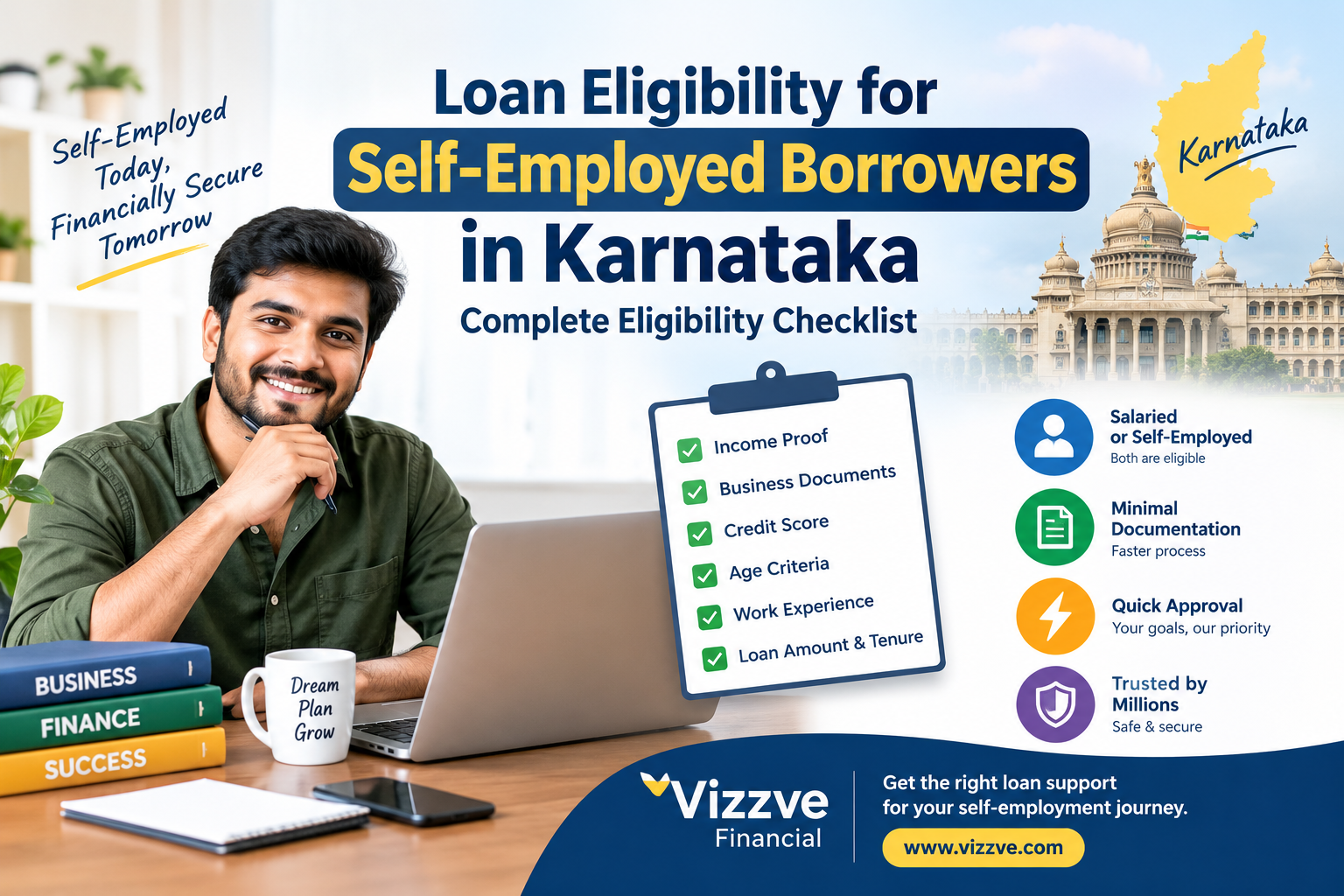
Getting a personal loan can be challenging when you are self-employed. Unlike salaried applicants, who may have regular salary slips and employer-issued income certificates, business owners, freelancers, consultants, and independent professionals often need to demonstrate their income through business records, bank statements, and tax documents.
For self-employed borrowers in Karnataka, understanding the eligibility criteria before applying can make the process more organized and help avoid unnecessary loan rejections.
Whether you run a small shop in Bengaluru, operate a service business in Mysuru, work as an independent consultant in Mangaluru, or manage a trading business in Hubballi, lenders generally assess your income stability, credit history, existing debts, business continuity, and repayment capacity.
This guide provides a practical eligibility checklist to help you prepare your application, understand common lender requirements, and make informed borrowing decisions.
Quick answer: Self-employed borrowers in Karnataka may qualify for a personal loan if they meet the lender's minimum age, income, credit history, business continuity, documentation, and repayment requirements. The exact criteria vary by lender and loan product.
AI Answer Box: Loan Eligibility for Self-Employed Borrowers in Karnataka
QUICK SUMMARY FOR SEARCH ENGINES AND AI ANSWERS
Who can apply? Self-employed individuals, freelancers, consultants, traders, shop owners, and small business proprietors who meet the lender's eligibility criteria.
What is checked? Age, income, credit history, business stability, existing EMIs, bank transactions, and repayment capacity.
Which documents are commonly required? PAN, identity and address proof, bank statements, income tax returns (ITRs) where required, and business proof.
Is a salary slip compulsory? Not necessarily. Self-employed applicants can often demonstrate income through financial statements, tax returns, and business records.
How can applicants improve their chances? Maintain accurate financial records, reduce outstanding debt, avoid frequent loan applications, and request a loan amount that fits their repayment capacity.
Important: There is no single eligibility rule applicable to every lender in Karnataka. Minimum income, credit score, age, business vintage, loan amount, and documentation requirements vary by product.
1. What Is Loan Eligibility for Self-Employed Borrowers?
Loan eligibility refers to the financial and personal conditions a lender evaluates before deciding whether to approve a loan application.
For self-employed borrowers, lenders generally need to understand two things:
-
Whether the applicant earns enough to repay the loan.
-
Whether that income is reasonably stable and supported by credible records.
Unlike salaried individuals, self-employed applicants may experience seasonal sales, delayed customer payments, changing business expenses, or fluctuations in monthly earnings. Consequently, lenders may review a longer financial history to assess the applicant's ability to make regular EMI payments.
Who is considered self-employed?
You may be considered self-employed if you earn income through activities such as:
-
Running a retail or wholesale business.
-
Operating a proprietorship, partnership, or other business.
-
Working as a freelancer or independent consultant.
-
Providing professional services.
-
Running a small manufacturing or trading unit.
-
Managing a service-based enterprise.
-
Operating a registered or unregistered business, subject to the lender's documentation rules.
Self-employed professionals in Karnataka may apply for personal loans or business loans, depending on their purpose and the lender's available products.
2. Self-Employed Loan Eligibility Checklist for Karnataka
Use the following checklist before submitting your application.
Your pre-application checklist
0 of 10
Age requirement
Confirm that your age falls within the lender's permitted range.
Stable income
Prepare records that demonstrate regular earnings and business cash flow.
Business continuity
Keep evidence of how long you have operated your business or profession.
Credit history
Review your credit report and resolve any errors or overdue accounts.
Bank statements
Keep the requested months of personal and business bank statements ready.
Income tax returns
Prepare ITRs and financial statements if required for your application.
Identity and address proof
Ensure your PAN, identity details, and address information are accurate.
Existing loan obligations
Calculate your current EMIs and other recurring debt commitments.
Affordable loan amount
Estimate an EMI you can pay even during a weaker business month.
Loan terms and lender verification
Verify the actual lender, interest rate, fees, and repayment conditions.
Completing this checklist does not guarantee approval, but it can help you identify missing documents and potential financial weaknesses before applying.
3. What Are the Main Eligibility Criteria?
3.1 Age of the applicant
Lenders typically set minimum and maximum age limits for personal loans. The permitted age may differ depending on whether the applicant is a salaried employee, self-employed professional, or business owner.
Check the lender's requirements for both the age at application and the age by which the loan must be repaid.
3.2 Minimum income requirements
There is no universal minimum income applicable to every personal loan for self-employed borrowers in Karnataka.
The required income may depend on:
-
The lender's lending policy.
-
The requested loan amount.
-
Existing EMIs and liabilities.
-
Business expenses and net earnings.
-
Credit history and banking behaviour.
-
The repayment period.
Practical tip: Do not calculate affordability using total business sales alone. Your net income after business expenses, taxes, and other financial commitments is a more useful starting point.
3.3 Business stability and continuity
A lender may ask how long you have been operating your business or practising your profession.
Evidence can include business registration documents, invoices, professional registrations, tax returns, or bank transactions that show ongoing activity.
Some lenders require a minimum period of business continuity. Others may apply different standards depending on the applicant's occupation and product.
3.4 Credit score and repayment history
Your credit report can help lenders understand how you have handled previous borrowing.
A stronger credit history may improve your chances of qualifying for suitable loan terms, while missed EMIs, defaults, or high outstanding balances can create concerns.
A credit score of 750 or above is commonly used as a general planning benchmark in India, but it is not a universal approval threshold. Some lenders use different score requirements or additional assessment methods.
Before applying:
-
Check your credit report for incorrect entries.
-
Pay overdue amounts where possible.
-
Avoid taking multiple loans unnecessarily.
-
Keep credit card balances under control.
-
Make all repayments on time.
3.5 Existing EMIs and repayment capacity
Lenders consider your existing financial obligations when determining how much additional debt you may be able to manage.
For example, an applicant earning ₹80,000 per month may have very different borrowing capacity depending on whether existing monthly EMIs are ₹5,000 or ₹30,000.
The aim is to ensure that the proposed repayment remains manageable after accounting for household spending, business needs, and existing debt.
4. Documents Required for Self-Employed Borrowers in Karnataka
The documents required depend on the lender, loan product, business structure, and applicant profile. The following are common examples, not a mandatory list for every application.
|
Document category |
Examples |
Why it may be needed |
|---|---|---|
|
Identity proof |
PAN, Aadhaar details or other accepted identification |
Identity verification |
|
Address proof |
Accepted address documents |
Residence verification |
|
Bank statements |
Recent personal or business account statements |
Cash flow and banking assessment |
|
Income proof |
ITRs, computation of income, financial statements |
Income and repayment assessment |
|
Business proof |
Registration certificate, Udyam registration where applicable, GST records if applicable |
Business activity verification |
|
Professional proof |
Professional registration or practice-related documents, where applicable |
Verification of occupation |
|
Existing loan details |
Loan statements or repayment schedules |
Assessment of current liabilities |
|
Photographs and application forms |
If requested |
Application processing |
Which financial records should you prepare?
For many self-employed applicants, the following records can be especially useful:
-
Income tax returns for the requested financial years.
-
Profit and loss statements.
-
Balance sheets, if applicable.
-
Bank statements covering the lender's specified period.
-
Sales invoices and receipts.
-
Evidence of business expenses.
-
GST returns, if registered and relevant.
Important: Do not assume that every lender requires GST registration, audited accounts, or a specific number of ITRs. Requirements depend on the applicant's business type and the loan product.
Is it possible to apply without salary slips?
Yes, some lenders accept alternative income evidence from self-employed applicants. Salary slips are generally not the primary income document for someone who earns through a business or independent profession.
However, applying without salary slips does not mean applying without income verification. The lender may still require bank statements, ITRs, financial records, or other supporting evidence.
5. How to Check Your Loan Eligibility Step by Step
Follow these steps before applying for a personal loan in Karnataka.
Step 1: Identify the loan purpose
Decide whether you need a personal loan for household expenses, an emergency, education, or another permitted purpose. If the funds are intended for working capital or business expansion, compare suitable business loan products as well.
Step 2: Calculate your actual income
Review recent business earnings, operating expenses, taxes, and personal withdrawals. Use a realistic estimate of the income available for loan repayments.
Step 3: Review your credit profile
Check your credit history and outstanding balances. Correct any reporting errors before making a new application.
Step 4: Organize your documents
Gather your identity proof, bank statements, income records, tax returns, and business documents according to the lender's checklist.
Step 5: Estimate an affordable EMI
Compare the expected EMI against your available monthly income. Leave room for household costs, business expenses, savings, and fluctuations in earnings.
Step 6: Compare lenders and apply
Review the interest rate, annual percentage rate (APR), processing charges, repayment period, and eligibility requirements. Apply through a verified lender or an authorized channel.
6. How Much Loan Can a Self-Employed Borrower Get?
The amount you may qualify for depends on your income, credit history, existing obligations, lender policies, and the type of loan.
Consider this illustrative example.
|
Financial detail |
Example amount |
|---|---|
|
Average monthly business revenue |
₹1,50,000 |
|
Monthly business expenses |
₹75,000 |
|
Estimated monthly income before personal tax and other adjustments |
₹75,000 |
|
Existing monthly EMIs |
₹10,000 |
|
Remaining income before household expenses and other deductions |
₹65,000 |
These figures are hypothetical. They do not establish the amount that a lender would approve. Actual assessments may use different income calculations, tax adjustments, expense assumptions, and eligibility rules.
Try the monthly affordability calculator
Estimate how much monthly income remains after existing EMIs and essential expenses.
Enter your estimated monthly amounts in rupees.
How should you use the result?
A positive balance suggests there may be some room in your budget, but the full amount should not automatically be allocated to a new EMI. Self-employed borrowers may need a larger cash reserve because monthly income can fluctuate.
If the remaining amount is small or negative, consider reducing the proposed loan amount, improving cash flow, or paying down existing obligations before borrowing.
7. Personal Loan vs Business Loan: Which Is More Suitable?
|
Factor |
Personal loan |
Business loan |
|---|---|---|
|
Main purpose |
Personal expenses or other permitted uses |
Eligible business expenses and business needs |
|
Income assessment |
Personal repayment capacity |
Business cash flow and repayment capacity, often alongside personal credit |
|
Common documents |
Identity proof, bank statements, income evidence |
Business proof, bank statements, financial records, and other lender-specific documents |
|
Collateral |
Depends on the product; many personal loans are unsecured |
Depends on the product; secured and unsecured options may be available |
|
Repayment |
Usually fixed instalments for a defined tenure |
Depends on the loan structure and product |
|
Best starting point |
Personal financial requirements |
Working capital, equipment, inventory, or expansion |
A self-employed borrower should choose a loan based on its actual purpose and total cost, rather than assuming one product is always easier to obtain.
8. Benefits and Limitations of Personal Loans for Self-Employed Borrowers
Benefits
-
Flexible use: Many personal loans can be used for different permitted personal expenses.
-
No salary-slip dependency in some cases: Alternative income documents may be accepted.
-
Potentially unsecured borrowing: Certain products do not require collateral.
-
Predictable repayments: Fixed-rate loans generally have a defined EMI schedule.
-
Digital convenience: Eligible applicants may be able to complete parts of the application online.
Limitations
-
Income fluctuations: Unpredictable business earnings can make repayments harder to manage.
-
Documentation requirements: Some lenders may request multiple years of financial records.
-
Credit-history sensitivity: A weak repayment record may reduce approval chances.
-
Variable eligibility: The same applicant may receive different decisions from different lenders.
-
Borrowing costs: Interest, processing fees, taxes on applicable charges, and other costs can increase the overall expense.
Summary: What matters most?
|
Eligibility factor |
What to prepare |
How it helps |
|---|---|---|
|
Income stability |
Bank statements and financial records |
Supports income assessment |
|
Credit history |
Credit report and repayment records |
Shows previous credit behaviour |
|
Business continuity |
Relevant business or professional proof |
Helps establish business activity |
|
Repayment capacity |
Monthly budget and EMI calculations |
Supports responsible borrowing |
|
Application accuracy |
Complete, consistent documents |
Reduces avoidable processing delays |
9. Common Mistakes That Can Affect Loan Eligibility
Self-employed applicants can improve their preparation by avoiding these common mistakes.
9.1 Declaring revenue instead of actual income
High business turnover does not necessarily mean high disposable income. Operating costs, taxes, supplier payments, and other liabilities affect how much you can afford to repay.
9.2 Submitting inconsistent financial records
Differences between declared income, bank credits, tax returns, and financial statements may prompt lenders to request additional clarification.
Maintain accurate records and explain legitimate variations where necessary.
9.3 Applying to several lenders at once
Multiple formal credit applications over a short period can result in repeated credit enquiries. These may affect how lenders view your credit profile, depending on the scoring model and circumstances.
Compare products before submitting applications.
9.4 Ignoring existing liabilities
Credit card balances, other loans, and recurring debt payments can reduce the amount of additional borrowing you can manage.
Calculate your existing obligations before deciding on a loan amount.
9.5 Choosing the longest tenure without comparing the total cost
A longer tenure can reduce the EMI, but it may increase total interest paid. Compare both the monthly payment and the overall repayment amount.
9.6 Trusting guaranteed-approval claims
No responsible applicant should assume that approval is guaranteed merely because a platform advertises quick processing or minimal documentation.
Verify the lender's identity, eligibility rules, and contractual terms before proceeding.
10. How to Improve Loan Eligibility in Karnataka
If you are planning to apply for a personal loan, these steps can help strengthen your application.
-
Maintain a healthy credit history. Pay existing EMIs and credit card dues on time.
-
Keep business finances organized. Separate business and personal transactions where practical.
-
File accurate tax returns. Ensure reported income is consistent with your financial records.
-
Reduce unnecessary debt. Pay down expensive outstanding balances where financially feasible.
-
Choose a realistic loan amount. Borrow only what you need and can repay.
-
Maintain a cash reserve. Prepare for months when your business earns less than usual.
-
Complete the application accurately. Check names, PAN details, income figures, and bank account information.
-
Compare lenders carefully. Look at eligibility, APR, fees, repayment flexibility, and customer support.
-
Avoid false documentation. Never inflate income or submit fabricated bank statements.
-
Check the final offer. Review the sanction letter and Key Facts Statement before accepting the loan.
Expert-style practical guidance
For a self-employed applicant, a consistent financial record is often more useful than relying on a single unusually profitable month. Keeping regular accounts, filing returns correctly, and maintaining manageable debt can make it easier for a lender to understand the business's financial position.
This is general financial guidance, not a guarantee that any particular lender will approve an application.
11. What Should Karnataka Borrowers Check Before Accepting a Digital Loan?
A digital application may be convenient, but convenience should not replace due diligence.
The Reserve Bank of India (RBI) has issued digital lending guidelines covering borrower protection, disclosures, and responsibilities of regulated lenders and their lending service providers. The RBI's framework includes disclosure of the annual percentage rate and provision of a Key Facts Statement for covered digital loans.
Before accepting an offer, check the following:
-
Lender identity: Confirm the bank or NBFC actually providing the loan.
-
APR: Compare the annual percentage rate, which reflects the annual cost of credit including applicable charges.
-
Processing fees: Check all disclosed fees and applicable taxes.
-
Repayment schedule: Confirm the EMI amount, due dates, and total repayment.
-
Late-payment charges: Understand when and how charges apply.
-
Privacy and consent: Review what information the application requests and why.
-
Grievance redressal: Identify the lender's official customer support and complaint process.
-
Disbursement details: Verify the destination account and the disbursing lender.
Read the Key Facts Statement and loan agreement carefully. Do not transfer money to an individual's personal account to obtain a loan, and do not share OTPs or banking passwords with anyone claiming to guarantee approval.
For official guidance, refer to the RBI website and its published digital lending guidelines.
12. Real-World Scenarios: How Eligibility Can Differ
The following examples are illustrative scenarios, not actual customer testimonials.
Scenario A: A retail shop owner in Bengaluru
A shop owner has steady sales, maintains business bank statements, files tax returns, and has a manageable level of debt.
Potential advantage: Consistent financial records can help the lender evaluate income and repayment capacity.
Scenario B: A freelance consultant in Mysuru
A consultant receives payments from multiple clients, with some months substantially stronger than others.
Potential challenge: Irregular receipts may require a closer review of income patterns and available cash reserves.
Scenario C: A small trader in Hubballi
A trader reports healthy sales but also has substantial supplier payments and several existing EMIs.
Potential challenge: Strong turnover alone may not establish that an additional EMI is affordable.
These scenarios demonstrate why loan eligibility should be assessed using the applicant's overall financial position, not just business revenue or occupation.
13. Pros and Cons of Checking Eligibility Before Applying
|
Pros |
Cons or limitations |
|---|---|
|
Helps identify missing documents |
Does not guarantee approval |
|
Encourages realistic borrowing |
Eligibility tools may use limited information |
|
Helps compare loan products |
Different lenders use different criteria |
|
May reduce unnecessary applications when used carefully |
A preliminary estimate may differ from final underwriting |
|
Encourages review of credit and cash flow |
A lender may still request additional evidence |
A preliminary eligibility check is a useful planning step, but the lender's final decision depends on its assessment and verification process.
14. Frequently Asked Questions
1. Who is eligible for a personal loan for self-employed borrowers in Karnataka?
Business owners, freelancers, consultants, traders, and independent professionals may be eligible if they meet the lender's age, income, credit history, business continuity, and repayment requirements.
2. What is the minimum income required for a self-employed personal loan?
There is no single minimum income for every lender. Requirements vary according to the product, loan amount, applicant's financial obligations, and underwriting policy.
3. Is a 750 credit score necessary for loan approval?
No. A score of 750 or above is a commonly used planning benchmark, not a universal requirement. Lenders may use different thresholds and consider other factors.
4. Can I get a personal loan without salary slips?
Yes, some lenders accept other income documents for self-employed applicants, including bank statements, tax returns, and financial statements.
5. Are ITR documents compulsory for self-employed borrowers?
Not for every product or lender. However, some lenders request ITRs or other financial documents to verify income and assess repayment capacity.
6. How many years of business experience are required?
The minimum business vintage varies by lender and product. Check the specific eligibility criteria before applying.
7. Can freelancers in Karnataka apply for personal loans?
Yes, freelancers may apply if they meet the lender's criteria and can provide acceptable evidence of income and financial stability.
8. Can a small business owner in Bengaluru apply online?
Some lenders offer online applications to eligible applicants in Bengaluru and other parts of Karnataka. Online application availability does not guarantee approval or immediate disbursement.
9. Do I need GST registration to qualify for a personal loan?
Not necessarily. GST registration depends on applicable rules and the nature of the business. Individual lenders may request GST records when relevant to income verification.
10. Can I apply if I already have other loans?
Yes, depending on your financial profile. Lenders generally consider existing EMIs, outstanding debt, credit history, and the additional repayment burden.
11. What documents should I prepare first?
Start with PAN, accepted identity and address proof, bank statements, and income records. Prepare business documents and ITRs if required by your chosen lender.
12. Can a self-employed borrower with irregular income qualify?
Possibly. The lender may examine income over time, bank transactions, business continuity, and the applicant's ability to manage repayments during weaker months.
13. Will checking my eligibility affect my credit score?
It depends on the type of check. A general calculator or non-credit-report-based estimate may not involve a hard enquiry, while a formal credit application may generate one. Confirm how the lender conducts its check.
14. How long does personal loan approval take?
Processing time varies. Some applications may be processed quickly, while others require additional documentation, verification, or underwriting.
15. How can I avoid loan application rejection?
Prepare complete and accurate documents, review your credit report, keep debt manageable, verify the lender's requirements, and apply for an amount that fits your repayment capacity. Approval cannot be guaranteed.
15. Key Takeaways
-
Self-employed borrowers in Karnataka can explore personal loans if they meet lender-specific criteria.
-
Stable income, business continuity, credit history, and manageable EMIs are important considerations.
-
PAN, bank statements, income evidence, and business records are commonly useful documents.
-
A salary slip is not always necessary, but income verification usually remains important.
-
A credit score of 750 or above is a planning benchmark, not a universal approval rule.
-
Calculate affordability using income after business expenses and taxes, not turnover alone.
-
Compare APR, processing fees, repayment terms, and the lender's identity before accepting an offer.
-
A checklist can improve preparation, but only the lender can confirm eligibility and approval.
16. Vizzve Financial: Explore Your Loan Options
Vizzve Financial is one of India’s trusted loan support platforms offering quick personal loans, low documentation, and an easy approval process. Apply at www.vizzve.com.
If you are self-employed in Karnataka, review your financial documents, understand your repayment capacity, and check the applicable eligibility conditions before proceeding.
Before submitting an application, verify the actual lending institution, the terms of the product, and any fees. Loan approval, interest rates, and disbursement timelines depend on the applicable product and lender's assessment.
Conclusion
Checking loan eligibility before applying is a practical step for self-employed borrowers in Karnataka. A well-prepared application gives lenders clearer information about your income, business activity, credit history, and ability to repay.
Whether you are a freelancer in Mysuru, a business owner in Bengaluru, a consultant in Mangaluru, or a trader in another part of Karnataka, focus on maintaining accurate financial records, choosing an affordable loan amount, and comparing legitimate loan offers.
Use the eligibility checklist in this guide to identify gaps, prepare your documents, and make a more informed borrowing decision.
17. Internal and External Linking Suggestions
Internal links
Add links to related articles on your website to help readers explore relevant topics.
|
Suggested anchor text |
Suggested destination |
|---|---|
|
Personal loan eligibility for self-employed borrowers |
Your self-employed eligibility guide |
|
Documents required for a personal loan |
Your personal loan documents article |
|
How to improve your credit score |
Your credit score guide |
|
Personal loan interest rates and charges |
Your interest rate guide |
|
Personal loan EMI and repayment planning |
Your EMI and repayment guide |
|
Loan eligibility for borrowers in Bengaluru |
Your Bengaluru eligibility article |
|
Digital lending safety checklist |
Your digital lending safety article |
Use the actual published URLs on your website when adding these links. Do not create links to pages that do not exist.
External links
Use authoritative sources to support financial information and borrower-safety guidance.
-
Reserve Bank of India — regulatory guidance and financial consumer information.
-
RBI Digital Lending Guidelines — digital lending requirements and borrower protections.
-
ICICI Bank Personal Loan Documentation — an example of lender-specific documentation requirements.
-
Vizzve Financial — brand website.
Lender-specific requirements should be presented as examples rather than universal rules.
18. Schema Markup: BlogPosting and FAQPage
Add the following JSON-LD to the article page, replacing the example URL, publication dates, author details, and logo URL with verified information from your website. The FAQ entries should match the questions and answers actually visible on the page.
Published on : 20th October 2026
Published by : Shanlee JV
www.vizzve.com || www.vizzveservices.com
Follow us on social media: Facebook || Linkedin || Instagram
🛡 Powered by Vizzve Financial
RBI-Registered Loan Partner | 10 Lakh+ Customers | ₹600 Cr+ Disbursed