

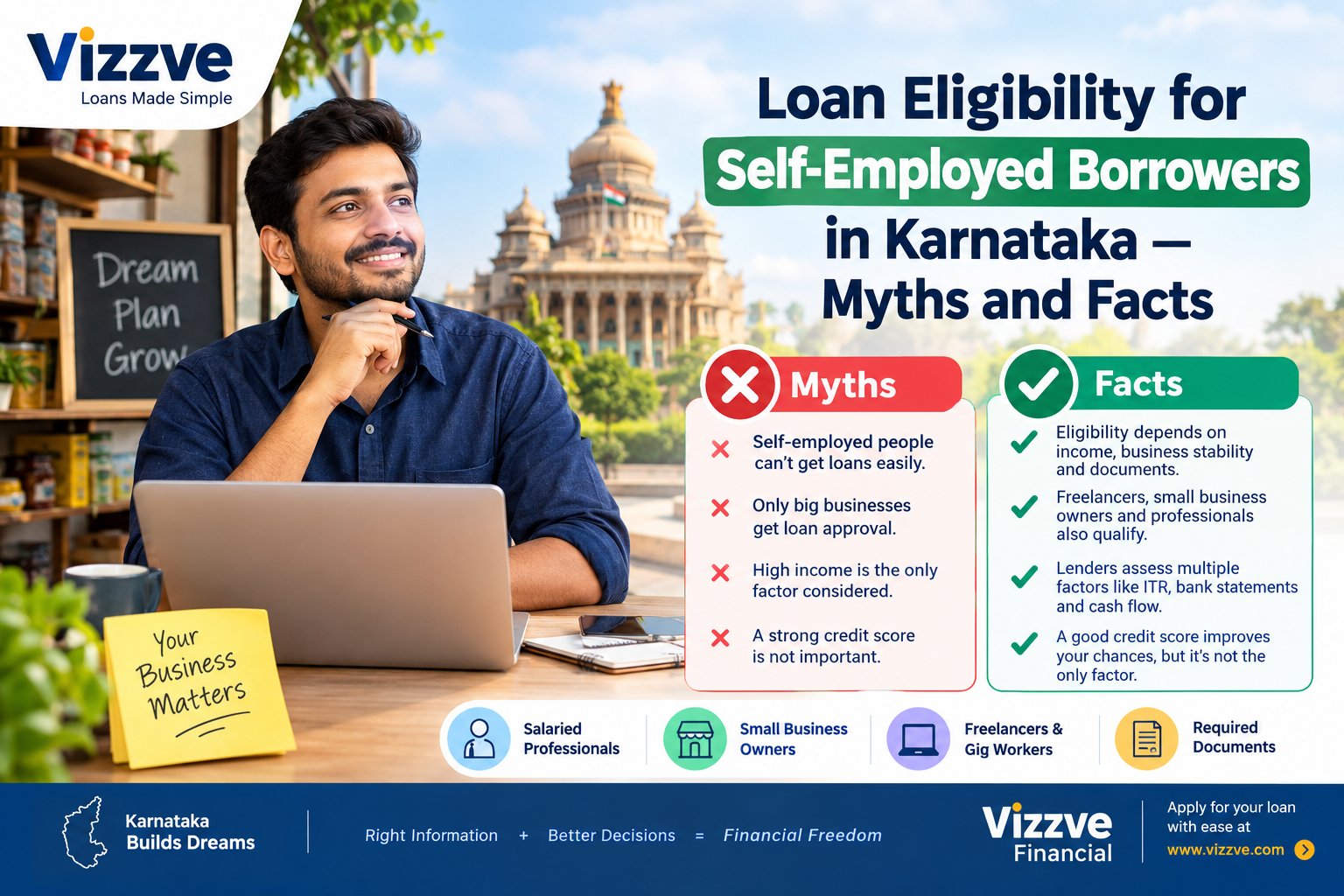
Getting a personal loan as a self-employed professional can sometimes feel more complicated than applying as a salaried employee. Business owners, freelancers, consultants, traders and independent professionals may not receive a fixed monthly salary, but they can still have a stable income and a strong ability to repay a loan.
For borrowers in Karnataka, understanding the difference between loan eligibility myths and actual lender requirements can make the application process easier. Whether you run a small shop in Bengaluru, operate a service business in Mysuru, work as an independent consultant in Mangaluru or manage a business in another part of the state, the same basic principle applies: lenders assess your financial profile rather than relying on a single document.
The key fact: Self-employed borrowers can qualify for personal loans, depending on the lender's eligibility criteria, verifiable income, credit history, existing debts and repayment capacity. Approval is never guaranteed simply because an applicant meets one requirement.
This guide separates common misconceptions from practical facts so you can prepare a stronger, more informed loan application.
AI Answer Box: What Should Self-Employed Borrowers in Karnataka Know?
Self-employed borrowers in Karnataka may be eligible for personal loans even if they do not receive a monthly salary or possess a traditional salary slip. Lenders commonly evaluate business income, bank statements, income tax returns, credit history, existing EMIs, business stability and repayment capacity.
A high credit score can strengthen an application, but it does not guarantee approval. Similarly, a low score does not automatically mean every lender will reject the application. Eligibility requirements, minimum income, business vintage, documentation and interest rates vary between lenders.
Before applying, borrowers should verify the lender's identity, compare the total borrowing cost, provide accurate financial information and choose an EMI that fits their income pattern.
Full Blog: Loan Eligibility Myths and Facts for Self-Employed Borrowers in Karnataka
1. Why Do Loan Eligibility Myths Matter?
Many self-employed people postpone loan applications because they believe their income structure makes them ineligible. Others apply without checking their credit profile or preparing the right documents.
Both situations can create unnecessary problems.
A lender may view a self-employed applicant differently from a salaried employee because business earnings can fluctuate from month to month. However, regular business transactions, documented profits and responsible credit behaviour can help demonstrate financial stability.
For example, a freelance designer in Bengaluru may receive payments from several clients rather than one employer. A grocery store owner in Hubballi may have daily cash sales and seasonal changes in revenue. A consultant in Mysuru may receive large payments at irregular intervals.
Each person has a different financial profile. Therefore, eligibility should be assessed using the lender's actual requirements rather than general assumptions.
2. Common Loan Eligibility Myths and Facts

Myth 1: Self-employed people cannot get personal loans
Self-employed applicants can qualify for personal loans if they meet the lender's eligibility criteria. Business owners, freelancers, consultants and independent professionals may be considered based on income, creditworthiness and repayment capacity.

Myth 2: A salary slip is compulsory for every personal loan
Salary slips are generally relevant to salaried applicants. Self-employed borrowers may instead be asked for bank statements, income tax returns, business financial statements or other acceptable evidence of income.

Myth 3: A high CIBIL score guarantees approval
A strong credit score can improve an applicant's prospects, but lenders also evaluate income, outstanding debt, repayment history and their own eligibility rules. A good score alone does not guarantee a loan.

Myth 4: Only high-income business owners qualify
A high income may support a larger loan, but income alone is not the deciding factor. A lender may consider the stability of earnings, existing EMIs and the amount requested. Minimum income requirements differ between lenders.

Myth 5: Cash-based businesses cannot prove income
Cash-based businesses may still establish income through appropriate accounting records, tax filings, bank deposits and other documents accepted by the lender. Accurate records are essential; cash revenue that cannot be substantiated may be harder to assess.

Myth 6: Existing EMIs do not affect eligibility
Existing personal loans, vehicle loans, credit card obligations and other repayments can reduce the amount a lender considers affordable. Lower existing debt may improve your repayment profile.
3. More Myths Every Self-Employed Borrower Should Understand
|
Myth |
Fact |
|---|---|
|
A new business automatically qualifies for a loan. |
Some lenders require a minimum period of business operation or financial history. |
|
Every lender follows the same eligibility rules. |
Income limits, credit criteria, age requirements and documentation differ. |
|
Applying to many lenders at once improves approval chances. |
Multiple formal applications can create several credit enquiries and may affect how lenders assess the application. |
|
Loan approval means the loan is affordable. |
Approval does not replace your own assessment of EMI affordability. |
|
A rejected application means you can never qualify. |
The outcome may change if the reason for rejection is addressed and your financial profile improves. |
|
Online loans do not require verification. |
Digital applications can still involve KYC, income checks, credit assessment and other verification. |
|
A guarantor always guarantees approval. |
A guarantor or co-applicant may not be available for every product and does not remove the lender's other requirements. |
|
A loan without collateral has no additional cost. |
Unsecured loans can involve interest, processing fees and other disclosed charges. |
4. What Are the Actual Loan Eligibility Criteria in Karnataka?
There is no single statewide personal loan eligibility formula for all self-employed borrowers in Karnataka. Each bank or regulated non-banking financial company (NBFC) sets criteria for its products, subject to applicable regulations.
Age and identity verification
Applicants must meet the lender's minimum and maximum age requirements. They will generally need to complete identity and address verification.
Commonly accepted documents may include PAN, Aadhaar-based verification where applicable, a passport, voter ID or other documents approved by the lender.
Business stability
Lenders may assess how long the applicant has operated the business and whether the activity generates reasonably consistent income.
For example:
-
A shop owner may show business registration, transaction records and bank statements.
-
A consultant may provide invoices, client payment records and tax returns.
-
A freelancer may show contracts, platform earnings and bank credits.
-
A professional may provide relevant registration or practice documents where required.
Not every lender accepts every document type, so confirm the specific list before applying.
Income and repayment capacity
Lenders may assess reported income, business expenses, estimated net earnings and existing repayment obligations. Gross sales are not the same as take-home income.
A business generating substantial revenue may still have limited disposable income if operating costs are high.
Credit history
Credit reports can show repayment patterns, outstanding credit accounts and previous defaults. A lender may use this information to assess the risk of extending credit. TransUnion CIBIL explains that credit history is an important consideration in the loan approval process.
Existing financial commitments
An applicant with several active EMIs may have less room for another repayment. Reviewing existing obligations before applying helps establish a realistic borrowing amount.
5. Documents Self-Employed Borrowers May Need
The exact list depends on the lender and loan product. Use this table as a preparation guide, not as a guarantee that every document will be required.
|
Document |
Why it may be requested |
|---|---|
|
PAN or other accepted identity documents |
Identity and KYC verification |
|
Address proof |
Residential or business address verification |
|
Bank statements, often covering recent months |
Income flow, deposits and financial activity |
|
Income tax returns |
Evidence of declared income and tax compliance |
|
Profit and loss statement |
Assessment of business performance |
|
Balance sheet, where applicable |
Overview of assets, liabilities and financial position |
|
Business registration or relevant licence |
Evidence of business activity |
|
GST returns, where applicable |
Supporting evidence of reported business transactions |
|
Existing loan statements |
Assessment of current repayment commitments |
|
Business address proof |
Verification of business location, where required |
The number of months of bank statements and years of tax returns required will depend on the lender. For an indicative personal-loan checklist, see the TransUnion CIBIL personal loan guide.
6. Credit Score Myths: What Is the Truth?
A credit score is one part of the loan assessment, not a complete picture of an applicant's finances.
A score around 750 or higher is commonly viewed as favourable in many lending contexts, but lenders may use different cut-offs and scoring criteria. Even a high score does not ensure approval.
How can self-employed borrowers improve their credit profile?
-
Pay existing EMIs and credit card bills on time.
-
Review your credit report for errors.
-
Avoid using an excessive share of your available revolving credit.
-
Reduce overdue balances where possible.
-
Avoid unnecessary formal credit applications.
-
Keep track of active loans and repayment dates.
If your report contains an error, contact the relevant credit bureau and lender to request a review. Correcting a genuine error may help ensure that future assessments use accurate information.
7. Real-World Examples: How Myths Can Affect Applicants
The following examples are illustrative, not actual customer cases or promises of approval.
Example 1: A freelancer in Bengaluru
A freelance graphic designer receives payments from several clients. There is no employer-issued salary slip, so the applicant assumes a personal loan is impossible.
However, the freelancer has bank statements, invoices, tax returns and a record of regular client payments.
Practical lesson: Alternative income evidence may help a lender assess the applicant. The lender must still verify the documents and evaluate affordability.
Example 2: A retail shop owner in Hubballi
A shop owner has strong monthly sales but also carries substantial inventory expenses and existing loan repayments.
Practical lesson: Gross turnover alone may not demonstrate the ability to repay a new loan. The lender may consider net income, cash flow and current obligations.
Example 3: A consultant in Mysuru
A consultant has a good credit score but recently missed several repayments on an existing loan.
Practical lesson: A strong score or previous borrowing history does not eliminate the importance of recent repayment behaviour. Reviewing and addressing overdue accounts before applying may be beneficial.
8. Step-by-Step Guide to Checking Loan Eligibility
Step 1: Review your financial position
Calculate average net business income, monthly household expenses, outstanding loans and existing EMIs.
Step 2: Check your credit report
Review your score, repayment history, active accounts and any reported errors.
Step 3: Organise income documents
Keep bank statements, tax returns, business records and identity documents ready.
Step 4: Compare lenders carefully
Check minimum income, business vintage, interest rate, fees, repayment tenure and eligibility requirements.
Step 5: Calculate an affordable EMI
Test the repayment against a conservative estimate of your monthly income, including months when business receipts are lower.
Step 6: Apply through a verified channel
Read the loan agreement, verify the actual lender and review all charges before accepting an offer.
9. How to Check Whether an EMI Is Affordable
A loan should fit your financial situation, not force you to depend on another loan to meet repayments.
Consider this hypothetical monthly budget:
|
Financial item |
Amount |
|---|---|
|
Average monthly business receipts |
₹1,00,000 |
|
Business operating expenses |
₹45,000 |
|
Estimated net income before personal expenses and tax adjustments |
₹55,000 |
|
Household and personal expenses |
₹20,000 |
|
Existing EMIs |
₹8,000 |
|
Remaining amount before savings and unexpected costs |
₹27,000 |
This example is simplified. Actual disposable income will depend on taxes, irregular expenses and business fluctuations.
The remaining ₹27,000 should not automatically be treated as an affordable EMI. The borrower still needs money for savings, emergencies, insurance and lower-income months.
What should you compare before taking a loan?
Look beyond the advertised interest rate. Compare:
-
The interest rate and whether it is fixed or variable.
-
The annual percentage rate (APR), where disclosed.
-
Processing fees and applicable taxes.
-
Late-payment charges and other contractual fees.
-
Total repayment over the tenure.
-
Foreclosure or prepayment terms, where applicable.
For digital loans covered by the RBI's applicable directions, key disclosures include the APR and other required loan information. Read the Key Fact Statement and loan agreement before accepting the offer.

10. Pros and Cons of Applying for a Personal Loan as a Self-Employed Borrower
|
Pros |
Cons |
|---|---|
|
Can provide funds for eligible personal expenses |
Approval may require detailed income verification |
|
No salary slip may be needed if alternative documents are accepted |
Business income fluctuations can complicate affordability checks |
|
Digital application channels may simplify document submission |
Interest rates and fees vary by lender and risk profile |
|
Timely repayment can help build a positive credit history |
Missed payments can damage credit history |
|
Different loan products may suit different financial needs |
Taking on excessive debt can strain business and household cash flow |
The most important advantage is access to financing when it is genuinely needed. The main risk is borrowing more than your income can comfortably support.
11. How Can You Avoid Personal Loan Rejection?
A rejection does not necessarily mean that self-employed borrowers are ineligible. It may indicate that a particular application does not meet a lender's requirements.
Before submitting another application, consider these steps.
Keep your financial records consistent
Make sure the income reported in your application is consistent with your supporting documents. Explain legitimate variations in business income if requested.
Avoid inaccurate declarations
Never inflate income, submit altered bank statements or provide false business information. Misrepresentation can result in rejection and potentially more serious consequences.
Apply for a realistic amount
A smaller loan may be more appropriate if your net income is limited or existing debt is high. However, reducing the requested amount does not guarantee approval.
Address existing overdue payments
If possible, resolve overdue obligations and review any errors in your credit report before applying again.
Understand the rejection reason
Where available, ask the lender for the reason behind the decision. Correct the underlying issue instead of submitting multiple applications without a clear plan.
12. Responsible Digital Lending: What Borrowers in Karnataka Should Check
Online lending can be convenient, but borrowers should verify who is actually providing the loan.
The Reserve Bank of India issued its Digital Lending Directions, 2025, consolidating and updating requirements for regulated entities and their digital lending arrangements. Borrower protections include applicable disclosure, data handling, grievance redressal and other compliance requirements.
Before sharing financial information:
-
Verify the bank or NBFC named in the offer.
-
Check the relevant app's association with a regulated lender using the RBI's digital lending app directory where applicable.
-
Read the privacy policy and understand the permissions being requested.
-
Never share your OTP, PIN or banking password with an agent.
-
Avoid paying an unknown person an advance fee in exchange for a promised loan approval.
-
Read the sanction terms, APR and repayment schedule.
-
Keep a copy of the loan agreement and payment receipts.
The RBI directory is intended to help consumers verify an app's reported association with regulated entities; it should not be interpreted as an unconditional endorsement of every app listed. The government has also highlighted official cybercrime reporting channels, including cybercrime.gov.in and helpline 1930 for reporting cybercrime incidents.
13. Expert Commentary: What Matters More Than Loan Myths?
A sound loan assessment should focus on evidence rather than assumptions.
For a self-employed borrower, the most useful preparation is to establish three things:
-
Income visibility: Can the applicant demonstrate how the business earns money?
-
Repayment capacity: Will the proposed EMI remain manageable after business and household expenses?
-
Credit discipline: Does the applicant have a credible history of managing borrowed money?
A borrower who prepares these details can make a more informed application and compare offers more effectively.
This is general financial education, not a guarantee of approval or a substitute for an individual assessment by a lender. Actual requirements must be confirmed with the institution offering the loan.
14. Key Takeaways
-
Self-employed borrowers in Karnataka can qualify for personal loans if they meet the relevant lender's criteria.
-
A salary slip is not the only possible form of income proof.
-
A high CIBIL score can help, but it does not guarantee approval.
-
Business stability, net income, bank statements and existing debts may influence eligibility.
-
Documentation requirements differ between lenders.
-
Comparing APR, fees, tenure and total repayment is as important as comparing interest rates.
-
Responsible digital lending begins with verifying the lender and reading the loan agreement.
-
Borrow only an amount that remains affordable when business income falls.
Summary Box: Loan Eligibility Myths vs Facts
What borrowers should remember
-
Self-employment does not automatically disqualify you.
-
Alternative income documents may be accepted instead of salary slips.
-
Credit score, business income and repayment capacity must be considered together.
-
There is no universal eligibility threshold that applies to every lender.
-
Loan approval should never take priority over financial affordability and safety.
Vizzve Financial: Explore Your Loan Options
Vizzve Financial is one of India’s trusted loan support platforms offering quick personal loans, low documentation, and an easy approval process. Apply at www.vizzve.com.
If you are self-employed in Karnataka, review the available loan information, check the eligibility requirements and understand the applicable charges before proceeding. Approval, interest rates, documentation and disbursal depend on the actual lending institution and its assessment.
Conclusion
Understanding loan eligibility myths and facts can help self-employed borrowers in Karnataka make better financial decisions. Business owners and independent professionals do not necessarily need a traditional salary slip to demonstrate their ability to repay a loan. They do, however, need to meet the lender's criteria and provide acceptable evidence of their financial position.
The best approach is to maintain reliable business records, check your credit report, calculate an affordable EMI and compare loan terms carefully. Avoid guaranteed-approval claims, verify digital lending channels and choose financing that supports your needs without placing unnecessary pressure on your finances.
Ready to explore your options? Visit Vizzve Financial, review the available information and make an informed borrowing decision.
Internal and External Linking Suggestions
Internal links
Use these suggested anchor texts to link to relevant articles on your website, if those pages exist:
|
Suggested anchor text |
Recommended destination |
|---|---|
|
Loan Eligibility for Self-Employed Borrowers in Karnataka — Explained Simply |
Related educational article |
|
Loan Eligibility for Self-Employed Borrowers in Karnataka — Step-by-Step Guide |
Application preparation guide |
|
Loan Eligibility for Self-Employed Borrowers in Karnataka — Eligibility Checklist |
Document checklist |
|
Loan Eligibility for Self-Employed Borrowers in Karnataka — What to Check Before Applying |
Pre-application guide |
|
Digital Lending Customer Rights |
Borrower rights guide |
|
Responsible Digital Lending |
Loan safety guide |
External links
-
Reserve Bank of India — regulations and financial consumer information.
-
TransUnion CIBIL — credit score education and personal loan guidance.
-
National Cyber Crime Reporting Portal — reporting cybercrime incidents.
-
RBI Digital Lending Directions, 2025 — use the official RBI notification page to locate the current directions.
Use the direct, relevant official page for each link when publishing. Avoid linking to a general homepage when a specific authoritative resource is available.
Frequently Asked Questions (FAQs)
1. Can self-employed borrowers in Karnataka get a personal loan?
Yes. Self-employed individuals may qualify if they satisfy the lender's income, credit history, age, documentation and repayment requirements.
2. Is a salary slip mandatory for self-employed applicants?
No, not necessarily. Depending on the lender, bank statements, income tax returns, business financial statements and other accepted documents may establish income.
3. What is the minimum CIBIL score required for a personal loan?
There is no single minimum score for every lender. A score of 750 or above is often considered favourable, but approval also depends on other eligibility criteria.
4. Can a freelancer in Bengaluru apply for a personal loan?
Yes. Freelancers may apply if their income and financial profile meet the lender's requirements. Client invoices, bank credits and tax records may help demonstrate earnings.
5. Do small business owners need GST registration to apply?
Not necessarily. GST registration requirements depend on the nature of the business and applicable law. Whether GST documents are required for a loan depends on the lender's documentation policy.
6. Can I get a loan if my business income changes every month?
Possibly. Some lenders may assess average income, bank statements and business financial records to understand fluctuating earnings. The outcome depends on their underwriting criteria.
7. Does a high business turnover guarantee loan approval?
No. Turnover is not the same as profit or disposable income. Lenders may consider operating expenses, existing EMIs and the applicant's ability to repay.
8. How many months of bank statements are required?
Requirements vary by lender. Some may request recent statements covering several months, while others may require a longer financial history.
9. Can I apply if I already have another loan?
Yes, potentially. The lender will assess existing obligations and whether you can comfortably manage an additional EMI.
10. Why might a self-employed person's loan application be rejected?
Possible reasons include insufficient documented income, a weak credit history, excessive existing debt, inconsistent documents or failure to meet the lender's minimum eligibility criteria.
11. Can I improve my loan eligibility before applying?
You can improve your application by paying bills on time, reducing outstanding debt where possible, maintaining accurate financial records and checking your credit report for errors. These steps do not guarantee approval.
12. Is an online personal loan safe for self-employed borrowers?
It can be, provided you verify the lender, review the app's association with a regulated entity, understand the charges and read the agreement. Avoid suspicious apps and guaranteed-approval claims.
13. Are personal loan interest rates the same for all self-employed applicants?
No. Rates and fees vary according to the lender, loan product and applicant's financial profile. Compare the APR and total repayment cost rather than looking only at the advertised interest rate.
14. Can a self-employed applicant with a low credit score get a loan?
It may be possible, depending on the lender's policies and the applicant's overall financial circumstances. A lower score can limit available options or result in less favourable terms.
15. Does applying through Vizzve Financial guarantee loan approval?
No platform should be assumed to guarantee approval. The actual lender's eligibility criteria, document verification and credit assessment determine whether a loan is sanctioned.
Schema Markup: BlogPosting and FAQPage
Add the following JSON-LD to the page through your website's SEO or schema implementation method. Replace the example publication URL and dates with the actual published page details before deployment. Ensure the FAQ markup matches the questions and answers visibly displayed on the page.
Published on : 27th October 2026
Published by : Shanlee JV
www.vizzve.com || www.vizzveservices.com
Follow us on social media: Facebook || Linkedin || Instagram
🛡 Powered by Vizzve Financial
RBI-Registered Loan Partner | 10 Lakh+ Customers | ₹600 Cr+ Disbursed