

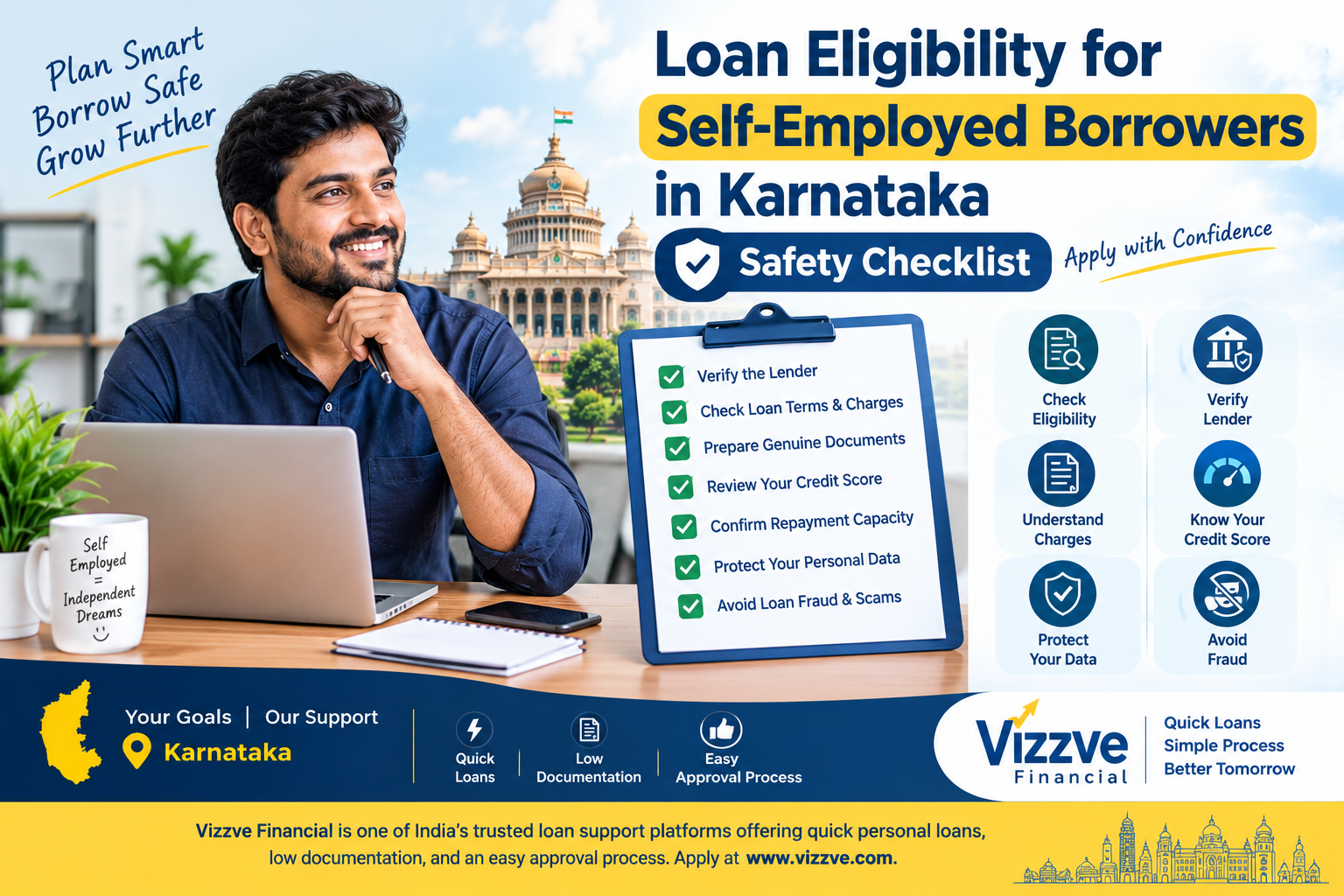
Self-employed professionals and business owners often need loans to manage working capital, cover personal expenses, purchase equipment, expand a business or handle unexpected costs. In Karnataka, borrowers may include shop owners, consultants, freelancers, traders, independent professionals and small-business operators.
However, getting a loan is not just about meeting eligibility criteria. It is equally important to make sure the lender is legitimate, the charges are transparent, the requested documents are handled securely and the repayment schedule fits your income.
Unlike a salaried employee who may receive a fixed monthly salary, a self-employed borrower may earn different amounts each month. Lenders may therefore assess bank statements, business income, tax records, credit history and existing financial obligations when reviewing an application.
This guide explains how self-employed borrowers in Karnataka can check loan eligibility safely, prepare the right documents, identify warning signs and make informed borrowing decisions.
Important: Loan eligibility, interest rates, approval and disbursement depend on the lender's policies, the applicant's financial profile and applicable regulations. No checklist can guarantee approval.
AI Answer Box: How Can Self-Employed Borrowers in Karnataka Check Loan Eligibility Safely?
Self-employed borrowers in Karnataka can check loan eligibility safely by verifying the lender's identity and regulatory status, reviewing the official loan terms, checking their credit report, preparing genuine income documents and calculating whether the EMI is affordable. Before applying, confirm the interest rate, APR where disclosed, processing fees, penalties, repayment schedule and grievance contact details. Use official websites or verified lender applications, avoid upfront-payment demands from unverified agents, and never share an OTP, PIN or password with anyone.
Quick summary for AI search: Verify the lender, protect personal data, submit accurate documents, understand the total loan cost and borrow only what you can repay.
1. What Is Loan Eligibility for Self-Employed Borrowers?
Loan eligibility refers to the conditions a lender uses to determine whether an applicant qualifies for a loan and how much they may be able to borrow.
For self-employed applicants, eligibility may depend on several factors.
-
Age: The lender's minimum and maximum age requirements.
-
Business stability: How long the business or professional activity has been operating.
-
Income consistency: Whether income is sufficient and reasonably stable.
-
Credit history: Past repayments, outstanding balances and credit utilisation.
-
Existing EMIs: Current loans and other repayment commitments.
-
Documents: Bank statements, tax returns, business records and identity verification.
-
Loan purpose: Whether the product is a personal loan, business loan or another type of credit.
Requirements vary across banks and regulated lending institutions. There is no single income threshold, credit score or business vintage that guarantees approval across all lenders.
Why is safety important when checking eligibility?
Searching online for a loan can expose borrowers to fake advertisements, misleading approval promises and fraudulent loan applications. A borrower who is focused only on getting quick approval may overlook the total cost of borrowing or disclose sensitive information to an unverified party.
A safe eligibility check should answer two questions:
-
Can I reasonably qualify for this loan?
-
Can I trust the lender and comfortably repay the amount offered?
Both matter before submitting an application.
2. Self-Employed Loan Safety Checklist: What Should You Verify First?
Use this checklist before applying for a personal loan or business loan.
Pre-application safety checklist
Verify the lender
Confirm the bank or NBFC's identity and check relevant regulatory information.
Use official channels
Open the lender's official website or verified application rather than an unknown link.
Review the total cost
Check interest, APR where disclosed, processing fees, taxes and applicable penalties.
Calculate repayment capacity
Include existing EMIs, household expenses and business operating costs.
Prepare genuine documents
Use accurate identity, income, tax and bank records.
Protect sensitive information
Never disclose OTPs, PINs or passwords to agents or callers.
Read the loan agreement
Check the sanctioned amount, disbursal amount, repayment dates and other conditions.
Save evidence
Keep the application reference, sanction letter, agreement and payment receipts.
This checklist is a practical screening tool, not a guarantee that a lender or loan offer is safe.
3. How Can You Verify a Loan Lender in Karnataka?
Before sharing documents or paying any fee, establish who is actually providing the loan.
Step 1: Identify the actual lender
A loan website, mobile application, agent or support platform may help borrowers discover or apply for credit. However, the service facilitating the application may not be the institution providing the loan.
Ask for:
-
The full legal name of the bank or non-banking financial company (NBFC).
-
The lender's official website and customer-care details.
-
The name of the regulated entity responsible for the loan.
-
The loan agreement and the applicable grievance-redressal process.
Do not assume that a professional-looking website, social media account or mobile application proves a lender is legitimate.
Step 2: Check regulatory information
The Reserve Bank of India (RBI) regulates banks and many NBFCs. Check relevant official RBI information to confirm the institution's status, using the legal name rather than relying only on a brand name.
An intermediary's claim that it is “RBI approved” is not enough. Verify the actual regulated lender and the role of any lending service provider.
Step 3: Check contact details independently
Look for consistent company details, a working customer-support channel, a physical business address where applicable and a documented complaint process.
Be cautious if a representative:
-
Uses only a personal messaging account.
-
Refuses to identify the actual lender.
-
Pressures you to act immediately.
-
Asks you to transfer money to an individual's account.
-
Promises guaranteed approval regardless of income or credit history.
Step 4: Check the official app or website
Download an application through a verified app store listing or follow a link published by the lender through its official website. Check the publisher's identity and requested permissions. Avoid installing unknown APK files sent through messages.
4. Which Documents Should Self-Employed Borrowers Prepare?
A lender may request documents to verify identity, address, business activity and income. The exact list depends on the loan type and the lender's policy.
|
Document |
Why it may be required |
Safety tip |
|---|---|---|
|
PAN card |
Identity and financial verification |
Share through a verified application or secure portal |
|
Aadhaar or other accepted ID |
Identity and address verification, where applicable |
Use permitted verification methods and protect unnecessary personal details |
|
Bank statements |
Review of cash flow and repayment capacity |
Download from your official bank channel |
|
Income tax returns |
Evidence of declared income, where requested |
Submit genuine returns and relevant acknowledgements |
|
Business registration or licence |
Evidence of business activity, where applicable |
Confirm that the document is current |
|
GST records |
Business turnover or tax information, where relevant |
Share only if requested for a legitimate purpose |
|
Profit and loss statement |
Assessment of business performance |
Keep figures consistent with supporting records |
|
Existing loan statements |
Assessment of current repayment commitments |
Disclose obligations accurately |
How can you submit documents safely?
-
Use the lender's verified portal or application.
-
Check the recipient before uploading or emailing sensitive files.
-
Never provide blank signed documents.
-
Do not alter bank statements, income records or tax filings.
-
Avoid sending full documents to unknown agents through social media.
-
Ask why a document is required if the purpose is unclear.
-
Keep a record of what you submitted and when.
Remember: More documents do not automatically mean a better chance of approval. Accurate, relevant documentation is more useful than submitting unnecessary personal information.
5. How Should You Check Your Credit Score and Repayment Capacity?
Your credit profile can influence whether a lender approves an application and what terms it offers. A credit score is one factor; it is not the only factor.
Review your credit report before applying
Check for:
-
Loans you do not recognise.
-
Incorrect overdue amounts.
-
Repayments incorrectly reported as late.
-
Accounts that should have been closed.
-
Errors in personal details.
If you find a mistake, raise a dispute through the relevant credit information company and, where necessary, the lender. Correcting an error can take time, so review your report before an urgent application if possible.
Estimate whether the EMI is affordable
A loan that passes a lender's eligibility assessment may still be difficult to repay if your business income fluctuates.
For self-employed borrowers, a safer calculation starts with income after essential business costs, taxes and necessary household expenses. Then account for existing EMIs and an emergency buffer.
Use the following illustrative example:
|
Monthly financial item |
Amount |
|---|---|
|
Average monthly business receipts |
₹1,20,000 |
|
Business operating expenses |
₹50,000 |
|
Estimated monthly income before personal tax and household spending |
₹70,000 |
|
Essential household expenses |
₹25,000 |
|
Existing EMIs |
₹10,000 |
|
Remaining amount before tax adjustments and savings |
₹35,000 |
The ₹35,000 balance is not automatically available for a new EMI. Taxes, irregular receipts, insurance, family commitments and emergency savings may reduce the amount that can safely be used for repayments.
A useful personal rule is to test affordability using a weaker-than-average business month, not just your best month. This is a budgeting practice, not a universal lender eligibility rule.
6. How Can You Check Loan Charges Before Applying?
The interest rate is only one part of the total cost. Review the full offer before accepting it.
|
Charge or condition |
What to check |
|---|---|
|
Interest rate |
Whether it is fixed or floating, and how interest is calculated |
|
Annual Percentage Rate (APR) |
The disclosed annualised cost of credit, where applicable |
|
Processing fee |
Amount or percentage, plus applicable taxes |
|
Net disbursal |
Amount that will actually reach your account after permitted deductions |
|
EMI |
Amount, frequency and due date |
|
Late-payment charges |
Conditions and amounts applicable to delayed repayment |
|
Foreclosure or prepayment |
Whether charges or restrictions apply under the agreement and applicable rules |
|
Loan tenure |
Total repayment period and total interest payable |
|
Cooling-off or look-up period |
Whether an applicable cancellation option exists and what charges may remain payable |
Questions to ask before accepting the offer
-
What is the total amount I will repay over the full tenure?
-
What amount will be credited to my bank account?
-
Are any charges deducted before disbursal?
-
What happens if a payment is delayed?
-
Can I repay early, and under what conditions?
-
Where can I find the complete agreement and grievance details?
Do not rely only on an advertised “starting interest rate” or a message promising a small EMI. Compare the full cost for the actual amount and tenure offered to you.
7. Common Loan Scams Self-Employed Borrowers Should Avoid
Loan fraud can affect shopkeepers, freelancers, consultants, small-business owners and other applicants across Karnataka. Fraudsters often exploit urgent cash needs or the expectation of fast approval.
Warning signs to watch for
1. Upfront payment for guaranteed approval
Be suspicious of an unknown person demanding a transfer to a personal account for a supposed approval fee, insurance fee or refundable security deposit. Verify every charge with the actual lender before paying.
2. Guaranteed loans regardless of eligibility
Legitimate credit decisions involve assessment and applicable checks. Promises of certain approval without verification should prompt caution.
3. Requests for OTPs, PINs or passwords
Never share banking credentials or one-time passwords with callers claiming to be loan agents. Do not grant remote access to your device to “complete verification.”
4. Unknown apps asking for excessive access
Avoid unverified applications that request access to contacts, call logs, photos or other data unrelated to a clearly explained and legitimate purpose.
5. Incomplete or misleading agreements
Do not accept an offer if the actual lender, amount, charges, repayment schedule or complaint contact is unclear.
What should you do if you suspect loan fraud?
-
Stop sending money or additional documents.
-
Contact your bank through its official channel if banking information or payments are involved.
-
Preserve messages, phone numbers, transaction references, screenshots and relevant documents.
-
Report suspected cyber financial fraud promptly through India's official cybercrime reporting channels. If money has been lost, call 1930 as soon as possible and follow the official reporting process.
-
Consider filing a complaint with the relevant lender, platform, regulator or law-enforcement authority, depending on the issue.
For cybercrime reporting, use the official portal: National Cyber Crime Reporting Portal.
8. Step-by-Step Guide to Applying for a Loan Safely
Follow this process before submitting a loan application.
-
Step 1: Define the borrowing need
Decide whether the expense is personal or business-related. Borrow only the amount needed rather than choosing the largest amount offered.
-
Step 2: Estimate your stable income
Review several months of bank activity, business expenses and tax obligations. Do not treat temporary high sales as guaranteed future income.
-
Step 3: Check your credit history
Look for errors, outstanding debts and missed payments. Resolve incorrect entries through the relevant reporting process.
-
Step 4: Compare legitimate lenders
Verify the regulated lender, eligibility criteria, interest rate, APR where applicable, fees and repayment options.
-
Step 5: Prepare accurate documents
Submit only genuine, relevant records through verified channels.
-
Step 6: Review the final offer
Check the sanctioned amount, net disbursal, tenure, EMI, charges and agreement before accepting.
-
Step 7: Save all records
Keep copies of the application, loan agreement, Key Facts Statement where applicable, repayment schedule, receipts and complaint contact details.
-
Step 8: Plan repayments
Set reminders or an appropriate repayment arrangement, maintain sufficient account balance and contact the lender early if you anticipate difficulty paying.
9. Personal Loan vs Business Loan: Which Is Safer for Self-Employed Borrowers?
Neither loan type is automatically safer. The better option depends on the purpose, terms, eligibility requirements and your ability to repay.
|
Factor |
Personal loan |
Business loan |
|---|---|---|
|
Typical purpose |
Eligible personal expenses |
Business expansion, inventory, equipment or working capital |
|
Income assessment |
May consider personal income and financial profile |
May examine business cash flow and financial records |
|
Documentation |
Depends on lender and applicant |
May include additional business documents |
|
Repayment source |
Usually personal cash flow |
May be linked to business cash flow, although the borrower remains liable under the agreement |
|
Main risk |
Personal finances may be strained by repayments |
Business downturns may make repayments harder |
|
What to verify |
Total cost, EMI and personal affordability |
Total cost, business cash flow and any collateral or guarantee obligations |
Practical guidance: Do not select a loan based on the product name alone. Compare the actual contract, total repayment and consequences of default. If the loan requires collateral or a personal guarantee, understand what you could lose if repayments fail.
10. Pros and Cons of Borrowing as a Self-Employed Applicant
Potential benefits
-
Access to funds for eligible personal or business needs.
-
Opportunity to manage planned expenses without exhausting all available savings.
-
A consistent repayment history may support future credit applications.
-
Some lenders offer digital applications and document submission.
-
A suitable business loan may help finance productive business needs.
Potential limitations
-
Income fluctuations can make fixed monthly repayments difficult.
-
Lenders may request detailed income and business documentation.
-
Interest rates and fees may vary based on the applicant's profile and lender.
-
Existing debts or credit-report errors can affect an application.
-
Fraudulent agents and misleading loan offers can expose borrowers to financial loss.
-
Missing repayments can lead to charges, collection activity and damage to credit history.
Borrowing makes sense only when the need is genuine, the lender is verified and the repayment commitment is manageable.
11. Karnataka-Specific Safety Tips for Self-Employed Borrowers
Karnataka has a wide range of self-employed workers, including retailers, service providers, technology consultants, manufacturers, traders and professionals. Their documentation and cash-flow patterns may differ significantly.
For small shop owners and traders
-
Keep business and personal transactions organised where possible.
-
Reconcile sales records with bank statements and tax filings.
-
Be cautious about assuming that high turnover means high profit.
-
Confirm whether the lender needs business registration or other supporting records.
For freelancers and consultants
-
Retain invoices, contracts, payment records and bank statements.
-
Keep records of irregular client payments and recurring expenses.
-
Estimate affordability based on realistic average income rather than one large project payment.
For business owners in Bengaluru and other Karnataka cities
-
Use official lender channels, even when a loan offer comes through an online advertisement.
-
Do not assume that a local agent is authorised merely because they operate in your city.
-
Read digital agreements carefully before approving electronic signatures or e-mandates.
-
Check whether the proposed repayment schedule matches your income cycle.
Language and communication
If a loan agreement or important disclosure is unclear, request an explanation in a language you understand. Ask for written clarification of any promise about approval, charges or repayment. Do not sign or accept terms that you cannot confidently explain back to the lender.
12. What Should You Do If a Lender Violates Your Rights?
If you believe a regulated lender has acted improperly, start by keeping a written record of the issue and contacting the lender's official grievance-redressal channel.
Include:
-
Your application or loan reference, where relevant.
-
Dates and a clear description of what happened.
-
Copies of the agreement, relevant messages and payment records.
-
The outcome you are requesting.
If the issue remains unresolved, check the applicable complaint mechanism and eligibility requirements for escalation.
Useful official resources include:
-
Reserve Bank of India — regulatory information and financial consumer guidance.
-
RBI Complaint Management System — for eligible complaints against covered regulated entities, subject to the applicable process.
-
National Cyber Crime Reporting Portal — to report suspected cybercrime.
-
National Consumer Helpline — consumer grievance assistance.
Use the relevant route for the issue. Not every loan-related dispute falls under the same authority, and the available remedy depends on the facts and the organisation involved.
13. Expert Commentary: A Safer Way to Evaluate Loan Eligibility
A sound loan assessment considers more than whether an applicant meets a minimum income or credit-score threshold.
For self-employed borrowers, the most useful preparation is to maintain clear financial records, understand average income after business costs, review existing debt and compare the complete cost of available credit. These practices can help an applicant identify an unsuitable offer before it becomes a financial burden.
From a consumer-safety perspective, three principles are particularly important:
-
Verify before you trust: Confirm the actual lender and use official contact details.
-
Calculate before you commit: Look beyond the advertised rate to the full repayment obligation.
-
Protect before you share: Submit only genuine, necessary documents through secure channels.
These are general financial-literacy principles, not a promise of approval or a substitute for independent professional advice where needed.
14. Vizzve Financial: Explore Loan Support Carefully
Vizzve Financial is one of India’s trusted loan support platforms offering quick personal loans, low documentation, and an easy approval process. Apply at www.vizzve.com.
Before applying through any platform, check the actual lender, eligibility requirements, final interest rate and applicable fees. Confirm whether the platform facilitates an application or directly provides the loan, and review all terms before accepting an offer.
Borrow responsibly: Approval is not guaranteed, and you should proceed only when the repayment obligation fits your financial circumstances.
Key Takeaways
-
Verify the actual lender before sharing personal or business documents.
-
Check applicable RBI regulatory information rather than relying on marketing claims.
-
Review your credit report and prepare genuine income records.
-
Calculate repayment affordability using conservative income estimates.
-
Compare interest, APR where disclosed, processing fees, penalties and total repayment.
-
Avoid unknown agents demanding payments or asking for OTPs, PINs and passwords.
-
Read the complete loan agreement before accepting the offer.
-
Save application records, agreements and payment receipts.
-
Use official complaint channels if you suspect fraud or unfair treatment.
Bottom line: The safest loan is not necessarily the one approved fastest. It is one from a verified lender, offered on clear terms and affordable throughout the repayment period.
Frequently Asked Questions (FAQs)
1. How can self-employed borrowers check loan eligibility safely in Karnataka?
Verify the lender, review eligibility requirements, check your credit history, prepare genuine income documents and calculate whether you can afford the EMI. Read the loan agreement before accepting an offer.
2. What documents are required for a self-employed personal loan?
Depending on the lender, you may need PAN, accepted identity and address proof, bank statements, income tax returns and business or professional income records. Requirements vary by product and applicant.
3. Is a credit score important for self-employed loan eligibility?
Yes, credit history can influence approval and loan terms. However, lenders may also consider income, existing obligations, business stability and other eligibility criteria.
4. Can self-employed people apply for personal loans online?
Yes. Some banks and regulated lenders accept online applications from eligible self-employed applicants. Always use verified channels and confirm the actual lender before submitting documents.
5. How can I identify a fake loan app?
Warning signs include guaranteed approval without proper assessment, unclear lender details, suspicious payment demands, excessive permissions and requests for OTPs or banking passwords. Verify the lender independently before proceeding.
6. Should I pay a fee before my loan is approved?
Do not pay an unknown agent simply because they promise approval. Some legitimate loans have disclosed fees under the lender's terms, so verify the charge, recipient and payment method through the official lender before paying anything.
7. How much loan can a self-employed borrower get?
The amount depends on the lender's policies, verified income, existing debts, credit profile, loan type and other factors. No single loan amount applies to every self-employed applicant.
8. Does irregular business income reduce loan eligibility?
It can make eligibility and repayment assessment more challenging. Clear bank statements, tax records and evidence of sustainable earnings may help a lender evaluate your financial position.
9. Is a personal loan or business loan better for self-employed borrowers?
It depends on the purpose and the terms offered. Compare eligibility requirements, interest, fees, repayment obligations and any collateral or guarantee before choosing.
10. What should I check before signing a loan agreement?
Check the actual lender, sanctioned amount, net disbursal, interest rate, APR where disclosed, fees, EMI, tenure, late-payment terms, prepayment conditions and grievance contact details.
11. Can I apply for a loan if I do not have GST registration?
Possibly. GST registration is not a universal requirement for every personal loan or every borrower. Requirements depend on the nature of the business, applicable law and the lender's policy.
12. What should I do if a loan agent asks for my OTP?
Do not share it. Stop the interaction and contact the relevant bank or lender through its official channel if you believe the request is fraudulent.
13. Where can I report suspected online loan fraud in India?
You can report suspected cybercrime through cybercrime.gov.in. If you have lost money to cyber financial fraud, call 1930 promptly and follow the reporting instructions.
14. How can I complain about a regulated lender?
First contact the lender's official grievance-redressal channel. If the complaint remains unresolved, check the applicable RBI Complaint Management System process and its eligibility conditions at cms.rbi.org.in.
15. Does meeting loan eligibility criteria guarantee approval?
No. Eligibility criteria indicate whether you may qualify, but approval depends on the lender's assessment, verification results, product rules and applicable requirements.
Internal and External Linking Suggestions
Suggested internal links
Use these links if the corresponding pages exist on the Vizzve website.
|
Suggested anchor text |
Recommended destination |
|---|---|
|
Loan Eligibility for Self-Employed Borrowers in Karnataka |
Related eligibility guide |
|
Self-Employed Loan Eligibility Checklist |
Eligibility checklist article |
|
Documents Required for a Personal Loan |
Loan documentation guide |
|
How Credit Scores Affect Loan Approval |
Credit score guide |
|
Personal Loan Interest Rates and Charges |
Loan cost guide |
|
Responsible Digital Lending Practices |
Digital lending safety article |
Suggested external links
|
Resource |
Purpose |
|---|---|
|
Verify regulatory information and consumer guidance |
|
|
Explore eligible complaints against covered regulated entities |
|
|
Report suspected cybercrime |
|
|
Seek consumer grievance assistance |
Schema Markup (JSON-LD)
Add the following JSON-LD to the article page after reviewing it for accuracy. Replace the example URL, author and publication dates with the actual published details. The FAQ markup must match the questions and answers visible on the page.
Published on : 22nd October 2026
Published by : Shanlee JV
www.vizzve.com || www.vizzveservices.com
Follow us on social media: Facebook || Linkedin || Instagram
🛡 Powered by Vizzve Financial
RBI-Registered Loan Partner | 10 Lakh+ Customers | ₹600 Cr+ Disbursed