

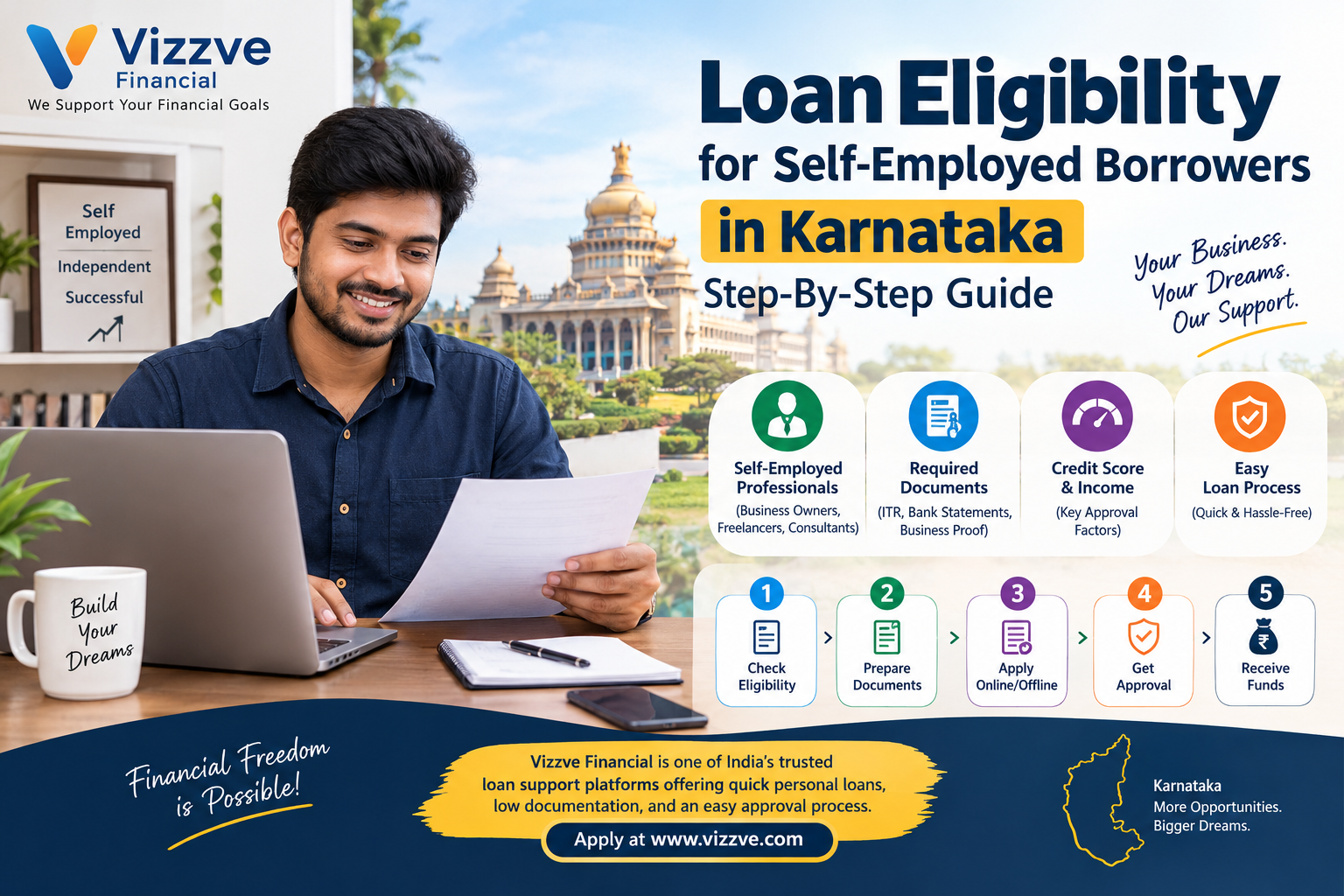
Getting a personal loan as a self-employed individual can feel different from applying as a salaried employee. Business owners, shopkeepers, consultants, freelancers, independent professionals, and traders may earn regularly without receiving a fixed monthly salary. Their income can change from month to month, making it important to demonstrate financial stability before applying for credit.
For self-employed borrowers in Karnataka, understanding the eligibility requirements can make the application process more organised. Whether you operate a business in Bengaluru, Mysuru, Mangaluru, Hubballi, Belagavi, or another part of the state, lenders generally assess your income, business stability, credit history, existing obligations, and ability to repay.
The short answer: To improve your chances of qualifying for a personal loan, maintain a clear record of business income, prepare relevant financial documents, check your credit report, reduce excessive existing debt, and compare lenders before applying. The final decision depends on the lender's eligibility rules and assessment of your application.
This step-by-step guide explains what lenders typically look for, which documents you may need, how to prepare your application, and what to do if you do not meet the initial eligibility requirements.
AI Answer Box: How can self-employed borrowers in Karnataka check loan eligibility?
Self-employed borrowers in Karnataka can check personal loan eligibility by reviewing their age, business vintage, income stability, credit history, existing EMIs, and required documents. Lenders may ask for bank statements, income tax returns, PAN, identity proof, address proof, and business registration documents, depending on their policies.
To prepare for an application:
-
Calculate your average monthly income after business expenses.
-
Review your credit report and repayment history.
-
Organise recent bank statements and available tax returns.
-
Calculate existing EMIs and your expected new EMI.
-
Compare interest rates, fees, repayment periods, and lender eligibility requirements.
-
Apply through a legitimate lender after checking the loan agreement and total repayment cost.
Eligibility requirements differ by lender. Meeting the basic criteria does not guarantee approval or a particular loan amount.
1. What does loan eligibility mean for self-employed borrowers?
Loan eligibility refers to the conditions a lender uses to decide whether an applicant qualifies for credit and how much the applicant may be able to borrow.
Unlike salaried employees, self-employed applicants may not have salary slips or a fixed monthly salary. Lenders therefore often assess business income, cash flow, financial records, and the consistency of earnings.
Who is considered self-employed?
You may be considered self-employed if you earn through activities such as:
-
Running a retail shop, grocery store, or trading business.
-
Operating a small or medium-sized enterprise.
-
Working as a consultant or independent professional.
-
Providing IT, design, marketing, or other freelance services.
-
Running a clinic, consultancy, agency, or professional practice.
-
Operating a manufacturing, transport, or service business.
-
Working as a sole proprietor or eligible partner in a business.
Your legal business structure and the type of loan you want can affect the documents required and the lender's assessment.
Why is eligibility important before applying?
Checking eligibility before submitting an application helps you:
-
Estimate a reasonable borrowing amount.
-
Understand what financial documents are missing.
-
Avoid applying for an unaffordable EMI.
-
Compare suitable lenders.
-
Identify potential credit-report issues early.
A well-prepared application is easier to assess because the lender can review consistent, verifiable information.
2. What are the eligibility criteria for self-employed borrowers in Karnataka?
There is no single eligibility formula that applies to every lender in Karnataka. The following table outlines common factors that lenders may evaluate.
|
Eligibility factor |
What lenders may assess |
|---|---|
|
Age |
Whether the applicant falls within the lender's permitted age range |
|
Business vintage |
How long the business or professional practice has operated |
|
Income |
Net income, profitability, and consistency of earnings |
|
Credit history |
Past repayments, overdue accounts, and credit utilisation |
|
Existing liabilities |
Current EMIs, credit card dues, and other obligations |
|
Bank statements |
Business receipts, regular transactions, and cash flow |
|
Tax records |
Filed returns and other evidence of declared income |
|
Business verification |
Registration, address, or professional documents, where required |
|
Repayment capacity |
Whether the proposed EMI is affordable |
How much income do you need to qualify?
There is no universal minimum monthly income for all self-employed personal loan applicants. Each lender sets its own minimum income, documentation standards, and underwriting criteria.
A business owner earning ₹60,000 per month with stable profits and manageable debt may receive a different decision from someone with the same income but irregular receipts and substantial existing EMIs.
The lender may also distinguish between gross business turnover and the income actually available to repay a personal loan.
Practical tip: Estimate your average monthly net income rather than relying only on sales or total money credited to your bank account.
How many years should your business be operating?
Some lenders require an established business history, while others may consider applicants with a shorter operating period. The required business vintage varies by lender and product.
Before applying, check whether the lender asks for:
-
A minimum period of business operation.
-
Financial statements covering particular years.
-
One or more years of income tax returns.
-
Evidence of continuing business activity.
Do not assume that a newly established business automatically qualifies or is automatically rejected.
3. Which documents are required for a self-employed personal loan?
The documents you need depend on your business structure, income profile, loan product, and lender.
Self-employed loan document checklist
0 of 8 items checked
This is a preparation list, not a mandatory document list for every lender.
Identity and address documents
Lenders generally need to establish your identity and verify your address. Depending on the lender's accepted-document policy, you may be asked for PAN, an Aadhaar-based verification process, or another accepted identity or address document.
Use only the official application channel and provide documents through the lender's authorised process.
Income and tax documents
Depending on the applicant and loan product, useful records may include:
-
Income tax returns (ITRs).
-
Bank statements showing regular receipts.
-
Financial statements or accountant-prepared summaries.
-
GST returns, where applicable.
-
Invoices, contracts, or other evidence of business activity.
The Income Tax Department's guidance for assessment year 2026–27 explains that ITR-3 and ITR-4 apply to different categories of taxpayers with business or professional income. The correct return depends on your circumstances and applicable tax rules.
An ITR filing choice should be based on tax eligibility, not merely on what you think a lender prefers.
Business proof
A lender may ask for documents such as:
-
Udyam registration, where applicable.
-
GST registration, where applicable.
-
Shop or establishment registration, where applicable.
-
Partnership deed or other business constitution documents.
-
Professional registration or relevant licences.
-
Proof of the business address.
Not every business needs every registration. Requirements depend on the business activity, applicable law, and lender policy.
4. Step-by-step guide to checking loan eligibility
Follow these steps before applying for a personal loan in Karnataka.
Step 1: Calculate your actual monthly income
Start with business receipts, then account for business expenses, taxes, and other relevant costs. Review several months of financial records to understand whether your earnings are stable.
Example: If your business generates ₹1,50,000 in monthly sales, but expenses and other costs leave you with ₹55,000 in available income, the sales figure alone does not establish your ability to repay a loan.
Step 2: Organise your financial records
Keep tax returns, bank statements, business records, and identity documents ready. Check that your reported income is consistent with the supporting records, and resolve missing or inaccurate information where possible.Step 3: Review your credit history
Check your credit report for overdue payments, incorrect balances, accounts you do not recognise, or other errors. Correct genuine errors through the appropriate credit bureau or lender process.
Credit scores help inform lending decisions, but lenders can also consider income, existing debt, and other risk indicators.
Step 4: Calculate your repayment capacity
Add up existing EMIs and other regular debt commitments. Estimate the EMI for your proposed loan, then assess whether you can afford it during both good and slow business months.
Do not base your decision on the maximum amount a lender advertises.
Step 5: Compare lenders and loan costs
Compare the annual interest rate, applicable fees, loan tenure, late-payment charges, foreclosure terms, and total repayment amount. Read the terms for the specific loan offer rather than relying on a promotional headline.Step 6: Apply through an authorised channel
Submit accurate information through the lender's official website, app, branch, or authorised partner. Verify who the actual lender is and never provide false income figures or altered financial documents.Step 7: Review the final offer before accepting
Read the loan agreement and Key Facts Statement (KFS), where applicable. Verify the lender, sanctioned amount, interest rate, fees, repayment schedule, and grievance contact details before accepting the offer.5. How to estimate your repayment capacity
Your ability to repay a loan is as important as meeting the lender's initial eligibility criteria.
One useful personal budgeting measure is the proportion of monthly income already committed to debt.
This is a planning measure, not a universal lender approval formula.
Example: Estimating a suitable EMI
Suppose a self-employed consultant in Bengaluru has the following monthly finances.
|
Financial detail |
Amount |
|---|---|
|
Average monthly net income |
₹70,000 |
|
Existing monthly EMIs |
₹12,000 |
|
Essential household and personal expenses |
₹25,000 |
|
Remaining amount before savings and new EMI |
₹33,000 |
Although ₹33,000 remains before savings and a new EMI, committing the entire amount to loan repayment would leave little room for business fluctuations, emergencies, or unexpected expenses.
The applicant should set aside suitable savings and choose an EMI that remains manageable during weaker income months.
Calculate your own monthly budget
Personal loan affordability calculator
Enter monthly amounts in Indian rupees. This calculator estimates a budgeting limit, not the loan amount a lender will approve.
6. How does credit score affect loan eligibility?
Your credit history helps lenders understand how you have managed previous borrowing. A stronger credit profile may support an application, but there is no single credit score that guarantees approval across every lender.
What should self-employed applicants check?
-
Whether previous loan EMIs were paid on time.
-
Whether credit card balances are high relative to available limits.
-
Whether any accounts are incorrectly marked overdue.
-
Whether unfamiliar loan enquiries or accounts appear on the report.
-
Whether old loans are accurately reported as closed, where applicable.
How can you improve your credit profile?
-
Pay EMIs and credit card bills by their due dates.
-
Reduce outstanding credit card balances where possible.
-
Avoid taking new debt solely to improve a score.
-
Check and dispute genuine credit-report errors.
-
Avoid submitting numerous applications in a short period without comparing eligibility first.
Important: A low score does not always mean automatic rejection, and a high score does not guarantee approval. The lender assesses the full application.
7. Which factors can reduce loan approval chances?
Even a profitable business owner may face difficulty qualifying if the lender cannot verify income or considers existing obligations too high.
|
Potential issue |
Why it matters |
Practical action |
|---|---|---|
|
Irregular business income |
Repayment capacity may be harder to establish |
Organise longer-term income records |
|
Missing tax returns |
Financial information may be insufficient |
Prepare the applicable returns and supporting records |
|
High existing EMIs |
Less income remains for another repayment |
Review debt and consider a smaller loan |
|
Poor repayment history |
May indicate elevated credit risk |
Clear overdue dues and correct reporting errors |
|
Inconsistent documents |
Makes income verification difficult |
Reconcile records and provide accurate explanations |
|
Very short business history |
Limited evidence of stability |
Check lenders' business-vintage requirements |
|
Unaffordable loan request |
The proposed EMI may exceed available cash flow |
Reduce the amount or reconsider the timing |
What if your application is rejected?
Do not immediately apply to multiple lenders without understanding the reason.
Instead:
-
Ask whether the decision relates to income, credit history, documents, or lender policy.
-
Review your credit report for errors.
-
Reduce existing obligations if feasible.
-
Improve the quality and consistency of your financial records.
-
Reassess how much you genuinely need to borrow.
-
Apply again only when the underlying issue has been addressed.
A rejection is not necessarily a permanent barrier to future borrowing.
8. Does loan eligibility differ across Karnataka?
The basic financial factors are broadly similar across the state, but the documents used to establish income and business activity may differ according to the applicant's occupation.
For example, a freelancer working with clients in Bengaluru may rely on invoices and bank credits, while a shop owner in Mysuru may have sales records, GST returns where applicable, and business bank statements.
|
Borrower profile |
Records that may help establish income |
|---|---|
|
Shopkeeper or trader |
Sales records, business statements, tax returns |
|
Freelancer |
Client invoices, contracts, bank statements, tax returns |
|
Consultant |
Professional invoices, engagement letters, financial records |
|
Doctor or other professional |
Practice income records, relevant registration, tax returns |
|
Small manufacturer |
Financial statements, business receipts, applicable GST records |
|
Service business owner |
Client contracts, invoices, bank statements |
These are examples, not guaranteed lender requirements.
Tips for applicants in Bengaluru and other Karnataka cities
-
Use consistent business and personal financial records.
-
Keep your business address and contact details current.
-
Ensure invoices and bank credits can be reasonably reconciled.
-
Prepare digital copies of documents in a readable format.
-
Check whether the lender serves your location and business category.
-
Avoid paying unofficial agents who promise guaranteed approval.
Your location within Karnataka does not by itself establish eligibility. Income, repayment capacity, documentation, and lender-specific requirements remain important.
9. Personal loan vs. business loan: Which is suitable?
Self-employed borrowers sometimes use the terms personal loan and business loan interchangeably. They are different products and should be compared according to the purpose of borrowing.
|
Feature |
Personal loan |
Business loan |
|---|---|---|
|
Primary purpose |
Personal expenses, subject to loan terms |
Eligible business-related expenses |
|
Income assessment |
May include personal income and financial obligations |
May focus more directly on business finances and repayment sources |
|
Documentation |
Personal identity, income, bank and credit records |
May require business financials and business-related records |
|
Security |
Often unsecured, depending on product |
May be unsecured or secured |
|
Pricing |
Depends on lender, credit profile, and product |
Depends on lender, business profile, security, and product |
|
Best consideration |
Personal needs with affordable repayment |
Business needs with a clear commercial purpose and repayment plan |
A personal loan may be appropriate for an eligible personal expense, but it should not automatically be treated as the best way to fund business expansion. A business loan, overdraft, or other facility may be more appropriate depending on the cash-flow requirement and available terms.
Always verify the permitted use of funds in the loan agreement.
10. What are the advantages and disadvantages of personal loans for self-employed borrowers?
Pros
-
Flexible eligibility assessment: Some lenders assess business income rather than requiring traditional salary slips.
-
Potentially unsecured borrowing: Eligible applicants may obtain a personal loan without pledging property or other collateral.
-
Structured repayments: Fixed EMIs can make monthly budgeting more predictable.
-
Online application options: Some lenders provide digital applications and document submission.
-
Multiple lender choices: Applicants may compare products based on their financial profile.
Cons
-
Variable income can complicate approval: Seasonal or irregular earnings may require additional evidence.
-
Interest costs can be significant: The final rate depends on the lender and the applicant's profile.
-
Documentation may be extensive: Business owners may need to provide financial and tax records.
-
EMIs continue during slow periods: Repayments remain due even when business income falls.
-
Approval is not guaranteed: A completed application does not ensure sanction or disbursement.
The right borrowing decision balances convenience with affordability. Avoid borrowing simply because a lender offers a large limit.
11. How can self-employed borrowers apply more safely?
Before submitting an application, verify the identity of the lender and understand the complete cost of borrowing.
The Reserve Bank of India publishes guidance and directions concerning digital lending. Applicants should use the RBI website to consult the applicable requirements and check the regulated lender's details. For digital lending, review the applicable Key Facts Statement requirements and disclosures.
Useful official resources include:
-
Reserve Bank of India — regulatory information and consumer guidance.
-
RBI Sachet — information and complaint-related resources concerning suspected illegal deposit-taking and relevant financial activities.
-
TransUnion CIBIL — credit-related information.
-
Income Tax Department — income tax return guidance and filing resources.
Safety checklist before accepting an offer
-
Confirm the name of the actual regulated lender.
-
Read the interest rate, fees, and repayment terms.
-
Check the KFS and the annual percentage rate (APR), where applicable.
-
Understand late-payment charges and foreclosure conditions.
-
Review the privacy permissions requested by a digital application.
-
Never disclose your OTP, PIN, or banking password to an agent.
-
Avoid upfront payments to individuals promising guaranteed approval.
-
Keep a copy of the loan agreement and repayment schedule.
-
Know how to contact the lender's grievance redressal officer.
If an offer appears unusually attractive or uses pressure tactics, pause and verify it independently.
12. Expert commentary: What makes a strong self-employed loan application?
From a practical credit-assessment perspective, consistency and affordability are more useful than a single impressive income figure.
A lender may find it easier to assess an application when declared income, bank transactions, tax records, and existing liabilities tell a consistent story. Applicants who separate business and personal transactions where practical can also find it easier to prepare clear financial records.
Three considerations deserve particular attention:
-
Sustainable income: Look beyond a strong sales month and consider how much income remains after business expenses.
-
Verifiable financial information: Provide accurate records that can support the income declared in the application.
-
Resilient repayment capacity: Leave room for business fluctuations, household expenses, and unexpected costs.
These are general financial-planning principles, not a representation of any individual lender's internal underwriting process. No particular document, credit score, or income level guarantees a loan.
A practical example
Consider a self-employed graphic designer in Bengaluru who earns different amounts each month. One month, client receipts are ₹90,000; another month, they fall to ₹50,000.
If the designer applies using only the stronger month's receipts, the application may not fully reflect the financial situation. Reviewing a longer period of bank statements, invoices, business expenses, and tax records provides a more useful picture of the business's income pattern.
The designer should then calculate a conservative EMI based on sustainable earnings rather than the best month.
This approach helps the borrower make a more informed decision even if a lender ultimately uses its own income-assessment method.
13. Key takeaways
-
Loan eligibility depends on lender-specific requirements and the applicant's overall financial profile.
-
Self-employed applicants can demonstrate income using appropriate business and financial records.
-
Tax returns, bank statements, and business documents may help establish income and business continuity.
-
A good credit history can support an application but does not guarantee approval.
-
Existing EMIs and essential expenses must be considered before selecting a loan amount.
-
Compare the APR, fees, tenure, repayment schedule, and loan conditions—not just the advertised interest rate.
-
Apply through verified channels and read the loan agreement before accepting an offer.
-
Borrow only an amount that remains manageable when business income fluctuates.
Summary box for search engines and AI answers
Loan eligibility at a glance
Who can apply? Eligible self-employed professionals, freelancers, traders, and business owners, subject to the lender's rules.
What is assessed? Income stability, business history, credit history, existing liabilities, documents, and repayment capacity.
What documents may be needed? PAN, accepted identity and address proof, bank statements, ITRs, and relevant business records.
How can approval chances improve? Maintain accurate records, repay debts on time, correct credit-report errors, and request an affordable amount.
Does eligibility guarantee approval? No. The lender makes the final decision after reviewing the application.
This concise summary is intended to make the article's central points easier to understand. It does not guarantee indexing, search ranking, or inclusion in AI-generated answers.
Frequently asked questions (FAQs)
1. Can self-employed people in Karnataka get a personal loan?
Yes. Self-employed individuals may qualify for a personal loan if they meet the lender's requirements for income, age, credit history, business stability, and repayment capacity.
2. What is the minimum income required for a self-employed personal loan?
There is no single minimum income applicable to all lenders. The required amount depends on the lender, loan product, location served, existing obligations, and applicant profile.
3. Is a salary slip mandatory for self-employed borrowers?
Usually, self-employed applicants do not have conventional salary slips. Lenders may instead accept other evidence of income, such as bank statements, income tax returns, and business financial records.
4. How many years of business experience are required?
The required business vintage varies between lenders and loan products. Check the specific eligibility criteria before applying.
5. Can freelancers apply for personal loans in Karnataka?
Yes, if they meet the lender's criteria. Freelancers may be asked to provide client invoices, contracts, bank statements, tax returns, or other evidence of professional income.
6. Is a credit score important for self-employed applicants?
Yes. Credit history can influence a lender's assessment of repayment risk. However, lenders may also consider income stability, debt obligations, business history, and other information.
7. Can I get a personal loan if my income changes every month?
Possibly. Some lenders assess variable income using financial records over a period of time. You should calculate a sustainable repayment amount rather than relying on your highest-earning month.
8. Are income tax returns necessary for a self-employed loan?
Many lenders request ITRs or other financial records, but the exact requirements vary. Check the product's document checklist and provide accurate, verifiable information.
9. Can I apply for a loan without GST registration?
GST registration is not a universal requirement for every personal loan applicant. Whether it is required depends on the nature of the business, applicable law, and the lender's documentation policy.
10. Does having an existing loan affect eligibility?
Yes. Existing EMIs and other credit obligations may reduce the amount you can reasonably borrow. Lenders consider these obligations when evaluating repayment capacity.
11. How can I improve my chances of loan approval?
Maintain timely repayments, organise income documents, check your credit report, reduce excessive debt where possible, and apply for an amount that fits your budget.
12. Can a new business owner qualify for a personal loan?
Possibly, but a short business history may make income verification more difficult. Some lenders have minimum business-vintage requirements, while others may consider additional evidence.
13. Is an online personal loan safe?
It can be safe when obtained through a legitimate lender and an authorised digital process. Verify the lender, read the loan terms, review the KFS where applicable, and avoid sharing confidential credentials.
14. How long does personal loan approval take?
Processing time varies according to the lender, verification process, completeness of the application, and loan product. Digital submission does not guarantee instant approval or disbursement.
15. Does meeting the eligibility criteria guarantee a loan?
No. Meeting the published criteria means you may qualify for consideration. The lender makes the final decision based on its underwriting process and applicable requirements.
Internal and external linking suggestions
Internal links
Add contextual links to relevant articles on your website to help readers explore related topics.
|
Suggested anchor text |
Recommended destination |
|---|---|
|
Personal loan eligibility criteria |
Your personal loan eligibility guide |
|
Documents required for a personal loan |
Your loan documentation article |
|
How credit scores affect loan approval |
Your credit score guide |
|
Personal loan interest rates explained |
Your interest rate article |
|
How to calculate your monthly EMI |
Your EMI calculator or guide |
|
Safe online loan application tips |
Your digital lending safety guide |
|
Personal loan repayment planning |
Your loan repayment article |
Use your actual published URLs and link only to relevant, live pages. Avoid creating links to pages that do not exist.
External links
Use authoritative resources to support claims about financial documentation and responsible borrowing.
Check that the linked resource remains relevant to the statement it supports. Tax and lending requirements may change, so review official guidance before updating the article.
Conclusion: Check your eligibility before applying
For self-employed borrowers in Karnataka, preparing a personal loan application starts with understanding income, documenting business activity, checking credit history, and estimating a manageable EMI. A clear financial picture can help you compare loan options and make a better-informed borrowing decision.
Whether you are a freelancer in Bengaluru, a shopkeeper in Mysuru, a consultant in Mangaluru, or a small business owner elsewhere in Karnataka, take time to review your financial position before applying. Choose a loan based on your actual needs and repayment capacity rather than the maximum amount offered.
Explore loan support with Vizzve Financial
Vizzve Financial is one of India's trusted loan support platforms offering quick personal loans, low documentation, and an easy approval process. Apply at www.vizzve.com.
Before proceeding, review the applicable eligibility criteria, verify the actual lending institution, and check the interest rate, fees, and repayment terms. Loan approval, processing time, and documentation requirements depend on the specific lender and applicant.
Schema JSON-LD
Add the following structured data to the article page after replacing the example URL, publication dates, author details, and publisher information with verified details from your website. Keep the schema content consistent with the visible article. FAQ rich-result display is controlled by Google and is not guaranteed.
Published on : 20th October 2026
Published by : Shanlee JV
www.vizzve.com || www.vizzveservices.com
Follow us on social media: Facebook || Linkedin || Instagram
🛡 Powered by Vizzve Financial
RBI-Registered Loan Partner | 10 Lakh+ Customers | ₹600 Cr+ Disbursed