

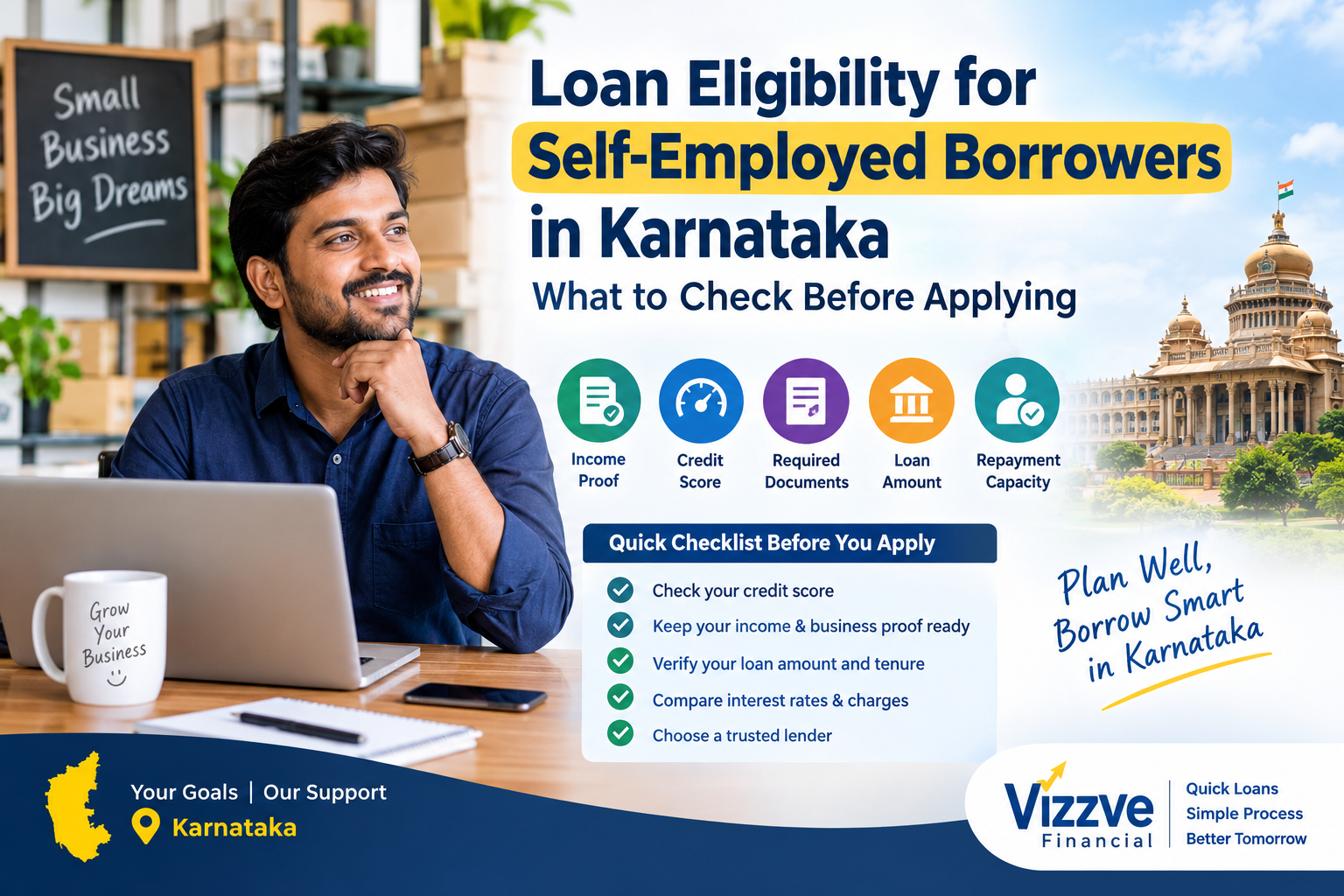
Being self-employed offers independence, flexibility, and the opportunity to grow a business. However, when you need a personal loan, proving your income can sometimes be more complicated than it is for a salaried employee.
If you run a shop in Bengaluru, operate a small business in Mysuru, work as a freelancer in Mangaluru, or provide professional services in another part of Karnataka, lenders may assess your income differently. They generally look at your earnings, financial records, credit history, business stability, and existing repayment commitments.
Understanding loan eligibility for self-employed borrowers in Karnataka before applying can help you prepare the right documents, compare suitable lenders, and avoid unnecessary applications.
The most important thing to remember is that there is no single eligibility formula used by every lender. Minimum income, business vintage, age limits, credit score requirements, interest rates, and documentation can vary by lender and loan product.
This guide explains what to check before applying, how to prepare your finances, and how to make a more informed borrowing decision.
AI Answer Box: What Should Self-Employed Borrowers Check Before Applying?
Self-employed borrowers in Karnataka should check their credit score, average business income, business stability, existing EMIs, bank statements, income tax returns, and required identity and address documents before applying for a personal loan. Lenders may also assess age, repayment capacity, business vintage, and the requested loan amount.
There is no universal minimum income or credit score for every lender. Applicants should compare interest rates, processing fees, repayment terms, and the total borrowing cost before accepting an offer.
1. Understand the Loan Eligibility Criteria
The first step is to understand how lenders evaluate self-employed applicants. Unlike salaried borrowers, who may submit salary slips and employer-issued documents, business owners and freelancers often need to demonstrate their income through financial records.
Who can apply for a personal loan in Karnataka?
Depending on the lender's policy, eligible applicants may include:
-
Small business owners and shopkeepers
-
Freelancers and independent consultants
-
Doctors, architects, lawyers, and other professionals
-
Traders and service providers
-
Sole proprietors and partnership business owners
-
Self-employed individuals operating online businesses
Applicants generally need to satisfy the lender's age, income, credit history, residency, and documentation requirements.
What factors affect self-employed loan eligibility?
|
Eligibility factor |
What lenders may check |
Why it matters |
|---|---|---|
|
Age |
Minimum and maximum age limits |
Determines eligibility under the lender's policy |
|
Income |
Regularity and amount of earnings |
Indicates repayment capacity |
|
Credit score |
Credit history and outstanding debts |
Helps assess credit risk |
|
Business stability |
Business operating history and continuity |
Shows whether income may continue |
|
Bank statements |
Deposits, expenses, and cash flow |
Helps verify financial activity |
|
Existing EMIs |
Current loan obligations |
Indicates how much additional debt you can manage |
|
Documentation |
Identity, address, and income proofs |
Supports identity and financial verification |
Important: Meeting basic eligibility criteria does not guarantee approval. The lender makes the final decision after assessing the complete application.
2. Check Your Credit Score Before Applying
Your credit score is one of the most important financial details to review before submitting a loan application.
A strong credit history can improve your chances of approval and may help you qualify for more favourable terms. A low score, missed payments, or several recent credit applications may make approval more difficult.
According to TransUnion CIBIL, a CIBIL Score is a three-digit number that summarises your credit history. Your credit report provides additional details about loans, credit cards, repayment behaviour, and credit enquiries.
What credit score should self-employed borrowers aim for?
There is no universal score that guarantees a personal loan. Each lender uses its own underwriting criteria.
As a practical preparation step, aim for a score of 750 or above where possible, while remembering that some lenders may consider applicants with lower scores depending on other factors.
Before applying:
-
Review your latest credit report.
-
Check whether existing loans show the correct outstanding balances.
-
Look for incorrectly reported missed payments.
-
Pay overdue amounts where possible.
-
Avoid making several loan applications within a short period.
-
Keep credit card balances under control.
What if your credit score is low?
A low score does not automatically mean that you can never qualify for credit. However, applying repeatedly without addressing the reasons for a low score may make your situation worse.
Instead, check your credit report, correct any genuine errors through the relevant credit bureau or lender, and build a consistent repayment record before applying again.
3. Calculate Your Actual Monthly Income
For self-employed borrowers, business turnover and personal income are not the same thing.
A shop may generate ₹5 lakh in monthly sales, for example, but the owner's earnings after stock purchases, rent, salaries, taxes, and other operating costs may be much lower.
Lenders may evaluate reported income, business profitability, cash flow, and the consistency of earnings. The exact calculation varies by lender and loan product.
How should you calculate income before applying?
Start with these steps:
-
Calculate your average monthly business revenue.
-
Subtract regular operating expenses.
-
Account for taxes and other financial obligations.
-
Review how much income is available for personal use.
-
Estimate the amount you can safely allocate to loan repayments.
Example: Estimating repayment capacity
Suppose a self-employed business owner in Bengaluru has the following monthly finances.
|
Financial detail |
Illustrative amount |
|---|---|
|
Average monthly revenue |
₹2,00,000 |
|
Business operating expenses |
₹1,20,000 |
|
Approximate income before personal tax and other adjustments |
₹80,000 |
|
Existing monthly loan EMIs |
₹15,000 |
|
Amount remaining before personal living costs and other obligations |
₹65,000 |
The remaining ₹65,000 is not automatically available for a new EMI. The borrower still needs to account for household expenses, taxes, savings, irregular business costs, and emergencies.
This example is for illustration only. A lender may calculate eligible income differently.
Why stable income matters more than one good month
Business earnings can fluctuate due to seasonal demand, delayed customer payments, supply costs, or changes in the market.
A lender may therefore review several months of bank statements and, where required, multiple years of tax returns or financial statements.
If your income varies significantly, maintain a realistic monthly budget based on conservative earnings rather than your best-performing month.
4. Keep Your Business and Income Documents Ready
Documentation is another important part of loan eligibility for self-employed borrowers in Karnataka.
Preparing documents in advance can reduce delays caused by missing information or inconsistent records.
What documents may be required?
|
Document category |
Examples |
|---|---|
|
Identity proof |
PAN card and other accepted identity documents |
|
Address proof |
Aadhaar, passport, utility bill, or another accepted document |
|
Bank statements |
Recent statements for the required period |
|
Income proof |
Income tax returns, computation of income, or financial statements |
|
Business proof |
GST registration, Udyam registration, trade licence, or other applicable business records |
|
Professional proof |
Professional registration or licence, where applicable |
|
Existing debt information |
Current loan statements or EMI details, if requested |
The exact list depends on the lender, the applicant's business structure, and the loan product. Not every applicant will need every document listed above.
Why are income tax returns important?
Income tax returns can help demonstrate declared income and provide a record of your financial activity.
Before applying, check that:
-
Your reported income is consistent with the supporting financial records.
-
Your tax returns cover the period requested by the lender.
-
Your PAN and other identification details are accurate.
-
Your bank statements are complete and readable.
-
Your business details match the information on your application.
Never create false income statements or submit altered documents to qualify for a loan. Such actions can result in rejection and may have legal consequences.
5. Review Your Business Stability and Vintage
Business vintage refers to how long a business has been operating.
Some lenders prefer applicants who have run a business or worked independently for a minimum period. The required period differs by lender and product.
What should you check?
-
How long has your business been active?
-
Do you have a consistent record of customer payments?
-
Are your business transactions reflected in your bank statements?
-
Can you provide evidence of your current business activity?
-
Are your business registrations and tax records up to date, where applicable?
What if you recently started your business?
A newer business may have fewer historical records to demonstrate stable income. Some lenders may therefore apply stricter eligibility criteria.
You can prepare by maintaining organised financial records, using appropriate bank accounts for business transactions, and avoiding unnecessary debt while your income becomes more predictable.
Do not assume that a newly established business will qualify or be rejected automatically. Confirm the specific lender's requirements before applying.
6. Calculate Existing EMIs and Your Debt Burden
A lender does not assess a new loan in isolation. Existing personal loans, vehicle loans, business borrowings, and credit card obligations may affect your repayment capacity.
Before applying, list every active credit obligation.
Use a simple debt checklist
How much EMI can you afford?
There is no single EMI-to-income ratio that works for every self-employed borrower. Your safe repayment amount depends on income stability, household expenses, business obligations, and emergency savings.
For example, if a business owner has irregular monthly earnings, a loan that appears affordable during a strong month may become difficult to repay during a slow period.
Practical advice: Choose a repayment amount you can manage using conservative income estimates, not optimistic sales projections.
7. Choose the Right Loan Amount and Tenure
Borrowing more than you need can increase the total interest paid. Choosing a very short tenure can also create an unnecessarily high EMI.
Your goal should be to find a balance between monthly affordability and total borrowing cost.
How loan tenure affects repayment
Consider an illustrative personal loan of ₹3,00,000 at an annual interest rate of 15%, assuming a fixed rate, monthly repayments, and no fees.
|
Repayment tenure |
Approximate monthly EMI |
Approximate total interest |
|---|---|---|
|
12 months |
₹27,075 |
₹24,900 |
|
24 months |
₹14,546 |
₹49,100 |
|
36 months |
₹10,400 |
₹74,400 |
Figures are rounded estimates, not lender quotations. Actual amounts may differ due to rounding, repayment dates, fees, and lender-specific calculations.
The comparison illustrates an important trade-off: a longer tenure reduces the monthly EMI but generally increases the total interest paid.
What should you consider before selecting a tenure?
-
Your average monthly take-home income
-
Seasonal changes in business earnings
-
Existing EMIs and financial commitments
-
The total interest payable
-
Processing fees and other charges
-
Your plans for business investment or household expenses
Use an EMI calculator to compare different loan amounts, rates, and tenures before making a decision.
8. Compare Lenders Before Submitting an Application
Not every lender offers the same terms to self-employed applicants. Comparing options helps you identify a loan that suits your financial profile.
What should you compare?
|
Comparison point |
What to look for |
|---|---|
|
Eligibility |
Income, age, business vintage, and credit criteria |
|
Interest rate |
Whether the rate is fixed or variable, where applicable |
|
Annual Percentage Rate (APR) |
The overall annualised cost of borrowing |
|
Processing fees |
Charges payable for processing the application |
|
Repayment tenure |
Available repayment periods |
|
Late-payment charges |
Applicable charges and their calculation |
|
Foreclosure terms |
Conditions and charges, if any |
|
Disbursal process |
Verification requirements and expected timeline |
|
Customer support |
Grievance contact details and complaint process |
Understand the Key Facts Statement
The Reserve Bank of India has established requirements for a Key Facts Statement (KFS) for applicable retail and MSME term loans. The statement helps borrowers understand important loan terms, including the Annual Percentage Rate and relevant charges.
Read the KFS and loan agreement before accepting an offer. Check the repayment schedule, total cost, fees, and applicable conditions instead of choosing a loan based only on the advertised interest rate.
9. Check Whether the Lender and Digital Loan Platform Are Legitimate
Online loan applications can be convenient, but convenience should not replace verification.
The RBI's Digital Lending Directions, 2025 set out requirements for regulated entities and their digital lending arrangements, including borrower protection and transparency measures. The RBI also provides a public directory to help consumers verify claims about digital lending apps and their association with regulated entities.

Safety checks before applying
-
Verify the actual bank or non-banking financial company (NBFC) providing the loan.
-
Check the platform's relationship with that lender.
-
Read the privacy policy and consent requests.
-
Review the KFS and loan agreement.
-
Never share your OTP, UPI PIN, or banking password with another person.
-
Be cautious of guaranteed-approval promises.
-
Avoid paying unexplained upfront charges to individuals claiming they can guarantee approval.
-
Save copies of your application, sanction letter, and repayment schedule.
For digital loans, applicable RBI rules require clear disclosure of the loan's overall cost and other important terms. Review the relevant documents carefully before accepting credit.
10. Common Mistakes to Avoid Before Applying
Even a financially stable borrower can face delays or rejection if an application contains errors.
Mistake 1: Reporting business turnover as personal income
High sales do not necessarily mean high disposable income. Provide accurate financial information and supporting documents.
Mistake 2: Ignoring your credit report
An error or overdue account can affect the lender's assessment. Review your report before applying.
Mistake 3: Applying to several lenders at once
Multiple formal applications can lead to several credit enquiries. Research your options and prioritise suitable lenders before submitting applications.
Mistake 4: Borrowing more than necessary
A larger loan means a larger repayment obligation. Borrow only what you need and can reasonably repay.
Mistake 5: Submitting incomplete documents
Missing bank statements, inconsistent business details, or unreadable documents can delay verification.
Mistake 6: Accepting the first offer without comparing costs
A low advertised rate may not reflect the full borrowing cost. Compare the APR, fees, tenure, and other conditions.
Mistake 7: Ignoring irregular income
A self-employed person should plan for slow business periods and unexpected expenses before committing to a fixed monthly EMI.
11. Step-by-Step Guide: How to Prepare for a Loan Application
Follow this checklist before submitting a personal loan application in Karnataka.
Step 1: Review your eligibility
Check the lender's age, income, credit score, and business vintage requirements.
Step 2: Calculate your income
Review business profits, bank deposits, expenses, taxes, and current EMIs.
Step 3: Organise your documents
Prepare identity proof, address proof, income records, bank statements, and business documents as required.
Step 4: Calculate a manageable EMI
Compare different loan amounts and tenures using conservative income estimates.
Step 5: Compare suitable lenders
Review interest rates, APR, fees, repayment conditions, and customer support.
Step 6: Read the offer before accepting
Verify the lender, review the KFS and agreement, and proceed only if the terms are affordable.
12. Pros and Cons of Preparing Before Applying
|
Advantages |
Limitations |
|---|---|
|
Helps identify missing documents early |
Gathering financial records can take time |
|
Makes it easier to estimate an affordable EMI |
Income calculations may differ from the lender's assessment |
|
Helps you compare total borrowing costs |
Different lenders may use different eligibility criteria |
|
Can reduce avoidable application errors |
Preparation cannot guarantee approval |
|
Encourages safer borrowing decisions |
Improving credit history may take time |
Preparation does not eliminate every obstacle, but it helps you make a more informed application and avoid preventable mistakes.
13. Real-World Examples for Self-Employed Borrowers in Karnataka
The following scenarios are illustrative examples, not actual customer testimonials or guarantees of approval.
Example A: A retail shop owner in Bengaluru
A shop owner earns revenue from daily sales but has changing inventory costs and seasonal demand.
Before applying, the owner organises business bank statements, reviews tax returns, calculates average earnings, and estimates how much can be paid toward an EMI during a slower month.
Lesson: Stable documentation and realistic income estimates can help the lender assess the business more clearly.
Example B: A freelancer in Mysuru
A freelance designer receives payments from multiple clients. Some months are profitable, while others have fewer projects.
The freelancer prepares invoices, bank statements, and tax records, where available, and checks the lender's requirements for demonstrating independent income.
Lesson: A clear financial trail can help explain irregular earnings.
Example C: A professional service provider in Mangaluru
A consultant has an established business but already pays EMIs on a vehicle loan.
Before applying for additional credit, the consultant reviews the existing repayment schedule, household expenses, and available monthly cash flow.
Lesson: Business stability is important, but the new EMI must also fit the borrower's existing financial commitments.
These examples reflect common financial planning considerations. Actual eligibility depends on the individual applicant and the lender's policies.
14. Expert Commentary: What Makes a Strong Self-Employed Loan Application?
A strong loan application is not simply about having a high income. It is about demonstrating that your income is reliable enough to support the proposed repayment schedule.
From a financial planning perspective, self-employed applicants should focus on three areas:
-
Income transparency: Keep your business earnings, expenses, and declared income properly documented.
-
Credit discipline: Pay existing EMIs and credit card bills on time, and avoid borrowing beyond your capacity.
-
Repayment sustainability: Make sure you can afford the EMI even when business earnings temporarily decline.
The RBI's Key Facts Statement framework is designed to help borrowers understand the cost and terms of eligible loans before entering into a contract. Reviewing these details is an important part of responsible borrowing.
These are general financial education principles, not a guarantee of loan approval or a substitute for advice based on your individual financial circumstances.
15. Key Takeaways
Frequently Asked Questions (FAQs)
1. What is the eligibility for a personal loan for self-employed borrowers in Karnataka?
Eligibility generally depends on age, income, credit history, business stability, existing financial obligations, and the lender's documentation requirements. Criteria vary between lenders.
2. Can a self-employed person apply for a personal loan in Bengaluru?
Yes. Self-employed applicants living or operating businesses in Bengaluru can apply if they meet the selected lender's requirements. Approval depends on the individual application and the lender's assessment.
3. What is the minimum income required for a self-employed personal loan?
There is no universal minimum income for all lenders. The required amount depends on the lender, loan product, requested amount, existing EMIs, and other eligibility factors.
4. What credit score is required for a personal loan?
Requirements differ by lender. A score of 750 or above is a useful target when preparing to apply, but it does not guarantee approval, and some lenders may consider other credit profiles.
5. Which documents are required for self-employed loan applicants?
Commonly requested documents include PAN, accepted identity and address proof, bank statements, income tax returns, and business or professional records. The exact list varies by lender.
6. Can freelancers apply for personal loans in Karnataka?
Yes, depending on the lender's eligibility criteria. Freelancers may be asked to provide bank statements, invoices, tax returns, contracts, or other evidence of income.
7. Can I get a personal loan if my business income changes every month?
Possibly. Lenders may assess income over a period rather than relying on one month's earnings. Clear financial records and affordable existing debt obligations can help demonstrate repayment capacity.
8. Does business vintage affect loan eligibility?
Yes, it can. Some lenders require the business to have operated for a minimum period. The required business vintage varies according to the lender and loan product.
9. Can I apply if I already have an existing loan?
Yes, if you meet the lender's criteria. However, your existing EMIs and other debt obligations may reduce the amount you can reasonably borrow.
10. How can I improve my loan eligibility before applying?
Review your credit report, make repayments on time, organise income documents, reduce excessive debt where feasible, and apply for an amount that fits your repayment capacity.
11. Is GST registration compulsory for a self-employed personal loan?
Not necessarily. GST registration requirements depend on the nature of the business and applicable rules. Whether a lender requires GST documents also depends on its policy and the applicant's business circumstances.
12. Can I apply for a loan without income tax returns?
Some lenders may accept alternative income documentation in certain circumstances, while others require tax returns. Confirm the specific lender's policy before applying, and provide only accurate financial information.
13. Does checking my own CIBIL Score reduce it?
No. Checking your own CIBIL Score does not reduce it. However, formal applications for new credit may generate lender enquiries that can affect your credit profile.
14. How do I check whether an online lending platform is safe?
Verify the actual regulated lender, its relationship with the platform, the applicable loan disclosures, and the privacy policy. Check the RBI's digital lending resources where relevant, and never share your OTP or banking password.
15. Does meeting all eligibility requirements guarantee loan approval?
No. Meeting stated requirements makes you eligible to be considered, but the lender may conduct additional verification and assess repayment capacity before making a decision.
Conclusion: Prepare Before You Apply
Understanding loan eligibility for self-employed borrowers in Karnataka can make the borrowing process more organised and transparent. Whether you are a shop owner in Bengaluru, a freelancer in Mysuru, a consultant in Mangaluru, or a small business owner elsewhere in the state, the same principle applies: prepare your financial records, understand your repayment capacity, and compare loan terms carefully.
Before applying, review your credit score, calculate your average income, check your existing EMIs, and organise your documents. Read the lender's terms carefully and choose a repayment schedule that remains manageable even during slower business periods.
Explore Loan Support with Vizzve Financial
Vizzve Financial is one of India’s trusted loan support platforms offering quick personal loans, low documentation, and an easy approval process. Apply at www.vizzve.com.
Explore the available options, review the applicable eligibility criteria, and check all loan terms before proceeding. Approval, interest rates, documentation, and disbursal depend on the applicable lender and its assessment.
Internal and External Linking Suggestions
Internal links
Add relevant links to other articles on your website to help readers explore related subjects.
|
Suggested anchor text |
Recommended destination |
|---|---|
|
Personal loan eligibility for self-employed borrowers |
Your self-employed eligibility guide |
|
Documents required for a personal loan |
Your loan documentation article |
|
How to improve your credit score |
Your credit score guide |
|
Personal loan EMI calculation |
Your EMI calculator or repayment guide |
|
Personal loan safety checklist |
Your digital lending safety article |
|
Benefits and limitations of personal loans |
Your loan comparison article |
Use the actual published URLs when adding these links. Avoid creating links to pages that do not exist.
External links
The following authoritative resources can support the article's financial and regulatory information.
-
Reserve Bank of India — Official RBI website for regulatory updates and borrower information.
-
TransUnion CIBIL — Official CIBIL website for credit score and credit report information.
-
Ministry of MSME — Official MSME website for business-related information.
Schema Markup: BlogPosting + FAQPage
Add the following JSON-LD to the page template or the article's structured-data field. Replace the example URL, publication dates, and author or publisher details with accurate information from the live website before publishing.
Published on : 22nd October 2026
Published by : Shanlee JV
www.vizzve.com || www.vizzveservices.com
Follow us on social media: Facebook || Linkedin || Instagram
🛡 Powered by Vizzve Financial
RBI-Registered Loan Partner | 10 Lakh+ Customers | ₹600 Cr+ Disbursed