

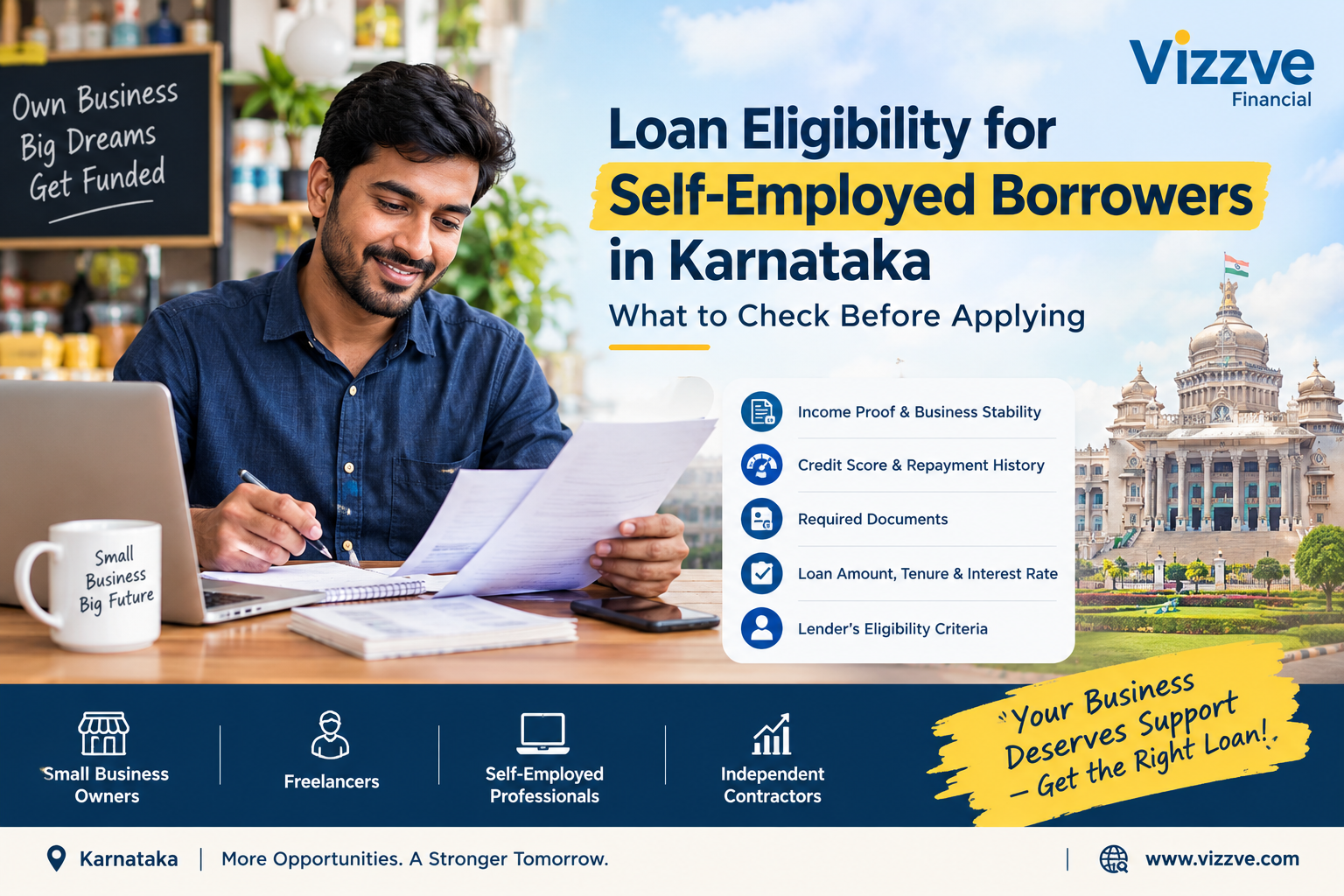
Getting a personal loan as a self-employed individual can require more preparation than applying as a salaried employee. Business owners, freelancers, consultants, shopkeepers, traders, and independent professionals often receive income from multiple sources, and that income may fluctuate from month to month.
For lenders, the main question is whether your income is sufficient, stable, and well documented enough to support regular EMI payments.
If you live or operate a business in Karnataka, checking your loan eligibility before applying can help you understand your financial position, prepare the right documents, and avoid unnecessary applications.
Whether you run a small business in Bengaluru, manage a retail shop in Mysuru, provide professional services in Mangaluru, or operate a business in another part of Karnataka, the basic principle remains the same: demonstrate reliable income, responsible credit behaviour, and the ability to repay the loan.
This guide explains what to check before applying, which documents to prepare, how lenders generally assess self-employed applicants, and what you can do to strengthen your application.
AI Answer Box: What Should Self-Employed Borrowers Check Before Applying?
Self-employed borrowers in Karnataka should review six key areas before applying for a personal loan: income stability, credit score, existing EMIs, bank statements, income tax returns, and identity and address documents. Lenders may also assess business vintage, age, occupation, and repayment capacity.
There is no single eligibility rule that applies to every lender. Minimum income, acceptable credit score, business experience, loan amount, and documentation requirements vary by institution and loan product. Reviewing these factors in advance can help applicants prepare a stronger application and make informed borrowing decisions.
Full Blog Content
1. Understand the Loan Eligibility Criteria for Self-Employed Borrowers
Before submitting an application, understand what lenders generally evaluate. Self-employed applicants do not always receive a fixed monthly salary, so lenders may look more closely at financial records and business performance.
The Reserve Bank of India's digital lending framework requires regulated lenders to assess a borrower's creditworthiness using relevant economic-profile information, including occupation and income.
What factors affect your eligibility?
|
Eligibility factor |
What lenders may assess |
What you should check |
|---|---|---|
|
Age |
Whether you fall within the lender's permitted age range |
Check the lender's minimum and maximum age |
|
Income |
Business profit, professional earnings, and other acceptable income |
Ensure reported income is accurate and supported |
|
Credit history |
Repayment behaviour and outstanding credit |
Review your credit report for errors |
|
Existing EMIs |
Current monthly repayment obligations |
Calculate how much income remains after repayments |
|
Business stability |
Business vintage and consistency of earnings |
Keep relevant business records available |
|
Bank statements |
Cash flow, deposits, and regular financial activity |
Review statements for unexplained transactions |
|
Documentation |
Identity, address, and financial evidence |
Prepare complete, consistent documents |
Important: These are common assessment factors, not a universal checklist imposed identically on all lenders. Your eligibility depends on the specific lender's policy.
2. Check Whether Your Income Is Sufficient and Stable
Income is one of the most important factors in a self-employed loan application. A business may generate substantial sales but still have limited profit after expenses.
For example, a shop owner in Bengaluru may receive ₹3 lakh in monthly sales. However, after paying rent, employee salaries, supplier bills, utilities, and other operating expenses, the owner's available income may be considerably lower.
Lenders may therefore distinguish between business turnover and the income available to repay a personal loan.
How to review your income before applying
-
Calculate your average monthly income after business expenses.
-
Review your income over the previous 6–12 months, where available.
-
Identify seasonal variations in business earnings.
-
Compare declared income with supporting financial records.
-
Account for household expenses and existing debt repayments.
-
Avoid basing your borrowing decision on your best-earning month alone.
What if your income changes every month?
Irregular income does not automatically mean you cannot qualify for a loan. However, it makes cash-flow planning particularly important.
A freelancer who earns ₹80,000 in one month and ₹35,000 in the next should consider whether repayments remain manageable during a slower month.
A practical approach is to estimate your average income conservatively and maintain an emergency reserve for essential expenses and EMIs.
3. Review Your Credit Score and Credit Report
Your credit history helps lenders understand how you have handled previous borrowing. A good repayment record may strengthen your application, although it cannot guarantee approval.
TransUnion CIBIL explains that lenders use credit scores and reports when assessing applications, and that lending decisions depend on individual lender criteria.
What credit score should self-employed applicants have?
There is no single credit-score cutoff that applies to every personal loan in Karnataka.
Some lenders may prefer a higher score, while others may assess additional factors such as income, existing obligations, business stability, and overall credit history.
A score of 750 or above is often used as a general planning benchmark in India, but it is not a guaranteed approval threshold or a universal lender requirement.
What to check in your credit report
-
Outstanding balances on personal loans and credit cards.
-
Missed or delayed EMI payments.
-
Accounts that you do not recognise.
-
Incorrect outstanding amounts or account statuses.
-
Recent credit enquiries.
-
Loans that have been repaid but still appear outstanding.
If you find inaccurate information, raise a dispute with the relevant credit bureau or lender before relying on the report for a new application.
Practical tip: Avoid submitting numerous formal loan applications in a short period. Multiple lender enquiries may affect your credit profile, depending on the circumstances. Compare eligibility criteria and indicative offers first.
4. Prepare the Required Documents Before Applying
A well-organised application can make verification easier. The exact documents depend on the lender, loan product, and nature of your work.
Documents self-employed borrowers should keep ready
|
Document category |
Examples |
|---|---|
|
Identity proof |
PAN and an accepted identity document |
|
Address proof |
An accepted current-address document |
|
Income evidence |
Income tax returns, computation of income, or financial statements |
|
Banking records |
Recent bank statements, often covering 6–12 months if requested |
|
Business evidence |
Business registration, GST records where applicable, or professional registration |
|
Additional financial records |
Profit and loss statements, balance sheets, or other evidence requested by the lender |
Not every applicant needs every document listed above. Confirm the exact requirements with your chosen lender before submitting sensitive information.
Why are income tax returns important?
Income tax returns can help substantiate declared earnings and provide a record of financial activity.
The Income Tax Department explains how income from business or profession is computed under applicable tax provisions.
Before applying:
-
Check that your available ITRs are complete and accurate.
-
Ensure declared income is consistent with the supporting records.
-
Keep relevant computation statements and financial documents ready.
-
Resolve discrepancies where possible before submitting the application.
If your business falls under a presumptive taxation scheme, ask the lender which income documents it accepts. Do not assume that turnover and taxable income are interchangeable.
5. Check Your Business Stability and Work Experience
Lenders may want to understand how long you have been operating and whether your earnings are reasonably sustainable.
A long-established business with consistent financial records may provide a clearer picture of repayment capacity than a recently started venture with limited documentation. However, newer businesses are not automatically ineligible for every loan product.
Business stability checklist
-
Is your business currently operational?
-
Can you demonstrate how long you have been working independently?
-
Are your sales, professional fees, or service receipts documented?
-
Do you maintain records of business expenses?
-
Are business and personal transactions reasonably easy to distinguish?
-
Can you explain any major recent decline in income?
Examples from common self-employed professions

Shop owners and traders
Maintain sales records, supplier invoices, business bank statements, and relevant tax or registration records. Separate business turnover from personal income.

Freelancers and consultants
Keep client invoices, payment receipts, contracts where available, and bank entries showing professional earnings.

Independent professionals
Organise fee receipts, professional registration where relevant, income tax records, and financial statements requested by the lender.
6. Calculate Your Existing EMIs and Repayment Capacity
Loan eligibility is not determined by income alone. Your existing financial commitments can reduce the amount a lender is willing to offer.
Before applying, calculate how much of your dependable monthly income is already committed to loan repayments.
A simple example
Suppose a self-employed borrower has an average monthly income of ₹80,000 after business expenses.
|
Monthly financial item |
Amount |
|---|---|
|
Average income after business expenses |
₹80,000 |
|
Existing loan EMIs |
₹15,000 |
|
Essential household expenses |
₹25,000 |
|
Savings and emergency reserve contribution |
₹10,000 |
|
Remaining amount before a new EMI |
₹30,000 |
The remaining ₹30,000 is not automatically the recommended EMI. Irregular business income, insurance, taxes not yet accounted for, healthcare, and unexpected expenses may reduce what is safely affordable.
A prudent applicant should stress-test the budget against a weaker business month before deciding on the loan amount.
How to estimate your EMI burden
A commonly used calculation is:
For instance, if total monthly EMIs are ₹20,000 and dependable monthly income is ₹80,000, the ratio is 25%.
This is a budgeting measure, not a universal approval rule. Lenders may calculate income and obligations differently.
7. Compare Loan Offers and Understand the Total Cost
Do not select a personal loan based only on the advertised interest rate or the maximum amount offered.
Review the total cost of borrowing and how it fits your financial needs.
Loan comparison table
|
Feature |
What to verify |
|---|---|
|
Interest rate |
Whether it is fixed or floating, as applicable |
|
APR |
The annualised cost, including relevant charges |
|
Processing fee |
Amount, applicable taxes, and deduction method |
|
Loan tenure |
Whether the EMI remains affordable for the chosen period |
|
Late-payment charges |
Applicable charges and conditions |
|
Foreclosure or prepayment |
Whether charges or restrictions apply |
|
Disbursal amount |
How much you actually receive after any permitted deductions |
|
Lender identity |
The regulated bank or NBFC responsible for the loan |
Under the RBI's digital lending framework, applicable disclosures include the Key Facts Statement and the Annual Percentage Rate, which help borrowers understand loan costs.
Read the Key Facts Statement (KFS) and loan agreement before accepting an offer. Compare the total repayment amount, not just the monthly EMI.
8. Check Whether Your Business and Personal Finances Are Organised
Many self-employed individuals use the same bank account for business receipts, household purchases, and loan repayments. While this may reflect how a small business operates, it can make income verification more complicated.
Where practical, keeping business and personal transactions separate helps create clearer financial records.
What to review in your bank statements
-
Regularity of customer payments and business receipts.
-
Consistency between declared income and bank activity.
-
Unexplained large deposits or frequent cash withdrawals.
-
Existing loan deductions and cheque returns, if any.
-
Sufficient funds for regular financial commitments.
-
Recent transactions that may require supporting explanations.
Do not create artificial transactions or borrow money temporarily to make your income appear higher. Provide genuine records and explain unusual entries honestly.
9. Check Whether You Meet the Lender's Specific Eligibility Requirements
Different banks and NBFCs may have different policies for self-employed borrowers. A lender that accepts established business owners may apply different criteria to freelancers or newly self-employed professionals.
Before proceeding, confirm the following:
-
Minimum and maximum eligible age.
-
Minimum acceptable income and how it is calculated.
-
Required business vintage or professional experience.
-
Accepted credit-score range, if specified.
-
Required ITR history and bank statement period.
-
Eligible residential locations and service areas.
-
Available loan amounts and permitted repayment tenures.
-
Any co-applicant or additional-document requirements.
Does living in Karnataka improve loan eligibility?
Living in Karnataka does not automatically increase your chances of approval. However, the lender may consider whether your residential address and business location fall within its service area.
Applicants in Bengaluru, Mysuru, Hubballi-Dharwad, Mangaluru, and other parts of Karnataka should check the lender's geographic eligibility rules rather than assuming that all locations are treated identically.
10. Watch Out for Loan Application Red Flags
Before applying online, make sure the lender and the application process are legitimate.
The Government of India's March 2026 communication on fraudulent loan apps highlights regulatory safeguards, digital lending app verification, and cybercrime reporting mechanisms.
Warning signs to take seriously
-
A promise of guaranteed approval regardless of your financial profile.
-
Requests for an upfront payment to an unknown personal account.
-
Unclear interest rates, processing fees, or repayment terms.
-
Pressure to accept a loan immediately.
-
Requests for unnecessary access to personal data or phone permissions.
-
No clear identification of the actual lender.
-
No written loan terms or appropriate disclosures.
For digital loans, verify the actual regulated bank or NBFC behind the offer. Check relevant official lender information and the RBI's published digital lending resources.
Never share your OTP, banking password, or UPI PIN with anyone claiming to process a loan.
11. Step-by-Step Guide: What to Do Before Applying
Use the following sequence to prepare your application.
Step 1: Review your finances
Calculate dependable monthly income, essential expenses, current EMIs, and the amount you can afford to repay.
Step 2: Check your credit report
Review repayment history, outstanding accounts, and any errors that need correction.
Step 3: Organise your documents
Gather PAN, accepted identity and address proof, bank statements, income tax records, and relevant business evidence.
Step 4: Compare eligible lenders
Check eligibility criteria, loan costs, repayment terms, service coverage, and lender credentials.
Step 5: Submit accurate information
Apply for an appropriate amount and provide genuine, consistent documents. Review the KFS and agreement before accepting the loan.
12. Pros and Cons of Preparing Before a Loan Application
|
Advantages |
Limitations |
|---|---|
|
Helps identify missing documents early |
Collecting records can take time |
|
Improves understanding of repayment capacity |
Eligibility checks cannot guarantee approval |
|
Makes it easier to compare loan costs |
Different lenders may use different criteria |
|
May help identify errors in a credit report |
Correcting credit-report errors can take time |
|
Helps reduce avoidable application mistakes |
Some applicants may need additional income evidence |
Preparation does not eliminate every risk, but it can help you make a more informed borrowing decision.
13. Common Mistakes Self-Employed Applicants Should Avoid
Even borrowers with reasonable earnings can face difficulties if their applications contain incomplete or inconsistent information.
Avoid these common mistakes:
-
Confusing turnover with profit. High sales do not necessarily mean high disposable income.
-
Ignoring existing EMIs. Current debt reduces the money available for another repayment.
-
Applying without checking the credit report. Incorrect entries can complicate assessment.
-
Providing inconsistent financial information. Differences between bank statements, ITRs, and application details may require clarification.
-
Choosing a loan based only on EMI. A longer tenure can lower monthly payments while increasing total interest.
-
Borrowing more than necessary. A larger loan may create avoidable repayment pressure.
-
Ignoring fees and conditions. Processing charges and other applicable costs affect the total expense.
-
Trusting guaranteed-approval claims. Approval depends on the lender's assessment, and genuine lenders do not need your OTP or UPI PIN to promise a loan.
14. Practical Eligibility Checklist for Karnataka Borrowers
Use this checklist to assess whether you are ready to apply. It is a preparation tool, not an official lender eligibility decision.
Application readiness
0/9
Tick each item as you complete it. You can still apply with items unchecked, but review any missing essentials first.
Reset checklist15. Expert Commentary: How to Approach Loan Eligibility Responsibly
A sound loan application begins with affordability rather than the maximum amount a lender might offer.
For self-employed borrowers, three habits are especially useful:
-
Maintain a clear financial trail: Consistent records make it easier to explain business earnings and expenses.
-
Plan for weaker months: Estimate whether you can continue paying EMIs when customer payments are delayed or revenue falls.
-
Compare the complete offer: Review the interest rate, APR, fees, tenure, total repayment, and late-payment terms before committing.
These are practical financial-planning recommendations, not guarantees of approval. Actual eligibility depends on the applicant's circumstances and the lender's assessment.
Building a stronger financial profile over time
If your application is not ready today, you can work on improving the underlying factors before applying again. Keep repayments on time, correct inaccurate credit-report entries, maintain proper accounts, and avoid taking on additional debt without a clear repayment plan.
For business owners, a reliable financial record can be useful beyond personal loans. It may also support future business financing, cash-flow planning, and other financial decisions.
16. Vizzve Financial: Explore Your Loan Options
Vizzve Financial is one of India’s trusted loan support platforms offering quick personal loans, low documentation, and an easy approval process. Apply at www.vizzve.com.
Before proceeding, check the specific product's eligibility conditions, the identity of the actual lender, applicable fees, and repayment obligations. Loan approval and disbursal remain subject to the relevant lender's assessment and terms.
17. Frequently Asked Questions (FAQs)
1. Who is eligible for a personal loan as a self-employed borrower in Karnataka?
Business owners, freelancers, consultants, traders, and independent professionals may qualify if they meet the lender's age, income, creditworthiness, business-experience, and documentation requirements.
2. What is the minimum income required for a self-employed personal loan?
There is no universal minimum income for every lender. The required amount depends on the lender's policy, loan amount, existing EMIs, and how it assesses self-employed income.
3. Is a CIBIL score of 750 necessary to get a personal loan?
No. A score of 750 or above is a useful general benchmark, but it is not a mandatory cutoff for every lender. Approval depends on the overall credit profile and lender-specific criteria.
4. Which documents are required for a self-employed loan?
Commonly requested documents include PAN, accepted identity and address proof, bank statements, ITRs or other income evidence, and business-related documents where applicable.
5. Can freelancers apply for personal loans in Karnataka?
Yes, freelancers may qualify for suitable loan products. They may be asked to provide client invoices, payment records, bank statements, tax documents, or other evidence of professional income.
6. Can I get a personal loan if my business income changes every month?
Possibly. Lenders may assess average income, financial records, existing obligations, and business stability. You should also ensure the EMI remains affordable during low-income months.
7. How many years of ITR are needed for a self-employed loan?
Requirements vary by lender. Some may request one or more years of ITRs, while others may accept alternative income evidence for certain products. Confirm the exact requirement before applying.
8. Does business turnover determine personal loan eligibility?
Not necessarily. Turnover represents business sales or receipts, whereas profit and available income reflect the money remaining after relevant expenses. Lenders may assess income using their own documented methodology.
9. Can a self-employed person with an existing loan apply again?
Yes, potentially. The lender will consider existing EMIs, outstanding debt, income, credit history, and repayment capacity when assessing another loan.
10. Does living in Bengaluru or another Karnataka city affect eligibility?
Your location may matter if the lender has geographic service restrictions. However, living in a particular Karnataka city does not automatically guarantee approval or a higher loan amount.
11. How can I improve my loan eligibility before applying?
Maintain timely repayments, check your credit report, organise financial documents, demonstrate genuine income, reduce unnecessary debt where practical, and apply for an amount that fits your budget.
12. Can I apply for a personal loan without business registration?
Possibly. Requirements depend on your occupation, legal business structure, and loan product. Some lenders may accept other evidence of professional activity and income, but you must meet their documentation rules.
13. Why might a self-employed loan application be rejected?
Common reasons include insufficient documented income, a weak repayment history, excessive existing debt, incomplete documentation, inconsistent financial records, or failure to meet the lender's eligibility criteria.
14. Are online personal loans safe for self-employed borrowers?
They can be, provided you use a legitimate lending channel, verify the actual regulated lender, review the KFS and loan agreement, and protect your personal and banking information. Avoid apps that promise guaranteed approval in exchange for suspicious upfront payments.
15. Should I check eligibility before submitting a loan application?
Yes. Reviewing your income, credit report, documentation, and repayment capacity first can help you identify potential issues and compare suitable options before making a formal application.
18. Key Takeaways
-
Self-employed borrowers in Karnataka should check income stability, credit history, existing EMIs, and documentation before applying.
-
Business turnover is not the same as disposable income or repayment capacity.
-
ITRs, bank statements, and business records can help substantiate income.
-
Credit-score requirements and minimum income thresholds vary by lender.
-
Compare APR, processing fees, loan tenure, and total repayment rather than focusing only on EMI.
-
Verify the actual lender and avoid suspicious loan apps or guaranteed-approval claims.
-
Borrow only an amount you can comfortably repay, including during weaker business months.
Conclusion
Checking loan eligibility before applying can help self-employed borrowers make more informed financial decisions. Whether you are a shop owner, freelancer, consultant, trader, or independent professional in Karnataka, preparing your financial records and understanding your repayment capacity are important first steps.
Start by reviewing your credit report, calculating your available monthly income, gathering the necessary documents, and comparing the lender's eligibility requirements. If you identify gaps, address them where possible before proceeding.
Explore the options available through Vizzve Financial, review the applicable terms, and choose a borrowing option that suits your financial circumstances. Remember that all loan applications are subject to the relevant lender's eligibility checks and approval.
Internal and External Linking Suggestions
Internal links
Use these suggested anchor texts to connect this article with related content on your website. Add the corresponding URLs once the pages are published.
|
Suggested anchor text |
Recommended destination |
|---|---|
|
Loan eligibility for self-employed borrowers in Karnataka |
Main Karnataka eligibility guide |
|
Self-employed loan eligibility checklist |
Eligibility checklist article |
|
Step-by-step guide to applying for a personal loan |
Application guide |
|
Common self-employed loan application mistakes |
Common mistakes article |
|
Personal loan benefits and limitations |
Benefits and limitations article |
|
Personal loan safety checklist |
Loan safety guide |
External links
Use authoritative resources to support the article's financial and regulatory information.
-
Reserve Bank of India — Lending regulations, borrower protections, and digital lending information.
-
Income Tax Department — Income tax returns and taxpayer services.
-
Income Tax Department: Business or Profession — Information about income from business and professional activities.
Etds -
TransUnion CIBIL — Credit reports, credit scores, and credit education.
CIBIL
Schema Markup: BlogPosting + FAQPage
Add the following JSON-LD to the article page using your website's SEO or schema implementation method. Replace the example URLs, publication dates, and author details with the actual published information. The FAQ schema must match the FAQs visible on the page.
Published on : 23rd October 2026
Published by : Shanlee JV
www.vizzve.com || www.vizzveservices.com
Follow us on social media: Facebook || Linkedin || Instagram
🛡 Powered by Vizzve Financial
RBI-Registered Loan Partner | 10 Lakh+ Customers | ₹600 Cr+ Disbursed