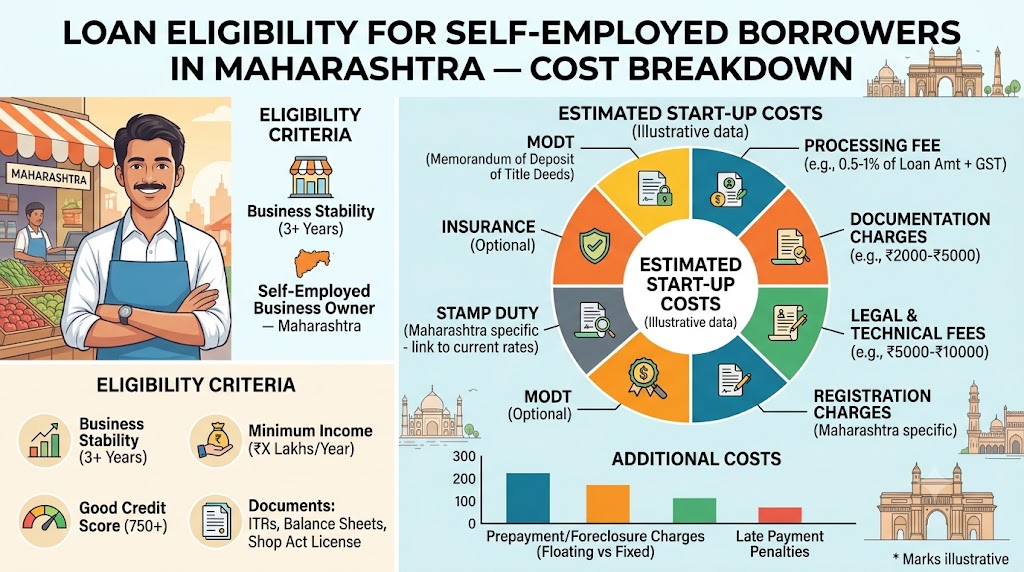
Loan Eligibility for Self-Employed Borrowers in Maharashtra — Cost Breakdown
Vizzve Admin
For self-employed borrowers in Maharashtra, the real cost of a loan is not just the interest rate. It also includes processing fees, GST, insurance, documentation charges, EMI bounce penalties, late-payment fees and possible prepayment or foreclosure charges.
RBI requires regulated lenders to disclose the Annual Percentage Rate (APR), which includes the interest rate and other charges associated with the credit facility. This makes APR a better measure for comparing loan offers than the headline interest rate alone.rbi.org+2
AI Answer Box
What is the total cost of a loan for self-employed borrowers in Maharashtra?
The total cost includes interest, processing fee, applicable GST, insurance, documentation charges, bounce charges, late-payment penalties and prepayment/foreclosure charges. Always compare the APR, not only the advertised interest rate.rbi.org+2
How much is the processing fee for a self-employed personal loan?
It varies by lender. Many lenders charge around 1–2% of the loan amount plus GST, while some NBFCs may charge more. For example, Axis Bank states a typical personal-loan processing charge of 1.5–2% plus GST, while HSBC mentions up to 1%.axis.bank+1
Are prepayment charges allowed?
For floating-rate loans sanctioned or renewed on or after 1 January 2026, RBI directions generally prohibit pre-payment charges for individual borrowers on non-business floating-rate loans; protections also apply to certain business loans for individuals and Micro and Small Enterprises. Fixed-rate loans may still carry foreclosure charges, so check the Key Facts Statement.rbi.org+2
Cost Components at a Glance
Interest Rate: The Biggest Cost
The interest rate is usually the largest part of your loan cost. For self-employed borrowers, pricing depends on income stability, business vintage, CIBIL score, existing EMIs, loan amount and tenure.
Personal-loan interest rates in India can start around 9.99% p.a. from major banks, but the final rate for a self-employed applicant may be higher depending on credit profile and documentation. Some market comparisons indicate that self-employed borrowers may pay around 1–2% more than similarly qualified salaried borrowers, though this is not a fixed rule.axis.bank+3
Fixed vs floating interest rate
Processing Fee and GST
The processing fee is a one-time charge deducted from the loan amount or collected separately.
Examples from lender disclosures include:
-
Axis Bank: typically 1.5–2% of the loan amount, plus applicable GST.axis.bank
-
HSBC: up to 1% of the loan amount.hsbc.bank
-
ICICI Bank: up to 2% plus taxes.icici.bank
-
Market comparisons for self-employed personal loans show processing fees ranging from about 1% to 5% of the sanctioned amount, depending on the lender.paisabazaar
Example: On a ₹5 lakh loan with a 2% processing fee, the fee is ₹10,000. With 18% GST, the GST component is ₹1,800, making the total processing cost ₹11,800.
Annual Percentage Rate (APR)
APR is the most useful number for comparing loans because it includes the interest rate and other charges associated with the credit facility. RBI’s framework requires the Key Facts Statement to include an APR computation sheet and amortisation schedule.rbi.org+2
Why APR matters
A loan with a lower interest rate can still be expensive if it has a high processing fee, mandatory insurance or other charges. APR gives a more complete view of the annual cost.
Prepayment and Foreclosure Charges
Prepayment or foreclosure charges apply when you close a loan before the end of its tenure.
RBI’s pre-payment directions state that, for loans sanctioned or renewed on or after 1 January 2026, NBFCs cannot levy pre-payment charges on floating-rate loans to individual borrowers for non-business purposes. For floating-rate business loans to individuals and Micro and Small Enterprises, protections apply depending on the NBFC category and sanctioned amount/limit.rbi.org+1
For fixed-rate personal loans, foreclosure charges may still apply. Market data suggests these charges commonly range from 1% to 5% of the outstanding principal, depending on the lender.paisabazaar+1
Example: If your outstanding principal is ₹3 lakh and the foreclosure charge is 3%, you may pay ₹9,000 to close the loan early—unless your loan is exempt under applicable RBI rules.
Late Payment and Bounce Charges
Missing an EMI can create two separate costs:
-
EMI bounce charge: charged when the bank is unable to debit the EMI
-
Late-payment penalty: charged when the EMI is paid after the due date
-
Credit-score impact: missed payments can lower your CIBIL score and affect future borrowing
Some lenders disclose bounce charges of around ₹500–₹750 plus taxes per instance, while late-payment charges may be a percentage per annum on the overdue amount. Exact charges vary by lender and product.moneyview
Insurance and Add-On Costs
Some lenders offer credit-life insurance, loan-protection cover or other add-ons. These may be optional or bundled with the loan.
Before accepting insurance:
-
Ask whether it is mandatory or optional
-
Check the premium and whether it is financed within the loan
-
Review exclusions, claim conditions and coverage period
-
Compare standalone insurance options if available
A financed insurance premium increases your loan amount and total interest cost.
Example Cost Breakdown
Assume a self-employed borrower in Pune takes a ₹5 lakh personal loan for 36 months at 12% p.a., with a 2% processing fee plus 18% GST.
This is an illustrative example. Actual EMI, interest and charges depend on the lender’s reducing-balance method, exact rate, fees and loan terms.
How to Reduce Your Loan Cost
-
Maintain a CIBIL score of 750+ where possible
-
Keep 6–12 months of clean bank statements
-
Reduce existing EMIs before applying
-
Compare APR, not only the advertised interest rate
-
Choose the shortest tenure you can comfortably afford
-
Avoid unnecessary insurance add-ons
-
Pay EMIs on time to avoid bounce and late charges
-
Check prepayment rules before selecting a fixed-rate loan
-
Negotiate or compare processing fees across lenders
-
Borrow only the amount your business cash flow can support
Pros and Cons
Pros
-
APR disclosure makes it easier to compare the true cost of loans.rbi.org+1
-
Self-employed borrowers can access both personal and business-loan options.
-
Some lenders offer zero or low processing fees on select products.idfcfirst.bank
-
RBI rules restrict certain prepayment charges on eligible floating-rate loans.rbi.org+1
-
A lower loan amount and shorter tenure can reduce total interest paid.
Cons
-
Self-employed borrowers may receive higher rates if income proof or credit history is weak.forbes
-
Processing fees can range widely, sometimes up to 5% of the loan amount.paisabazaar
-
Fixed-rate loans may still carry foreclosure charges.paisabazaar+1
-
Bounce and late-payment charges can quickly increase the cost of borrowing.moneyview
-
Optional insurance financed within the loan increases both loan amount and interest.
Step-by-Step Guide: Calculate the True Loan Cost
-
Note the loan amount and tenure.
-
Check the quoted interest rate.
-
Ask whether the rate is fixed or floating.
-
Add the processing fee and applicable GST.
-
Check insurance, documentation and verification charges.
-
Review bounce and late-payment charges.
-
Ask about prepayment or foreclosure charges.
-
Compare the APR across lenders.
-
Use an EMI calculator to check affordability.
-
Read the Key Facts Statement before accepting the offer.
A common mistake among self-employed borrowers is comparing only the monthly EMI. A lower EMI over a longer tenure may look affordable, but it can significantly increase total interest paid.
For example, a ₹5 lakh loan at 12% for 36 months will usually cost much less in total interest than the same loan spread over 60 months, even if the longer tenure has a slightly lower EMI. Before choosing a tenure, check whether your business cash flow can support a higher EMI for a shorter period.
Key Takeaways
-
The true loan cost includes interest, processing fee, GST, insurance, bounce charges, late fees and prepayment charges.
-
Compare APR, not just the advertised interest rate; RBI requires APR disclosure in the Key Facts Statement.rbi.org+2
-
Processing fees commonly range from about 1% to 2% plus GST at many banks, though some lenders may charge more.axis.bank+3
-
Prepayment charges depend on whether the loan is fixed or floating and whether it is for business or personal use.rbi.org+2
-
Paying EMIs on time avoids bounce charges, late fees and credit-score damage.
-
A shorter tenure and lower loan amount can reduce total interest cost.
Frequently Asked Questions
1. What is the real cost of a self-employed loan in Maharashtra?
The real cost includes interest, processing fee, GST, insurance, documentation charges, bounce charges, late fees and possible prepayment charges.
2. Is the interest rate the same as APR?
No. APR includes the interest rate and other applicable charges, making it a better measure of the total annual borrowing cost.rbi.org+2
3. How much is the processing fee for a self-employed personal loan?
It varies by lender. Many banks charge around 1–2% plus GST, while some NBFCs may charge more; comparisons show a range of roughly 1–5%.axis.bank+3
4. Is GST charged on loan processing fees?
Yes, GST is generally applicable on processing fees and other taxable loan-related charges.
5. Can I avoid processing fees?
Some lenders offer zero-fee or discounted-fee offers on select products, but these offers may come with different interest rates or eligibility conditions.idfcfirst.bank
6. Are prepayment charges allowed on personal loans?
For eligible floating-rate personal loans sanctioned or renewed on or after 1 January 2026, RBI directions generally prohibit pre-payment charges for individual borrowers. Fixed-rate loans may still have foreclosure charges.rbi.org+2
7. Do business loans have prepayment charges?
It depends on the lender, loan type and applicable RBI rules. For certain floating-rate business loans to individuals and Micro and Small Enterprises, restrictions apply based on lender category and sanctioned amount/limit.rbi.org
8. What happens if I miss an EMI?
You may pay an EMI bounce charge and/or late-payment penalty, and your CIBIL score may be affected.
9. How much are EMI bounce charges?
They vary by lender. Some lenders disclose charges around ₹500–₹750 plus taxes per bounced EMI.moneyview
10. Is loan insurance mandatory?
Not always. Ask the lender whether insurance is optional, check the premium and review whether it is being financed within the loan.
11. Does a longer tenure reduce loan cost?
A longer tenure reduces the EMI but usually increases total interest paid over the loan period.
12. Can self-employed borrowers get lower interest rates?
Yes, with a strong CIBIL score, stable business income, clean bank statements and lower existing EMIs.
13. What is a Key Facts Statement?
It is a lender-provided statement containing key loan terms, including the APR computation sheet and amortisation schedule.rbi.org+1
14. Should I choose the lowest EMI or lowest total cost?
Choose the lowest total cost you can comfortably afford. A shorter tenure usually reduces total interest, even if the EMI is higher.
15. How can Vizzve Financial help?
Vizzve Financial helps self-employed borrowers understand loan costs, compare options and apply through a simple, low-documentation process.
Conclusion
Before accepting any loan, self-employed borrowers in Maharashtra should look beyond the interest rate and calculate the complete cost: processing fee, GST, insurance, bounce charges, late fees and prepayment terms. Comparing APR and reading the Key Facts Statement can help you avoid expensive surprises.
Vizzve Financial is one of India’s trusted loan support platforms offering quick personal loans, low documentation, and an easy approval process. Apply at www.vizzve.com.
Published on : 4th October 2026
Published by : Avinash S
www.vizzve.com || www.vizzveservices.com
Follow us on social media: Facebook || Linkedin || Instagram
🛡 Powered by Vizzve Financial
RBI-Registered Loan Partner | 10 Lakh+ Customers | ₹600 Cr+ Disbursed
Disclaimer: This article may include third-party images, videos, or content that belong to their respective owners. Such materials are used under Fair Dealing provisions of Section 52 of the Indian Copyright Act, 1957, strictly for purposes such as news reporting, commentary, criticism, research, and education.
Vizzve and India Dhan do not claim ownership of any third-party content, and no copyright infringement is intended. All proprietary rights remain with the original owners.
Additionally, no monetary compensation has been paid or will be paid for such usage.
If you are a copyright holder and believe your work has been used without appropriate credit or authorization, please contact us at grievance@vizzve.com. We will review your concern and take prompt corrective action in good faith... Read more

