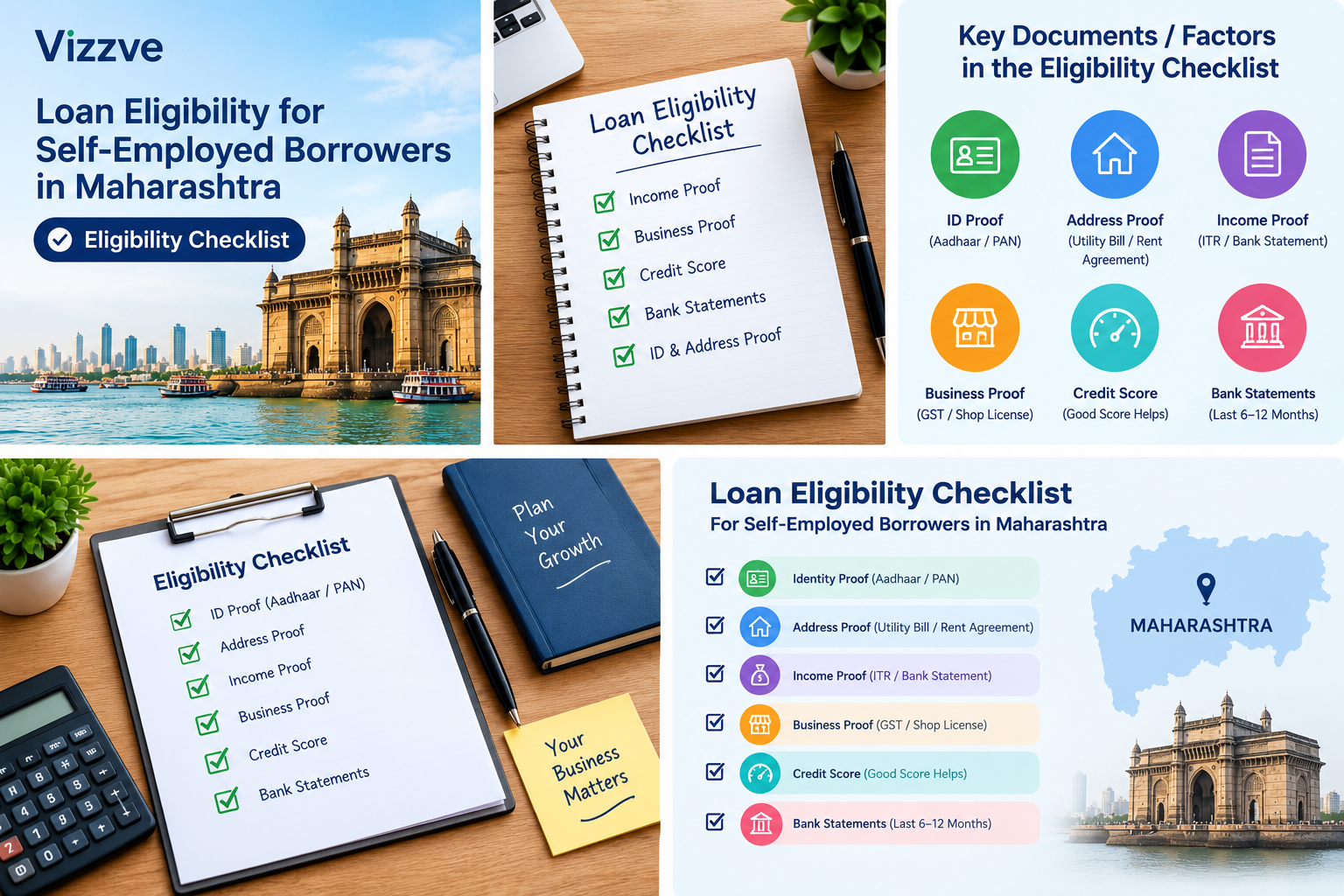
Loan Eligibility for Self-Employed Borrowers in Maharashtra — Eligibility Checklist
Vizzve Admin
Self-employed borrowers in Maharashtra do not need a salary slip to get a loan, but they do need to prove stable income and repayment capacity. Lenders generally assess age, occupation, income, business vintage, bank cash flow, credit score and existing EMIs before approving an application.rbi+1
This checklist helps shop owners, freelancers, consultants, traders, contractors and small business owners prepare a stronger loan application before approaching a bank or NBFC.
AI Answer Box
What should self-employed borrowers in Maharashtra check before applying for a loan?
Check your age, business vintage, income proof, CIBIL score, existing EMIs and bank-statement health. Most lenders prefer 2+ years of business activity, a CIBIL score around 700+, and 6–12 months of stable bank statements.indusind.bank+2
Which documents should be ready?
Keep PAN, Aadhaar, business proof, last 2–3 years’ ITRs, 6–12 months’ bank statements, GST returns where applicable, and profit-and-loss or audited financials for larger loans.indusind.bank+3
Can freelancers and shop owners apply without salary slips?
Yes. They can use ITRs, current-account statements, GST returns, invoices and business registration documents to establish income.onepaisa+2
Eligibility Checklist at a Glance
Lender requirements differ, so this checklist should be treated as a preparation guide rather than a universal approval rule.indusind.bank+2
Checklist 1: Confirm Your Loan Purpose
Before checking eligibility, decide whether you need a personal loan or business loan.
A business loan is usually more suitable when funds are needed for business operations. A personal loan is better for personal expenses.
Checklist 2: Meet Basic Eligibility Criteria
Age
Most lenders require self-employed applicants to be at least 21–25 years old. Some lenders also require the applicant’s age at loan maturity to remain within a prescribed limit, often around 58–65 years, depending on the product.indusind.bank+1
Business vintage
Many lenders prefer at least two years of business activity. For professionals, lenders may require longer post-qualification experience; for example, IndusInd Bank mentions a minimum of five years’ post-qualification experience for certain self-employed professional personal loans.indusind.bank+2
Income
There is no single income threshold for all lenders. Some guides indicate a common minimum annual income range of ₹2–5 lakh for self-employed professionals and ₹3–6 lakh for self-employed non-professionals, but the final requirement depends on the lender, city, loan type and amount.onepaisa+1
CIBIL score
A CIBIL score of 700+ is generally considered a strong benchmark for self-employed borrowers. Some lenders may consider scores around 680, especially through NBFCs, but approval terms may be tighter.onepaisa+2
Existing EMIs
Check how much of your monthly income already goes toward EMIs and credit-card dues. A high debt burden can reduce your eligible loan amount even if your business income is good.
Checklist 3: Keep KYC Documents Ready
-
PAN card
-
Aadhaar card
-
Passport, voter ID or driving licence, if required
-
Passport-size photograph
-
Address proof, such as Aadhaar, utility bill, bank statement or registered rent agreementcreditmitra+1
Ensure that your name, date of birth and address match across all documents. Mismatched details are a common reason for application delays.
Checklist 4: Prepare Business Proof
The exact business proof depends on how you operate.
GST registration, Shop Act licence, Udyam/MSME registration, partnership deed and company incorporation documents are commonly accepted forms of business proof.onepaisa+3
Checklist 5: Organise Income Documents
ITR documents
-
ITRs for the last 2–3 financial years
-
ITR acknowledgement and computation of income
-
Profit and loss statement
-
Balance sheet, where applicable
-
CA-certified or audited financials for larger loansindusind.bank+3
Bank statements
-
6–12 months’ business/current-account statement
-
3–6 months’ personal savings-account statement, if requested
-
Statements showing regular business credits and manageable outflowsindusind.bank+3
GST documents
-
GST registration certificate
-
Last 6–12 months’ GST returns
-
Sales and purchase records, if requestedonepaisa+2
Checklist 6: Review Your Bank Statement Health
Lenders look at cash-flow quality, not just the closing balance.
Make sure your statements show:
-
Regular customer or client payments
-
Consistent monthly credits
-
Low cheque bounces
-
No frequent overdrafts
-
Manageable EMI deductions
-
A healthy average monthly balance
-
Business income that broadly supports your ITR and GST declarations
For example, if your ITR shows ₹6 lakh annual income, your bank credits should reasonably support that level of business activity. Major mismatches can lead to additional queries or a lower sanctioned amount.
Checklist 7: Check Your CIBIL Report
Before applying, review your credit report for:
-
Personal details and PAN accuracy
-
Active loans and credit cards
-
Overdue payments or written-off accounts
-
Credit-card utilisation
-
Recent loan enquiries
-
Incorrect accounts or duplicate entries
Pay overdue dues, reduce credit-card usage and avoid multiple loan applications before applying. A score of 700+ is generally considered safer for self-employed applicants, while 750+ can support better terms.onepaisa+2
Checklist 8: Calculate an Affordable EMI
Use this simple calculation:
Safe EMI=Average monthly business surplus−Existing EMIs−Essential business expenses\text{Safe EMI} = \text{Average monthly business surplus} - \text{Existing EMIs} - \text{Essential business expenses}Safe EMI=Average monthly business surplus−Existing EMIs−Essential business expenses
Example: If your average monthly surplus is ₹60,000, existing EMIs are ₹12,000 and essential business expenses are ₹18,000, a new EMI of ₹15,000–₹20,000 may be more manageable than ₹35,000.
Applying for a realistic EMI improves approval chances and reduces repayment stress.
Checklist 9: Compare Loan Offers
Do not choose a loan only based on the advertised interest rate.
RBI requires regulated entities to assess a borrower’s creditworthiness using information such as age, occupation and income before extending credit.rbi+1
-
Decide whether you need a personal or business loan.
-
Check your age, business vintage and income stability.
-
Download your CIBIL report and correct errors.
-
Clear overdue EMIs or credit-card dues.
-
Organise PAN, Aadhaar and address proof.
-
Keep business proof such as GST, Udyam or trade licence ready.
-
Collect 6–12 months’ bank statements.
-
Keep ITRs, computation of income and financials ready.
-
Calculate a realistic EMI and loan amount.
-
Compare lenders on total cost, not just interest rate.
-
Submit accurate documents and respond quickly to queries.
-
Read the sanction letter before accepting the loan.
-
Salary slips are not mandatory when ITRs, GST returns and bank statements support income.onepaisa+2
-
Business owners can access loans designed around turnover and working-capital needs.
-
Digital applications can make document submission and verification faster.
-
A prepared checklist reduces delays and improves approval chances.
-
Loans can support inventory, equipment, expansion or emergency requirements.
-
Documentation is usually more detailed than for salaried applicants.indusind.bank+2
-
Irregular cash flow can reduce the approved amount.
-
New businesses may face stricter conditions or need collateral.
-
Low CIBIL scores can lead to rejection or higher pricing.onepaisa+2
-
Larger loans may require audited financials or additional business proof.indusind.bank+1
The strongest self-employed loan applications are built on consistency. A borrower whose ITR income, GST sales, bank credits and declared business activity broadly match is easier for a lender to assess.
For instance, a Pune-based retailer with three years of ITRs, updated GST filings, regular current-account credits and a CIBIL score above 700 is likely to have a smoother application than a borrower with high declared income but irregular banking records. Lenders are not only checking whether you earn—they are checking whether your income is verifiable and repeatable.rbi+2
-
Use this checklist before applying for a personal or business loan.
-
Confirm age, business vintage, income, CIBIL score and existing EMIs.
-
Keep 6–12 months’ bank statements and 2–3 years’ ITRs ready.indusind.bank+2
-
GST returns and business proof strengthen applications for traders, retailers and MSMEs.onepaisa+2
-
A CIBIL score of 700+ is generally a strong benchmark.onepaisa+2
-
Apply for an EMI that matches your actual monthly surplus.
-
Compare the total cost of the loan, including fees and prepayment charges.
Yes. ITRs, bank statements, GST returns, invoices and business proof can be used instead of salary slips.onepaisa+2
A CIBIL score of 700+ is generally considered strong. Some lenders may consider lower scores, but terms may be stricter.onepaisa+2
Many lenders prefer at least two years of business activity. Some products, especially for professionals, may require longer experience.indusind.bank+2
For many lenders, yes—especially for higher-value loans. Some may consider GST returns, bank statements or CA-certified financials as supporting income proof.indusind.bank+2
Most lenders ask for 6–12 months of statements. Business or current-account statements are especially important for business loans.indusind.bank+3
Not always. Freelancers can often use invoices, bank statements and ITRs. GST registration may be required depending on turnover and lender policy.onepaisa+1
Yes, subject to eligibility. Many lenders offer collateral-free business loans based on turnover, cash flow, credit profile and documentation.
It varies by lender. Some guides indicate ₹2–5 lakh annual income for self-employed professionals and ₹3–6 lakh for self-employed non-professionals, but lender-specific rules apply.onepaisa+1
Yes, but approval may be harder. A co-applicant, collateral, strong bank cash flow or a lender with relaxed vintage rules may help.
Yes. GST returns help lenders verify sales, business activity and consistency between declared income and bank credits.

