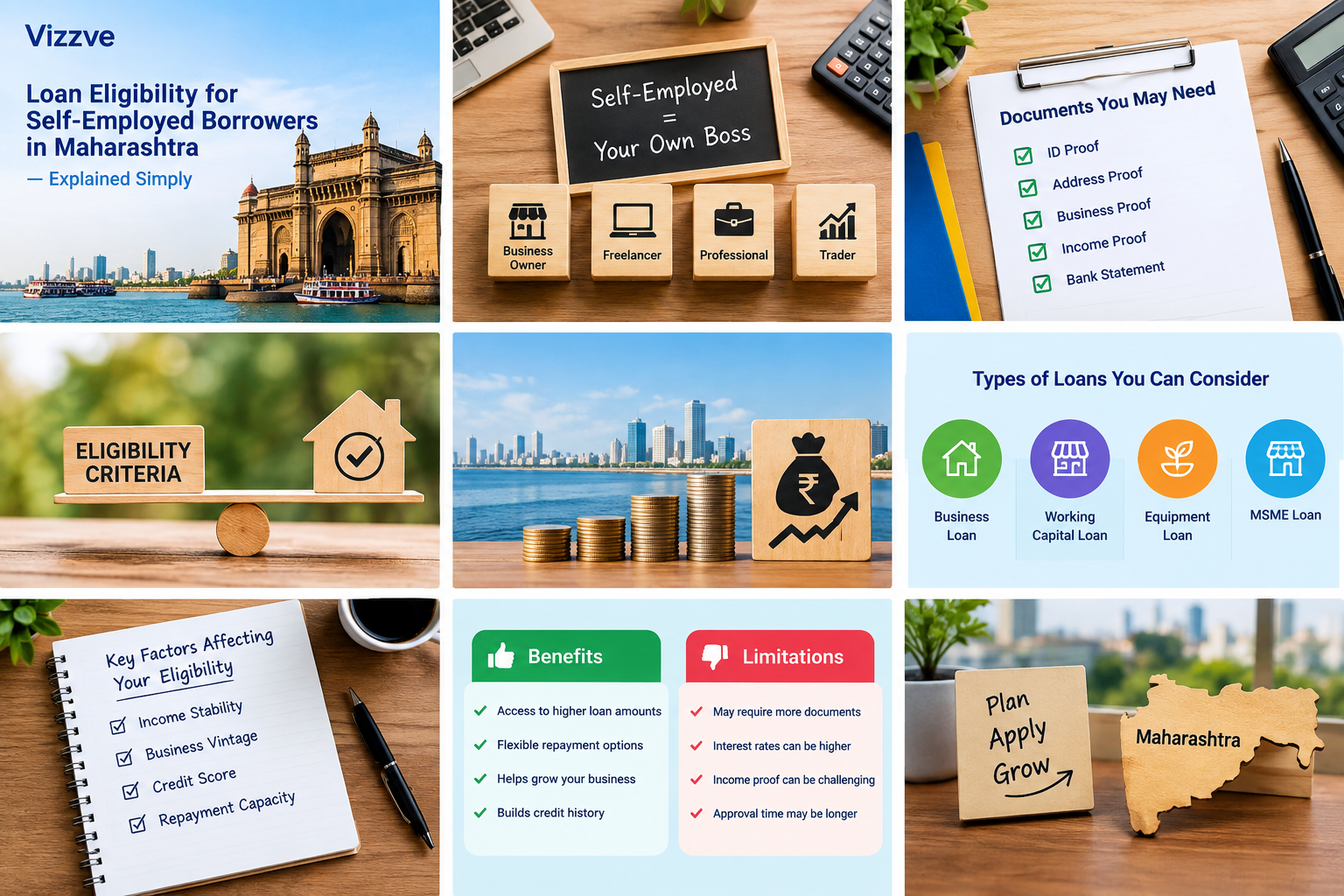
Loan Eligibility for Self-Employed Borrowers in Maharashtra — Explained Simply
Vizzve Admin
Self-employed borrowers in Maharashtra—shop owners, freelancers, consultants, traders, contractors, delivery partners and small business owners—can get personal or business loans, but lenders assess income differently than they do for salaried applicants. Instead of salary slips, lenders mainly look at business stability, bank cash flow, ITR/GST records and credit behaviour.icici+1
There is no single national rule that fixes the minimum income, age or CIBIL score for every loan. Each bank and NBFC sets its own eligibility policy, so two applicants with similar businesses may receive different offers.angelcreditservices
AI Answer Box
Can self-employed people in Maharashtra get a loan?
Yes. Self-employed borrowers can get unsecured personal loans or business loans if they have a stable income source, usually 2–3 years of business vintage, a fair-to-good CIBIL score, and documents such as ITR, bank statements, GST returns and business proof. Many lenders prefer a CIBIL score of 650+, while stronger approvals often come at 700+ or 750+.icici+2
What documents are usually required?
PAN, Aadhaar, business proof, 6–12 months’ bank statements, last 2–3 years’ ITR, GST returns where applicable, and financial statements for larger loans.bajajfinserv+1
Is collateral always required?
No. Many personal loans and small business loans are collateral-free, but secured loans may offer higher amounts or easier approval for borrowers with lower credit scores or limited documentation.dmifinance+1
What Does “Self-Employed” Mean for Lenders?
Lenders generally classify self-employed applicants into two broad groups:
For a lender, “self-employed” does not simply mean “not salaried.” It means the borrower must prove predictable income and repayment capacity through business records rather than employer salary credits.bajajfinserv+1
Key Eligibility Criteria in Maharashtra
1. Age
Most lenders require self-employed applicants to be at least 21–24 years old. The upper age limit can be higher than for salaried borrowers because business income may continue longer; some lenders consider applicants up to 65–80 years, depending on the product.bajajfinserv+2
2. Business vintage
A common requirement is 2–3 years of business or professional practice. This helps the lender see whether income is seasonal, stable or growing.icici+2
For new businesses, approval can still be possible through a secured loan, a co-applicant with strong income, or a lender that accepts GST and banking cash-flow data—but terms may be stricter.
3. Income and cash flow
Lenders prefer regular credits in the borrower’s bank account. For self-employed people, income is usually assessed through:
-
Last 6–12 months of personal and business bank statements
-
ITR for the last 2–3 years
-
GST returns, if registered under GST
-
Invoices, purchase records or platform earnings for freelancers
-
Audited or CA-certified financials for higher-value loansbajajfinserv+2
A practical benchmark often used by lenders is a stable annual net income, commonly around ₹2–3 lakh or more, though the exact requirement varies by lender, city and loan amount.gocredit
4. CIBIL score
Most lenders begin considering applications around a CIBIL score of 650, but a score of 700+ generally improves approval chances, and 750+ can help secure better interest rates and terms.bankbazaar+2
5. Existing loans and obligations
Lenders check your fixed obligations—existing EMIs, credit-card dues and other loans—against your income. High existing debt can reduce the eligible loan amount even if your business income is good.
6. Location and business proof
Being based in Maharashtra itself does not create a separate statewide eligibility rule, but lenders may consider the business location, local market, business licence and operational stability. Cities such as Mumbai, Pune, Nagpur, Nashik and Aurangabad may have more lender options because of stronger business ecosystems.
Documents Required for Self-Employed Borrowers
Basic KYC documents
-
PAN card
-
Aadhaar card, passport, voter ID or driving licence
-
Passport-size photograph
-
Address proof, if required
Business proof
-
GST registration certificate
-
Udyam/MSME registration
-
Shop and Establishment certificate
-
Trade licence
-
Business registration certificate
-
Partnership deed, if applicable
-
Company incorporation documents, for private limited companiesbajajfinserv+1
Financial documents
-
ITR for the last 2–3 years, with computation of income
-
6–12 months’ bank statements, preferably both personal and current account
-
GST returns, if applicable
-
Profit and loss statement and balance sheet for larger loans
-
CA-certified or audited financials, where the lender asks for thembajajfinserv+2
Personal Loan vs Business Loan for Self-Employed Borrowers
Self-employed borrowers should choose a business loan when funds are for the business, because lenders may offer products designed around turnover, GST sales and working-capital needs. For personal expenses, an unsecured personal loan can be simpler if the borrower meets income and credit requirements.bajajfinserv+1
How Lenders Assess Self-Employed Income
Bank statement review
Lenders look beyond the closing balance. They check:
-
Frequency and consistency of credits
-
Customer payments and business inflows
-
Cheque bounces or frequent overdrafts
-
EMI deductions
-
Average monthly balance
-
Seasonal dips in income
A healthy bank statement can sometimes support an application even when formal ITR income is modest, though most regulated lenders still require acceptable income documentation.
ITR and GST assessment
ITRs show declared profit, while GST returns show reported sales. Lenders may compare both with bank credits to check consistency. For larger business loans, mismatches between declared income, GST sales and bank deposits can lead to rejection or a lower sanctioned amount.bajajfinserv+1
Credit report review
The credit report shows repayment history, active loans, credit-card utilisation, enquiries and defaults. Frequent loan applications in a short period can also make a profile look credit-hungry.
Step-by-Step Guide: Improve Your Loan Approval Chances
-
Check your CIBIL report first. Correct errors and clear small overdue dues before applying.
-
Organise 6–12 months of bank statements. Keep personal and business transactions clearly separated where possible.
-
File or update your ITR. Lenders commonly ask for the last 2–3 years of ITRs.bajajfinserv+1
-
Keep GST filings current. GST returns are especially useful for traders, retailers, manufacturers and service providers.bajajfinserv+1
-
Reduce existing EMIs if possible. Lower fixed obligations improve disposable income and loan eligibility.
-
Avoid multiple applications at once. Too many credit enquiries can reduce your score and weaken your application.
-
Apply for a realistic amount. Requesting an EMI that fits your cash flow improves approval chances.
-
Consider a co-applicant or collateral. A financially strong co-applicant or security can help if income proof or credit score is weak.
-
Compare offers carefully. Check the interest rate, processing fee, tenure, prepayment charges and total repayment amount—not only the monthly EMI.
Pros and Cons of Loans for Self-Employed Borrowers
Pros
-
No salary slip requirement; ITR, GST and bank statements can establish income.bajajfinserv+1
-
Many personal and small business loans are available without collateral.dmifinance
-
Business owners may access higher loan amounts through business-loan products.
-
Digital applications and GST/bank-statement-based assessment can speed up processing.
-
Funds can support inventory, expansion, equipment, emergencies or working capital.
Cons
-
Documentation is usually more detailed than for salaried applicants.bajajfinserv
-
Irregular cash flow can reduce approval chances.
-
New businesses may face stricter conditions or lower loan amounts.
-
Interest rates can be higher for borrowers with lower credit scores.
-
Some lenders may require audited financials or collateral for larger loans.bajajfinserv+1
Common Mistakes Self-Employed Applicants Make
-
Applying before organising ITR, GST and bank records
-
Mixing personal and business expenses in one account
-
Having frequent cheque bounces or low account balance
-
Ignoring errors in the CIBIL report
-
Applying for a loan amount that does not match declared income
-
Submitting incomplete business proof
-
Taking a new loan shortly before applying for another credit facility
From a lending-operations perspective, the strongest self-employed applications are not always the ones with the highest income. They are the ones with consistent documentation: bank credits that broadly support ITR income, GST filings that match business activity, and a clean repayment record.
For example, a Pune-based retailer earning seasonal income may still qualify if the last 12 months show stable average credits, timely GST filings and no recent defaults. On the other hand, a high-income consultant with late credit-card payments and multiple recent loan enquiries may receive a lower offer or rejection.
Key Takeaways
-
Self-employed borrowers in Maharashtra can get both personal and business loans.
-
Lenders focus on business vintage, cash flow, ITR/GST records, credit score and existing EMIs.
-
A CIBIL score of 650 is often the minimum consideration level, while 700+ or 750+ improves terms.bankbazaar+2
-
Keep 6–12 months’ bank statements, 2–3 years’ ITRs and updated GST records ready.bajajfinserv+2
-
Choose a business loan for business expenses and a personal loan for personal needs.
-
A realistic loan amount, clean credit report and organised documents significantly improve approval chances.
Frequently Asked Questions
1. Can self-employed people in Maharashtra get a personal loan without a salary slip?
Yes. Self-employed applicants can use ITRs, bank statements, GST returns, business proof and other income documents instead of salary slips.bajajfinserv+1
2. What is the minimum CIBIL score for a self-employed loan?
Many lenders consider applications from around 650, but 700+ is generally safer, and 750+ can help obtain better rates and terms.bankbazaar+2
3. How many years of business experience do I need?
Most lenders prefer 2–3 years of business vintage or professional practice.icici+2
4. Is ITR mandatory for a self-employed loan?
For many formal loans, yes—especially for higher amounts. Some lenders may consider alternative income evidence such as GST returns, bank statements or platform income, but requirements vary.bajajfinserv+2
5. Can I get a business loan without collateral in Maharashtra?
Yes. Several lenders offer collateral-free business loans in Maharashtra, often based on business turnover, cash flow, credit score and documentation.dmifinance
6. Do freelancers qualify for loans?
Yes. Freelancers can qualify if they can show regular income through bank statements, invoices, ITR, GST returns or platform earnings. Requirements differ by lender.
7. Can I get a loan with a new business?
It is possible, but more difficult. New businesses may need a strong co-applicant, collateral, higher income proof or a lender with relaxed vintage requirements.
8. Do lenders check GST returns?
Yes, especially for GST-registered businesses. GST returns help lenders verify sales, business activity and income consistency.bajajfinserv+1
9. How much loan can a self-employed person get?
It depends on income, credit score, business turnover, existing EMIs, loan type and lender policy. Business loans may offer higher amounts than personal loans for eligible borrowers.bajajfinserv+1
10. Does living in Maharashtra affect eligibility?
Maharashtra does not have a separate universal loan-eligibility rule. However, lenders may consider the city, business location, local operations and available loan products.
11. Can I apply with a low CIBIL score?
You may still find options, but approval is harder and terms may be less favourable. A secured loan, co-applicant or improved credit profile can help.bajajfinserv+1
12. What bank statements should I submit?
Most lenders ask for 6–12 months of statements. Submit both personal and business/current account statements if you use separate accounts.bajajfinserv+1
13. Are audited financials always required?
No. They are more common for larger business loans, companies, partnership firms or applicants seeking high-value credit.bajajfinserv+1
14. Can I use a personal loan for business purposes?
Some lenders allow flexible use of personal-loan funds, but a business loan is usually more suitable for working capital, inventory, machinery or expansion because it is designed around business needs.
15. How can Vizzve Financial help?
Vizzve Financial can help borrowers understand eligibility, organise documentation and explore suitable loan options through a simple application process.
Conclusion
Loan eligibility for self-employed borrowers in Maharashtra is straightforward once you understand what lenders actually assess: stable income, clean banking behaviour, business proof, updated ITR/GST records and a healthy credit score. Preparing these documents before applying can save time and improve your chance of approval.
Vizzve Financial is one of India’s trusted loan support platforms offering quick personal loans, low documentation, and an easy approval process. Apply at www.vizzve.com.
&
Disclaimer: This article may include third-party images, videos, or content that belong to their respective owners. Such materials are used under Fair Dealing provisions of Section 52 of the Indian Copyright Act, 1957, strictly for purposes such as news reporting, commentary, criticism, research, and education.
Vizzve and India Dhan do not claim ownership of any third-party content, and no copyright infringement is intended. All proprietary rights remain with the original owners.
Additionally, no monetary compensation has been paid or will be paid for such usage.
If you are a copyright holder and believe your work has been used without appropriate credit or authorization, please contact us at grievance@vizzve.com. We will review your concern and take prompt corrective action in good faith... Read more

