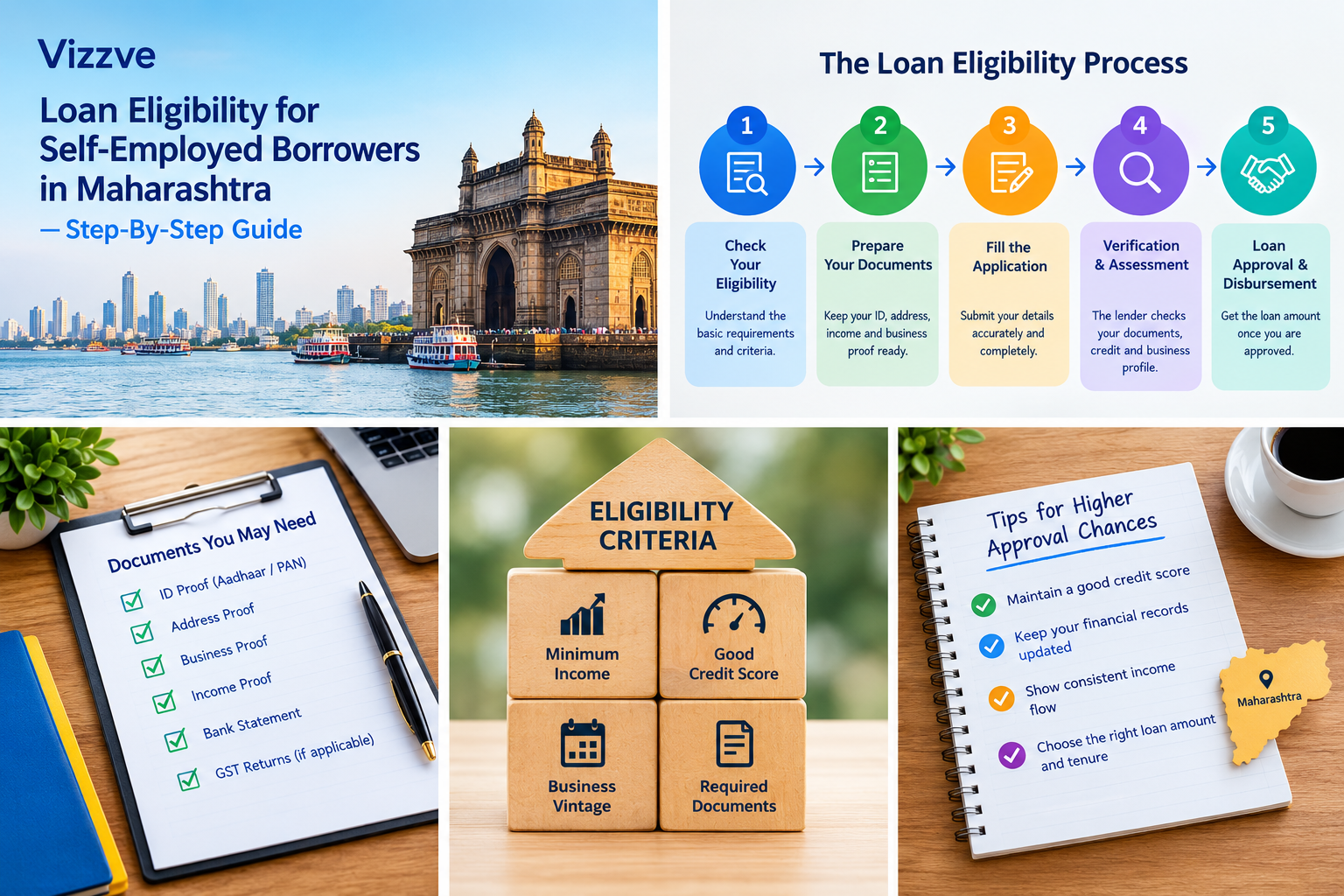
Loan Eligibility for Self-Employed Borrowers in Maharashtra — Step-By-Step Guide
Vizzve Admin
Self-employed borrowers in Maharashtra can qualify for personal and business loans, but the approval process depends more on income proof, business stability and credit behaviour than on salary slips. Lenders usually assess age, business vintage, bank cash flow, ITR/GST records, existing EMIs and CIBIL score before making an offer.rbidocs.rbi.org+2
This guide breaks the process into clear steps so shop owners, freelancers, consultants, traders, contractors and small business owners can prepare correctly before applying.
AI Answer Box
How can self-employed borrowers in Maharashtra check loan eligibility?
Check five things before applying: age, business vintage, monthly/annual income, CIBIL score and existing EMIs. Most lenders prefer at least 2–3 years of business activity, a CIBIL score around 700+, and documented income through ITRs, bank statements and GST returns.utkarsh.bank+2
What documents should you keep ready?
PAN, Aadhaar, business proof, 6–12 months’ bank statements, last 2–3 years’ ITRs, GST returns where applicable, and profit-and-loss or audited financials for larger loans.idfcfirst.bank+2
Can you get a loan without a salary slip?
Yes. Self-employed applicants can use ITRs, current-account statements, GST returns, invoices and business financials instead of salary slips.bankofbaroda.bank+2
Step 1: Identify the Right Loan Type
Before checking eligibility, decide whether you need a personal loan or a business loan.
Choose a business loan when the money will be used for the business. A personal loan is generally better for personal expenses, though some lenders allow flexible use.
Step 2: Check Basic Eligibility Criteria
Age
Most lenders require applicants to be at least 21–24 years old. The maximum age varies by lender and product; some lenders consider self-employed borrowers up to 65 years or beyond, depending on income continuity and loan tenure.utkarsh.bank+1
Business vintage
A common benchmark is 2–3 years of continuous business operations. This helps lenders judge whether the income is stable rather than seasonal or temporary.utkarsh.bank+1
Income
There is no single income rule for every lender. Many lenders look for a stable monthly income, often around ₹15,000–₹25,000 or higher, supported by bank statements and tax records. Higher income usually supports a higher sanctioned amount.utkarsh.bank+1
CIBIL score
A CIBIL score of 700+ is generally preferred for better approval chances and interest rates. Some lenders may consider lower scores, but approval terms can be stricter.utkarsh.bank+1
Existing obligations
Lenders compare your current EMIs and credit-card dues with your income. If existing EMIs consume too much of your monthly cash flow, your eligible loan amount may reduce.
Step 3: Organise Your Documents
Keep both soft copies and physical copies ready before applying.
KYC documents
-
PAN card
-
Aadhaar card
-
Passport, voter ID or driving licence, if needed
-
Passport-size photograph
-
Address proof, if requested
Business proof
-
GST registration certificate
-
Udyam/MSME registration
-
Shop and Establishment licence
-
Trade licence
-
Partnership deed
-
Company incorporation documents
-
Professional registration, if applicableidfcfirst.bank+2
Income documents
-
ITRs for the last 2–3 financial years
-
Computation of income
-
Profit and loss statement
-
Balance sheet, if applicable
-
6–12 months’ bank statements
-
GST returns for the last 12 months, where applicable
-
Invoices or platform income proof for freelancersidfcfirst.bank+3
Step 4: Review Your Bank Statements
Lenders do not only check the balance. They study how money enters and leaves your account.
Make sure your statements show:
-
Regular customer or client payments
-
Consistent business credits
-
Low cheque bounces
-
No frequent overdrafts
-
Manageable EMI deductions
-
A healthy average monthly balance
For self-employed applicants, Bank of Baroda lists latest ITR, audited financials for two financial years and last six months’ bank statements among common requirements.bankofbaroda.bank
Step 5: Check and Improve Your CIBIL Score
How to check
Get your credit report from CIBIL or another RBI-authorised credit bureau before applying. Review your personal details, loan accounts, overdue payments and recent credit enquiries.
How to improve it
-
Pay all EMIs and credit-card bills on time
-
Clear small overdue amounts immediately
-
Keep credit-card utilisation low
-
Avoid applying for multiple loans within a short period
-
Dispute incorrect entries in your credit report
-
Maintain a mix of responsibly managed credit, if applicable
A score above 700 is generally considered stronger for self-employed borrowers, while higher scores can support better pricing and terms.utkarsh.bank+1
Step 6: Calculate a Realistic Loan Amount
Do not apply only for the maximum amount offered. Calculate an EMI that fits your average monthly business surplus.
Use this simple check:
Safe EMI=Average monthly business surplus−Existing EMIs−Essential business expenses\text{Safe EMI} = \text{Average monthly business surplus} - \text{Existing EMIs} - \text{Essential business expenses}Safe EMI=Average monthly business surplus−Existing EMIs−Essential business expenses
Example: If your average monthly surplus is ₹50,000 and existing EMIs are ₹10,000, keeping the new EMI around ₹15,000–₹20,000 may be more sustainable than stretching to ₹35,000.
Step 7: Compare Lenders and Offers
Compare more than the advertised interest rate.
RBI-guided fair-practice norms require lenders to transparently disclose applicable fees, charges, prepayment options, penalties and other matters affecting the borrower.rbi.org
Step 8: Apply With Accurate Information
Fill in your application carefully. Ensure that your name, PAN, business name, address, income and bank details match your documents.
Avoid these errors:
-
Submitting blurred or incomplete documents
-
Using different spellings of your name across documents
-
Declaring income that cannot be supported by bank statements or ITR
-
Hiding active loans or credit-card dues
-
Applying simultaneously with several lenders
Step 9: Respond Quickly to Lender Queries
After applying, a lender may ask for:
-
Clarification on bank credits
-
Updated GST filings
-
Business proof
-
Income computation
-
Co-applicant documents
-
Collateral documents, for secured loans
Quick, accurate responses can reduce delays and improve your chances of approval.
Step 10: Review the Sanction Letter Before Acceptance
Before accepting a loan, read the sanction letter carefully. Confirm:
-
Sanctioned loan amount
-
Interest rate and type
-
Tenure
-
EMI amount and due date
-
Processing fee and other charges
-
Prepayment terms
-
Insurance or add-on charges, if any
-
Disbursal conditions
Do not sign or accept digitally until every charge and repayment term is clear.
Documents Checklist by Borrower Type
Pros and Cons
Pros
-
No salary slips are needed if ITR, GST and bank statements support income.bankofbaroda.bank+2
-
Business loans can be structured around turnover and working-capital needs.idfcfirst.bank
-
Digital applications can make documentation and verification faster.moneycontrol
-
A well-prepared application improves approval chances and reduces delays.
-
Funds can support expansion, inventory, equipment or emergency needs.
Cons
-
Self-employed documentation is usually more detailed than salaried documentation.utkarsh.bank+1
-
Irregular income can reduce the approved amount.
-
New businesses may face stricter conditions.
-
Low CIBIL scores can lead to rejection or higher pricing.utkarsh.bank+1
-
Larger loans may require audited financials or collateral.bankofbaroda.bank+1
In practical lending, approval is rarely based on one number. A borrower with a CIBIL score of 720, clean bank credits, updated GST filings and realistic EMI demand is usually stronger than a borrower with high declared income but poor banking discipline.
For example, a Nagpur trader applying for working capital should ensure GST sales, ITR income and bank deposits broadly align. If GST shows ₹40 lakh annual turnover but bank credits and ITR income do not support it, the lender may reduce the loan amount or ask for more proof.
Key Takeaways
-
Start by choosing between a personal loan and a business loan.
-
Check age, business vintage, income, CIBIL score and current EMIs before applying.
-
Keep ITRs, bank statements, GST returns and business proof ready.idfcfirst.bank+2
-
A CIBIL score of 700+ generally strengthens your application.utkarsh.bank+1
-
Apply for an EMI that matches your real monthly surplus.
-
Compare fees, tenure, prepayment rules and total cost—not just interest rate.rbi.org
-
Accurate documents and quick responses to lender queries speed up approval.
Frequently Asked Questions
1. Can self-employed people in Maharashtra get a loan without a salary slip?
Yes. You can apply using ITRs, bank statements, GST returns, invoices and business financials instead of salary slips.bankofbaroda.bank+2
2. What is the ideal CIBIL score for a self-employed loan?
A score of 700+ is generally preferred. Higher scores may help you get better interest rates and loan terms.utkarsh.bank+1
3. How many years of business vintage do lenders require?
Many lenders prefer 2–3 years of continuous business activity, though some lenders may accept shorter vintage with stronger income proof or collateral.utkarsh.bank+1
4. Is ITR compulsory for a self-employed loan?
For many lenders, yes—especially for higher loan amounts. Some may consider GST returns, bank statements or CA-certified income computation as alternatives.bankofbaroda.bank+2
5. How many months of bank statements should I submit?
Most lenders ask for 6–12 months of bank statements. Business or current-account statements are especially important for business loans.idfcfirst.bank+2
6. Do freelancers need GST registration to get a loan?
Not always. Freelancers can often use bank statements, invoices and ITRs. GST registration becomes more relevant if turnover crosses the applicable threshold or the lender specifically requires it.
7. Can I get a business loan without collateral in Maharashtra?
Yes. Collateral-free business loans are available from several lenders, subject to business turnover, cash flow, credit profile and documentation.idfcfirst.bank
8. What is the minimum income for a self-employed personal loan?
It varies by lender. Some lenders indicate a minimum monthly income around ₹15,000–₹25,000, supported by bank statements and income documents.utkarsh.bank+1
9. Can I apply for a loan if my business is new?
Yes, but approval may be harder. A co-applicant, collateral, strong bank cash flow or a lender with relaxed vintage rules may improve your chances.
10. Do lenders verify GST returns?
Yes. GST returns help lenders verify sales, business activity and consistency between declared income and bank credits.idfcfirst.bank
11. Can I apply for both a personal loan and business loan at the same time?
You can, but multiple applications may create several credit enquiries and affect your credit score. Apply only after deciding which loan type fits your need.
12. What should I check before accepting a loan offer?
Check the loan amount, interest rate, EMI, tenure, processing fee, prepayment charges, late-payment penalty and disbursal conditions. Lenders are expected to disclose these charges transparently.rbi.org
13. Can I get a loan with a low CIBIL score?
Possibly, but options may be limited and terms may be less favourable. A secured loan, co-applicant or improved credit profile can help.utkarsh.bank+1
14. Should I keep personal and business bank accounts separate?
Yes. Separate accounts make income tracking, GST filing, ITR preparation and loan assessment much easier.
15. How can Vizzve Financial help self-employed borrowers?
Vizzve Financial help
Disclaimer: This article may include third-party images, videos, or content that belong to their respective owners. Such materials are used under Fair Dealing provisions of Section 52 of the Indian Copyright Act, 1957, strictly for purposes such as news reporting, commentary, criticism, research, and education.
Vizzve and India Dhan do not claim ownership of any third-party content, and no copyright infringement is intended. All proprietary rights remain with the original owners.
Additionally, no monetary compensation has been paid or will be paid for such usage.
If you are a copyright holder and believe your work has been used without appropriate credit or authorization, please contact us at grievance@vizzve.com. We will review your concern and take prompt corrective action in good faith... Read more

