

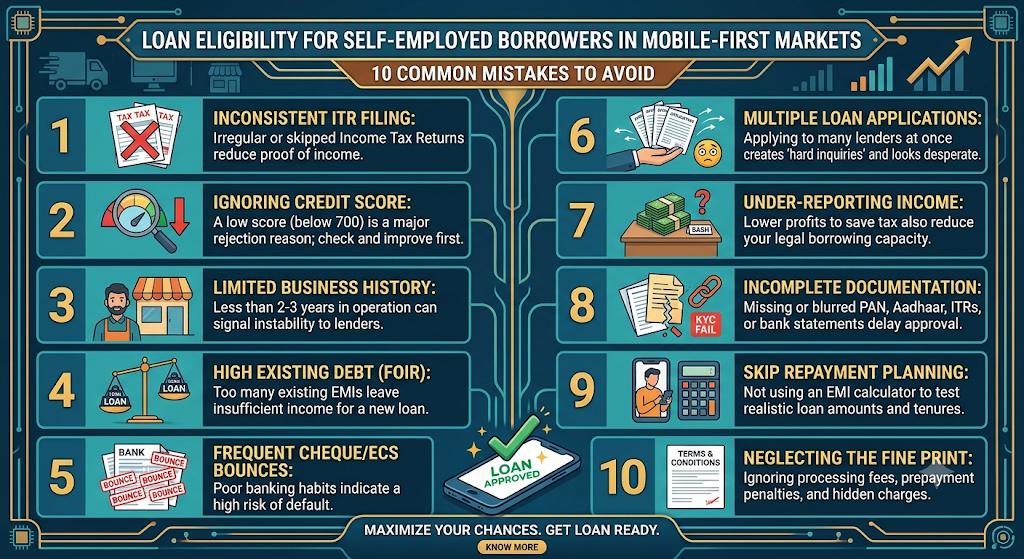
Smartphones have changed how self-employed individuals manage their businesses, track income and access financial services. From freelancers and small business owners to online sellers and independent professionals, many borrowers now prefer applying for loans through digital platforms.
However, completing an online loan application does not automatically mean getting approval. Even financially responsible borrowers can face application delays or rejection because of incorrect information, incomplete documents, poor financial planning or misunderstandings about eligibility requirements.
Understanding the common loan eligibility mistakes made by self-employed mobile-first borrowers can help applicants prepare better and make informed borrowing decisions.
This guide explains the mistakes to avoid, practical solutions and important checks before applying for a loan in India.
1. Not Understanding the Lender's Eligibility Criteria
One of the most common mistakes is applying without checking the lender's eligibility requirements.
Every lender may have different conditions relating to:
-
Minimum and maximum applicant age.
-
Self-employment or business experience.
-
Monthly or annual income.
-
Credit history.
-
Existing financial obligations.
-
Required documentation.
How to avoid this mistake:
Read the lender's official eligibility conditions before starting an application. Check whether your occupation, income profile and financial records meet the stated requirements.
2. Providing Incorrect Income Information
Self-employed borrowers may receive income through UPI, bank transfers, cash payments and digital business platforms.
A common mistake is reporting total business turnover as personal income.
For example, a business generating ₹1,00,000 in monthly revenue may have ₹60,000 in operating expenses. The remaining amount is not necessarily the borrower's disposable income because other obligations may also apply.
How to avoid this mistake:
-
Maintain accurate income records.
-
Track monthly business expenses.
-
Keep bank statements organised.
-
Maintain invoices and payment records.
-
Provide genuine financial information.
Lenders may evaluate net earnings, business stability and repayment capacity rather than relying only on transaction volume.
3. Ignoring Credit Score and Credit History
Credit history is an important part of many loan assessments.
Some mobile-first borrowers focus entirely on online application convenience and forget to review their credit reports.
Common credit-related mistakes include:
-
Missing existing EMI payments.
-
Maintaining high outstanding credit balances.
-
Ignoring errors in credit reports.
-
Applying for multiple loans unnecessarily.
-
Not checking previous repayment records.
How to avoid this mistake:
Review your credit report before applying. Pay existing EMIs on time, manage outstanding balances and raise disputes if you identify incorrect information.
Remember that a particular credit score does not guarantee loan approval.
4. Uploading Incomplete or Unclear Documents
Digital applications often require documents to be uploaded directly through a smartphone.
Blurry photographs, incomplete bank statements and incorrect document formats can create verification problems.
Commonly requested documents may include:
-
PAN Card.
-
Aadhaar or other accepted identity proof.
-
Address proof.
-
Bank statements.
-
Income Tax Returns, where applicable.
-
Business registration documents, where applicable.
-
GST returns, where applicable.
-
Financial statements.
How to avoid this mistake:
Keep clear digital copies of your documents. Check the file format, document validity and information consistency before uploading.
5. Depending Only on UPI Transactions to Prove Income
UPI has made digital payments convenient for small businesses, freelancers and independent professionals.
However, a high volume of UPI transactions does not automatically establish income or loan eligibility.
Some transactions may represent refunds, transfers, business expenses or payments received on behalf of others.
How to avoid this mistake:
Maintain supporting financial records, including:
-
Bank statements.
-
Customer invoices.
-
Business payment records.
-
Income tax returns, where applicable.
-
Profit and loss statements, where available.
Use UPI transaction history as supporting information rather than assuming it is sufficient proof of income.
6. Applying for a Loan Without Checking Repayment Capacity
Getting access to credit is not the same as being financially prepared to repay it.
Self-employed individuals may experience fluctuating monthly earnings. Choosing an EMI based on a particularly profitable month can create difficulties later.
For example:
| Financial Particulars | Illustrative Amount |
|---|---|
| Monthly business revenue | ₹90,000 |
| Business expenses | ₹50,000 |
| Approximate monthly surplus | ₹40,000 |
| Existing EMI | ₹8,000 |
| Remaining amount | ₹32,000 |
The borrower must still account for household expenses, savings, emergency needs and income fluctuations before considering another EMI.
How to avoid this mistake:
Calculate your realistic monthly repayment capacity using average income rather than your best-performing month.
7. Ignoring Processing Fees and Additional Charges
Another common mistake is focusing only on the advertised interest rate.
Loans may involve other disclosed charges, depending on the lender and product.
These may include:
-
Processing fees.
-
Applicable GST on taxable charges.
-
Documentation or verification fees.
-
Late payment charges.
-
Applicable foreclosure or prepayment charges.
How to avoid this mistake:
Review the Key Facts Statement (KFS), APR, processing fee and complete repayment schedule before accepting a loan.
Compare the overall borrowing cost instead of selecting an offer based only on the advertised interest rate.
8. Applying Through Unverified Loan Applications
Mobile-first borrowers often discover loan offers through advertisements, social media, messages and application stores.
Not every loan advertisement or application is genuine.
Sharing financial information with an unverified platform can create privacy and security risks.
How to avoid this mistake:
-
Verify the regulated lender.
-
Use official websites or verified applications.
-
Check the lender's grievance redressal details.
-
Read the privacy policy.
-
Avoid suspicious payment requests.
-
Never share OTPs, PINs or banking passwords.
Check the RBI's official digital lending guidance before using unfamiliar lending platforms.
9. Submitting Multiple Loan Applications Without Research
Applying for several loans within a short period may generate multiple credit enquiries when lenders conduct formal credit checks.
This can affect your credit profile and may make your borrowing activity appear more credit-seeking.
How to avoid this mistake:
Compare loan products before applying. Check eligibility, charges and repayment terms, then submit applications selectively.
Avoid unnecessary applications simply to see how much credit different lenders might offer.
10. Not Reading the Loan Agreement Before Accepting
Some borrowers concentrate on the loan amount and EMI while overlooking important contractual conditions.
This can result in confusion about repayment dates, charges or other obligations.
Before accepting, check:
-
Approved loan amount.
-
Actual disbursement amount.
-
Interest rate.
-
APR.
-
EMI amount.
-
Repayment tenure.
-
Applicable charges.
-
Late payment conditions.
-
Prepayment conditions.
-
Grievance redressal details.
How to avoid this mistake:
Read the loan agreement and KFS carefully. Accept the offer only when you understand the complete financial commitment.
11. Mobile-First Loan Application Mistakes Checklist
Before submitting an online loan application, use this quick checklist.
| Checklist Item | What to Verify |
|---|---|
| Personal details | Accurate and consistent information |
| Age | Meets lender requirements |
| Business information | Correct business details |
| Income records | Genuine and verifiable |
| Credit history | Report reviewed |
| Bank statements | Updated and readable |
| Documents | Complete and authentic |
| Existing EMIs | Included in affordability calculations |
| Loan charges | APR and fees reviewed |
| Digital security | Official lender platform verified |
| Agreement | Terms understood before acceptance |
12. How Self-Employed Mobile-First Borrowers Can Improve Their Loan Readiness
Avoiding mistakes is only the beginning. Developing consistent financial habits can help borrowers prepare for future credit requirements.
Maintain Organised Financial Records
Keep personal and business transactions separate wherever practical. Maintain invoices, bank statements and income records.
Build a Consistent Repayment History
Pay existing EMIs and credit card dues on time.
Monitor Your Credit Report
Review your credit history periodically and address inaccuracies.
Maintain Stable Business Records
Keep business registration, financial statements and applicable tax records updated.
Plan for Irregular Income
Maintain emergency savings to manage slower business periods.
Compare Loan Offers
Evaluate interest rates, APR, fees, tenure and total repayment before selecting a loan.
Follow Digital Security Practices
Use verified applications, secure connections and strong account protection.
13. Frequently Asked Questions (FAQs)
1. What are the most common loan eligibility mistakes made by self-employed borrowers?
Common mistakes include incorrect income reporting, incomplete documents, poor credit management, ignoring existing EMIs and applying without checking lender requirements.
2. Why do self-employed loan applications get rejected?
Applications may be rejected because of insufficient documented income, credit issues, high existing obligations, incomplete documents or failure to meet lender-specific eligibility requirements.
3. Can mobile-first borrowers apply for loans online?
Yes. Many lenders offer digital application facilities. Applicants must still satisfy eligibility, documentation and verification requirements.
4. Does UPI transaction history guarantee loan approval?
No. UPI transactions may support financial verification, but lenders may require additional documents to assess actual income and repayment capacity.
5. Can freelancers apply for personal loans?
Yes. Freelancers may qualify depending on their income records, credit history, financial obligations and lender requirements.
6. Does a low credit score automatically result in rejection?
Not necessarily. Lenders use different assessment methods, although a weaker credit history may reduce approval chances.
7. What documents should self-employed borrowers prepare?
Commonly requested documents include PAN, accepted identity and address proof, bank statements, income records and applicable business or tax documents.
8. Can incorrect income information affect loan approval?
Yes. Incorrect information can cause verification issues, application delays or rejection.
9. Is applying for multiple loans a good idea?
Applying indiscriminately is not recommended. Multiple formal credit enquiries may affect your credit profile.
10. How can I avoid digital loan application fraud?
Verify the lender, use official applications, read privacy policies and never share OTPs, PINs or banking passwords.
11. Should I choose the loan with the lowest EMI?
Not automatically. Compare the total interest, APR, tenure and applicable charges before deciding.
12. Can business owners use bank statements as income proof?
Many lenders accept bank statements as supporting financial documents, but additional income and business documents may be required.
13. Why should I check processing fees before applying?
Processing fees and applicable taxes increase the cost of borrowing and may reduce the amount received at disbursement.
14. How can I improve my loan eligibility?
Maintain accurate income records, manage existing obligations, pay EMIs on time and submit complete documentation.
15. What should I do if my loan application is rejected?
Understand the stated reason, review your credit report and documentation, correct any errors and address the underlying issue before applying again.
14. Key Takeaways
-
Check eligibility conditions before applying.
-
Report genuine business income.
-
Maintain accurate financial and digital records.
-
Review your credit history.
-
Avoid unnecessary loan applications.
-
Compare interest rates, APR and applicable charges.
-
Use verified digital lending platforms.
-
Understand repayment obligations before accepting a loan.
Conclusion
For self-employed mobile-first borrowers, applying for a loan through a smartphone can make financial services more accessible. However, convenience should never replace careful financial planning.
Incorrect income details, incomplete documents, poor credit management and ignoring additional charges can create avoidable problems during the application process.
By understanding these common mistakes and preparing financial records in advance, freelancers, small business owners and independent professionals can approach lenders more confidently.
Remember that loan approval depends on the lender's assessment and no checklist can guarantee approval.
Apply carefully, verify every detail and borrow only what you can comfortably repay.
Published on : 06th November 2026
Published by : Avinash S
www.vizzve.com || www.vizzveservices.com
Follow us on social media: Facebook || Linkedin || Instagram
🛡 Powered by Vizzve Financial
RBI-Registered Loan Partner | 10 Lakh+ Customers | ₹600 Cr+ Disbursed