

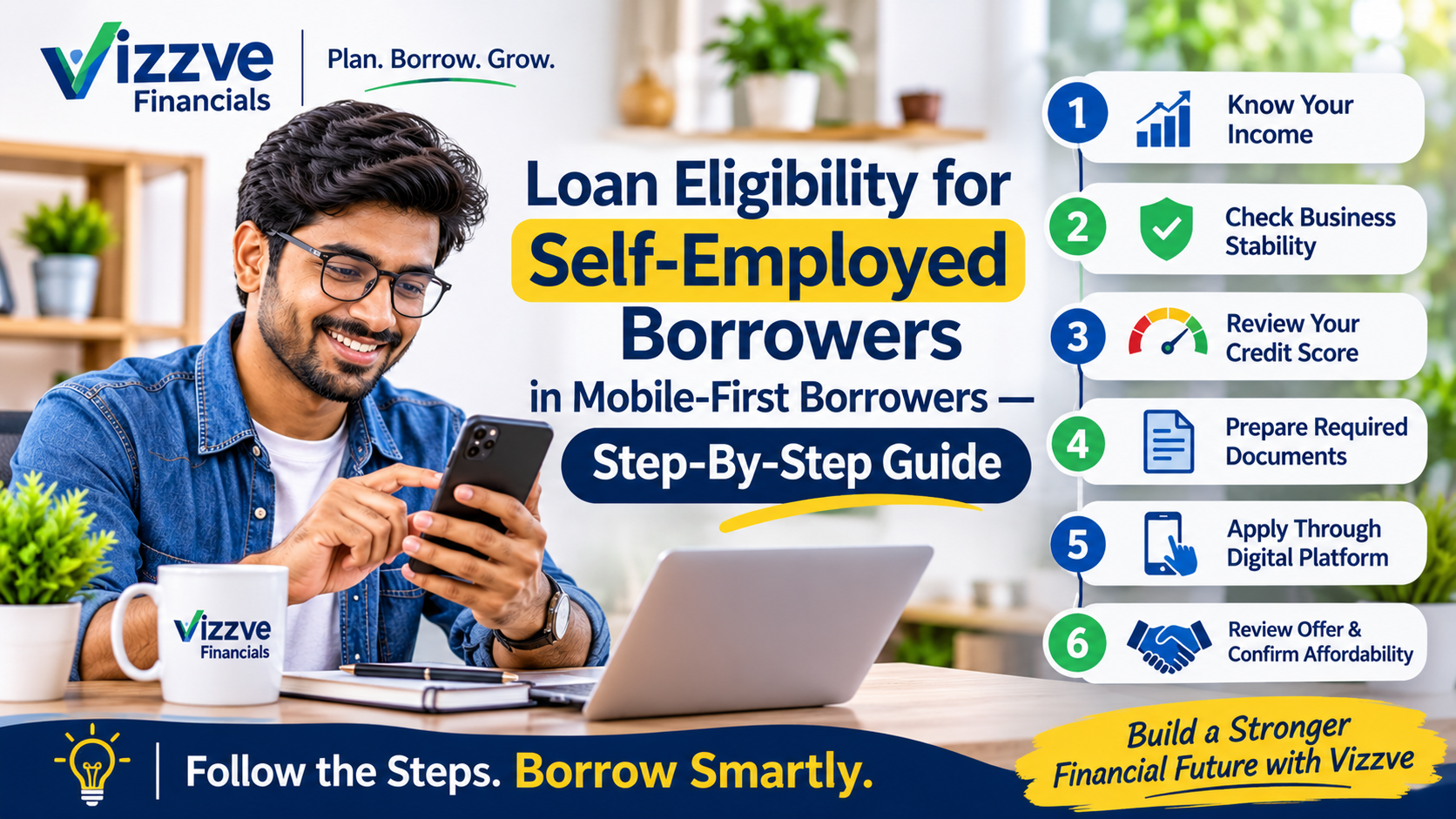
Applying for a loan as a self-employed individual can sometimes feel challenging. Unlike salaried employees, business owners, freelancers, consultants, and independent professionals may not receive a fixed monthly salary. Their earnings can vary depending on business performance, customer payments, seasonal demand, and market conditions.
But does that mean self-employed individuals cannot get loans? Absolutely not.
Today, digital financial services are making it more convenient for borrowers to explore loan options, understand eligibility requirements, and complete application processes using their smartphones.
For mobile-first borrowers, knowing the right steps before applying can save time and help avoid unnecessary application mistakes.
In this guide, we explain how self-employed borrowers can check loan eligibility, prepare documents, understand credit requirements, and approach digital borrowing responsibly.
What Is Loan Eligibility for Self-Employed Borrowers?
Loan eligibility refers to the financial and personal requirements an applicant must satisfy to qualify for a loan.
For self-employed individuals, lenders generally evaluate several factors before making a lending decision.
These may include:
-
Monthly or annual business income.
-
Business stability and continuity.
-
Credit score and repayment history.
-
Existing loans and financial commitments.
-
Bank account transactions.
-
Income tax returns or financial records.
-
Overall repayment capacity.
Since self-employed individuals may not have salary slips, lenders can assess other acceptable documents to understand their income and financial position.
The exact requirements depend on the lender, loan product, loan amount, and applicable lending policies.
Why Mobile-First Borrowers Should Understand the Eligibility Process
Mobile-first borrowers prefer accessing financial services through smartphones and digital platforms.
Instead of depending entirely on physical branch visits, borrowers may be able to explore financial products, submit information, upload documents, and track application progress online.
However, digital convenience does not mean every applicant will qualify automatically.
Understanding eligibility requirements before applying helps borrowers:
-
Prepare the necessary documents.
-
Check their financial readiness.
-
Understand the importance of credit history.
-
Avoid incorrect application information.
-
Compare available loan options.
-
Make informed repayment decisions.
A well-prepared application can make the borrowing process more organised.
Step-by-Step Guide to Check Loan Eligibility for Self-Employed Borrowers
Step 1: Understand Your Monthly Business Income
The first step is to calculate how much money you earn through your business or professional activities.
Self-employed individuals may generate income through:
-
Retail and wholesale businesses.
-
Freelancing and independent projects.
-
Consulting services.
-
Online businesses.
-
Small manufacturing units.
-
Professional services.
-
Local shops and trading activities.
Calculate your average monthly income using reliable financial records rather than considering only your best-performing month.
Example:
Suppose a small business owner earns:
| Month | Business Income |
|---|---|
| January | ₹45,000 |
| February | ₹50,000 |
| March | ₹55,000 |
| April | ₹48,000 |
Average monthly income: ₹49,500.
This calculation provides a clearer picture of income consistency.
Step 2: Check Your Business Stability
Lenders may consider how long your business has been operating and whether it generates consistent income.
Prepare relevant records that demonstrate business activity.
Depending on the lender, these may include:
-
Business registration documents.
-
GST records, where applicable.
-
Income tax returns.
-
Business bank statements.
-
Financial statements.
-
Professional registration documents, where relevant.
A consistent financial record can help explain your business activity and income sources.
Step 3: Review Your Credit Score
Your credit score is an important part of your borrowing profile.
It reflects information from your credit history, including previous loans and repayment behaviour.
Before applying, review:
-
Your existing credit accounts.
-
Previous EMI payment records.
-
Outstanding credit card balances.
-
Late payment history.
-
Recent credit enquiries.
-
Errors in your credit report.
Paying existing EMIs and credit card bills on time can help maintain a healthy credit profile.
There is no universal credit score that guarantees loan approval across all lenders.
Step 4: Calculate Your Existing Financial Obligations
Before applying for another loan, understand how much of your monthly income is already committed.
Consider:
-
Existing loan EMIs.
-
Credit card payments.
-
Business expenses.
-
Household expenses.
-
Other financial commitments.
Example:
| Financial Details | Monthly Amount |
|---|---|
| Average monthly income | ₹60,000 |
| Business expenses | ₹15,000 |
| Household expenses | ₹15,000 |
| Existing loan EMI | ₹8,000 |
| Remaining amount | ₹22,000 |
The remaining ₹22,000 is not automatically available for a new EMI. You should also account for emergency savings, seasonal income changes, and unexpected expenses.
Choose a repayment amount that fits your actual financial situation.
Step 5: Prepare the Required Documents
Documentation is an important part of the loan application process.
Self-employed borrowers should keep their financial and identity records organised.
Commonly requested documents may include:
| Document | Purpose |
|---|---|
| PAN card | Identity and financial verification |
| Aadhaar or accepted ID | Identity verification |
| Address proof | Residential verification |
| Bank statements | Income and transaction assessment |
| Income tax returns | Income verification, where required |
| Business registration | Business verification, where applicable |
| Financial statements | Understanding business performance |
Requirements vary by lender and loan product. Check the official document checklist before applying.
Step 6: Choose a Verified Digital Lending Platform
Mobile-first borrowers should always verify the platform before sharing personal or financial information.
Check the following:
-
Identify the actual regulated lender.
-
Verify the bank or NBFC involved.
-
Visit the official website or application.
-
Review customer support information.
-
Read the privacy policy.
-
Check the loan-related terms and conditions.
Do not trust applications or individuals promising guaranteed approval without proper verification.
Step 7: Complete the Loan Application Carefully
Once you understand the eligibility requirements and have prepared your documents, you can proceed with the application through the lender's verified channel.
During the application:
-
Enter your personal details accurately.
-
Provide correct business information.
-
Declare your actual income.
-
Submit genuine supporting documents.
-
Check the information before submitting.
-
Use secure document-upload facilities.
Incorrect information or incomplete documents may delay the application or affect the lender's assessment.
Step 8: Review the Loan Offer and Charges
If a lender offers you a loan, do not accept it without understanding the financial obligations.
Carefully review:
-
Approved loan amount.
-
Interest rate.
-
Annual Percentage Rate (APR).
-
Processing charges.
-
Repayment period.
-
Monthly EMI.
-
Late payment charges.
-
Foreclosure or prepayment conditions, where applicable.
-
Total repayment amount.
Review the Key Fact Statement (KFS), where applicable, before accepting the loan.
Step 9: Confirm Your Repayment Capacity
The final step is to determine whether you can comfortably repay the loan.
Self-employed borrowers should consider fluctuations in business income, unexpected expenses, and seasonal slowdowns.
Do not borrow simply because a loan is available.
Choose an amount and repayment schedule that allow you to manage your existing financial responsibilities without unnecessary pressure.
Important Factors That Influence Loan Eligibility
| Eligibility Factor | Why It Matters |
|---|---|
| Business income | Demonstrates earning capacity |
| Income consistency | Helps assess financial stability |
| Credit history | Shows previous repayment behaviour |
| Existing EMIs | Indicates current debt obligations |
| Bank statements | Provide evidence of financial activity |
| Business continuity | Helps assess business stability |
| Documentation | Supports identity and income verification |
| Repayment capacity | Helps determine affordability |
Practical Example: How a Self-Employed Borrower Can Prepare
Consider Priya, who operates a small online clothing business.
She wants to explore a personal loan for an important business-related expense.
Before applying, she follows these steps:
-
Calculates her average monthly business income.
-
Reviews her bank statements.
-
Checks her credit report.
-
Calculates existing monthly EMIs.
-
Organises her identity and financial documents.
-
Researches verified lending options.
-
Compares interest rates and repayment terms.
-
Selects a loan amount based on affordability.
By following a structured process, Priya can understand her financial readiness before submitting an application.
Her final eligibility and approval will depend on the lender's independent assessment.
Common Mistakes to Avoid During the Loan Application Process
1. Not Checking Credit History
Applying without reviewing your credit report can result in overlooking errors or previous repayment issues.
2. Providing Incorrect Income Information
Always declare genuine and verifiable income. Avoid exaggerating business earnings.
3. Ignoring Existing EMIs
Taking additional financial commitments without calculating existing obligations can create repayment difficulties.
4. Uploading Incomplete Documents
Missing or unclear documents can delay verification.
5. Applying Through Unknown Platforms
Never share sensitive personal information with unverified loan applications or representatives.
6. Ignoring Loan Charges
A seemingly attractive loan offer may include processing charges and other costs. Review the total borrowing cost before accepting.
7. Choosing an Unaffordable EMI
Your repayment schedule should match your real income and expenses, not your expected future earnings.
Benefits of Following a Step-by-Step Eligibility Process
Understanding the loan eligibility process provides several advantages.
-
Better preparation: You know which documents to arrange.
-
Improved financial awareness: You understand your actual repayment capacity.
-
Fewer application mistakes: Accurate information helps avoid preventable issues.
-
Better loan comparisons: You can evaluate multiple offers.
-
Responsible borrowing: You avoid taking loans beyond your financial capacity.
-
Digital convenience: You can prepare and manage many application activities online.
Digital Lending Safety Tips for Mobile-First Borrowers
Digital lending can offer convenience, but borrowers should remain careful while using online platforms.
Follow these safety practices:
-
Verify the identity of the regulated lender.
-
Check the official lender's website.
-
Read the KFS and loan agreement.
-
Understand the APR and all applicable charges.
-
Review the application's data permissions.
-
Never share your OTP, PIN, or banking password.
-
Avoid transferring money to personal accounts claiming to represent a lender.
-
Save payment receipts and loan documents.
For regulatory information, refer to the Reserve Bank of India's official website.
How Vizzve Supports Informed Digital Borrowing
Vizzve aims to make financial information and digital financial services easier to understand and access.
For self-employed individuals exploring borrowing options, understanding income requirements, documentation, eligibility conditions, and repayment responsibilities is an important first step.
Before proceeding with any Vizzve-related financial service, check the official website for the relevant product details, applicable eligibility conditions, charges, and lending partner information.
Always verify the actual lender and review the complete terms before accepting a financial product.
Frequently Asked Questions (FAQs)
1. Can self-employed individuals apply for personal loans?
Yes. Business owners, freelancers, consultants, and independent professionals may apply for personal loans, subject to the lender's eligibility requirements.
2. What is the first step in checking loan eligibility?
Start by calculating your average monthly income and reviewing your existing financial commitments.
3. Is a salary slip required for self-employed borrowers?
Not necessarily. Lenders may accept bank statements, income tax returns, and other business financial records as income evidence.
4. What documents are needed for a self-employed loan?
Common documents include PAN, accepted identity and address proof, bank statements, income tax returns, and business-related records where required.
5. Does business age affect loan eligibility?
It can. Some lenders consider how long a business has operated and whether it demonstrates consistent financial activity.
6. Can freelancers apply for digital loans?
Yes. Freelancers may qualify if they meet the lender's income, credit, documentation, and repayment requirements.
7. Does a low credit score affect loan approval?
It may affect the lender's assessment. However, eligibility criteria and credit score requirements differ between lenders.
8. Can I apply for a loan using my smartphone?
Yes. Some lenders provide digital application facilities through official mobile applications and websites.
9. How do existing EMIs affect loan eligibility?
Existing EMIs reduce the income available for additional repayments and may influence the lender's assessment.
10. Can I get a loan if my business income changes every month?
Possibly. Lenders may examine income patterns, financial records, and overall repayment capacity when assessing variable income.
11. How can I improve my chances of loan eligibility?
Maintain a healthy credit history, organise financial documents, demonstrate genuine income, repay existing loans on time, and avoid excessive borrowing.
12. Does completing all application steps guarantee approval?
No. Approval depends on the lender's verification, underwriting process, eligibility requirements, and lending policies.
Final Thoughts
Understanding loan eligibility does not have to be complicated for self-employed borrowers.
Whether you run a small shop, manage an online business, work as a freelancer, or provide professional services, following a step-by-step process can help you prepare for borrowing.
For mobile-first borrowers, digital platforms can make financial services more accessible and convenient. However, convenience should always be combined with careful financial planning.
Check your income, review your credit history, prepare your documents, verify the lender, and understand the repayment terms before applying.
With Vizzve, make informed financial decisions, explore digital financial services responsibly, and take confident steps towards your financial goals.
Published on : 05th November 2026
Published by : Avinash S
www.vizzve.com || www.vizzveservices.com
Follow us on social media: Facebook || Linkedin || Instagram
🛡 Powered by Vizzve Financial
RBI-Registered Loan Partner | 10 Lakh+ Customers | ₹600 Cr+ Disbursed