

Introduction
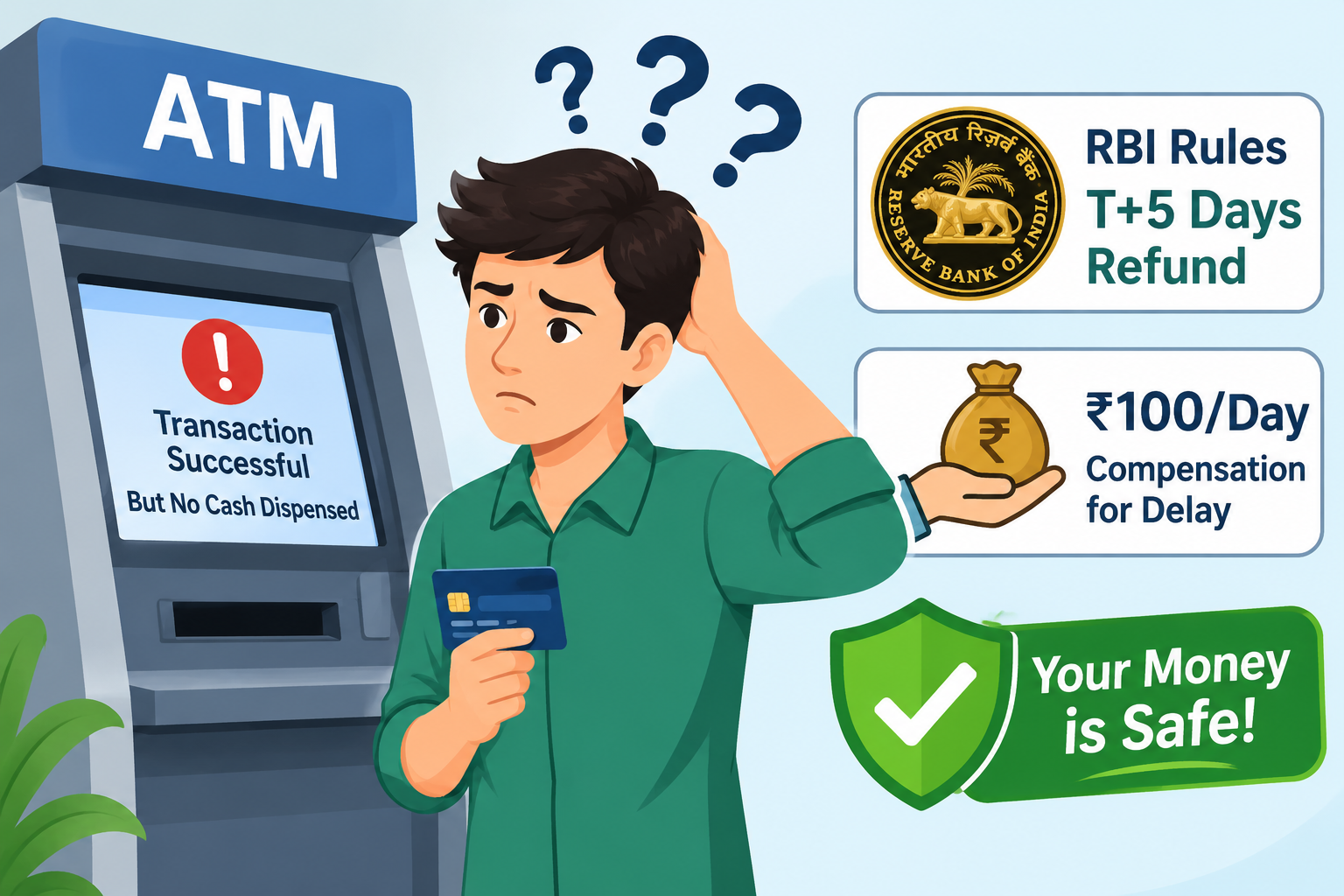
Imagine visiting an ATM to withdraw ₹5,000 for an urgent business payment. You enter your PIN, the screen processes the request, and your bank sends a debit notification. However, the ATM does not release any cash.
You check the account balance, and the amount has been deducted.
This situation can be stressful, especially when you are self-employed and depend on your bank account for daily business expenses, supplier payments, customer collections and loan repayments.
The good news is that a failed ATM withdrawal does not automatically mean your money is lost. The Reserve Bank of India (RBI) has established a time limit for reversing eligible failed ATM transactions. It has also prescribed compensation when the reversal is delayed beyond the permitted period.
For self-employed borrowers using mobile-first lending platforms, understanding this process is important. A failed transaction may temporarily reduce the available account balance and create difficulties when managing cash flow or preparing financial records.
This guide explains what happens when an ATM debits your account but does not dispense cash, how to raise a complaint, what RBI rules say about refunds and compensation, and how to maintain reliable banking records for future loan applications.
AI Answer Box: What should you do if an ATM debits your account but gives no cash?
If your bank account is debited but the ATM does not dispense cash, immediately check your account statement and save the transaction details. Register a complaint with your card-issuing bank or the ATM owner bank. Under RBI rules, an eligible failed ATM transaction must generally be reversed within a maximum of T+5 calendar days, where T is the transaction date. If the reversal is delayed beyond this period, the card-issuing bank must pay compensation of ₹100 per day of delay, credited automatically.
Keep your complaint number, SMS alert, transaction details and bank response until the matter is resolved.
1. What Does ATM Debited but Cash Not Dispensed Mean?
An ATM failed transaction occurs when the withdrawal process is unsuccessful, but the customer's bank account is still charged.
For example:
-
You request ₹3,000 from an ATM.
-
The transaction appears successful on your banking app.
-
Your account balance decreases by ₹3,000.
-
The ATM does not release the money.
This is commonly called a cash-not-dispensed transaction or a failed ATM withdrawal.
The failure may happen because of a technical problem, communication interruption, insufficient cash in the machine or a timeout during transaction processing.
The important point is that a debit notification alone does not prove that cash was successfully delivered.
2. Why Does an ATM Deduct Money Without Dispensing Cash?
Several technical and operational problems can cause this situation.
2.1 ATM Communication Failure
ATMs communicate with banking networks to verify account details and authorise withdrawals.
If the communication link becomes unstable during the transaction, the account may be debited even though the machine does not complete the cash-dispensing process.
2.2 ATM Runs Out of Cash
Sometimes an ATM does not contain enough suitable currency notes to complete a withdrawal.
For example, you request ₹5,000, but the ATM cannot dispense the required combination of notes. A technical failure during this process may result in a debit without cash delivery.
2.3 Technical or Software Error
An ATM may experience:
-
Hardware malfunction
-
Software errors
-
Cash dispenser problems
-
Network interruptions
-
Transaction timeouts
-
Communication errors between the ATM and the bank
2.4 Power Interruption
A sudden power failure or system restart during a transaction may interrupt the withdrawal process.
2.5 Delayed Transaction Processing
In some cases, the ATM and bank systems may not update at exactly the same time. The account may show a debit even though the withdrawal has not been completed successfully.
The transaction should be checked through the bank's records rather than assuming that the money has permanently disappeared.
3. What Are the RBI Rules for ATM Debited but Cash Not Dispensed?
The RBI has issued specific instructions for failed transactions involving ATMs and Micro-ATMs.
Under RBI Circular RBI/2019-20/67, dated September 20, 2019, banks are required to reverse eligible failed ATM transactions within a maximum of T+5 days.
The framework became effective on October 15, 2019.
RBI ATM Refund and Compensation Rules
| Situation | RBI requirement |
|---|---|
| Account debited but cash not dispensed | Automatic or proactive reversal |
| Maximum reversal period | T+5 calendar days |
| Meaning of T | Date of the transaction |
| Compensation for delay | ₹100 per day |
| Who receives compensation? | Account holder |
| How is compensation credited? | Automatically, without a separate claim |
Important: T+5 means five calendar days after the transaction date, not five working days. The transaction date is counted as T.
Example of an ATM Refund Timeline
Suppose you withdraw money on November 7.
| Event | Example |
|---|---|
| ATM transaction date | November 7 |
| Transaction reference generated | November 7 |
| Maximum reversal period | T+5 calendar days |
| Expected latest reversal date | November 12 |
| Delay beyond the permitted period | Compensation becomes applicable |
The bank should reverse the eligible amount within the prescribed period. If it does not, ₹100 per day of delay beyond the deadline is payable.
The exact refund and compensation calculation should be checked against the transaction date and the applicable RBI framework.
4. How to Get Your Money Back After a Failed ATM Withdrawal
If your account is debited but the ATM does not dispense cash, follow these steps.
Step 1: Check Your Bank Account
Open your bank's mobile application, internet banking service or account statement.
Confirm:
-
Whether the amount was actually debited
-
The date and time of the transaction
-
The withdrawal amount
-
The transaction reference number
-
Whether a reversal has already taken place
Do not rely only on the ATM screen.
Step 2: Save the Transaction Details
Keep the following information:
-
Date of withdrawal
-
Approximate transaction time
-
ATM location
-
ATM identification number, if visible
-
Bank name
-
Withdrawal amount
-
Transaction reference number
-
Debit SMS or app notification
If the ATM prints a failed transaction receipt, preserve it.
Step 3: Contact Your Card-Issuing Bank
Register a complaint with the bank that issued your debit card.
You can generally use:
-
Customer care telephone number
-
Mobile banking application
-
Internet banking complaint section
-
Bank branch
-
Official email or grievance portal
RBI also advises customers to report failed ATM transactions promptly.
Step 4: Obtain a Complaint Reference Number
Always ask for a complaint or service request number.
This number helps you:
-
Track the investigation
-
Follow up with customer care
-
Submit supporting information
-
Escalate the issue if the refund is delayed
Step 5: Monitor Your Account
Check your account statement regularly until the amount is reversed.
If the amount is credited, verify that the reversal matches the original withdrawal amount.
Step 6: Follow Up if the Refund Is Delayed
If the reversal does not happen within T+5 calendar days, contact the bank again.
Mention the applicable RBI rule and ask the bank to confirm:
-
The transaction investigation status
-
The expected reversal date
-
Whether compensation has been credited
5. Which Bank Should You Contact?
Customers sometimes use an ATM operated by a bank different from the one that issued their debit card.
For example:
-
Your savings account is with Bank A.
-
You use an ATM operated by Bank B.
-
Your account is debited, but Bank B's ATM does not dispense cash.
In such cases, you should contact your card-issuing bank first. RBI's customer guidance also recommends lodging a complaint with the card-issuing bank or ATM owner bank at the earliest.
| ATM situation | Recommended action |
|---|---|
| Your own bank's ATM | Contact your card-issuing bank |
| Another bank's ATM | Contact your card-issuing bank first |
| White Label ATM | Contact your card-issuing bank and use the operator details displayed at the ATM if needed |
| Cash partially dispensed | Report the exact amount received and the amount missing |
| No cash and no receipt | Use the account debit alert and transaction details |
Do not assume that you must visit the ATM owner's branch before reporting the issue to your own bank.
6. What Documents Are Required for an ATM Failed Transaction Complaint?
Most complaints can be started using transaction details. Additional documents may be requested during the investigation.
| Document or information | Why it is useful |
|---|---|
| Bank account statement | Shows the debit |
| SMS notification | Confirms the transaction alert |
| ATM receipt | Provides transaction information, if available |
| ATM location | Helps identify the machine |
| Transaction reference number | Helps trace the transaction |
| Complaint acknowledgement | Supports follow-up |
| Identity verification | May be requested by the bank |
Never share your ATM PIN, OTP, CVV or full card credentials with anyone claiming to process your refund.
A genuine bank representative should not need your ATM PIN or OTP to reverse a failed withdrawal.
7. What If the Bank Does Not Refund the ATM Amount?
If your bank does not resolve the complaint, you can escalate the matter through its grievance redressal system.
7.1 Contact the Bank's Grievance Officer
If customer care does not provide a satisfactory response, raise the issue with the bank's official grievance redressal department.
Include:
-
Original complaint number
-
Transaction date and amount
-
ATM location
-
Account debit proof
-
Previous communication
-
Your requested resolution
7.2 Approach the RBI Ombudsman
The Reserve Bank – Integrated Ombudsman Scheme, 2026 provides a cost-free grievance redress mechanism for eligible complaints involving covered regulated entities.
Before approaching the RBI Ombudsman, customers generally need to complain to the concerned bank first.
Under the current scheme, an eligible complaint may be taken to the RBI Ombudsman if:
-
The bank has rejected the complaint or provided an unsatisfactory response; or
-
The bank has not replied within 30 days, or the applicable higher timeline where relevant.
The complaint must also meet the scheme's other eligibility and limitation requirements.
Official complaint portal: https://cms.rbi.org.in
RBI Contact Centre: 14448. This contact centre provides guidance about the grievance process and complaint status; it is not itself the complaint filing portal.
8. How Does an ATM Failed Transaction Affect Self-Employed Borrowers?
Self-employed individuals often depend on their bank accounts for business and personal financial activities.
Unlike salaried employees, they may receive income from multiple customers, platforms, projects or business activities.
A failed ATM withdrawal can temporarily affect their available balance.
8.1 Temporary Cash-Flow Problems
Suppose a freelance designer withdraws ₹8,000 to pay a supplier.
The ATM debits the amount but does not dispense cash. Until the reversal arrives, the money may not be available for the planned payment.
This can create temporary difficulty in managing:
-
Supplier payments
-
Business purchases
-
Travel expenses
-
Employee payments
-
Household expenses
-
Loan instalments
8.2 Bank Statement Clarity
A failed ATM transaction may appear as a debit followed by a reversal.
This does not automatically indicate irresponsible financial behaviour.
However, borrowers should keep the complaint reference and reversal entry so that they can explain the transaction if a lender asks for clarification.
8.3 Loan Repayment Planning
If a failed withdrawal reduces the available balance, a borrower may need to arrange another payment method for an upcoming EMI.
A missed EMI may affect repayment history. Therefore, borrowers should monitor their account and arrange an alternative payment if a scheduled repayment is at risk.
8.4 Does a Failed ATM Transaction Reduce Your Credit Score?
A failed ATM withdrawal by itself does not automatically reduce your credit score.
Credit scores are influenced by credit-related information such as repayment history, outstanding balances and credit enquiries.
However, if the temporary shortage causes a loan EMI or credit card payment to be missed, that separate repayment issue may affect your credit profile.
9. ATM Failed Transactions and Mobile-First Lending
Mobile-first lending allows borrowers to explore loan products, submit applications and complete eligible verification steps using digital channels.
For self-employed borrowers, digital banking records can help demonstrate income patterns and financial activity.
A failed ATM transaction does not automatically make a borrower ineligible for a loan. Lenders generally assess several factors, including income, repayment capacity, existing obligations, credit history and the documents required by their lending policy.
Banking Records That May Help a Self-Employed Borrower
-
Recent bank statements
-
Business income records
-
Invoices and customer payment records
-
Tax-related documents, where applicable
-
Existing loan repayment records
-
Valid KYC information
What Should Borrowers Do After a Failed ATM Transaction?
-
Report the transaction immediately.
-
Save the complaint reference.
-
Keep the debit and reversal entries.
-
Monitor upcoming EMI dates.
-
Avoid unnecessary withdrawals until the issue is resolved.
-
Maintain separate business and personal records where practical.
-
Provide accurate information if a lender asks about an unusual transaction.
10. Real-World Example: A Self-Employed Business Owner Faces an ATM Failure
Consider a fictional example.
Ravi runs a small electrical repair business. He receives customer payments through bank transfers and uses his savings account for regular business expenses.
One afternoon, Ravi tries to withdraw ₹6,000 from an ATM to purchase repair materials.
The ATM processes the transaction but does not release cash. His bank sends a debit alert showing that ₹6,000 has been deducted.
Ravi takes the following steps:
-
He checks his mobile banking application.
-
He saves the transaction reference number.
-
He notes the ATM location and transaction time.
-
He contacts his card-issuing bank.
-
He receives a complaint reference number.
-
He checks his account until the amount is reversed.
-
He keeps the complaint and reversal details with his financial records.
This approach helps Ravi track the problem and maintain a clear record of the failed withdrawal.
Practical lesson: A failed ATM transaction should be treated as a banking service issue that needs documentation and follow-up. It should not be hidden or confused with an unexplained cash withdrawal.
11. Common Mistakes to Avoid After an ATM Cash Withdrawal Failure
| Mistake | Why it can create problems | Better approach |
|---|---|---|
| Waiting without reporting | Makes follow-up harder | Register a complaint promptly |
| Deleting debit messages | Removes useful evidence | Save SMS and screenshots |
| Not noting ATM location | Makes investigation difficult | Record the location |
| Sharing an OTP | Creates fraud risk | Never disclose OTPs |
| Contacting unofficial agents | May expose you to scams | Use official bank channels |
| Ignoring complaint number | Makes tracking difficult | Preserve acknowledgement |
| Assuming the debit is final | May cause unnecessary panic | Check for reversal |
| Ignoring upcoming EMIs | Can create repayment problems | Arrange an alternative payment if needed |
12. How to Protect Yourself from ATM Withdrawal Problems
A few precautions can reduce confusion and make it easier to resolve failed transactions.
Before Using an ATM
-
Prefer ATMs in secure, well-maintained locations.
-
Check whether the machine appears damaged or tampered with.
-
Avoid accepting help from strangers.
-
Cover the keypad while entering your PIN.
-
Check the ATM screen for transaction messages.
During the Transaction
-
Wait for the transaction to complete.
-
Do not leave immediately if the machine displays an error.
-
Check whether cash has actually been dispensed.
-
Avoid repeating the withdrawal immediately if the first transaction is still being processed.
After the Transaction
-
Check your account balance.
-
Save the transaction alert.
-
Collect the receipt if available.
-
Report any mismatch promptly.
-
Monitor the account until the issue is resolved.
13. Pros and Cons of Mobile-First Banking for Self-Employed Borrowers
Mobile-first banking can make daily financial management easier, but borrowers should understand its limitations.
| Advantages | Limitations |
|---|---|
| Convenient account monitoring | Requires a working internet connection |
| Instant transaction alerts | Notifications may sometimes be delayed |
| Easy access to statements | Digital records may need explanation |
| Online complaint registration | Complaint resolution may take time |
| Easier tracking of transactions | Technical errors can interrupt services |
| Convenient loan application journeys | Digital access does not guarantee loan approval |
14. How to Maintain Better Financial Records for Loan Eligibility
Self-employed borrowers can improve their financial documentation by following consistent banking practices.
Keep Business and Personal Transactions Organised
Where practical, use a dedicated account for business receipts and expenses. This can make it easier to identify income and regular business costs.
Review Bank Statements Regularly
Check monthly statements for:
-
Unexplained debits
-
Failed ATM withdrawals
-
Reversal entries
-
Duplicate transactions
-
Unusual charges
-
EMI deductions
Maintain Supporting Documents
Keep invoices, receipts, tax records and relevant bank complaint acknowledgements.
Avoid Unnecessary Cash Withdrawals
Use cash when needed, but maintain records for important business expenses.
Pay Existing EMIs on Time
Consistent repayment behaviour is important when lenders evaluate creditworthiness.
Apply for Suitable Loan Amounts
Choose a loan amount and repayment period that fit your income pattern and financial obligations.
15. Expert Commentary: Why Transaction Documentation Matters
From a responsible banking and lending perspective, a failed ATM withdrawal should be handled through a documented complaint process rather than treated as an ordinary cash expense.
For a self-employed borrower, a bank statement may show the original debit and a later reversal. Keeping the transaction reference and complaint acknowledgement helps explain this entry if it is questioned during financial verification.
A lender may consider bank statements alongside other income and repayment documents. The impact of any transaction depends on the lender's assessment process and the borrower's overall financial profile.
Trust and safety reminder: Never pay an unofficial person to speed up an ATM refund. Use your bank's official complaint channels and RBI's recognised grievance mechanism where applicable.
Frequently Asked Questions (FAQs)
1. What should I do if an ATM debits my account but does not dispense cash?
Check your bank statement, save the transaction details and immediately register a complaint with your card-issuing bank. Keep the complaint reference number for follow-up.
2. How many days does an ATM refund take in India?
Under RBI rules, an eligible failed ATM transaction must be reversed within a maximum of T+5 calendar days, where T is the transaction date.
3. What does T+5 mean in ATM transactions?
T refers to the date of the failed transaction. T+5 means five calendar days after that date, not five working days.
4. Can I get ₹100 compensation for a failed ATM transaction?
Yes. If the eligible failed ATM transaction is not reversed within the prescribed T+5 period, the card-issuing bank must pay ₹100 per day of delay beyond the deadline.
5. Do I need to apply separately for ATM delay compensation?
No. RBI's framework requires applicable compensation to be credited automatically to the customer's account without waiting for a separate claim.
6. Should I contact my bank or the ATM owner's bank?
Start with your card-issuing bank. You can also contact the ATM owner bank if necessary. RBI advises customers to report failed transactions promptly.
7. What if I used another bank's ATM?
You can still report the failed transaction to your card-issuing bank. Provide the ATM location, transaction date, amount and reference number.
8. What if the ATM did not give a receipt?
You can still raise a complaint. Use your bank statement, debit SMS, transaction reference and ATM location as supporting information.
9. Can I complain to RBI if the bank does not refund my money?
Yes, eligible customers can approach the RBI Ombudsman under the Reserve Bank – Integrated Ombudsman Scheme, 2026 after first complaining to the bank and meeting the applicable waiting period and other requirements.
10. Does a failed ATM transaction affect my credit score?
A failed ATM transaction by itself does not automatically affect your credit score. However, if it causes you to miss a loan EMI or credit card payment, that missed repayment may affect your credit profile.
11. Can self-employed borrowers face loan rejection because of a failed ATM withdrawal?
A failed ATM withdrawal alone does not automatically result in loan rejection. Lenders assess the applicant's overall income, repayment capacity, credit history and documentation.
12. Should I keep the failed ATM transaction receipt?
Yes, if the ATM provides one. Also save the debit alert, transaction reference and bank complaint acknowledgement.
13. What should I do if the ATM dispenses only part of the requested amount?
Report the exact amount received and the amount missing to your card-issuing bank. Provide the transaction details and request an investigation of the short-dispensed amount.
14. Can I use mobile banking to complain about a failed ATM transaction?
Most banks provide digital complaint facilities through mobile banking or internet banking. You can also use customer care or visit a branch.
15. Is it safe to share an OTP with someone offering an ATM refund?
No. Never share your OTP, ATM PIN, CVV or password with anyone. Use only official bank channels to report and resolve the issue.
Conclusion
An ATM debiting your bank account without dispensing cash can be frustrating, particularly when you depend on that money for business expenses or personal commitments.
However, customers in India have protection under RBI's failed transaction framework. Eligible ATM withdrawals must be reversed within T+5 calendar days, and a delay beyond that period attracts compensation of ₹100 per day.
The most important steps are to report the issue promptly, preserve transaction evidence, track the complaint and monitor your account until the amount is returned.
For self-employed borrowers, maintaining clear banking records is equally important. A properly documented failed transaction can be explained during financial verification and should not automatically be treated as a sign of poor financial behaviour.
Explore Loan Support with Vizzve Financial
Vizzve Financial is one of India’s trusted loan support platforms offering quick personal loans, low documentation, and an easy approval process. Apply at www.vizzve.com.
Explore suitable loan options, review the applicable eligibility requirements and choose borrowing that matches your repayment capacity.
Published on : 7th November
Published by : Doulath beee
www.vizzve.com || www.vizzveservices.com
Follow us on social media: Facebook || Linkedin || Instagram
🛡 Powered by Vizzve Financial
RBI-Registered Loan Partner | 10 Lakh+ Customers | ₹600 Cr+ Disbursed