

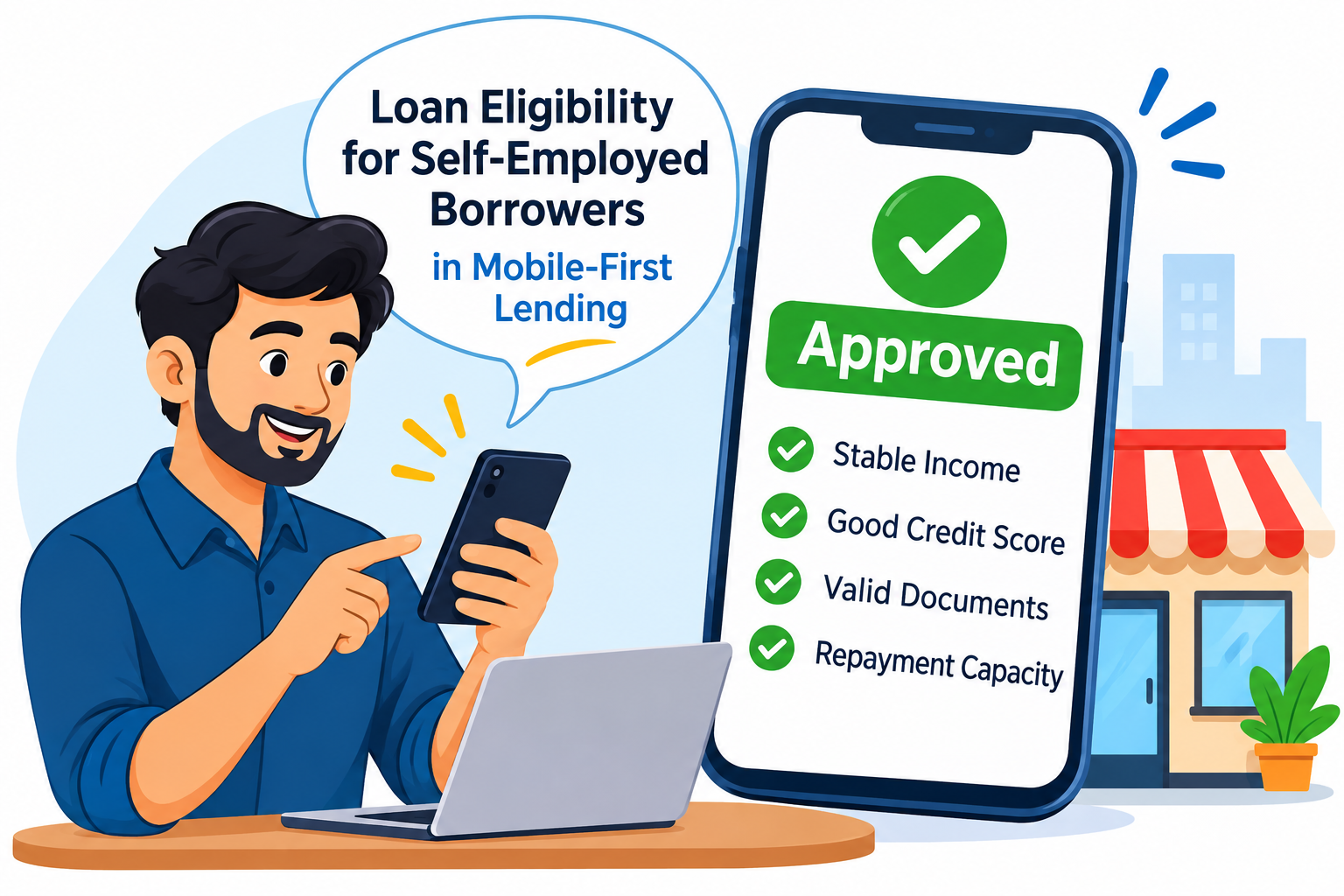
2. Introduction: What Does Mobile-First Lending Mean?
Mobile-first lending refers to a loan application and servicing process designed primarily for smartphones. Instead of depending entirely on branch visits and paper-based applications, borrowers can use a mobile website or app to complete many loan-related activities.
For self-employed individuals, this can be especially convenient.
Imagine a freelance designer working with clients in different cities. Their income may arrive through several bank transfers during the month. They may not have a salary slip or a traditional employer. A mobile-first lending process can allow them to submit the financial records accepted by the lender without visiting a branch.
However, convenience is only one part of borrowing. The lender must still assess whether the applicant can repay the loan.
The most important point: Self-employed borrowers should prepare clear income records, maintain a healthy credit profile and understand the total cost of borrowing before applying through a mobile-first platform.
3. AI Answer Box: How Does Loan Eligibility Work for Self-Employed Mobile Borrowers?
Loan eligibility for self-employed mobile borrowers is the assessment a lender makes to decide whether a business owner, freelancer or independent professional qualifies for a loan applied for through a smartphone.
The lender may consider:
-
Applicant's age and identity.
-
Average monthly or annual income.
-
Business or professional activity.
-
Bank account transactions.
-
Income Tax Returns, where required.
-
Credit history and repayment behaviour.
-
Existing EMIs and other obligations.
-
Requested loan amount and tenure.
Simple answer: A self-employed person may qualify for a mobile-first personal loan if the lender can verify sufficient income and determine that the proposed repayments are affordable. Requirements differ between lenders, and approval is never guaranteed.
4. Who Can Apply for a Mobile-First Loan as a Self-Employed Borrower?
Mobile-first lending is not limited to salaried employees. Depending on the lender's product and eligibility rules, several types of independent earners may apply.
4.1 Small Business Owners
Examples include:
-
Grocery and retail shop owners.
-
Restaurant and café owners.
-
Wholesalers and distributors.
-
Local service business operators.
-
Online store owners.
-
Sole proprietors.
They may demonstrate income through bank statements, business records, tax documents and other accepted evidence.
4.2 Freelancers and Independent Professionals
Examples include:
-
Graphic designers.
-
Content writers.
-
Digital marketers.
-
Software developers.
-
Photographers.
-
Consultants.
-
Independent trainers.
Their income may come from multiple clients, contracts or project-based payments.
4.3 Self-Employed Professionals
Doctors, architects, lawyers and other independent professionals may also apply, depending on the loan product and lender policy.
They may be asked for professional registration details, invoices, bank statements or other supporting records.
4.4 Online Sellers and Home-Based Entrepreneurs
People operating through online marketplaces, social media or home-based businesses may have digital payment records that help demonstrate their business activity.
The lender decides which records are acceptable.
5. What Makes Mobile-First Lending Different?
A mobile-first process is designed around the smartphone experience. It aims to make applications and loan-related services easier to access.
|
Traditional loan process |
Mobile-first loan process |
|---|---|
|
May involve branch visits |
Many steps can be completed online |
|
Physical documents may be requested |
Supported documents can often be uploaded digitally |
|
Application tracking may involve calls or visits |
Some platforms provide digital status updates |
|
Communication may be branch-based |
Updates may be sent through digital channels |
|
Paper-based signatures may be used |
Permitted electronic agreement processes may be available |
Not every lender offers a completely paperless process. Some applications still require additional verification, document clarification or an in-person step.
5.1 Why Can Mobile-First Lending Help Self-Employed Applicants?
Self-employed people often manage their business, customers, payments and records using smartphones.
A mobile-first process can help them:
-
Apply without travelling to a branch for every step.
-
Submit available digital income documents.
-
Review loan information online.
-
Track application progress where the service supports it.
-
Access loan account information digitally.
-
Make repayments through supported payment methods.
The main benefit is convenience. The lender's eligibility requirements still apply.
6. What Are the Eligibility Criteria for Self-Employed Mobile Borrowers?
There is no single eligibility formula used by all digital lenders. Each regulated lender sets requirements based on its loan product and risk policy.
6.1 Age and Identity
The applicant must meet the lender's minimum and maximum age conditions and complete the required identity verification.
The permitted documents and verification method can vary.
6.2 Income Stability
Lenders may review whether the applicant earns enough to repay the proposed EMI.
For self-employed borrowers, income assessment may include:
-
Average monthly income.
-
Annual earnings.
-
Business revenue.
-
Net profit.
-
Professional fees.
-
Regularity of payments.
-
Business operating expenses.
A business with high sales may still have limited disposable income after expenses. This is why profit and cash flow can matter more than revenue alone.
6.3 Business Continuity
Some lenders may require evidence that the applicant has been operating a business or professional activity for a minimum period.
They may check:
-
How long the business has existed.
-
Whether the applicant receives regular payments.
-
Whether business records are available.
-
Whether the income source is reasonably sustainable.
The required business vintage is lender-specific.
6.4 Credit Score and Repayment History
A credit score and credit report help lenders understand previous borrowing behaviour.
They may examine:
-
Timely repayment of existing EMIs.
-
Credit card payment history.
-
Outstanding balances.
-
Loan defaults or settlements.
-
Recent credit enquiries.
-
Credit utilisation.
A strong credit profile can support an application, but it does not guarantee approval.
6.5 Existing Loans and Financial Commitments
Existing EMIs reduce the amount of income available for a new repayment.
For example, a self-employed consultant may earn ₹65,000 per month but already pay ₹18,000 in loan EMIs. The lender may consider these obligations before deciding whether another EMI is affordable.
6.6 Bank Transactions
Bank statements can help show how money moves through the applicant's account.
A lender may examine:
-
Client payments.
-
Business receipts.
-
Average balances.
-
EMI deductions.
-
Returned payments.
-
Unusual or unexplained transactions.
Organised banking records can make income verification easier.
7. What Documents Do Self-Employed Borrowers Need for Mobile Loans?
The exact document list depends on the lender. Some applications may need only a few digital records, while others may require additional financial information.
|
Document |
Purpose |
|---|---|
|
PAN card |
Financial and identity verification |
|
Aadhaar or other accepted identity proof |
Identity verification through permitted methods |
|
Address proof |
Residential verification |
|
Bank statements |
Review of income and cash flow |
|
Income Tax Returns |
Evidence of declared income, where required |
|
Business registration proof |
Evidence of business activity, where applicable |
|
GST records |
Supporting business information, where applicable |
|
Profit and loss statement |
Review of business earnings and expenses |
|
Balance sheet |
Financial position, where required |
|
Professional registration |
Verification for certain professions, where applicable |
7.1 Can You Apply Without a Salary Slip?
Yes. Self-employed people generally do not receive salary slips from an employer.
Depending on lender policy, they may provide:
-
Bank statements.
-
ITR acknowledgements.
-
Client invoices.
-
Business payment records.
-
Contracts or work orders.
-
GST documents, where applicable.
-
Other accepted income evidence.
Remember: No salary slip does not mean no income verification. A lender still needs to assess your repayment capacity.
7.2 How Should You Prepare Documents on Your Smartphone?
Before starting the application:
-
Keep the required documents accessible on your device.
-
Check that images or PDFs are clear and readable.
-
Confirm that names and details match across documents.
-
Use only the lender's official app or website.
-
Upload documents through the authorised process.
-
Avoid sending financial documents to unknown phone numbers or personal email addresses.
8. How Does a Mobile-First Loan Application Work?
The process is generally designed to be completed through a mobile app or mobile-friendly website. The exact steps depend on the platform and the regulated lender providing the loan.
Step 1: Visit the Official Platform
Open the lender's official website or verified mobile application. Check the platform's name, website address and lender information before entering personal details.
Step 2: Enter Basic Information
You may be asked for:
-
Full name.
-
Mobile number.
-
Date of birth.
-
Residential address.
-
PAN details.
-
Employment or business category.
Enter information accurately. Incorrect details can cause verification delays.
Step 3: Select Your Employment Category
Choose the option that correctly describes your work, such as:
-
Self-employed business owner.
-
Freelancer.
-
Independent professional.
-
Sole proprietor.
-
Consultant.
Do not select salaried employment if you operate independently.
Step 4: Provide Income Information
Enter realistic income details based on your records. Depending on the lender, you may need to share bank statements, ITRs or other supporting documents.
Step 5: Complete Required Verification
The lender may perform identity, credit and income checks through permitted processes. Additional information may be requested if the submitted records are incomplete.
Step 6: Review the Loan Offer
If an offer is available, examine:
-
Loan amount.
-
Interest rate.
-
Annual Percentage Rate (APR).
-
Processing fees.
-
Repayment tenure.
-
EMI.
-
Late-payment charges.
-
Prepayment or foreclosure conditions.
Step 7: Read the KFS and Loan Agreement
Read the Key Fact Statement and agreement before accepting. Check that the actual lender is clearly identified and that the amount, charges and repayment terms match the offer you intend to accept.
Step 8: Complete Acceptance and Disbursal
After the required checks and acceptance of the agreement, the regulated lender may disburse the loan according to its process. Disbursal timing is not guaranteed and may vary.
9. How Can Self-Employed Borrowers Improve Mobile Loan Eligibility?
A smartphone makes applying easier, but it cannot replace a strong financial profile. These steps may help improve your chances of qualifying for suitable loan offers.
9.1 Maintain Consistent Income Records
Keep records of payments received from customers, clients and business partners.
Useful records may include:
-
Bank statements.
-
Client invoices.
-
Business receipts.
-
Contracts.
-
Tax filings.
-
Professional payment records.
If your income changes each month, organised records can help show the overall pattern.
9.2 Build a Positive Credit History
Make repayments on time and avoid taking on more debt than you can manage.
Practical habits include:
-
Paying EMIs by their due dates.
-
Paying credit card bills on time.
-
Avoiding unnecessary loan applications.
-
Reviewing your credit report periodically.
-
Correcting inaccurate credit information.
9.3 Reduce Existing Financial Obligations
Before applying, review your outstanding loans and credit card balances.
Reducing unnecessary debt may leave more income available for a new EMI. Do not close useful credit accounts or take financial decisions solely to change a score without understanding the consequences.
9.4 Choose an Affordable Loan Amount
Do not select the highest amount displayed by a platform simply because it is available.
Estimate how much you can repay during both strong and slow business months. A smaller loan with a manageable EMI may be more appropriate than a larger loan that puts pressure on your cash flow.
9.5 Keep Your Business Information Updated
Ensure that your business name, address, registration details and financial records are accurate wherever applicable.
Consistent information can help reduce avoidable verification issues.
10. How Is Repayment Capacity Assessed?
Repayment capacity means the amount a borrower can reasonably afford to pay after considering income and existing financial commitments.
One commonly used measure is the Fixed Obligation to Income Ratio (FOIR). Different lenders may use different formulas and definitions of income.
A simplified illustration is:
Example: A Self-Employed Mobile Loan Applicant
Suppose a small business owner has the following monthly finances:
|
Financial detail |
Amount |
|---|---|
|
Average monthly income |
₹75,000 |
|
Existing loan EMIs |
₹15,000 |
|
Proposed new EMI |
₹9,000 |
|
Total monthly EMIs |
₹24,000 |
|
EMI-to-income ratio |
32% |
Calculation:
This is only an illustrative calculation. It is not an RBI-prescribed approval threshold or a guarantee of loan eligibility.
A lender may also account for business expenses, household costs, income fluctuations, dependants and other obligations.
11. Mobile-First Lending vs Traditional Lending
Both mobile-first and traditional loan processes can provide access to credit. The main difference is the way applications, communication and servicing are handled.
|
Feature |
Mobile-first lending |
Traditional lending |
|---|---|---|
|
Application |
Smartphone app or website |
Branch, website or other channel |
|
Document submission |
Digital upload may be available |
Physical or digital documents |
|
Communication |
App, SMS, email or calls |
Branch, phone or digital channels |
|
Application tracking |
May be available online |
May involve branch or online tracking |
|
Verification |
Digital and other permitted checks |
Digital, manual or in-person checks |
|
Customer support |
Digital support and designated officers |
Branch and other support channels |
A mobile-first process may be convenient, but it is not automatically cheaper, faster or safer than every traditional loan option. Compare the actual terms.
12. Advantages and Limitations of Mobile-First Loans
Advantages
-
Convenient access: Applicants can complete supported steps using a smartphone.
-
Less travel: Many applications do not require repeated branch visits.
-
Digital documents: Accepted financial records can often be uploaded online.
-
Application updates: Some platforms provide digital status tracking.
-
Easy access to information: Loan terms and account details may be available online.
-
Useful for independent earners: Freelancers and business owners can apply without relying on a traditional salary slip.
Limitations
-
Approval is not guaranteed: Lenders still assess financial eligibility.
-
Document requirements remain: Self-employed applicants may need income and business records.
-
Digital fraud risks: Fake apps and impersonation attempts can target borrowers.
-
Technology problems: Poor connectivity or upload errors can interrupt applications.
-
Additional verification: A lender may request manual checks or further information.
-
Loan costs vary: Processing fees, interest and other charges can increase the total repayment amount.
13. Common Mistakes Self-Employed Borrowers Should Avoid
13.1 Entering Estimated Income Without Supporting Records
Do not overstate your income to qualify for a larger loan. Use figures that you can support with genuine financial information.
13.2 Applying Through Unknown Mobile Apps
Avoid apps that do not clearly identify the regulated lender or explain their privacy and grievance processes.
13.3 Ignoring the Total Loan Cost
A low advertised interest rate does not necessarily mean a low-cost loan. Consider the APR and all applicable charges.
13.4 Submitting Unclear Documents
Blurry photographs, incomplete statements and mismatched information can delay verification.
13.5 Applying for Multiple Loans at the Same Time
Repeated applications can lead to multiple credit enquiries. Compare options carefully before applying.
13.6 Accepting an EMI That Is Too High
Self-employed income can change from month to month. Choose an EMI that remains manageable when business receipts are lower.
14. How Can You Identify a Safe Mobile-First Loan Platform?
Convenience should never come at the cost of personal information or financial security.
Before applying, use this checklist:
-
Check the actual bank or NBFC providing the loan.
-
Verify whether the app claims an association with a regulated entity.
-
Review the lender's website and contact information.
-
Read the privacy policy.
-
Understand what personal information is being requested and why.
-
Check the APR, processing fees and repayment schedule.
-
Read the KFS and loan agreement.
-
Look for a clearly identified grievance-redressal officer.
-
Avoid applications that demand unnecessary access to contacts, call logs or personal files.
-
Never share OTPs, passwords or banking PINs with another person.
14.1 What Does the RBI Say About Digital Lending?
The Reserve Bank of India issued the Reserve Bank of India (Digital Lending) Directions, 2025 on 8 May 2025. These directions consolidate requirements for regulated entities involved in digital lending and address areas such as borrower creditworthiness, disclosures, customer protection, digital lending apps and lending-service-provider arrangements.
Some important borrower-facing principles include:
-
The regulated lender must assess the borrower's creditworthiness.
-
Important loan terms must be disclosed.
-
A Key Fact Statement must be provided as applicable.
-
Digital data collection must follow the prescribed consent and privacy requirements.
-
Grievance-redressal arrangements must be made available.
-
The regulated entity remains responsible for its regulatory obligations even when it works with a lending service provider.
Track RBI+1
14.2 How Can You Check a Digital Lending App?
RBI's Digital Lending Apps directory is intended to help customers check an app's claimed association with a regulated entity. The directory has been operational since 1 July 2025. It is an aid to verification, not a guarantee that an app or offer is safe or endorsed by RBI.
Borrowers should independently verify the actual lender and read the loan documents before proceeding.
14.3 What Should You Do If You Have a Digital Lending Complaint?
Start by raising the issue with the lender or its designated grievance-redressal officer. Keep copies of the application, KFS, agreement, payment records and complaint correspondence.
For eligible complaints against covered regulated entities, the Reserve Bank–Integrated Ombudsman Scheme, 2026 came into effect on 1 July 2026. The RBI's official FAQ explains the scheme and complaint channels.
15. Real-World Example: A Freelancer Applying Through a Mobile Platform
Consider a freelance video editor living in Bengaluru.
The freelancer receives payments from several clients. Some months are profitable, while others have fewer projects. The freelancer wants a personal loan for an important expense and decides to explore a mobile-first application.
Before applying, they:
-
Review their income over recent months.
-
Organise client invoices and payment confirmations.
-
Download available bank statements.
-
Check their credit report.
-
Calculate current EMIs and household expenses.
-
Estimate an affordable new EMI.
-
Compare the APR and applicable charges of available offers.
-
Verify the actual lender.
-
Read the KFS and agreement before accepting.
This preparation does not guarantee approval. It does, however, help the applicant understand their financial position and provide clearer supporting information.
16. Mobile Loan Eligibility Checklist for Self-Employed Applicants
Check before applying
17. When Should You Avoid Applying for a Mobile Loan?
A mobile loan may not be suitable if:
-
Your business income has dropped sharply.
-
You cannot estimate your future repayment capacity.
-
You already have several outstanding loans.
-
You are borrowing to repay another loan without a workable plan.
-
You do not understand the interest rate or fees.
-
The platform cannot identify the actual lender.
-
Someone is pressuring you to accept an offer immediately.
-
You are asked to pay an unexplained advance fee to secure approval.
Borrowing should support a genuine financial need, not create a larger repayment problem.
18. Frequently Asked Questions (FAQs)
1. What is mobile-first lending?
Mobile-first lending is a digital loan process designed primarily for smartphones. It may allow borrowers to apply, upload documents, receive updates and manage loan information through an app or mobile website.
2. Can self-employed people apply for mobile personal loans?
Yes. Business owners, freelancers, consultants and independent professionals can apply if they meet the lender's eligibility and verification requirements.
3. What is the eligibility for self-employed mobile borrowers?
Lenders may assess age, income, business continuity, credit history, bank transactions, existing EMIs and repayment capacity. Exact requirements differ between lenders.
4. Can I apply for a loan without a salary slip?
Yes. Self-employed applicants may provide alternative income evidence, such as bank statements, ITRs, client invoices and business records accepted by the lender.
5. Is ITR mandatory for a self-employed digital loan?
Not for every lender or product. Some lenders may request ITRs, while others may accept alternative financial documents.
6. Can freelancers get personal loans through mobile apps?
Yes. Freelancers may apply by providing acceptable income evidence, including client payment records, invoices, contracts, bank statements and tax documents.
7. Do mobile loan apps approve loans instantly?
Not necessarily. Some applications may be processed quickly, but identity, income, credit and other verification checks can take time. Approval and disbursal are not guaranteed.
8. What credit score is required for a self-employed loan?
There is no universal score that guarantees approval. Lenders consider the applicant's overall credit history and financial profile under their own policies.
9. What documents should I keep ready on my phone?
Depending on lender requirements, you may need PAN, accepted identity and address proof, bank statements, ITRs, business records and other income documents.
10. Can small business owners apply for digital personal loans?
Yes. Small business owners may apply if they meet the lender's criteria and can demonstrate sufficient repayment capacity.
11. How do mobile lenders verify self-employed income?
They may review bank statements, tax records, invoices, business financial statements and other permitted information, depending on their verification process.
12. How can I improve my mobile loan eligibility?
Maintain timely repayments, organise your income records, review your credit report, reduce unnecessary debt and request an amount that fits your repayment capacity.
13. Are mobile-first loans safe in India?
They can be safe when provided through a legitimate arrangement involving a regulated lender. Verify the actual lender, check the platform's claims, read the KFS and avoid suspicious applications.
14. What is the Key Fact Statement in digital lending?
The KFS is a standardised loan disclosure document that explains important information such as the APR and applicable charges. Read it before accepting the loan.
15. Does mobile-first loan eligibility guarantee approval?
No. Meeting basic criteria does not guarantee approval. The lender makes the final decision after assessing documents, credit history, income and repayment capacity.
19. Conclusion
Mobile-first lending can make borrowing more convenient for self-employed individuals who manage their businesses and finances through smartphones. Freelancers, shop owners, consultants, online sellers and independent professionals may all explore digital personal loans, subject to lender-specific requirements.
The key to a stronger application is preparation. Maintain clear income records, manage existing EMIs, review your credit profile and choose a loan amount that you can repay comfortably.
Before accepting any offer, verify the actual lender, compare the total borrowing cost and read the KFS and loan agreement carefully.
Explore digital loan support with Vizzve Financial: Visit www.vizzve.com and review the available options and applicable terms before applying.
Published on : 03rd November
Published by : Doulath bee
www.vizzve.com || www.vizzveservices.com
Follow us on social media: Facebook || Linkedin || Instagram