

Introduction
For self-employed people, income does not always arrive on the same date or in the same amount. A freelancer may receive several payments in one month and very few in the next. A small business owner may experience seasonal sales, delayed customer payments or unexpected operating costs.
These income fluctuations make financial planning especially important. Without savings, even a temporary interruption in work can make it difficult to pay household bills, manage business expenses or repay an existing personal loan.
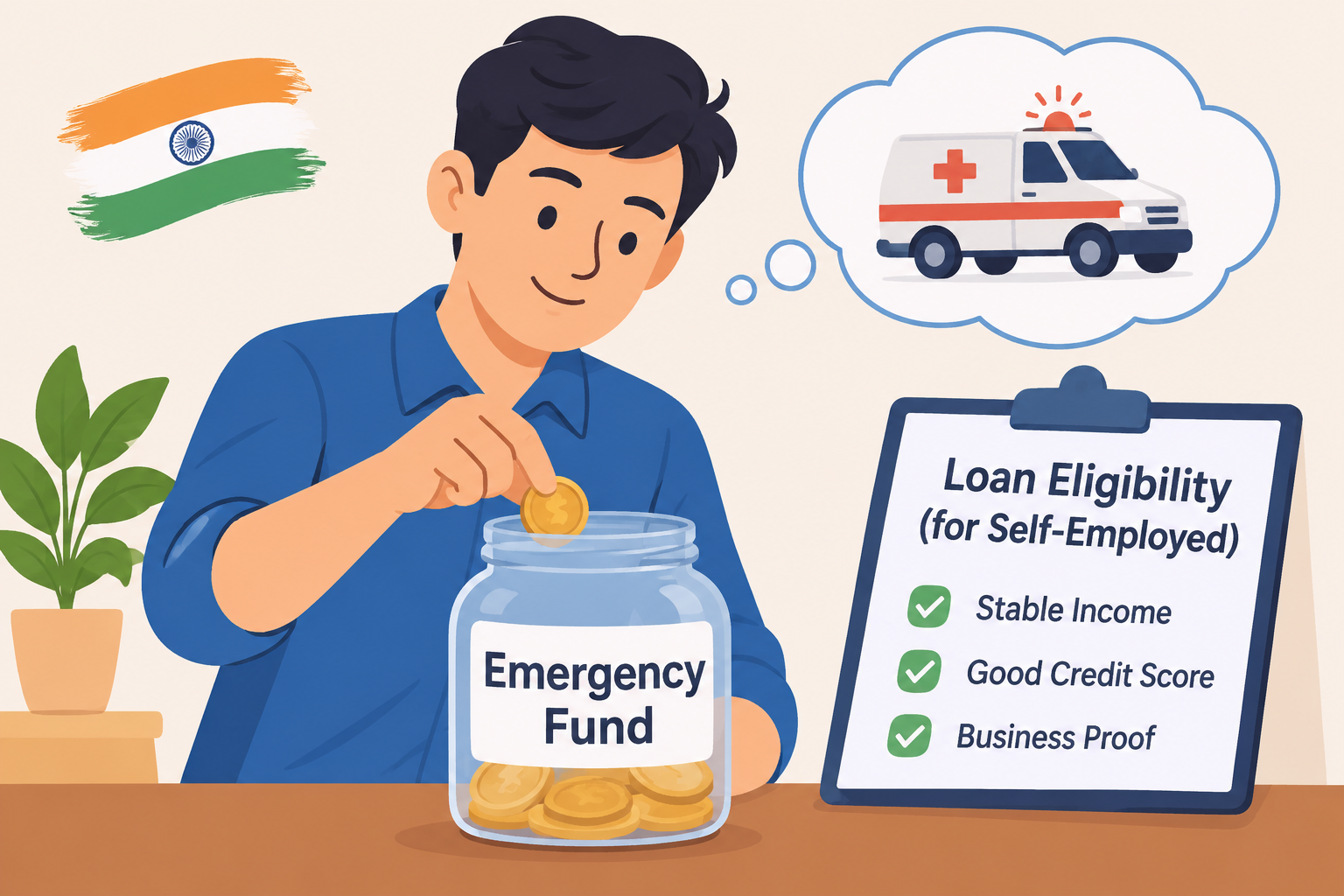
An emergency fund is money set aside for unexpected expenses and temporary income shortages. It provides a financial safety net so that you do not have to depend immediately on credit cards, personal loans or informal borrowing whenever something goes wrong.
The Reserve Bank of India's financial education material recommends that people with less secure income, including self-employed individuals, consider keeping savings that can cover at least six months of expenses or more. It also encourages starting with small, regular contributions if building the full amount immediately is not possible.
This guide explains how self-employed borrowers in India can calculate their emergency fund target, save with irregular income, choose a suitable place to keep the money and protect their loan repayments.
AI Answer Box: How to Build an Emergency Fund in India
An emergency fund is a separate savings reserve used for unexpected expenses such as medical bills, urgent repairs, temporary loss of income or essential household costs.
Self-employed borrowers can build one by following these steps:
-
Calculate essential monthly household and business expenses.
-
Set a target covering at least six months of essential expenses, adjusting for income stability.
-
Open or designate a separate, accessible savings account.
-
Save a fixed percentage of income whenever payments arrive.
-
Transfer a larger amount during high-income months.
-
Keep the money liquid and avoid investing the entire reserve in volatile assets.
-
Refill the fund after using it for a genuine emergency.
Example: If essential monthly expenses are ₹30,000, a six-month emergency fund target is ₹1,80,000. You can build it gradually through monthly or income-based savings.
H2: What Is an Emergency Fund?
An emergency fund is a dedicated amount of money saved to handle unexpected financial situations. It is not meant for planned shopping, holidays, routine lifestyle upgrades or regular business expansion.
For a self-employed person, it can help cover:
-
Essential household expenses during a slow business period
-
Medical treatment or urgent healthcare costs
-
Emergency vehicle or equipment repairs
-
Essential business expenses during temporary cash-flow problems
-
Rent, electricity and other necessary bills
-
Loan EMIs when income is temporarily delayed
-
Urgent travel due to a family emergency
An emergency fund is different from ordinary savings because it has a specific purpose: protecting your financial stability when something unexpected happens.
H3: Why Is an Emergency Fund Important for Self-Employed Borrowers?
Unlike salaried employees who may receive a predictable monthly salary, self-employed people often experience changes in income.
For example:
-
A consultant may have fewer projects in a particular month.
-
An online seller may experience lower sales outside festive seasons.
-
A shop owner may face delayed customer payments.
-
A freelancer may wait several weeks for an invoice to be cleared.
-
A small business may need to temporarily stop operations because of equipment damage.
Without savings, these situations can affect household finances and loan repayment schedules.
An emergency fund gives you time to manage the problem without immediately taking on additional debt.
H2: How Much Emergency Fund Should You Have in India?
The right emergency fund amount depends on your monthly expenses, income stability, family responsibilities, existing loans and business requirements.
A common planning guideline is to save three to six months of essential expenses. Self-employed individuals with irregular income may benefit from targeting six to twelve months, depending on their circumstances.
The RBI's financial education material specifically advises people who run businesses or are self-employed to consider saving for six months or more.
H3: Emergency Fund Calculation
Use this simple formula:
Emergency Fund Target = Essential Monthly Expenses × Number of Months
For example, if your essential monthly expenses are ₹30,000:
| Emergency period | Required savings |
|---|---|
| 3 months | ₹90,000 |
| 6 months | ₹1,80,000 |
| 9 months | ₹2,70,000 |
| 12 months | ₹3,60,000 |
These figures are illustrative. Your target should reflect your actual financial responsibilities.
H3: What Expenses Should You Include?
Include expenses that you cannot easily avoid during an income disruption.
| Expense category | Example monthly amount |
|---|---|
| House rent | ₹9,000 |
| Groceries and household essentials | ₹6,000 |
| Electricity, phone and internet | ₹2,000 |
| Transport | ₹2,500 |
| Medical and essential insurance costs | ₹2,000 |
| Existing loan EMI | ₹6,000 |
| Essential business expenses | ₹2,500 |
| Total | ₹30,000 |
In this example, the six-month target is ₹1,80,000.
Do not automatically include every business expense. Separate essential operating costs from optional spending, expansion plans and purchases that can be postponed.
H3: Should You Save Three, Six or Twelve Months of Expenses?
| Financial situation | Possible target |
|---|---|
| Stable income and low financial responsibilities | 3–6 months |
| Variable freelance income | 6–9 months |
| Seasonal small business income | 6–12 months |
| Single-income household with dependants | 6–12 months |
| High fixed expenses or uncertain business cash flow | 9–12 months |
These are planning ranges, not mandatory financial rules. Choose a target that is realistic for your situation.
H2: How to Build an Emergency Fund with Irregular Income
Saving can feel difficult when your income changes every month. A fixed savings amount may not be practical for every freelancer or business owner.
Instead of depending only on a fixed monthly deposit, create a flexible system that adjusts to your cash flow.
H3: Step 1 — Track Your Income for at Least Three to Six Months
Start by recording the money you actually receive.
Do not calculate your savings plan only from invoices raised or expected payments. An unpaid invoice is not available cash.
Track:
-
Date of payment received
-
Client or business source
-
Amount received
-
Essential business costs
-
Household expenses
-
Loan repayments
-
Amount available for savings
This helps you identify your average income and understand how much you can save safely.
H3: Step 2 — Separate Personal and Business Money
Mixing personal and business funds can make it difficult to understand your actual financial position.
Consider maintaining separate accounts or clearly separated account records for:
-
Business receipts
-
Business operating expenses
-
Personal household expenses
-
Emergency savings
When you receive a business payment, first account for necessary business costs, taxes and other obligations. Then transfer an affordable amount towards household expenses and emergency savings.
Do not treat the entire customer payment as personal income.
H3: Step 3 — Start with a Small Savings Target
You do not need to save a large amount immediately.
For example:
-
Save ₹500 whenever you receive a small payment.
-
Transfer ₹1,000 after a completed project.
-
Set aside a percentage of larger customer receipts.
-
Increase the contribution when monthly income improves.
The first milestone can be ₹5,000 or ₹10,000. After reaching it, continue towards one month of essential expenses and then expand the reserve.
H3: Step 4 — Save a Percentage of Every Payment
A percentage-based system is often more practical than a fixed amount for people with variable income.
For example, you may decide to transfer 5% or 10% of the money available after essential business costs and required obligations into your emergency fund.
The percentage is a personal planning choice, not a prescribed rate. If cash flow is tight, start with a smaller contribution.
Illustrative example:
| Monthly available income | 5% savings | 10% savings |
|---|---|---|
| ₹25,000 | ₹1,250 | ₹2,500 |
| ₹40,000 | ₹2,000 | ₹4,000 |
| ₹60,000 | ₹3,000 | ₹6,000 |
| ₹80,000 | ₹4,000 | ₹8,000 |
The key is to make saving a regular habit while ensuring that essential expenses and existing repayment obligations remain manageable.
H3: Step 5 — Save More During High-Income Months
Self-employed borrowers may earn more during festive seasons, project completion periods or months with higher customer demand.
Instead of increasing lifestyle spending immediately, use part of the additional income to strengthen your emergency fund.
For example, if your usual available monthly income is ₹40,000 but you receive ₹65,000 in a strong month, consider transferring a portion of the additional ₹25,000 into savings after accounting for taxes, business costs and other commitments.
H3: Step 6 — Automate Your Savings
Mobile banking can make emergency savings easier to manage.
You can:
-
Set up a recurring transfer if your income is predictable.
-
Use a calendar reminder to transfer money after receiving payments.
-
Review your savings balance once a week.
-
Maintain a simple spreadsheet or budgeting app.
-
Turn on account alerts to monitor deposits and withdrawals.
Automation is useful, but do not set a recurring transfer so high that it causes an overdraft or leaves insufficient money for essential payments.
H2: Where Should You Keep Your Emergency Fund in India?
Emergency savings should be accessible when needed. The purpose is financial protection, not maximising investment returns.
Suitable options may include:
H3: 1. Separate Savings Bank Account
A separate savings account can help you avoid spending the money accidentally.
Advantages:
-
Easy access through authorised banking channels
-
Clear separation from daily spending
-
Convenient balance tracking
-
Suitable for the first layer of emergency savings
Check account fees, minimum balance requirements, withdrawal limits and the bank's deposit insurance status.
H3: 2. Sweep-In Fixed Deposit
A sweep-in facility may link a savings account with a fixed deposit. Depending on the bank's terms, money above a specified threshold may be moved into a fixed deposit and withdrawn automatically when the savings balance is insufficient.
Before using this option, check:
-
Minimum balance and sweep threshold
-
Premature withdrawal rules
-
Applicable interest rate
-
Penalties, if any
-
Whether funds are available when required
Do not assume every sweep-in product works the same way.
H3: 3. Short-Term Fixed Deposit
A short-term fixed deposit may be considered for the portion of your emergency reserve that you are less likely to need immediately.
However, check premature withdrawal conditions and ensure that you retain enough money in an easily accessible account.
H3: 4. Liquid Mutual Funds
Some people consider liquid mutual funds for short-term cash management. However, these are market-linked mutual fund products, not bank deposits.
They carry risks, including credit risk, interest-rate risk and possible delays or limitations in redemption. Returns are not guaranteed, and they are not covered by DICGC deposit insurance.
Do not put your entire emergency reserve into a mutual fund if you need guaranteed immediate access to that money.
H3: Comparing Emergency Fund Options
| Option | Access to money | Main consideration |
|---|---|---|
| Savings account | Generally easy | Interest may be relatively low |
| Sweep-in FD | Depends on bank rules | Understand sweep and withdrawal conditions |
| Short-term FD | Depends on premature withdrawal rules | May involve a penalty |
| Liquid mutual fund | Subject to redemption process | Market-linked; not a bank deposit |
A practical approach is to keep the immediately required portion in an accessible savings account and consider other options only for money that can tolerate their withdrawal conditions and risks.
H2: How to Build an Emergency Fund While Repaying a Personal Loan
Having an existing loan does not mean you must stop saving. However, your emergency fund contribution should not make your EMI difficult to pay.
Consider this order:
-
Cover essential household expenses.
-
Set aside required business operating costs and applicable taxes.
-
Pay existing loan EMIs on time.
-
Maintain necessary insurance and other essential obligations.
-
Contribute an affordable amount to emergency savings.
-
Review the contribution whenever income changes.
If you are struggling to meet an EMI, contact your lender through official channels to discuss the available options. Do not ignore repayment notices or take a high-cost loan simply to make another loan payment.
H3: Example of Monthly Budgeting
Suppose a self-employed consultant has ₹50,000 available for monthly household budgeting after business costs and tax provisions.
| Budget item | Amount |
|---|---|
| Household essentials | ₹22,000 |
| Existing personal loan EMI | ₹8,000 |
| Insurance and medical provision | ₹3,000 |
| Emergency fund contribution | ₹5,000 |
| Other planned expenses | ₹7,000 |
| Remaining buffer | ₹5,000 |
| Total | ₹50,000 |
This is an illustrative budget, not a recommended allocation for everyone. The right amounts depend on actual expenses, income and loan terms.
H2: Real-World Example: An Emergency Fund for a Freelancer
Consider a freelance graphic designer in Bengaluru who earns different amounts each month.
-
Month 1: ₹45,000
-
Month 2: ₹30,000
-
Month 3: ₹55,000
-
Month 4: ₹38,000
The freelancer calculates essential monthly expenses at ₹25,000. A six-month emergency fund target would therefore be ₹1,50,000.
Instead of trying to save the full amount immediately, the freelancer begins with a small reserve and contributes more during stronger months.
| Month | Illustrative savings |
|---|---|
| Month 1 | ₹3,000 |
| Month 2 | ₹1,500 |
| Month 3 | ₹5,000 |
| Month 4 | ₹2,500 |
| Total saved | ₹12,000 |
After four months, the freelancer has created an initial buffer of ₹12,000. The target is still some distance away, but the savings habit has started.
This example shows why consistency and flexible contributions can be more realistic than waiting for a month when a large amount is available.
H2: Common Mistakes to Avoid When Building an Emergency Fund
H3: 1. Keeping Emergency Savings in Your Daily Spending Account
When emergency money is mixed with regular spending, it may be used for non-essential purchases.
Better approach: Maintain a separate account or clearly identified reserve.
H3: 2. Investing All Emergency Money in Risky Assets
Shares, cryptocurrencies and other volatile investments can lose value when you need cash.
Better approach: Prioritise accessibility and capital stability over high returns.
H3: 3. Ignoring Business Expenses
A self-employed person's financial needs may include both household and essential business costs.
Better approach: Identify which business expenses are necessary to keep income-generating operations running.
H3: 4. Waiting Until Income Becomes Stable
Freelance and business income may never be exactly the same every month.
Better approach: Start with small contributions and increase them as cash flow allows.
H3: 5. Using the Fund for Planned Purchases
A holiday, new phone or festival shopping expense is usually not an emergency.
Better approach: Create separate savings goals for planned purchases.
H3: 6. Forgetting to Refill the Fund
Using emergency savings is not a failure. However, leaving the balance low for a long period can reduce your protection.
Better approach: Restart contributions after the emergency has passed.
H2: Pros and Cons of Having an Emergency Fund
| Pros | Cons or limitations |
|---|---|
| Helps manage unexpected expenses | Takes time to build |
| Reduces dependence on fresh borrowing | Money kept in savings may earn modest returns |
| Supports loan repayment during temporary income disruption | Requires regular monitoring |
| Provides financial confidence | Can be tempting to use for non-emergencies |
| Helps protect business continuity | Target may increase as expenses rise |
An emergency fund is not a substitute for health insurance, business insurance or responsible credit management. It works alongside these protections.
H2: How an Emergency Fund Can Support Loan Eligibility
An emergency fund does not automatically increase a credit score or guarantee personal loan approval. Lenders generally assess factors such as income, repayment capacity, existing debt, credit history and their own eligibility criteria.
However, maintaining savings can support better financial management.
It may help borrowers:
-
Manage temporary income interruptions.
-
Avoid missing EMI payments because of a short-term cash shortage.
-
Reduce the need for repeated borrowing.
-
Keep household and business cash flow more organised.
-
Demonstrate more disciplined money management in their own records.
H3: What Mobile-First Lenders May Review
Depending on the lender and product, a digital loan application may involve checks such as:
-
Identity and address verification
-
Bank account information
-
Income and cash-flow details
-
Bank statements or other permitted financial records
-
Credit history
-
Existing loan obligations
-
Repayment capacity
An emergency fund is a personal financial safety net. It should not be presented as a substitute for the documents or eligibility checks required by a lender.
H2: Emergency Fund Checklist for Self-Employed Borrowers
Use this checklist to review your progress.
-
I have calculated my essential monthly household expenses.
-
I have identified essential business expenses separately.
-
I have selected a realistic emergency fund target.
-
I have opened or designated a separate savings account.
-
I save a portion of income whenever payments arrive.
-
I increase savings during stronger income months.
-
I keep enough money accessible for urgent needs.
-
I understand the withdrawal rules of any deposit or investment product I use.
-
I review my emergency fund every three to six months.
-
I refill the fund after using it for a genuine emergency.
H2: Step-by-Step Emergency Fund Plan for the First 12 Months
You can use the following as a starting framework. Adjust the amounts and timeline according to your income and expenses.
| Period | Suggested action |
|---|---|
| Month 1 | Track income and calculate essential expenses |
| Month 2 | Set up a separate emergency savings account |
| Month 3 | Build an initial reserve |
| Months 4–5 | Continue regular income-based contributions |
| Month 6 | Review progress and adjust the target |
| Months 7–9 | Increase contributions during higher-income periods |
| Months 10–11 | Review account accessibility and savings discipline |
| Month 12 | Recalculate the target and plan the next year |
The goal is not to reach a specific amount at any cost. It is to build a sustainable savings habit without neglecting essential expenses or existing loan repayments.
H2: How Digital Tools Can Make Emergency Saving Easier
Mobile-first banking and budgeting tools can help self-employed people monitor cash flow without maintaining complicated paper records.
Useful digital habits include:
-
Checking account balances regularly.
-
Reviewing bank statements to identify recurring expenses.
-
Setting payment reminders for loan EMIs and bills.
-
Using automatic transfers where cash flow permits.
-
Maintaining a monthly income and expense spreadsheet.
-
Keeping transaction alerts active.
-
Using official banking apps and secure devices.
Never share your UPI PIN, ATM PIN, passwords or OTPs with anyone claiming to help you create an emergency fund or improve loan eligibility. A genuine financial institution should not ask you to disclose confidential authentication credentials.
H2: Trust and Safety: Where to Keep Your Bank Deposits
If you keep emergency savings in a bank, understand the deposit insurance rules.
According to DICGC, eligible deposits are insured up to ₹5 lakh per depositor per bank, including principal and interest, subject to the same-right-and-same-capacity rules and applicable conditions. Deposits across branches of the same bank are aggregated for this purpose. The limit does not mean that every financial product is insured.
For example, mutual funds, stocks and bonds are not covered by DICGC deposit insurance. NBFC deposits are also not covered under this bank deposit insurance scheme.
Before selecting an account, check whether the bank is covered and read the relevant product terms. Do not assume that multiple branches of the same bank provide separate ₹5 lakh coverage.
H2: Expert Commentary: Make Financial Resilience a Habit
A useful emergency fund is not necessarily built through large deposits. It is built through a repeatable process.
For a self-employed borrower, the most practical approach is to connect saving with the actual receipt of income. When a customer pays an invoice or a business receives a settlement, the borrower can first account for business costs and required obligations, then move an affordable portion into emergency savings.
The fund should be reviewed when rent, family responsibilities, insurance costs, business expenses or loan EMIs change.
Financial planning perspective: Emergency savings should be accessible, clearly separated from everyday spending and sized according to essential expenses. A high-return investment is not automatically a suitable emergency fund.
This article is for general financial education. It is not personalised financial, tax or investment advice.
H2: How Vizzve Financial Supports Digital Borrowers
Understanding income, expenses, savings and repayment obligations is an important part of responsible borrowing. Self-employed individuals should review their financial position before applying for any credit product and borrow only when the repayment schedule fits their budget.
Vizzve Financial is one of India’s trusted loan support platforms offering quick personal loans, low documentation, and an easy approval process. Apply at www.vizzve.com.
Before applying, review the lender's eligibility conditions, interest rate, fees, repayment schedule and applicable terms. Approval is subject to the relevant lender's assessment and is not guaranteed.
Frequently Asked Questions (FAQs)
1. What is an emergency fund?
An emergency fund is money kept aside to pay for unexpected expenses, such as medical bills, urgent repairs or temporary loss of income. It helps reduce dependence on borrowing during difficult periods.
2. How much emergency fund should a self-employed person have in India?
A common starting target is three to six months of essential expenses. Because self-employed income can fluctuate, six to twelve months may be more appropriate for some people.
3. How do I calculate my emergency fund?
Add your essential monthly household expenses, existing loan EMIs and necessary business costs. Multiply the total by the number of months you want to cover.
4. Can I build an emergency fund with irregular income?
Yes. Save a percentage of actual payments received rather than relying only on a fixed monthly amount. Increase contributions during higher-income months and reduce them when cash flow is tight.
5. Where should I keep my emergency fund in India?
A separate savings bank account is a simple starting point because it provides convenient access. You may consider other options for a portion of the reserve only after understanding their withdrawal conditions and risks.
6. Is a fixed deposit suitable for emergency savings?
A fixed deposit may suit money that you are less likely to need immediately. Check premature withdrawal rules and keep enough readily accessible money in a savings account.
7. Can I use a liquid mutual fund as an emergency fund?
A liquid mutual fund may be considered for part of a short-term reserve, but it is market-linked and not a bank deposit. Returns are not guaranteed, and redemption is subject to the fund's terms and applicable timelines.
8. Should I build an emergency fund before applying for a personal loan?
It is sensible to review your savings and repayment capacity before taking a loan. However, the decision depends on the purpose of borrowing, urgency, existing obligations and your overall financial position.
9. Does an emergency fund improve my credit score?
An emergency fund does not directly increase your credit score. It may help you manage cash shortages and avoid missed repayments, which can support better credit management.
10. Can I use my emergency fund to pay a loan EMI?
You may use it if a genuine emergency temporarily affects your income. Rebuild the reserve after the situation improves and contact your lender if you expect difficulty meeting repayments.
11. Should business owners maintain a separate business emergency fund?
Where possible, yes. Keeping business reserves separate from household emergency savings makes it easier to manage operating costs, supplier payments and temporary interruptions in business activity.
12. Is ₹50,000 enough for an emergency fund?
It depends on your essential monthly expenses. If your essential expenses are ₹25,000 per month, ₹50,000 covers approximately two months. It may be a useful first milestone, but not a complete six-month reserve.
13. How long does it take to build an emergency fund?
It depends on your target and monthly savings capacity. For example, saving ₹5,000 every month would take 36 months to build ₹1,80,000, excluding interest and any withdrawals.
14. Is emergency fund money covered by DICGC?
Eligible deposits in insured banks are covered up to ₹5 lakh per depositor per bank, including principal and interest, subject to DICGC rules. Mutual funds, stocks, bonds and NBFC deposits are not covered by this bank deposit insurance.
15. What should I do after using my emergency fund?
First, manage the emergency and stabilise your cash flow. Then review your monthly expenses, set a fresh savings target and restart contributions until the reserve is restored.
Conclusion: Start Building Your Emergency Fund Today
An emergency fund is one of the most useful financial habits for self-employed borrowers in India. It helps manage income uncertainty, unexpected expenses and temporary business interruptions without immediately depending on new loans.
You do not need a large amount to begin. Calculate your essential expenses, open a separate savings account and start transferring a manageable portion of every payment you receive. Increase your contributions when income improves and review your target regularly.
For mobile-first borrowers, digital banking tools can make tracking and saving easier. However, the most important part is consistency: save within your means, protect the money for genuine emergencies and maintain a repayment plan that does not put unnecessary pressure on your finances.
Plan your savings carefully, borrow responsibly and explore Vizzve Financial at www.vizzve.com for loan support options.
Published on : 21st November
Published by : Doulath bee
www.vizzve.com || www.vizzveservices.com
Follow us on social media: Facebook || Linkedin || Instagram
🛡 Powered by Vizzve Financial
RBI-Registered Loan Partner | 10 Lakh+ Customers | ₹600 Cr+ Disbursed