

Introduction
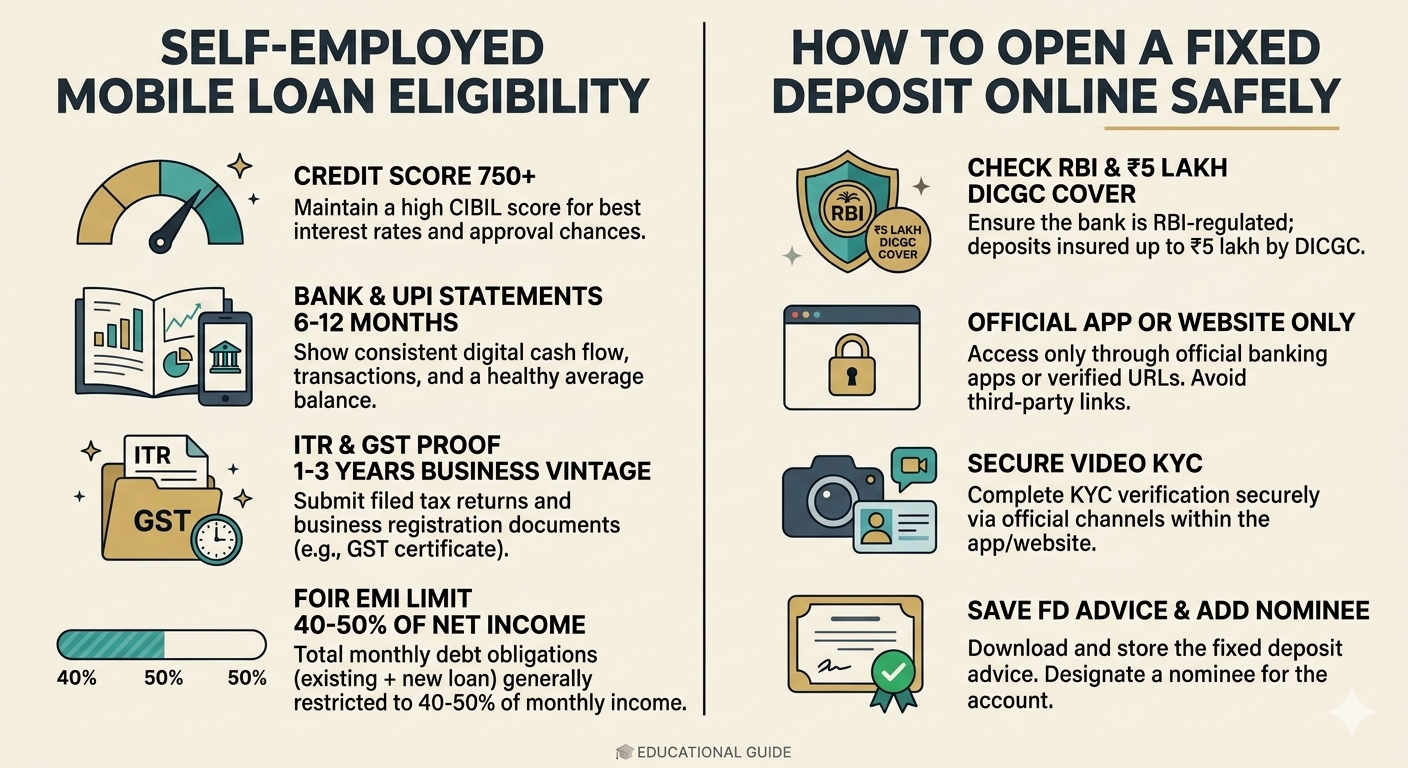
A fixed deposit is a popular savings option for people who want to deposit money for a chosen period and earn interest at a rate offered by the bank or financial institution. Today, many banks allow customers to open an FD through internet banking or a mobile banking application without visiting a branch.
For self-employed people, this convenience can be useful. Freelancers, shop owners, consultants, independent professionals and small business owners may receive income at different times. When business earnings are higher than usual, they may want to set aside a portion of their surplus money for future expenses, emergency planning or other financial goals.
However, opening an FD online should never be rushed. A fake banking website, fraudulent investment message or unsafe payment request can put your savings at risk. Before transferring money, verify the institution, use its official digital channel, understand the deposit terms and save the confirmation documents.
This guide explains how to open a fixed deposit online safely in India, what documents you may need, how to compare FD options, how deposit insurance works and what self-employed borrowers should consider before locking away their savings.
AI Answer Box: How Do You Open a Fixed Deposit Online Safely?
To open a fixed deposit online safely in India, use the official website or mobile banking application of a verified bank. Log in through a secure connection, complete the required KYC checks, select the deposit amount and tenure, review the interest rate and maturity instructions, and confirm the deposit using the bank's authorised authentication process.
Quick steps:
-
Choose a bank and verify its official website or app.
-
Check whether the bank is covered by DICGC deposit insurance.
-
Compare interest rates, tenure and premature-withdrawal conditions.
-
Complete or update your KYC.
-
Enter the FD amount and select the tenure.
-
Choose cumulative or non-cumulative interest, if offered.
-
Review nominee and maturity instructions.
-
Confirm the deposit through the bank's official process.
-
Download the FD receipt and check the details.
Never share your OTP, PIN, password or screen-sharing access with anyone claiming to help you open an FD.
What Is an Online Fixed Deposit?
A fixed deposit is a bank deposit in which you place a specific amount for a selected period. The bank pays interest according to the rate and terms applicable to that deposit.
When you open an FD online, you complete the process using the bank's authorised digital channels instead of filling out a physical form at a branch.
How does an online FD work?
The basic process is straightforward:
-
You select the amount you want to deposit.
-
You choose an available deposit period.
-
The bank displays the applicable interest rate.
-
You review the payout and maturity options.
-
The deposit is funded from an eligible account.
-
The bank issues a deposit confirmation or receipt.
-
The amount and interest are paid according to the selected maturity or payout instructions.
The exact process varies by bank. Some banks allow existing customers to open an FD directly through internet banking, while others may require additional verification or account setup.
Who can consider opening an FD online?
An online fixed deposit may be considered by:
-
Salaried individuals with surplus savings
-
Self-employed professionals
-
Freelancers and consultants
-
Small business owners
-
Retired individuals
-
Families saving for planned expenses
-
People who want to set aside money for a known future requirement
An FD is not suitable for every financial goal. Money needed immediately for business operations, household bills or emergencies should not be locked away without considering liquidity.
Why Should Self-Employed Borrowers Consider Fixed Deposits?
Self-employed people often manage both personal and business finances. Their income may depend on customer payments, seasonal demand, project completion, sales and operating costs.
A fixed deposit can be one way to organise surplus savings, provided the person has already accounted for business expenses and short-term cash requirements.
1. It can help organise surplus funds
A business owner may receive a large customer payment in one month. After accounting for taxes, supplier payments, salaries, rent and other obligations, a portion may remain available for personal savings.
An FD can help keep that surplus separate from money used for everyday spending.
2. It offers a defined interest arrangement
The bank displays the applicable rate and deposit terms before the FD is confirmed. Depending on the product, interest may be paid periodically or added to the deposit for payment at maturity.
Always check whether the quoted rate applies to your chosen amount, tenure and customer category.
3. It can support planned financial goals
You may consider an FD for a future expense such as:
-
Education fees
-
Annual insurance premiums
-
Planned home repairs
-
A major personal purchase
-
A future tax or business-related payment, where appropriate
Choose a maturity date that matches the expected need for the money.
4. It may offer a choice of deposit periods
Banks generally provide different tenure options. The available periods and interest rates vary by institution and may change over time.
5. It can support financial discipline
Keeping money in a separate deposit may reduce the temptation to spend it casually. However, premature withdrawal rules and any applicable penalty should be understood before opening the FD.
How to Open a Fixed Deposit Online Safely: Step-by-Step Guide
Follow these steps before and during the online FD application.
Step 1: Choose a bank or eligible deposit-taking institution
Start by deciding which institution you want to use. Compare banks based on their deposit terms, service quality, accessibility and applicable safety protections.
Do not select an institution only because an advertisement promises an unusually high interest rate.
Check:
-
The institution's legal name
-
Its official website address
-
Whether the institution is authorised to accept the type of deposit being offered
-
Whether the deposit is covered by DICGC insurance, where applicable
-
The institution's customer support and grievance channels
For bank deposits, use the official DICGC website to understand insured-bank coverage.
Step 2: Visit the official website or mobile banking app
Open the bank's website by typing its address yourself or using a trusted bookmark. Alternatively, install the app from the official app store and confirm that the publisher is the bank itself.
Avoid:
-
Links received from unknown WhatsApp numbers
-
Search advertisements that imitate bank websites
-
Unverified APK files
-
Links in unsolicited emails or SMS messages
-
Websites with misspelled bank names or unusual domain endings
A professional-looking website does not automatically prove that it is genuine.
Step 3: Log in securely
Use your existing internet banking credentials or the bank's authorised authentication process.
Before entering details:
-
Check the website address carefully.
-
Confirm that the connection is secure.
-
Avoid public computers for financial transactions.
-
Do not use public Wi-Fi for banking if you can avoid it.
-
Never save banking passwords on a shared device.
-
Do not let another person remotely control your phone or computer.
A padlock symbol alone does not prove that a website belongs to a genuine bank. Always verify the domain.
Step 4: Complete KYC requirements
Banks must follow applicable customer identification and KYC requirements. If you already hold an eligible savings account with the bank and your KYC is up to date, the process may be simpler.
Depending on your customer status and the bank's procedure, you may be asked for:
-
PAN details
-
Aadhaar-based verification, where applicable and voluntarily used under the permitted process
-
Proof of identity
-
Proof of address
-
Mobile number linked to the account
-
Other information required by the bank
Do not send identity documents to unknown individuals or personal email addresses. Submit them only through the bank's authorised channels.
Step 5: Select the FD amount
Decide how much money you can set aside without affecting your daily needs or business commitments.
For self-employed people, this means calculating the money left after accounting for:
-
Business operating expenses
-
Supplier and staff payments
-
Taxes and statutory obligations
-
Household expenses
-
Existing loan EMIs
-
Emergency savings
-
Upcoming large payments
Avoid depositing money that you may need for working capital or immediate expenses.
Step 6: Select the tenure
Choose a deposit period that suits your financial goal.
For example:
-
A short-term FD may suit a planned expense due within a relatively short period.
-
A medium-term FD may suit savings intended for a future purchase.
-
A longer-term FD may suit money that you do not expect to need soon.
Do not assume that a longer tenure will always provide a better return. Compare the actual rates and terms displayed by the bank.
Step 7: Choose the interest payout option
Banks may offer different interest arrangements.
Cumulative FD: Interest is accumulated and paid with the principal at maturity, according to the product's compounding terms.
Non-cumulative FD: Interest is paid at selected intervals, such as monthly, quarterly, half-yearly or annually, where offered.
| Feature | Cumulative FD | Non-Cumulative FD |
|---|---|---|
| Interest payment | Usually at maturity | At selected intervals |
| Regular income | No periodic payout | Yes, if the selected option provides it |
| Compounding | Interest is accumulated as per terms | Depends on the payout structure |
| Common use | Building a future lump sum | Receiving periodic interest |
| Best suited for | People who do not need regular payouts | People who want periodic interest income |
Check the bank's actual calculation method. The payout frequency and effective return may differ between products.
Step 8: Add or review nominee details
A nominee is a person recorded by the bank to facilitate the claim process in the event of the depositor's death, subject to applicable rules.
Check:
-
Whether a nominee is already registered
-
Whether the nominee's name is correct
-
Whether the relationship and other requested details are accurate
-
Whether the bank permits nomination changes online
Nomination is important for smoother claim handling, but it does not automatically settle every question about inheritance or legal ownership.
Step 9: Review all FD details before payment
Read the confirmation page carefully.
Check the following:
| Detail | What to Verify |
|---|---|
| Deposit amount | Correct principal amount |
| Tenure | Correct number of days, months or years |
| Interest rate | Applicable rate for your category |
| Interest option | Cumulative or non-cumulative |
| Maturity date | Correct date |
| Maturity value | Displayed estimate and applicable conditions |
| Premature withdrawal | Whether permitted and what penalty applies |
| Auto-renewal | Whether the FD renews automatically |
| Nominee | Correct details |
| Funding account | Your intended bank account |
Do not confirm the transaction if any important detail is unclear.
Step 10: Make payment through the authorised banking channel
Fund the FD using the payment method displayed inside the bank's official system.
Never transfer money to a personal bank account, QR code or UPI ID supplied by an unknown person claiming to represent a bank.
Do not approve a collect request or enter your UPI PIN merely to receive money or verify an FD. A UPI PIN authorises a payment from your account.
Step 11: Download the FD receipt
After successful completion, download or save the FD advice, receipt or confirmation.
Check that it contains:
-
Your name
-
Deposit account or reference number
-
Principal amount
-
Interest rate
-
Deposit date
-
Maturity date
-
Maturity instructions
-
Nominee details, where displayed
If the money has been debited but the FD confirmation is missing, do not repeat the payment immediately. Check the bank transaction status and contact the bank through its official support channel.
Documents Required to Open a Fixed Deposit Online
The documents required depend on the bank, the customer's existing relationship with it and the applicable KYC process.
| Document or Information | Why It May Be Required |
|---|---|
| PAN | Tax identification and reporting |
| Identity proof | Customer identification |
| Address proof | KYC verification |
| Registered mobile number | Authentication and alerts |
| Savings account details | Funding and maturity credit |
| Email address | Statements and transaction communication |
| Nominee details | Claim facilitation |
| Additional KYC information | Where required by the bank |
What if you are self-employed?
Being self-employed does not automatically mean that you need to submit business income documents to open an ordinary personal FD. The bank's KYC requirements and the type of account or deposit determine what is needed.
If you are depositing money from business earnings, maintain appropriate business and personal financial records. The bank may ask questions or documents where required under its policies and applicable law.
How to Compare Fixed Deposit Options Before Investing
Do not compare FDs only by the headline interest rate. Consider the complete deposit terms.
| Comparison Factor | What to Check |
|---|---|
| Interest rate | Rate for your chosen tenure and amount |
| Deposit period | Whether the maturity date suits your goal |
| Payout frequency | Monthly, quarterly or maturity payout |
| Premature withdrawal | Availability and penalty |
| Auto-renewal | Renewal settings and applicable rate |
| DICGC coverage | Whether the institution is an insured bank |
| Customer service | Official support and complaint process |
| Digital access | Online statements, maturity instructions and service options |
| Tax treatment | Taxability of interest and applicable TDS |
Example: Comparing two illustrative FD offers
The following example is for explanation only. These are not current bank offers or market rates.
| Particulars | Bank A | Bank B |
|---|---|---|
| Deposit amount | ₹1,00,000 | ₹1,00,000 |
| Illustrative annual rate | 6.50% | 6.75% |
| Illustrative tenure | 1 year | 1 year |
| Interest arrangement | Cumulative | Cumulative |
| Premature withdrawal | Check bank terms | Check bank terms |
Although Bank B displays a higher illustrative rate, you should still compare the institution, deposit protection, withdrawal terms and service conditions. A higher advertised rate should never replace due diligence.
How Is Fixed Deposit Interest Calculated?
The interest earned depends on the principal, interest rate, tenure, payout arrangement and compounding method.
For a simple-interest illustration:
Simple interest = Principal × Annual interest rate × Time
Suppose you deposit ₹1,00,000 at an illustrative annual simple-interest rate of 6% for one year.
-
Principal: ₹1,00,000
-
Annual rate: 6%
-
Period: 1 year
-
Illustrative simple interest: ₹6,000
This is only a simplified example. Actual FD interest may be calculated using the bank's applicable compounding and payout rules. The maturity amount may therefore differ.
Before confirming an FD, use the bank's own calculator or maturity-value illustration and check the terms.
Is a Fixed Deposit Safe? Understanding DICGC Deposit Insurance
Deposit safety is one of the most important considerations when opening an FD.
The Deposit Insurance and Credit Guarantee Corporation (DICGC), a wholly owned subsidiary of the Reserve Bank of India, provides deposit insurance for eligible deposits held with insured banks.
What is the DICGC insurance limit?
The current DICGC insurance limit is ₹5 lakh per depositor per insured bank, covering both principal and interest, for deposits held in the same right and capacity.
This means:
-
Savings, current, recurring and fixed deposits at the same insured bank are aggregated.
-
Deposits across different branches of the same bank are aggregated.
-
Eligible deposits at separate insured banks receive separate coverage limits.
-
Principal and accrued interest together count towards the ₹5 lakh limit.
For example, if your eligible deposits at one insured bank total ₹4.80 lakh and accrued interest is ₹10,000, the combined amount is ₹4.90 lakh, within the stated insurance limit. If the combined eligible balance exceeds ₹5 lakh, the excess is not covered by DICGC insurance.
Important: DICGC insurance is not a guarantee that every financial product advertised as an FD is insured. NBFC deposits, company deposits and other investment products should not be assumed to have the same protection as insured bank deposits.
Check the institution and product category before transferring money.
Bank FD vs NBFC Fixed Deposit: What Is the Difference?
Some non-banking financial companies (NBFCs) also accept fixed deposits under applicable rules. These products are not the same as bank deposits.
| Feature | Bank Fixed Deposit | NBFC Fixed Deposit |
|---|---|---|
| Provider | Eligible bank | Eligible deposit-taking NBFC |
| DICGC cover | Available for insured banks, within the limit | Not covered by DICGC |
| Interest rate | Depends on bank and tenure | Depends on NBFC and deposit terms |
| Risk assessment | Check bank and deposit terms | Assess issuer strength and applicable rating information |
| Premature withdrawal | Subject to bank rules | Subject to applicable rules and issuer terms |
| Verification | Check bank's official channels | Verify the NBFC and its authority to accept public deposits |
A credit rating is an opinion about credit risk, not a guarantee of repayment. Read the rating rationale, date and outlook rather than relying only on a rating symbol.
For many savers, understanding the difference between a bank deposit and an NBFC deposit is more important than comparing headline rates alone.
Common Online Fixed Deposit Scams and How to Avoid Them
Fraudsters may use fake websites, social media advertisements, messaging groups and phone calls to convince people to transfer money into fraudulent deposit schemes.
1. Fake bank websites
A fraudulent website may copy a bank's logo, colours and page layout.
Safety tip: Type the official website address yourself and verify the domain before entering login information.
2. Fake FD offers with unusually high returns
Scammers may advertise unusually high or guaranteed returns to create urgency.
Safety tip: Compare the offer with the institution's official published deposit rates. Verify that the institution is authorised to accept that type of deposit.
3. WhatsApp and SMS investment links
A message may claim that an FD offer is available only for a few hours.
Safety tip: Do not open unsolicited links. Visit the institution's official website independently.
4. Requests for OTP, PIN or password
A caller may claim that an OTP is needed to activate, verify or release an FD.
Safety tip: Never share your OTP, internet banking password, debit card PIN or UPI PIN with anyone.
5. Screen-sharing scams
A fraudster may ask you to install an app or share your screen to help complete the FD process.
Safety tip: Do not grant remote access to a stranger. Use the bank's official support channels instead.
6. Personal account payment requests
A fraudster may ask you to transfer money to an individual's account or scan a personal QR code.
Safety tip: Fund your FD only through the authorised payment flow of the verified institution.
7. Fake FD certificates
A person may send a PDF or certificate that looks like an FD receipt but has no genuine deposit behind it.
Safety tip: Verify the deposit by logging into your bank account independently or contacting the bank through official channels.
What Should You Do If You Suspect an Online FD Fraud?
Act quickly if you transferred money to a suspicious account or shared confidential banking details.
-
Contact your bank immediately using its official customer care number or branch.
-
Ask the bank to report and investigate the unauthorised transaction.
-
Block or secure affected banking access and payment instruments as advised by the bank.
-
Change compromised passwords using a trusted device.
-
Report financial cyber fraud through India's National Cyber Crime Reporting Portal at https://cybercrime.gov.in/.
-
Call the national cybercrime helpline 1930 as soon as possible if money has been lost through cyber fraud.
-
Save transaction references, messages, phone numbers, screenshots and other evidence.
-
Follow up with the bank and obtain a complaint reference number.
Do not pay a person who promises to recover your money for an advance fee.
What Happens If You Withdraw an FD Before Maturity?
A fixed deposit is designed for a chosen period, but many bank FDs allow premature withdrawal subject to their terms and applicable rules.
Possible consequences include:
-
A lower interest rate than the original contracted rate
-
A premature withdrawal penalty, where applicable
-
Interest recalculation based on the actual period for which the money remained deposited
-
Product-specific restrictions or exceptions
Some special deposits may have different withdrawal conditions. Always check the terms before opening the FD.
How can you reduce the need for premature withdrawal?
-
Keep emergency savings separate.
-
Avoid depositing business working capital.
-
Match FD maturity dates to expected expenses.
-
Consider splitting a large amount into smaller deposits if the bank permits and the structure suits your needs.
-
Review the bank's withdrawal conditions before confirming.
Splitting deposits may provide flexibility, but it does not increase DICGC insurance beyond the applicable limit at the same bank for deposits held in the same right and capacity.
Fixed Deposit Tax Rules: What Should You Know?
Interest earned on a fixed deposit is generally taxable according to the depositor's applicable income-tax rules. The tax treatment depends on the person's total taxable income and the law applicable for the relevant tax year.
Is FD interest tax-free?
Do not assume that FD interest is tax-free simply because the bank pays it at maturity or deducts tax at source.
Interest generally needs to be considered while calculating taxable income. The actual tax liability depends on the taxpayer's circumstances and applicable provisions.
What is TDS on FD interest?
Banks may deduct tax at source when the applicable statutory conditions and thresholds are met.
Remember:
-
TDS is not necessarily the final tax liability.
-
The amount deducted may need to be considered in your income-tax return.
-
PAN details and applicable declarations can affect tax deduction.
-
Thresholds and rules can change, so check the current tax-year provisions.
For current information, consult the Income Tax Department's official guidance or a qualified tax professional.
Fixed Deposits and Loan Eligibility: What Self-Employed Borrowers Should Understand
A fixed deposit can be part of personal financial planning, but opening an FD does not automatically improve personal loan eligibility.
Lenders may assess:
-
Income consistency
-
Business stability
-
Bank statements
-
Income-tax returns, where required
-
Credit history
-
Existing loan obligations
-
Repayment capacity
-
Other lender-specific eligibility conditions
Does an FD guarantee personal loan approval?
No. A fixed deposit is a savings product, not a guarantee of loan approval. Lenders make independent decisions based on their policies and assessment of the applicant.
Can you use an FD as security for a loan?
Some banks may offer an overdraft or loan against eligible fixed deposits, subject to their product terms.
Before choosing this option, check:
-
The permitted loan or overdraft amount
-
The interest rate
-
Any applicable fees
-
Repayment requirements
-
Whether the FD is marked as a lien
-
What happens if repayment is delayed
A loan against an FD is different from an unsecured personal loan. Compare the cost and conditions before deciding.
Practical Example: How a Self-Employed Person Can Plan an FD
Consider a freelance consultant who receives different amounts each month.
After paying business expenses, taxes, household bills and existing loan EMIs, the consultant has a surplus of ₹1,20,000.
Instead of putting the entire amount into one long-term FD, the consultant first considers:
-
Upcoming business expenses
-
Household emergency needs
-
Insurance and tax payments
-
Existing loan commitments
-
The date on which the money may be needed
After setting aside an appropriate cash buffer, the consultant may decide to place only the genuinely surplus amount into an FD.
This example illustrates a planning approach, not a recommended investment amount. The correct decision depends on actual cash flow, risk tolerance, financial goals and deposit terms.
Pros and Cons of Opening a Fixed Deposit Online
| Pros | Cons |
|---|---|
| Can be opened without visiting a branch, where the bank supports it | Requires careful digital security |
| Convenient access through internet banking or mobile banking | Fake websites and phishing attempts are possible |
| Deposit terms can be reviewed before confirmation | Premature withdrawal may reduce returns |
| Multiple tenure options may be available | Money may be less accessible during the chosen tenure |
| Digital FD receipts are easy to store | Interest is generally taxable |
| May support disciplined savings | Returns may not keep pace with inflation |
Online FD Safety Checklist Before You Confirm
Use this checklist before transferring your money:
-
I have verified the institution's legal name.
-
I am using the official bank website or application.
-
I have checked whether the institution is covered by DICGC, where applicable.
-
I have compared the interest rate and tenure.
-
I understand the premature withdrawal conditions.
-
I have checked the interest payout and maturity instructions.
-
I have reviewed nominee details.
-
I am transferring money only through an authorised banking channel.
-
I have not shared my OTP, PIN or password.
-
I will save the FD receipt after successful confirmation.
Expert Commentary: What Matters More Than a High FD Rate?
A sensible FD decision begins with the purpose of the deposit, not the advertised interest rate. A saver should first decide when the money may be needed, whether the institution is authorised to accept the deposit, what protection applies and what happens if the deposit is withdrawn early.
For self-employed people, liquidity deserves special attention. Business income can fluctuate, and money that appears to be surplus today may be needed for supplier payments, taxes or household expenses later. Keeping a suitable cash buffer before opening an FD can help avoid unnecessary premature withdrawals.
A clear understanding of the deposit terms and the institution's credentials is more valuable than choosing an offer based on a headline rate alone.
Frequently Asked Questions (FAQs)
1. How can I open a fixed deposit online safely in India?
Use the official website or mobile banking app of a verified bank. Complete KYC, compare the interest rate and tenure, review the deposit terms, fund the FD through the authorised channel and download the receipt.
2. Can I open an FD online without visiting a bank?
Yes. Many banks allow eligible customers to open FDs through internet banking or mobile banking. The exact process depends on the bank, account status and KYC requirements.
3. What documents are required to open an online fixed deposit?
Depending on the bank and your existing KYC status, you may need PAN details, identity and address information, a registered mobile number and an eligible bank account.
4. Is an online fixed deposit safe?
An online FD can be opened securely through an authorised bank channel. However, customers must verify the website or app, protect their login details and avoid suspicious payment requests.
5. What is the DICGC insurance limit for fixed deposits?
DICGC currently covers eligible deposits up to ₹5 lakh per depositor per insured bank, including principal and interest, for deposits held in the same right and capacity.
6. Are NBFC fixed deposits covered by DICGC?
No. DICGC insurance applies to eligible deposits with insured banks. NBFC deposits should not be assumed to have DICGC protection.
7. Can self-employed people open fixed deposits online?
Yes. Self-employed individuals can open an FD if they meet the institution's account-opening and KYC requirements. They should first account for business expenses, taxes and working-capital needs.
8. Which is better: cumulative or non-cumulative FD?
A cumulative FD generally pays accumulated interest with the principal at maturity. A non-cumulative FD pays interest at selected intervals where offered. The suitable option depends on whether you need periodic income or a maturity amount.
9. Can I withdraw my fixed deposit before maturity?
Many bank FDs allow premature withdrawal, subject to product conditions and applicable penalties. Check the specific terms before opening the deposit.
10. Is fixed deposit interest taxable in India?
FD interest is generally taxable according to the depositor's applicable income-tax rules. TDS may apply when statutory conditions are met, but TDS is not necessarily the final tax liability.
11. Can I open an FD through a mobile banking app?
Yes, if your bank offers this service and your account is eligible. Use the genuine application published by the bank and avoid installing APK files from unknown sources.
12. Does opening an FD improve my credit score?
Opening an FD does not normally improve your credit score by itself. Credit scores are influenced by credit-related information such as repayment behaviour and credit utilisation, as reported to credit bureaus.
13. Can I take a loan against my fixed deposit?
Some banks offer loans or overdrafts against eligible FDs. The amount, interest rate, repayment conditions and lien rules depend on the bank's product terms.
14. How can I identify a fake FD website?
Check the domain carefully, verify it through the institution's official website and avoid links from unknown messages. Never share banking credentials or transfer money to a personal account for an FD.
15. What should I do if money is debited but the FD is not created?
Check the transaction status through your bank's official channel and contact the bank immediately with the transaction reference. Do not repeat the payment until the first transaction is clarified.
Conclusion
Opening a fixed deposit online can be convenient, but safety begins before you enter your banking details or transfer money. Verify the institution, use its official digital channel, complete KYC securely and review the interest rate, tenure, maturity instructions and premature withdrawal rules.
For self-employed borrowers, the most important step is to separate genuine surplus savings from money needed for business operations, taxes, household expenses and emergencies. A fixed deposit can support a savings plan, but it should fit your cash-flow needs and financial goals.
Take time to understand deposit insurance and tax treatment, save your FD receipt and never share confidential banking information. Careful verification and sensible planning can help you use digital banking more confidently.
Plan your finances carefully and explore loan support options at www.vizzve.com with Vizzve Financial.
Published on : 22nd November 2026
Published by : Doulath bee
www.vizzve.com || www.vizzveservices.com
Follow us on social media: Facebook || Linkedin || Instagram
🛡 Powered by Vizzve Financial
RBI-Registered Loan Partner | 10 Lakh+ Customers | ₹600 Cr+ Disbursed