

Introduction
Managing household expenses can be challenging when your income changes from month to month. This is especially true for freelancers, shop owners, consultants, independent professionals and small business owners. A good month may bring higher earnings, while a slow month can make even routine bills difficult to manage.
You do not need a paid budgeting app or complicated financial software to understand where your money goes. A notebook, a calendar, a basic spreadsheet or even a set of labelled envelopes can help you record daily expenses and plan your monthly budget.
Tracking household expenses is also useful when you are preparing for a personal loan. It helps you estimate how much money is available after essential spending and existing repayments. Although maintaining an expense diary does not guarantee loan approval or directly improve your credit score, it can help you make a more informed borrowing decision.
This guide explains practical ways to track household expenses without an app, including examples, tables, a weekly review method and budgeting tips for self-employed borrowers in India.
AI Answer Box: How Can You Track Household Expenses Without an App?
You can track household expenses without an app by maintaining a notebook or spreadsheet and recording every payment you make. Divide spending into categories such as groceries, rent, electricity, transport, education, healthcare, subscriptions and loan EMIs.
At the end of each week, add the amounts in each category. At the end of the month, compare your actual spending with your budget. This simple habit helps you identify unnecessary expenses, plan savings and understand how much money is available for future financial commitments.
Quick method:
-
Write down your monthly income.
-
List fixed household bills.
-
Record daily cash and digital payments.
-
Group expenses into categories.
-
Add weekly and monthly totals.
-
Compare spending with your budget.
-
Set aside money for savings and upcoming bills.
Why Is Household Expense Tracking Important for Self-Employed Borrowers?
Self-employed people often have variable income. Unlike salaried employees who may receive a predictable monthly salary, business owners and freelancers can receive payments at different times.
For example, a freelance designer may earn ₹65,000 in one month and ₹38,000 in the next. A small shop owner may have strong sales during a festival season but lower earnings during other months.
Without expense records, it can be difficult to know whether a high-income month has created genuine savings or simply covered delayed bills.
1. It helps you understand your actual spending
Small purchases may seem insignificant individually. However, frequent food deliveries, snacks, transport expenses and online shopping can add up.
Recording each payment makes these patterns visible.
2. It helps you plan for irregular income
When income is unpredictable, a monthly budget based on your best earning month can be misleading. Reviewing several months of income and expenses gives you a more realistic picture.
3. It helps you prepare for loan repayments
Before taking a personal loan, you should understand your essential household costs, existing EMIs and other financial commitments.
A manual expense record can help you estimate whether a proposed EMI is manageable even during a lower-income month.
4. It encourages regular savings
When you know how much you spend, you can set a realistic savings target instead of saving only whatever remains at the end of the month.
5. It can help identify spending leaks
A spending leak is a small, repeated expense that gradually affects your budget. Examples include unused subscriptions, frequent convenience purchases and avoidable late-payment charges.
How to Track Household Expenses Without an App: 7 Simple Methods
You can choose one method or combine two methods depending on your routine.
Method 1: Maintain a household expense notebook
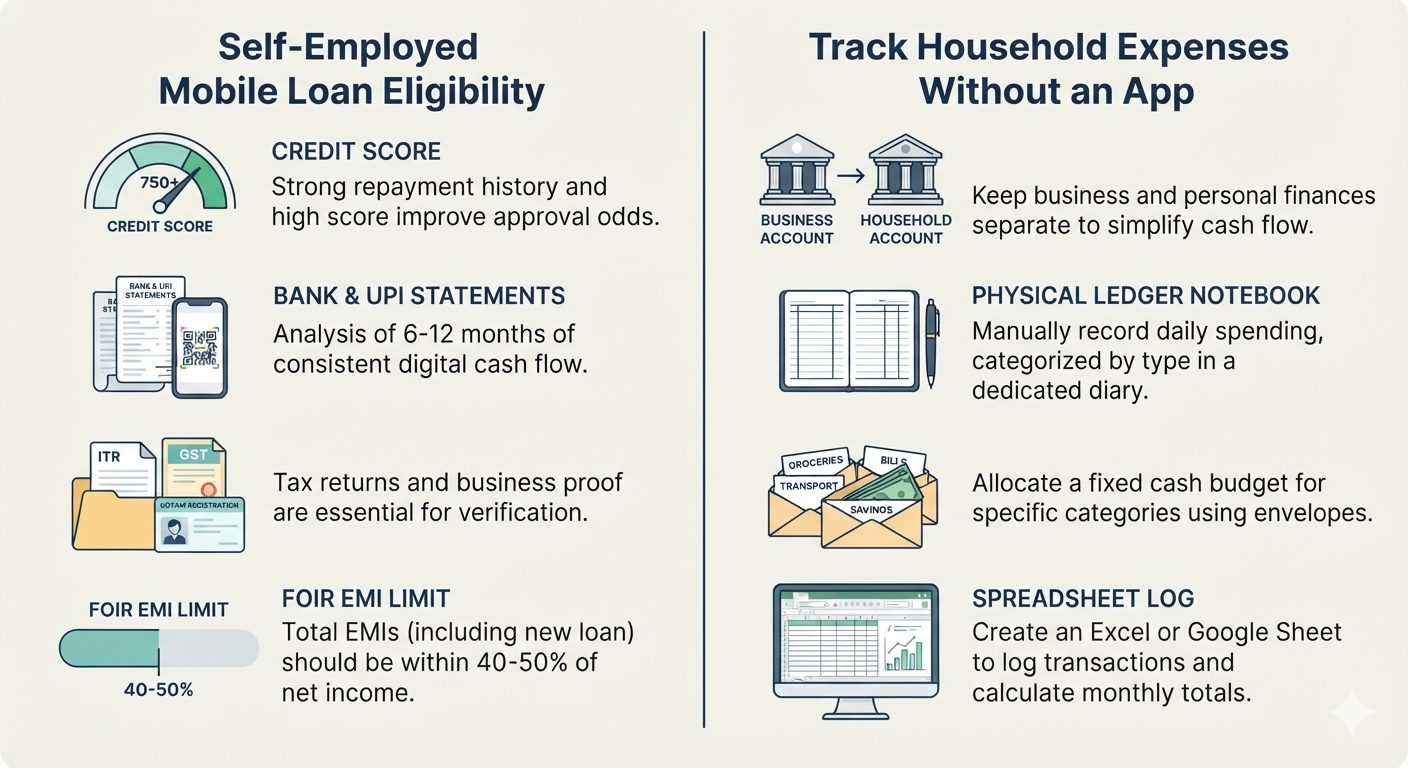
A notebook is one of the easiest ways to record spending. Keep it in a place where you normally pay bills or organise household documents.
Create five columns:
| Date | Expense | Category | Payment Method | Amount |
|---|---|---|---|---|
| 1 Nov | Groceries | Food | UPI | ₹1,250 |
| 2 Nov | Bus fare | Transport | Cash | ₹100 |
| 3 Nov | Electricity bill | Utilities | Bank transfer | ₹1,400 |
| 4 Nov | Medicines | Healthcare | Cash | ₹350 |
| 5 Nov | School supplies | Education | UPI | ₹600 |
Write down expenses as soon as possible. Waiting until the end of the week can make you forget small cash payments.
Best for: People who prefer writing things down and want a simple daily record.
Method 2: Use a monthly calendar
A wall calendar or pocket diary can help you remember bill due dates and planned payments.
Write fixed expenses on their expected dates:
-
House rent
-
Electricity and water bills
-
School fees
-
Insurance premiums
-
Loan EMIs
-
Internet and mobile bills
-
Regular medical expenses
After paying a bill, mark it as paid and record the amount.
This method is particularly useful for avoiding missed due dates and understanding which weeks may have higher expenses.
Best for: Households with several recurring bills and payment deadlines.
Method 3: Create a simple spreadsheet
If you use a computer, a basic spreadsheet can replace a budgeting app. You do not need advanced formulas.
Use these columns:
| Date | Description | Category | Amount |
|---|---|---|---|
| 1 Nov | Vegetables | Groceries | ₹250 |
| 2 Nov | Petrol | Transport | ₹500 |
| 3 Nov | Internet | Utilities | ₹799 |
| 4 Nov | Doctor visit | Healthcare | ₹600 |
At the bottom of the amount column, use a SUM formula to calculate the total.
You can also create separate sheets for each month. Keep the file protected if it contains sensitive financial information.
Best for: People who are comfortable using a computer and want automatic totals without a dedicated app.
Method 4: Keep separate records for cash and digital payments
Many households use a combination of cash, UPI, debit cards and bank transfers. Recording only bank transactions can leave out cash purchases.
Maintain two sections in your notebook:
Cash expenses
-
Vegetables and groceries
-
Local transport
-
Small household purchases
-
Snacks and refreshments
-
Cash medical payments
Digital expenses
-
UPI payments
-
Debit card purchases
-
Online shopping
-
Utility bill payments
-
Subscriptions and recharges
At the end of the week, combine both totals. This gives you a more complete picture of your spending.
Method 5: Use the envelope budgeting method
The envelope method is a simple cash-based approach.
At the beginning of the month, decide how much you can allocate to selected spending categories. Keep the amounts in separate labelled envelopes, or use clearly marked sections in a household cash ledger.
For example:
-
Groceries: ₹8,000
-
Transport: ₹2,500
-
Household supplies: ₹1,500
-
Personal spending: ₹2,000
When you spend from a category, write down the amount and reduce its remaining balance.
Important: Do not keep large amounts of cash at home unnecessarily. The envelope method is a budgeting technique, not a reason to avoid safe banking practices. You can use the same category limits in a notebook while keeping money in your bank account.
Method 6: Follow a weekly expense review
Instead of waiting until the month ends, review your spending every Sunday.
Ask yourself:
-
How much did I spend this week?
-
Did I exceed my grocery budget?
-
Were there unexpected medical or travel expenses?
-
Did I make purchases that could have been postponed?
-
Are there bills due next week?
A short weekly review makes it easier to correct overspending before it becomes a bigger problem.
Method 7: Maintain a household cash diary
A cash diary records money coming into and going out of the household.
| Date | Money Received | Money Spent | Balance |
|---|---|---|---|
| 1 Nov | ₹5,000 | ₹1,200 | ₹3,800 |
| 2 Nov | ₹0 | ₹450 | ₹3,350 |
| 3 Nov | ₹2,000 | ₹700 | ₹4,650 |
| 4 Nov | ₹0 | ₹300 | ₹4,350 |
This example is illustrative. Your opening balance, income and expenses should reflect your actual household cash position.
A cash diary is particularly useful for small business owners who withdraw money for household use at different times.
Which Household Expenses Should You Track?
A useful expense record should include both regular and irregular spending. If you only record rent and groceries, you may underestimate your actual cost of living.
Monthly household expense categories
| Category | Examples | Frequency |
|---|---|---|
| Housing | Rent, maintenance | Monthly |
| Food | Groceries, milk, vegetables | Daily or weekly |
| Utilities | Electricity, water, cooking gas | Monthly or as billed |
| Education | School fees, books, tuition | Monthly or periodically |
| Transport | Fuel, bus, auto, vehicle maintenance | Daily or monthly |
| Healthcare | Medicines, consultations, tests | As needed |
| Communication | Mobile recharge, internet | Monthly |
| Insurance | Health, life or vehicle premiums | Monthly or annually |
| Loan repayments | Personal loan, vehicle loan, other EMIs | As scheduled |
| Household supplies | Cleaning items, repairs | As needed |
| Personal spending | Clothing, entertainment, dining | Variable |
| Savings | Emergency fund and planned goals | Regularly |
Do not forget annual and occasional expenses
Some expenses occur only once or twice a year. If you ignore them, your monthly budget may appear healthier than it really is.
Examples include:
-
School admission fees
-
Vehicle insurance renewal
-
Annual medical check-ups
-
Home repairs
-
Festival purchases
-
Family functions
-
Appliance replacement
-
Professional or business-related personal expenses
Estimate the annual cost and divide it by 12 to create a monthly planning amount.
For example, if you expect to spend ₹12,000 on annual vehicle insurance, set aside an estimated ₹1,000 per month.
How to Prepare a Monthly Household Budget Without an App
A budget is a plan for how you intend to use your income. Your expense tracker records what actually happened. Comparing the two helps you make better decisions.
Step 1: Calculate your household income
For self-employed borrowers, do not automatically treat total business sales as personal income.
First account for business costs such as:
-
Stock and raw materials
-
Staff payments
-
Shop or office rent
-
Delivery charges
-
Equipment costs
-
Business utility bills
-
Taxes and other business obligations
Then estimate the amount genuinely available for household use.
If your income changes each month, review several months of records rather than relying on one unusually strong month.
Step 2: List essential expenses
Write down the payments that are necessary for daily living, such as rent, groceries, utilities, education, transport and healthcare.
Step 3: Add existing financial commitments
Include current loan EMIs, credit card payments and other regular debt obligations. Avoid recording only the minimum payment if you normally pay more.
Step 4: Set a realistic savings target
Decide how much you can save without missing essential bills. Even a modest, consistent amount can help build a financial cushion.
Step 5: Set limits for flexible spending
Create reasonable limits for eating out, entertainment, shopping and other optional purchases.
Step 6: Compare planned and actual spending
At the end of the month, check where you spent more or less than expected.
Example: Monthly household budget
The following example is for illustration only. Actual amounts will vary by household size, city, rent, family needs and income.
| Expense Category | Planned Budget |
|---|---|
| Rent | ₹10,000 |
| Groceries | ₹8,000 |
| Electricity, water and gas | ₹2,000 |
| Transport | ₹3,000 |
| Education | ₹3,000 |
| Healthcare | ₹1,500 |
| Mobile and internet | ₹1,000 |
| Existing loan EMI | ₹5,000 |
| Household and personal expenses | ₹2,500 |
| Savings | ₹4,000 |
| Total | ₹40,000 |
If the household has ₹40,000 available for these planned allocations, the budget assigns every rupee a purpose. If actual income is lower, adjust flexible spending and savings rather than assuming that all planned amounts can still be spent.
How Expense Tracking Helps When Applying for a Personal Loan
A lender may assess your income, existing obligations, credit history, repayment capacity and other eligibility criteria when reviewing a personal loan application.
For self-employed applicants, income can vary because of seasonal demand, delayed customer payments or changes in business activity. A household expense record can help you understand your own repayment capacity before applying.
1. Estimate your monthly surplus
Use this basic calculation:
Monthly household surplus = Household income available for personal use − Household expenses − Existing debt repayments
For example:
| Particulars | Amount |
|---|---|
| Average monthly income available for household use | ₹55,000 |
| Household expenses excluding loan EMIs | ₹32,000 |
| Existing loan EMIs | ₹6,000 |
| Estimated monthly surplus | ₹17,000 |
This ₹17,000 is not automatically the amount you can safely use for a new EMI. You should also consider irregular expenses, savings, emergencies and months when income is lower.
2. Check whether a proposed EMI is manageable
Suppose a borrower is considering a proposed EMI of ₹5,000.
| Particulars | Amount |
|---|---|
| Estimated monthly surplus before new EMI | ₹17,000 |
| Proposed new EMI | ₹5,000 |
| Remaining amount | ₹12,000 |
The remaining amount must still support savings, unexpected expenses and any costs not included in the original budget. The borrower should test this calculation against lower-income months before making a decision.
3. Keep personal and business spending separate
A self-employed person may use one bank account for several purposes. This can make it harder to understand how much money is actually available for household use.
Where practical:
-
Maintain separate records for business and household transactions.
-
Record money transferred from the business for personal use.
-
Do not count the same transfer as both business income and household income.
-
Keep invoices, receipts and relevant bank records.
4. Remember that an expense notebook is not formal income proof
A handwritten expense diary is useful for personal planning. It does not replace documents that a lender may request, such as bank statements, income tax returns, business records or other acceptable income evidence.
Loan requirements differ between lenders and products. Check the specific eligibility and documentation criteria before applying.
Household Expense Tracking vs Expense-Tracking Apps
| Feature | Notebook or Diary | Spreadsheet | Expense App |
|---|---|---|---|
| Internet required | No | Usually not for offline use | Depends on app |
| Automatic totals | No | Yes, with formulas | Usually |
| Easy to customise | Yes | Yes | Depends on app |
| Records cash payments | Yes | Yes | If entered manually |
| Privacy control | Physical storage | File security required | Depends on provider and permissions |
| Setup | Very simple | Basic setup needed | Installation and setup |
| Cost | Usually low | Often available at no extra cost | Free or paid, depending on app |
Which option is best? The best method is the one you can maintain consistently. A notebook may suit someone who prefers handwriting, while a spreadsheet may be useful for someone who wants automatic calculations. An app is optional, not essential.
Common Mistakes to Avoid When Tracking Household Expenses
1. Forgetting small purchases
A ₹30 snack or ₹50 local trip may seem unimportant. Repeated small expenses can become a meaningful monthly amount.
Better approach: Record small purchases on the same day.
2. Mixing business and personal expenses
Using household money for business purchases without recording the transaction can distort your budget.
Better approach: Maintain separate business and household sections.
3. Recording only cash expenses
UPI, debit card and automatic bill payments can be missed if you only write down cash spending.
Better approach: Review payment messages and bank statements regularly, then add missing transactions to your record.
4. Ignoring annual expenses
Large occasional expenses can disrupt a budget if they are not planned in advance.
Better approach: Create a separate annual-expense list and estimate a monthly provision.
5. Setting unrealistic spending limits
A budget that ignores normal family needs is difficult to maintain.
Better approach: Use actual spending records from previous months to set practical limits.
6. Treating savings as whatever is left
If you wait until the end of the month, there may be little money remaining.
Better approach: Include a realistic savings allocation in your monthly plan, while keeping essential expenses and due payments a priority.
A Simple 30-Day Plan to Start Tracking Expenses
You do not have to change your entire financial routine in one day. Start with a small process and improve it over a month.
| Period | What to Do | Expected Result |
|---|---|---|
| Days 1–3 | Choose a notebook or spreadsheet and create categories | A basic tracking system |
| Days 4–7 | Record every household payment | Better awareness of daily spending |
| Week 2 | Add fixed bills and recurring payments | Clearer view of monthly commitments |
| Week 3 | Review cash, UPI and bank payments | Fewer missed expenses |
| Week 4 | Calculate totals and compare with income | A first monthly spending summary |
| Day 30 | Set next month's budget | A practical plan based on actual records |
A weekly review checklist
-
All cash purchases have been recorded.
-
UPI and card expenses have been checked.
-
Household bills have been added.
-
Business expenses have not been mixed with personal expenses.
-
Upcoming payments have been noted.
-
Unexpected expenses have been reviewed.
-
Savings and emergency-fund contributions have been checked.
Practical Budgeting Tips for Self-Employed People With Irregular Income
Self-employed borrowers should prepare for both strong and weak earning months.
Use a conservative income estimate
Do not build your household budget around your highest-earning month. Review your income history and choose a realistic planning figure that can withstand fluctuations.
Build a buffer during stronger months
When income is higher than usual, consider setting aside money for future household bills, taxes, business needs and emergencies.
Avoid using borrowed money for routine overspending
A personal loan may be appropriate for a planned and affordable need, but repeatedly borrowing to cover ordinary household expenses can create repayment pressure.
Review your budget after major changes
Update your records when rent increases, a family member starts school, medical costs change or business income becomes less predictable.
Keep important records safely
Store bills, bank statements, loan schedules and income documents in a secure place. Avoid sharing banking passwords, PINs or OTPs with anyone claiming to help with budgeting or loan eligibility.
Pros and Cons of Tracking Household Expenses Without an App
| Pros | Cons |
|---|---|
| No dedicated app is required | Entries must be made manually |
| Can work without internet | Totals may need to be calculated |
| Easy to customise | Records can be misplaced |
| Encourages awareness of spending | Requires regular discipline |
| Can include cash and digital payments | Missed entries can reduce accuracy |
| Can help prepare a household budget | Does not automatically connect to bank transactions |
Expert Commentary: Why Consistency Matters More Than the Tool
A household budget does not need complicated software to be useful. The important steps are to record spending accurately, review it regularly and use the information when making financial decisions.
For self-employed people, it is especially important to distinguish business turnover from personal income. Money received from customers may still be needed for stock, staff, rent, taxes or other operating costs. Only after accounting for these commitments can a borrower estimate what is available for household spending and loan repayments.
A simple expense diary can support this process, but it should be used alongside appropriate financial documents and realistic income estimates.
Trust and Financial Safety: Keep Your Expense Records Private
Your household expense notebook may contain details about medical payments, school fees, bank transactions and other personal matters.
Follow these precautions:
-
Keep physical records in a secure place.
-
Protect spreadsheet files with an appropriate password.
-
Do not share bank passwords, UPI PINs or OTPs.
-
Check bank statements for unfamiliar transactions.
-
Use official lender websites and verified contact details.
-
Read the interest rate, fees, repayment schedule and other loan terms before accepting an offer.
-
Never pay an unknown person to guarantee loan approval.
For additional financial education, the Reserve Bank of India provides public material on budgeting, saving and responsible borrowing.
Frequently Asked Questions (FAQs)
1. How can I track household expenses without an app?
Use a notebook or spreadsheet to record the date, expense description, category, payment method and amount. Add the totals weekly and monthly to understand your spending.
2. What is the easiest way to track daily expenses manually?
Keep a small notebook or diary in an accessible place. Write down every payment immediately, including small cash purchases and digital transactions.
3. Can I manage a household budget using only a notebook?
Yes. A notebook can record income, fixed bills, daily purchases, savings and loan repayments. You only need to calculate the totals regularly.
4. How do I track cash expenses at home?
Create a separate cash-expense section in your diary. Record the date, reason for payment and amount whenever you spend cash.
5. How can I track UPI and bank expenses without an app?
Review your bank statement and transaction history. Add household payments to your notebook or spreadsheet and classify them by category. Avoid recording business transactions as household expenses.
6. How often should I review my household expenses?
A short weekly review is useful, followed by a complete monthly review. Weekly checks help identify overspending before the month ends.
7. What household expenses should I include in my budget?
Include rent, groceries, electricity, water, cooking gas, transport, education, healthcare, insurance, communication, household supplies, loan EMIs and savings.
8. How can self-employed people budget with irregular income?
Review income over several months, estimate a conservative planning amount and keep a buffer during stronger earning periods. Adjust flexible spending when income is lower.
9. Does tracking household expenses improve loan eligibility?
Expense tracking does not directly guarantee better loan eligibility. It helps you understand your repayment capacity. Lenders may independently assess income, credit history, existing obligations and supporting documents.
10. Can a household expense notebook be used as income proof?
Usually, a personal expense notebook is not a substitute for formal income documents. Lenders may request bank statements, income tax returns, business records or other documents under their own policies.
11. How do I separate business and household expenses?
Maintain separate records for business purchases and personal spending. Record any money transferred from the business for household use so that the same amount is not counted twice.
12. What should I do if my household expenses are higher than my income?
Review non-essential spending, identify avoidable recurring costs and prioritise essential bills. If the shortfall continues, reassess your budget and avoid taking additional debt without a realistic repayment plan.
13. Is a spreadsheet better than a notebook for expense tracking?
A spreadsheet can calculate totals automatically and make comparisons easier. A notebook is simpler and does not require a computer. Choose the method you can maintain regularly.
14. How can I plan for annual household expenses?
List expenses such as insurance renewals, school fees, vehicle maintenance and home repairs. Estimate their yearly cost and set aside a suitable amount each month.
15. How much should I save every month?
There is no single amount that suits every household. Start with an affordable amount after accounting for essential expenses and debt repayments. Increase it when your income and budget allow.
Conclusion
Tracking household expenses without an app is simple when you follow a consistent routine. A notebook, calendar, spreadsheet or cash diary can show how much your family spends, which bills are approaching and where you may be able to save.
For self-employed borrowers, this habit is especially useful because income may change from month to month. Separating business and household spending, reviewing several months of income and planning for existing EMIs can provide a clearer picture of financial capacity.
Start with a simple daily record, review it every week and prepare a realistic monthly budget. When considering a personal loan, use that budget to assess affordability and compare the lender's terms carefully.
Plan your expenses, understand your repayment capacity and make informed borrowing decisions with Vizzve Financial. Visit www.vizzve.com to explore the available loan support options.
Published on : 22nd November 2026
Published by : Doulath bee
www.vizzve.com || www.vizzveservices.com
Follow us on social media: Facebook || Linkedin || Instagram
🛡 Powered by Vizzve Financial
RBI-Registered Loan Partner | 10 Lakh+ Customers | ₹600 Cr+ Disbursed