

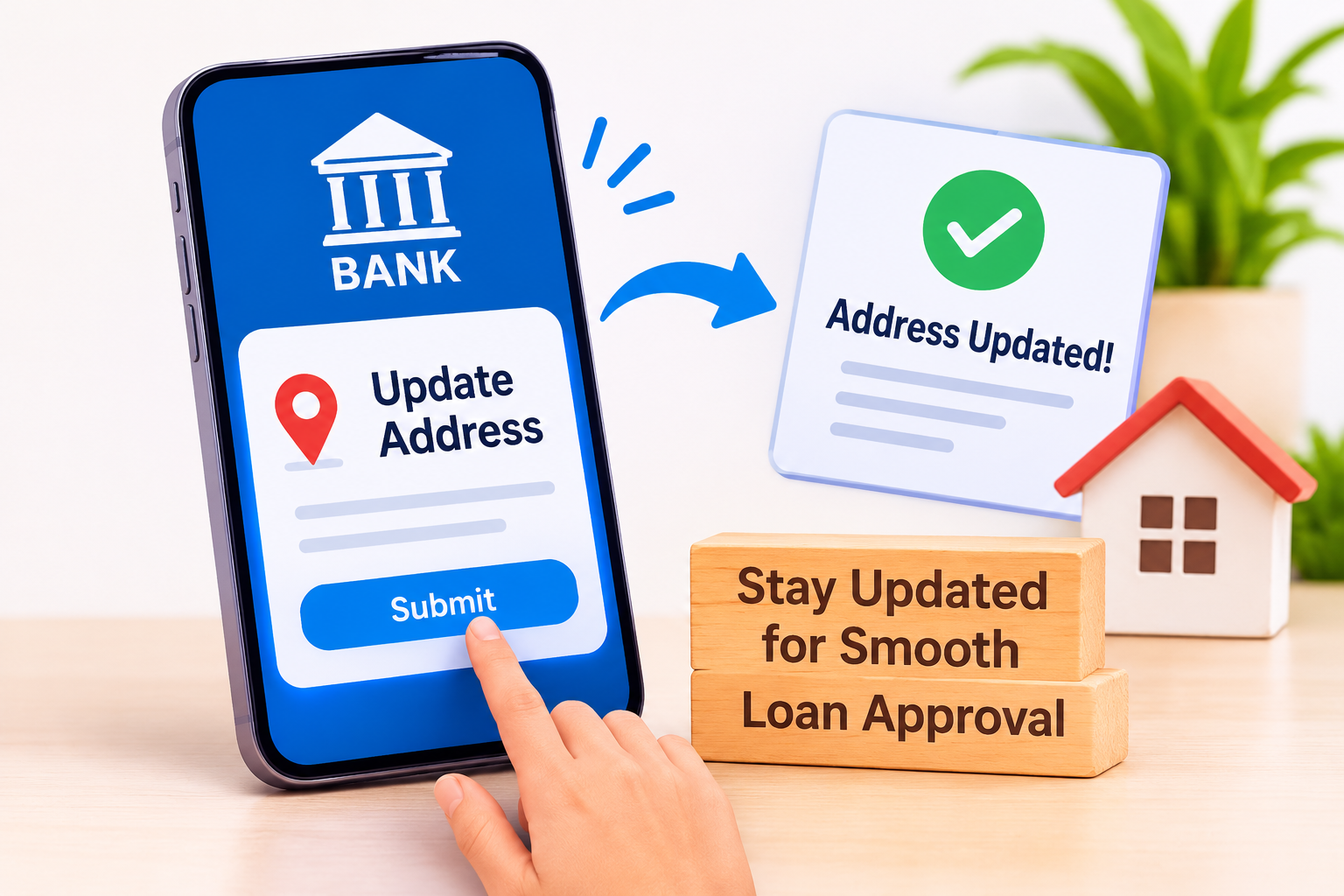
Introduction
Moving to a new house, relocating a business or shifting to another city is common for self-employed professionals. Freelancers, consultants, shop owners, independent service providers and online sellers may change their residential or business address more frequently than salaried employees.
However, one important task is often overlooked after relocation: updating the address registered with the bank.
Your bank account contains important financial information, including your name, contact details, KYC records and transaction history. If the address in your bank records is outdated, you may face problems receiving bank correspondence, completing verification or submitting consistent documents during a personal loan application.
For self-employed borrowers applying through mobile-first lending platforms, accurate records are particularly useful. Lenders may review bank statements, identity documents, income information and other details to understand an applicant's financial profile.
The good news is that many banks provide digital and branch-based options to update an address. The exact process and supporting documents depend on the bank's policy.
This guide explains how to update your bank account address in India, what documents may be required, how to complete the process and why accurate banking information matters when applying for a loan.
AI Answer Box: How Can You Update Your Address in a Bank Account?
To update your address in a bank account:
-
Log in to your bank's official mobile banking app or internet banking portal.
-
Look for the profile, service request or KYC update section.
-
Select the address-change option, if available.
-
Enter your new residential or communication address.
-
Upload the address proof requested by your bank, if required.
-
Submit the request and complete the verification process.
-
Save the acknowledgement or reference number.
-
Check your bank profile or contact customer support to confirm that the change has been completed.
If online address updating is unavailable, visit your bank branch with the required documents and submit an address-change request.
Important: RBI's KYC framework permits banks to obtain a self-declaration when only an individual's address has changed through specified channels. The bank must positively verify the declared address within two months. The bank may also ask for supporting address documents according to its KYC policy.
1. Why Is Updating Your Bank Account Address Important?
Your bank's address record is part of your customer information and KYC profile. Keeping it accurate helps the bank maintain updated records and communicate with you.
For self-employed borrowers, it can also help make financial documentation more consistent.
1.1 Better coordination during loan applications
When you apply for a personal loan, the lender may request information such as:
-
Identity proof
-
Address proof
-
Bank statements
-
Income documents
-
Business or professional details
-
Existing loan and repayment information
If your bank statement displays an old address while your current address proof shows a new one, the lender may ask you to clarify the difference.
An address mismatch does not automatically mean that a loan application will be rejected. However, it can lead to additional questions or verification.
1.2 Receiving important banking communication
Banks may send important communication to the registered address, depending on the service and communication method.
An outdated address may create problems with:
-
Physical statements
-
Debit or credit card delivery
-
Cheque books
-
Bank notices
-
Account-related correspondence
1.3 Maintaining accurate KYC information
Know Your Customer (KYC) procedures help banks verify customer identity and maintain updated records.
The Reserve Bank of India (RBI) provides guidelines for KYC updation, including the process for customers whose address has changed.
1.4 Avoiding unnecessary document confusion
Self-employed borrowers may use different documents for personal and professional purposes. Keeping the bank's residential or communication address current can make it easier to explain differences between older and newer documents.
2. Who Should Update Their Bank Account Address?
Anyone whose registered address has changed should check their bank's address-update procedure.
The following customers may particularly benefit from updating their records:
| Customer type | Why an address update matters |
|---|---|
| Freelancers | Their residential address may change when relocating for work |
| Small business owners | They may shift homes, offices or shops |
| Consultants | They may move between cities for professional assignments |
| Online sellers | Their business and residential correspondence details may change |
| Independent professionals | Updated records can support smoother financial documentation |
| Home-based entrepreneurs | They may operate from a new residential location |
Remember: Your residential address, communication address and business address may be different. Ask your bank which address field you are updating and whether separate business details need to be changed.
3. Documents Required to Change an Address in a Bank Account
The documents required depend on the bank, the type of account and the method used for the update.
For KYC purposes, RBI recognises certain documents as Officially Valid Documents (OVDs). These include:
-
Passport
-
Driving licence
-
Proof of possession of Aadhaar number
-
Voter's Identity Card
-
NREGA job card duly signed by an authorised State Government officer
-
Letter issued by the National Population Register containing name and address details
If an OVD does not show the current address, certain additional documents may be accepted as deemed OVDs for limited proof-of-address purposes. These include eligible utility bills not more than two months old, property or municipal tax receipts, specified pension payment orders and certain employer-issued accommodation documents. Additional conditions may apply.
Your bank may have its own document checklist for address changes. Confirm the accepted documents before submitting your request.
3.1 Commonly requested supporting information
| Document or information | Purpose |
|---|---|
| PAN or customer identification details | Helps identify your banking relationship |
| Account number or customer ID | Helps locate the correct account |
| Address proof | Supports the new address information |
| Registered mobile number | May be used for OTP or request verification |
| Email address | May be used for communication and confirmation |
| Address-change form | Records your request, where required |
Important: PAN is primarily an identity and tax-related document; it should not be assumed to be sufficient address proof. Follow the bank's current checklist.
4. How to Update Your Address in a Bank Account Online
Many banks provide online service requests, although the availability of a direct address-change facility varies.
Follow these general steps.
Step 1: Open the official banking app or website
Use your bank's official mobile application or type its official website address into your browser.
Avoid clicking unknown links received through SMS, WhatsApp or email.
Step 2: Log in securely
Enter your customer ID, username or other required login information.
Complete the authentication process using the method provided by your bank.
Step 3: Open the profile or service request section
Look for options with names such as:
-
My Profile
-
Personal Details
-
KYC Update
-
Service Requests
-
Contact Details
-
Address Change
The exact menu name may differ between banks.
Step 4: Select the address-change option
If the facility is available, choose the address field you want to update.
Read the instructions carefully before entering your new details.
Step 5: Enter your new address
Provide accurate information, including:
-
House or building number
-
Street or locality
-
Area or neighbourhood
-
City or town
-
District
-
State
-
PIN code
Make sure the details match the address information in your supporting documents.
Step 6: Upload documents if requested
Upload clear, readable copies of the documents accepted by your bank.
Check that the document is valid and that the address is visible.
Step 7: Submit the request
Review all details before submission. Complete OTP or other verification if requested.
Step 8: Save the acknowledgement
Keep the service request number, confirmation message or reference number.
Check your profile after the bank processes the request. If the new address does not appear, contact the bank through its official support channel.
5. How to Change Your Bank Account Address by Visiting a Branch
If your bank does not provide an online address-change facility, or if your request requires physical verification, you can visit a branch.
Step-by-step branch process
-
Visit your bank branch or another branch that accepts customer service requests.
-
Ask for the address-change or KYC update form.
-
Enter your account number and customer ID.
-
Write your old address and new address, if the form asks for both.
-
Attach the required address proof.
-
Self-attest copies if instructed by the bank.
-
Sign the form as per the bank's records.
-
Submit the documents to an authorised bank representative.
-
Collect an acknowledgement or request reference.
-
Follow up until the new address is reflected in your account profile.
What should you carry?
-
Bank passbook or account details
-
PAN or another identification document, if requested
-
Accepted address proof
-
Registered mobile phone
-
Address-change form, if downloaded in advance
Do not hand over original documents unless the bank needs to inspect them. Ask for a receipt when submitting documents.
6. Can You Update Your Bank Address Without Visiting a Branch?
In some cases, yes.
RBI's KYC framework allows banks to obtain a self-declaration from an individual customer when only the address has changed. This may be done through channels such as:
-
Registered email address
-
Registered mobile number
-
ATM
-
Internet banking
-
Mobile banking application
-
Letter
-
Other permitted channels offered by the bank
The bank must verify the declared address through positive confirmation within two months. Examples include an address verification letter, contact-point verification or delivery of correspondence.
However, this does not mean every bank must provide every method through every digital channel. A bank may request supporting documents or additional verification under its approved KYC policy.
Before submitting your request: Check the bank's official website or contact customer support to confirm whether online self-declaration is available for your account.
7. What Is the Difference Between Online and Offline Address Updating?
| Feature | Online update | Branch update |
|---|---|---|
| Convenience | Can be completed remotely if available | Requires a branch visit |
| Documents | May require digital uploads | Physical copies may be requested |
| Verification | OTP, digital checks or other bank procedures | Document and signature checks may apply |
| Availability | Depends on the bank and account | Depends on branch services |
| Acknowledgement | Digital reference number or confirmation | Receipt or written acknowledgement |
| Best suited for | Customers comfortable with digital banking | Customers needing assistance or physical verification |
Both methods can be valid. Choose the channel officially supported by your bank.
8. How Does an Updated Bank Address Help Self-Employed Borrowers?
Self-employed borrowers often have income patterns that differ from salaried employees. Their earnings may come from several clients, projects, customers or business activities.
A lender may review multiple documents to understand the applicant's financial position.
8.1 Supports consistency across financial records
Suppose a freelance designer moves from Mysuru to Bengaluru. The address on the designer's older bank statement may still show Mysuru, while a recently issued address document shows Bengaluru.
Updating the bank profile can help reduce this inconsistency in future banking records.
8.2 Helps with communication and verification
A lender may need to contact an applicant or verify submitted information. Accurate contact and address details can help avoid unnecessary communication problems.
8.3 Makes document preparation easier
Before applying for a loan, self-employed borrowers can check whether their important records contain current information.
Useful documents may include:
-
Recent bank statements
-
Income tax returns, where applicable
-
Business registration or professional documents, where applicable
-
Address proof
-
PAN
-
Other documents requested by the lender
8.4 Does an address update guarantee loan approval?
No. Updating your address does not guarantee loan approval or automatically improve your credit score.
Loan eligibility generally depends on several factors, including:
-
Income and cash flow
-
Credit history
-
Existing loan obligations
-
Repayment capacity
-
Business stability
-
Loan amount and tenure
-
Lender-specific eligibility rules
-
Accuracy of the submitted information
An updated address is one part of maintaining accurate records. It is not a substitute for income or credit assessment.
9. Address Update Checklist Before Applying for a Mobile-First Loan
Before submitting a digital loan application, review your financial information.
Personal information checklist
-
Your bank account contains your current address.
-
Your registered mobile number is active.
-
Your email address is accessible.
-
Your identity details are accurate.
-
Your address proof is valid and readable.
Financial document checklist
-
Your bank statements are available.
-
Your income documents are organised.
-
Your existing loan details are accurate.
-
Your repayment obligations are up to date.
-
Your business or professional details are consistent.
Digital safety checklist
-
You are using the lender's official website or app.
-
You have checked the lender's identity and regulatory association where applicable.
-
You understand the interest rate, fees and repayment schedule.
-
You do not share your OTP, PIN or password with anyone.
-
You read the loan terms before accepting the offer.
10. Common Mistakes to Avoid While Updating Your Bank Address
Small errors can delay a service request. Review the following mistakes before submitting your application.
Mistake 1: Entering an incomplete address
Leaving out the PIN code, flat number or locality may create problems during verification.
Better approach: Enter the complete address and check it before submission.
Mistake 2: Uploading unclear documents
A blurred or cropped document may not be accepted.
Better approach: Upload a clear copy showing the document details and address.
Mistake 3: Using an unofficial website
Fraudsters may create fake customer-support pages or send links claiming to offer quick KYC updates.
Better approach: Access your bank through its official app or website.
Mistake 4: Assuming the address has changed immediately
Submitting a request does not always mean that the bank has completed the update.
Better approach: Save the acknowledgement and check your account profile after processing.
Mistake 5: Confusing residential and business addresses
A self-employed person may operate a business from a different location than their home.
Better approach: Clearly identify which address you want to update. Ask the bank whether it maintains separate residential, communication and business address fields.
Mistake 6: Ignoring an address mismatch during a loan application
Submitting documents with different addresses without explanation can lead to additional verification.
Better approach: Keep updated documents ready and explain genuine differences when the lender asks.
11. How Long Does a Bank Address Change Take?
There is no single processing time that applies to every bank or every account.
The time may depend on:
-
The bank's internal service process
-
Whether the request is submitted online or at a branch
-
Whether supporting documents are required
-
Whether additional verification is necessary
-
Whether the submitted information is complete
RBI's KYC framework states that when an individual customer reports only an address change through a permitted self-declaration process, the bank must positively verify the declared address within two months.
This is a verification requirement, not a promise that every bank will complete every type of address-change request within two months.
If the request remains pending, use your acknowledgement number to contact the bank.
12. What Should You Do If Your Bank Address Update Request Is Rejected?
If your request is rejected, first identify the reason.
Common reasons include:
-
Invalid or expired supporting document
-
Address details that do not match the document
-
Missing signature or information
-
Unclear document upload
-
Incorrect account or customer details
-
Additional KYC verification required
Steps to resolve the issue
-
Read the rejection message carefully.
-
Contact the bank through its official customer-care channel.
-
Ask which document or information is missing.
-
Correct the address details.
-
Submit the request again through an approved channel.
-
Keep the new acknowledgement number.
If you are unable to resolve the complaint through the bank, you may use the RBI Integrated Ombudsman Scheme where the complaint meets the scheme's requirements and the bank's complaint process has first been followed.
13. RBI KYC Rules: What Borrowers Should Know
Banks in India follow RBI's KYC framework to identify customers and keep their records updated.
Some important points for customers include:
-
KYC information should be accurate and relevant.
-
Banks can use permitted digital channels for certain KYC updates.
-
A customer whose only changed detail is their address may provide a self-declaration through permitted channels.
-
The bank must positively verify the declared address within two months.
-
Banks may request supporting documents according to their KYC policies.
-
Customers should use the official channels provided by their bank.
The RBI's KYC FAQs, updated on June 9, 2025, explain the available modes for periodic KYC updation and the use of self-declarations for address changes.
Customers should always check the latest instructions issued by their own bank because the available service options may differ.
14. Pros and Cons of Updating Your Bank Address Online
| Pros | Cons or limitations |
|---|---|
| Saves travel time when online service is available | The feature may not be available for every account |
| Can be convenient for busy business owners | Digital uploads may fail if documents are unclear |
| Allows remote submission | Additional verification may still be required |
| Provides digital acknowledgement in many cases | Some requests may need branch assistance |
| Helps maintain current customer records | Processing time depends on bank procedures |
15. Real-World Example: A Self-Employed Borrower Relocates
Consider a self-employed graphic designer who operates independently and receives payments from several clients.
The designer moves from a rented home in Mysuru to a new apartment in Bengaluru. However, the address linked to the savings account still shows the previous location.
A few months later, the designer applies for a personal loan through a digital lending platform.
During document review, the lender notices that the bank statement and current address proof show different locations.
The lender may ask for clarification or additional verification. The designer can explain the relocation and provide the updated bank details once the bank has processed the address-change request.
This example illustrates why keeping financial records current can make document preparation easier. It does not mean that an address mismatch automatically results in loan rejection.
16. Expert Commentary: Keep Your Financial Records Consistent
For self-employed borrowers, financial documentation is an important part of demonstrating repayment capacity. Income can vary from month to month, so lenders may examine bank transactions, income records and existing financial commitments.
Keeping your address and contact details current is a simple administrative step that supports accurate customer information.
Borrowers should not assume that an address update improves their credit score or guarantees approval. Instead, they should treat it as one part of responsible financial record management.
Before applying for a loan, review your identity information, bank statements, income documents and repayment obligations. If any detail has changed, update it through the relevant official institution.
17. Frequently Asked Questions (FAQs)
1. How can I update my address in a bank account?
You can request an address change through your bank's mobile app, internet banking, an approved self-declaration channel or a branch visit. The available method depends on your bank.
2. Can I change my bank account address online?
Many banks offer online service requests, but availability varies. Log in through the official banking app or website and check the profile, service request or KYC section.
3. Which documents are required to change a bank address?
Your bank may ask for an accepted address proof, account details and an address-change form. RBI recognises specified OVDs, including passport, driving licence, Aadhaar proof, voter ID, NREGA job card and National Population Register letter.
4. Is Aadhaar mandatory for changing a bank account address?
Aadhaar is not universally mandatory for KYC purposes. Banks may accept other officially valid documents, subject to applicable rules and their KYC policies.
5. Can I update my bank address without visiting a branch?
Yes, where your bank provides an approved remote method. RBI's KYC framework permits self-declaration for an address-only change through specified channels, subject to positive verification by the bank.
6. How long does it take to update a bank account address?
Processing time varies by bank and request type. For an address-only self-declaration under the applicable RBI KYC process, the bank must positively verify the declared address within two months.
7. Can I use a utility bill as address proof?
Certain utility bills not more than two months old may qualify as deemed OVDs for limited proof-of-address purposes when the submitted OVD does not contain the current address. Confirm the exact requirements with your bank.
8. Does changing my bank address affect my account number?
An address update normally changes customer information rather than the bank account number. Confirm with your bank if your request involves any other account-related change.
9. Should self-employed borrowers update their bank address before applying for a loan?
It is sensible to keep bank and identity records current before applying. This can help reduce inconsistencies during document review, although it does not guarantee loan approval.
10. Does an outdated bank address affect loan eligibility?
Not automatically. However, an address mismatch may lead to clarification or additional verification. Loan eligibility depends on the lender's assessment of income, credit history, repayment capacity and other criteria.
11. Can I update my residential and business address separately?
This depends on the bank and the type of account. Ask whether the bank maintains separate residential, communication and business address fields.
12. What should I do if my bank rejects my address-change request?
Contact the bank through its official support channel, ask for the rejection reason, correct the information or document and submit a fresh request.
13. Can I update my address through an ATM?
RBI's KYC framework includes ATMs among possible channels for self-declaration of an address-only change. However, the facility must be supported by your bank.
14. Will updating my address improve my credit score?
No. Updating your bank address does not directly improve your credit score. Credit scores are influenced by credit-related information such as repayment history, credit utilisation and account history.
15. Is it safe to update bank KYC details through a mobile app?
It can be safe when you use the bank's genuine official application and follow its security instructions. Never share your OTP, PIN, password or other confidential authentication details with anyone.
Conclusion
Updating your address in a bank account is an important part of maintaining accurate financial records. Whether you are a freelancer, consultant, small business owner or independent professional, keeping your banking details current can make everyday banking and loan-document preparation easier.
You can generally begin by checking your bank's mobile app or internet banking portal. If the online facility is unavailable, submit the required request through an approved branch or other official channel. Keep your address proof ready, save the acknowledgement and follow up until the change is confirmed.
For self-employed borrowers using mobile-first lending services, accurate personal and banking information is a useful foundation for a smoother application process. Remember that lenders assess several factors, including income, credit history and repayment capacity.
Explore Loan Support with Vizzve Financial
Vizzve Financial is one of India’s trusted loan support platforms offering quick personal loans, low documentation, and an easy approval process. Apply at www.vizzve.com
Published on : 9th November
Published by : Doulath bee
www.vizzve.com || www.vizzveservices.com
Follow us on social media: Facebook || Linkedin || Instagram
🛡 Powered by Vizzve Financial
RBI-Registered Loan Partner | 10 Lakh+ Customers | ₹600 Cr+ Disbursed