

Introduction
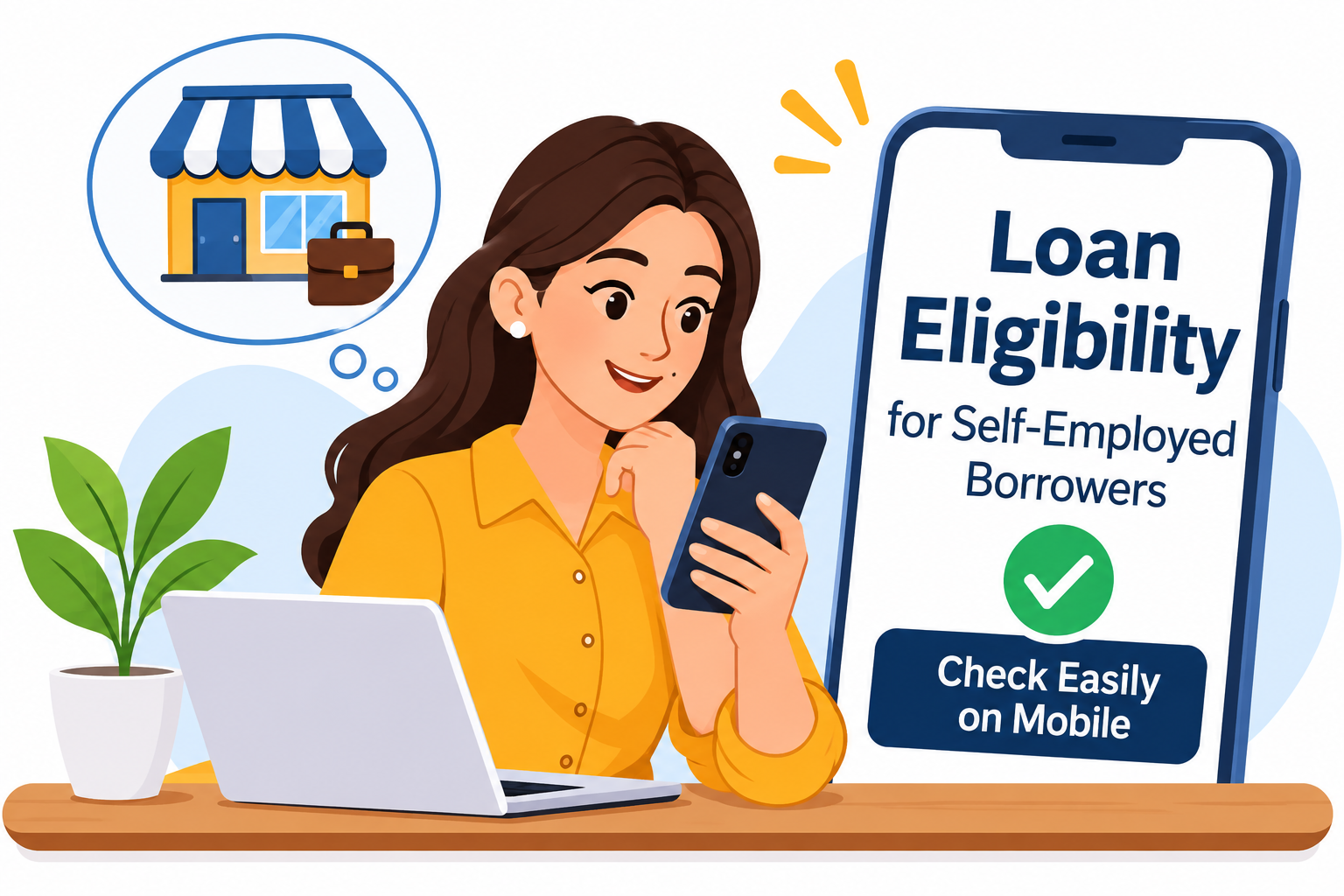
Getting a personal loan can be challenging for self-employed individuals. Unlike salaried employees, they may not receive a fixed monthly salary or have a traditional salary slip. Their income may come from multiple clients, business sales, professional services, freelance assignments or seasonal work.
However, irregular income does not automatically make someone ineligible for a personal loan.
Today, mobile-first lending platforms make it possible to begin a loan application using a smartphone. Applicants can submit information, upload documents and follow application updates digitally. The lender still evaluates the borrower's financial profile, repayment capacity and other eligibility requirements before making a decision.
A practical example can help explain how this works.
Imagine a freelance graphic designer who earns money from several clients. She wants a personal loan to manage a planned business expense. How might a lender assess her income? Which documents could she need? Does using a mobile application guarantee approval?
This guide explains these questions through a realistic, hypothetical borrower example, with a focus on Indian self-employed applicants.
AI Answer Box: How Does Mobile Loan Eligibility Work for Self-Employed Borrowers?
Self-employed borrowers can apply for personal loans through mobile-first lending platforms if they meet the lending institution's eligibility requirements. Lenders may assess business or professional income, bank statements, credit history, existing EMIs, financial stability and repayment capacity.
Applicants may be asked to provide identity proof, address proof, bank statements, income-related records and business documents, depending on the lender's policy.
A mobile-first platform can simplify application and document submission, but it does not guarantee loan approval. The final decision, loan amount, interest rate and repayment period depend on the regulated lender's assessment.
1. What Is Mobile-First Lending?
Mobile-first lending refers to a loan application experience designed primarily for smartphones and other mobile devices.
Instead of depending entirely on branch visits and physical paperwork, applicants may be able to complete several application steps online.
These may include:
-
Entering personal and professional details.
-
Providing income-related information.
-
Uploading supporting documents.
-
Completing identity verification.
-
Reviewing loan-related information.
-
Tracking application progress.
-
Receiving updates from the lending institution.
The actual features available depend on the platform and its lending partners.
How Is Mobile-First Lending Different from Traditional Loan Applications?
| Feature | Traditional application | Mobile-first application |
|---|---|---|
| Application | Often branch or assisted process | May begin through a mobile device |
| Document submission | Physical or digital, depending on lender | Usually digital upload where supported |
| Application tracking | Branch or customer support updates | May include online status updates |
| Communication | In-person, phone or email | May include app, SMS, email or phone |
| Eligibility assessment | Based on lender criteria | Based on lender criteria |
| Approval | Decided by lender | Decided by lender |
The important difference is convenience. A mobile interface can make the application journey easier, but it does not change the lender's responsibility to assess risk and repayment capacity.
2. Why Do Self-Employed Borrowers Need a Different Eligibility Assessment?
Self-employed people often have income patterns that differ from salaried employees.
A salaried applicant may be able to provide salary slips and an employer-issued certificate. A self-employed applicant may instead need to demonstrate income through a combination of financial records.
Examples include:
-
Freelancers receiving payments from multiple clients.
-
Consultants charging professional fees.
-
Small shop owners earning through daily sales.
-
Online sellers receiving payments through marketplaces.
-
Independent professionals working on contracts.
-
Small business owners with seasonal revenue.
What Do Lenders Usually Evaluate?
2.1 Income consistency
Lenders may review whether the applicant earns income regularly and whether the amount is sufficient to support the proposed EMI.
2.2 Bank statement history
Bank statements can help demonstrate incoming payments, spending patterns and existing financial commitments.
2.3 Credit history
Credit reports may show previous borrowing, repayment behaviour, outstanding accounts and missed payments.
2.4 Existing financial obligations
Applicants with several ongoing EMIs or credit-card dues may have less disposable income available for another loan.
2.5 Business or professional stability
Depending on the loan product, lenders may consider the length of business operations, nature of work, income records and business continuity.
Important: There is no single universal income level, business vintage or credit-score threshold that guarantees approval across all lenders. Eligibility rules vary by regulated lending institution and loan product.
3. Real-World Example: How a Self-Employed Borrower May Qualify Through a Mobile-First Process
The following is a fictional example designed to demonstrate how a lender may assess a self-employed applicant. It does not describe an actual Vizzve customer, actual loan offer or guaranteed eligibility outcome.
Meet Ananya, a Freelance Graphic Designer
Ananya is a 29-year-old freelance graphic designer based in Bengaluru, Karnataka. She works with small businesses, marketing agencies and independent clients.
She receives payments from different clients rather than one employer. Her monthly earnings therefore change depending on the projects she completes.
Ananya wants to explore a personal loan of ₹1,50,000 for a planned professional expense.
Ananya's Illustrative Financial Profile
| Financial detail | Example information |
|---|---|
| Profession | Freelance graphic designer |
| Work experience | 3 years |
| Average monthly income | ₹55,000 |
| Lowest recent monthly income | ₹38,000 |
| Highest recent monthly income | ₹72,000 |
| Existing monthly EMI | ₹5,000 |
| Requested loan amount | ₹1,50,000 |
| Application method | Mobile-first |
| Main income evidence | Bank statements and client payments |
These figures are illustrative. Actual lenders may calculate income differently and may not accept every type of income record.
Step 1: Ananya Checks Her Financial Position
Before applying, Ananya reviews her monthly income and expenses.
She does not consider only her highest-earning month. Instead, she looks at her earnings across several months to understand how much money she can reasonably use for loan repayment.
Her approximate monthly budget looks like this:
| Expense or income category | Amount |
|---|---|
| Average monthly income | ₹55,000 |
| Household and personal expenses | ₹22,000 |
| Existing EMI | ₹5,000 |
| Business and work expenses | ₹8,000 |
| Approximate amount remaining | ₹20,000 |
The remaining amount is not automatically available for a new EMI. Ananya also needs to consider savings, taxes, irregular expenses and months when client payments are delayed.
Practical lesson: Self-employed applicants should assess their average and weaker income months, not just their best month.
Step 2: She Organises Her Documents
Ananya prepares documents that may help the lender understand her financial profile.
| Document | Why it may be required |
|---|---|
| PAN card | Identity and financial verification |
| Aadhaar or other accepted ID | Identity and address verification |
| Recent bank statements | Evidence of income and financial activity |
| Income tax returns, if applicable | Supporting income information |
| Business or professional records | Evidence of work or business activity |
| Client invoices | Supporting evidence of professional earnings |
The exact requirements depend on the lender. Some applicants may be asked for additional records, while others may have a different verification process.
Step 3: She Starts a Mobile Loan Application
Ananya opens the relevant mobile-first application or platform and enters the requested details.
These may include:
-
Name and contact information.
-
Date of birth and residential details.
-
Employment or professional category.
-
Monthly income information.
-
Existing loan commitments.
-
Requested loan amount.
She checks that her information is accurate before submitting it.
A mobile-first process may reduce the need for repeated physical visits, but the applicant should still read the platform's privacy policy and understand how personal information is handled.
Step 4: The Lender Reviews Her Profile
After submission, the regulated lending institution may evaluate Ananya's application.
The assessment could include:
-
Whether her income can be reasonably verified.
-
Whether her bank statements support the income declared.
-
Whether her credit history meets the lender's policy.
-
Whether her existing EMIs affect repayment capacity.
-
Whether her professional activity meets the product's eligibility conditions.
-
Whether the requested loan amount is suitable for her financial profile.
The lender may ask for additional information or documents if something needs clarification.
Step 5: She Reviews the Loan Offer Before Accepting
Suppose a lender considers Ananya's application and provides a loan offer. She should not accept it simply because the application has progressed.
She should first review:
-
Sanctioned loan amount.
-
Interest rate.
-
Annual Percentage Rate (APR).
-
Processing fee and applicable taxes.
-
EMI amount.
-
Repayment period.
-
Late-payment and penal-charge terms.
-
Foreclosure or prepayment conditions, where applicable.
-
Total repayment amount.
She should also read the Key Facts Statement (KFS), where applicable, and compare the actual cost with her monthly budget.
What Does Ananya's Example Teach Us?
Ananya's example highlights five important points:
-
Self-employed income can be demonstrated through suitable financial records.
-
Income consistency may matter more than one unusually profitable month.
-
Existing EMIs affect repayment capacity.
-
A mobile-first application can simplify document submission and tracking.
-
The final approval decision belongs to the lender.
4. How Can Lenders Assess Income for Self-Employed Applicants?
Self-employed income can be more complex to evaluate because revenue and personal income are not always the same.
For example, a shop may receive ₹2 lakh in monthly sales, but the owner's actual earnings after stock purchases, rent, salaries and other expenses may be much lower.
Common Ways to Demonstrate Income
Bank statements
Bank statements may show client payments, business receipts and other financial activity.
Income tax returns
ITR documents, where available and applicable, can help demonstrate declared income.
Financial statements
Some lenders may ask business owners for profit-and-loss statements or other financial records.
Invoices and contracts
Freelancers and consultants may use invoices, work orders or contracts to support their income declarations.
Business registration records
Depending on the business and lender's requirements, registration or licence documents may help establish business activity.
Remember: A document is useful only if the lender accepts it for the specific loan product. Applicants should confirm the required document list before applying.
5. Documents Required for Mobile Loan Eligibility
The documentation process varies by lender, applicant profile and loan amount.
| Document category | Possible documents |
|---|---|
| Identity proof | PAN and other accepted identity documents |
| Address proof | Aadhaar, utility bill or another accepted document |
| Bank records | Recent bank statements |
| Income evidence | ITR, financial statements or accepted income records |
| Professional evidence | Client invoices, contracts or business records |
| Existing loan information | Details of current EMIs and outstanding balances |
How to Prepare Documents Before Applying
-
Make sure names and personal details match across records.
-
Use clear and readable document copies.
-
Keep bank statements complete and up to date.
-
Avoid changing or editing financial documents.
-
Provide accurate income information.
-
Submit documents only through authorised and secure channels.
-
Never share OTPs, passwords or banking PINs with people claiming to arrange loan approval.
6. What Factors Can Improve Loan Eligibility for Self-Employed Borrowers?
There is no guaranteed formula for loan approval. However, responsible financial preparation can make it easier for a lender to assess an application.
6.1 Maintain Clear Income Records
Use invoices, receipts, bank statements and appropriate tax records to maintain a consistent financial trail.
6.2 Repay Existing Loans on Time
Missed EMIs and delayed credit-card payments can negatively affect credit history.
6.3 Manage Existing Debt
Review your existing financial obligations before requesting another loan.
6.4 Apply for a Suitable Loan Amount
A loan amount should be based on genuine financial needs and repayment capacity rather than the maximum amount displayed by an application.
6.5 Avoid Multiple Unnecessary Applications
Submitting several applications within a short period may lead to multiple credit enquiries, depending on the lender and enquiry type. Compare options carefully before applying.
6.6 Keep Personal and Business Records Organised
Where practical, maintain clear records of business receipts and personal expenses. This can help explain cash flow and income patterns.
7. Understanding EMI and Repayment Capacity
EMI is an important part of loan eligibility because it represents the recurring repayment commitment.
A borrower should calculate the expected EMI before accepting a loan.
Illustrative EMI Example
Suppose a borrower receives a loan of ₹1,50,000 at an assumed annual interest rate of 18% for 24 months.
Using a standard reducing-balance EMI calculation:
| Detail | Illustrative value |
|---|---|
| Loan amount | ₹1,50,000 |
| Assumed annual interest rate | 18% |
| Repayment period | 24 months |
| Approximate monthly EMI | ₹7,489 |
| Approximate total repayment | ₹1,79,736 |
| Approximate interest amount | ₹29,736 |
These are estimates, not a live loan quotation. Actual repayment may differ due to the lender's rate, fees, APR, repayment schedule and other applicable terms. Processing fees and taxes are not included in this calculation.
Why Should Self-Employed Borrowers Plan for Lower-Income Months?
Ananya's income varies from month to month. If she commits to an EMI that is affordable only during her highest-earning months, she may struggle when client payments are delayed.
Before accepting a loan, she should ask:
-
Can I pay the EMI during a slow business month?
-
Do I have emergency savings?
-
Are my existing EMIs already high?
-
Will the loan help meet a necessary expense?
-
Can I manage repayment without affecting essential business expenses?
8. Mobile-First Lending: Pros and Cons for Self-Employed Borrowers
| Pros | Cons |
|---|---|
| Convenient application through a mobile device | Requires reliable internet and digital access |
| Documents may be uploaded online | Document quality or format issues can delay verification |
| Application updates may be available digitally | Not every platform provides real-time decisions |
| May reduce branch visits | Some cases may still need additional verification |
| Convenient access to application information | Borrowers must carefully check platform authenticity |
| Can make the process easier to follow | Digital convenience does not guarantee approval |
Benefits
-
Convenient application experience.
-
Easier access to application forms.
-
Potentially faster document submission.
-
Less dependence on physical paperwork.
-
Easier access to digital communication and updates.
Limitations
-
Approval depends on lender policy.
-
Some income types may need additional verification.
-
Applicants may face technical difficulties.
-
Digital fraud and impersonation risks exist.
-
Some applicants may still need to provide additional documents or complete offline checks.
9. How to Apply Through a Mobile-First Lending Platform: Step-by-Step Guide
The following is a general application guide. The exact process depends on the platform and the regulated lender.
Step 1: Identify the Lending Platform
Check the platform's official website, company details, privacy policy and lending partner information.
Step 2: Review Eligibility Requirements
Read the lender's requirements for age, income, occupation, credit history, location and other relevant conditions.
Step 3: Enter Accurate Details
Provide truthful personal, professional and financial information.
Step 4: Upload Required Documents
Submit only the documents requested through the authorised application process.
Step 5: Complete Verification
The lender may conduct identity, bank, income and credit-related checks, as permitted by applicable rules and with appropriate consent.
Step 6: Review the Offer
Read the KFS and loan agreement. Check the APR, EMI, charges and repayment conditions.
Step 7: Accept Only If the Loan Is Affordable
Proceed only after understanding the complete repayment obligation.
Step 8: Keep the Records
Save the sanction letter, KFS, loan agreement, repayment schedule and customer-support details.
10. How Can Borrowers Identify a Safe Mobile Lending Platform?
Mobile convenience should never replace basic safety checks.
Before submitting personal or financial information, borrowers should:
-
Identify the actual bank or NBFC responsible for the loan.
-
Check whether the lender is regulated by the RBI, where applicable.
-
Verify the app's association with the lender.
-
Read the privacy policy and understand requested permissions.
-
Review the interest rate, APR and all applicable charges.
-
Avoid apps that promise guaranteed approval without proper checks.
-
Never pay an unknown person to secure loan approval.
-
Never share OTPs, passwords or UPI PINs.
-
Keep copies of loan documents and payment receipts.
The RBI's Digital Lending Apps directory can help customers check an app's claimed association with a regulated entity. However, the directory is an aid for verification, not an RBI endorsement or a guarantee of an app's quality.
Borrowers can also use the National Cyber Crime Reporting Portal at https://cybercrime.gov.in/ to report suspected cybercrime.
11. Common Mistakes Self-Employed Borrowers Should Avoid
Declaring revenue as personal income
Business turnover and personal income are not necessarily the same. Applicants should provide accurate information in the format requested by the lender.
Ignoring existing EMIs
A new loan increases monthly financial commitments. Review all existing repayments before applying.
Submitting incomplete documents
Missing pages, unclear images or inconsistent records may lead to additional verification.
Applying without checking the total cost
A low advertised interest rate does not necessarily mean a low-cost loan. Review APR, fees and other charges.
Accepting an unaffordable EMI
A loan should fit the applicant's actual cash flow, including weaker income months.
Trusting guaranteed-approval claims
No genuine platform should be treated as a guarantee of approval simply because it offers an online application.
12. Expert Commentary: What Should Self-Employed Borrowers Focus On?
A practical approach to loan eligibility should begin with income quality and repayment capacity, not just the loan amount an applicant wants.
For self-employed borrowers, a clear record of income can help explain how their business or profession generates money. Bank statements, tax records, invoices and other accepted documents may provide useful evidence.
Borrowers should also remember that a strong credit history alone does not guarantee approval. Lenders may consider several factors together, including existing debt, income stability, loan purpose where relevant, and internal risk policies.
The best application is one that is accurate, properly documented and supported by a realistic repayment plan.
Frequently Asked Questions (FAQs)
1. Can self-employed borrowers apply for a personal loan through a mobile app?
Yes. Self-employed borrowers may apply through mobile-first lending platforms if they meet the relevant lender's eligibility conditions. Approval depends on the lender's assessment.
2. What is mobile-first lending?
Mobile-first lending is a loan application experience designed primarily for smartphones. It may allow applicants to enter details, submit documents and track application progress digitally.
3. What documents are required for a self-employed personal loan?
Depending on the lender, applicants may need PAN, accepted identity and address proof, bank statements, ITR documents, invoices or business-related records.
4. Can freelancers apply for mobile personal loans?
Freelancers may be eligible if they meet the lender's requirements. They may be asked to demonstrate income through bank statements, invoices, contracts or other accepted records.
5. Is a salary slip compulsory for self-employed applicants?
Not necessarily. Self-employed applicants generally do not receive salary slips. Lenders may accept other forms of income evidence, depending on their policies.
6. Does a mobile loan application guarantee approval?
No. A digital application does not guarantee approval. The regulated lender makes the final decision after reviewing the applicant's financial and eligibility information.
7. Does credit score affect loan eligibility?
Credit history and credit score may influence a lender's assessment. However, the required score and the weight given to it vary across lenders and loan products.
8. Can a borrower with irregular income get a personal loan?
Possibly. The lender may review income records over a period of time, bank statements and repayment capacity. Irregular income does not automatically mean rejection.
9. How do lenders check self-employed income?
Lenders may review bank statements, income tax returns, financial statements, invoices, contracts and other accepted documents to understand the applicant's financial position.
10. Can I apply if I already have an existing loan?
You may be able to apply, but existing EMIs and outstanding debt can affect your repayment capacity and eligibility.
11. How can I improve my loan eligibility?
Maintain accurate income records, repay existing debts on time, monitor your credit report, reduce unnecessary debt and apply for an amount that fits your budget.
12. Is mobile-first lending safe?
It can be safe when the application is associated with a legitimate regulated lender and follows applicable requirements. Verify the lender, check the app's association and read the privacy policy before sharing information.
13. What is APR in a personal loan?
APR, or Annual Percentage Rate, represents the annual cost of credit and includes the interest rate and applicable charges associated with the loan, as defined under the relevant rules.
14. What should I check before accepting a mobile loan offer?
Review the sanctioned amount, APR, interest rate, EMI, repayment period, processing fee, applicable taxes, penal charges, prepayment conditions and loan agreement.
15. Can Vizzve Financial help me explore personal loan options?
You can visit the official Vizzve Financial website to explore the available services and application information. Eligibility, loan terms and approval are subject to the relevant lender's policies and assessment.
Conclusion
Loan eligibility for self-employed borrowers depends on more than whether an applicant receives a fixed monthly salary. Lenders may evaluate income consistency, bank statements, credit history, existing financial commitments and the applicant's ability to repay.
Mobile-first lending can make the application journey more convenient by allowing borrowers to submit information and documents digitally. However, the most important step remains responsible borrowing.
Ananya's hypothetical example shows why self-employed applicants should organise their income records, review their monthly budget and understand the complete cost of a loan before accepting an offer.
If you are exploring personal loan options, visit Vizzve Financial at https://www.vizzve.com/ to review the available information and take your next step carefully. Always check the lender's terms and borrow only what you can comfortably repay.
Published on : 5th November
Published by : Doulath bee
www.vizzve.com || www.vizzveservices.com
Follow us on social media: Facebook || Linkedin || Instagram
🛡 Powered by Vizzve Financial
RBI-Registered Loan Partner | 10 Lakh+ Customers | ₹600 Cr+ Disbursed