

Introduction
Managing money can be challenging when you are self-employed. Freelancers, consultants, small business owners and independent professionals may receive income on different dates and in varying amounts. Some months may bring strong earnings, while others may require careful budgeting.
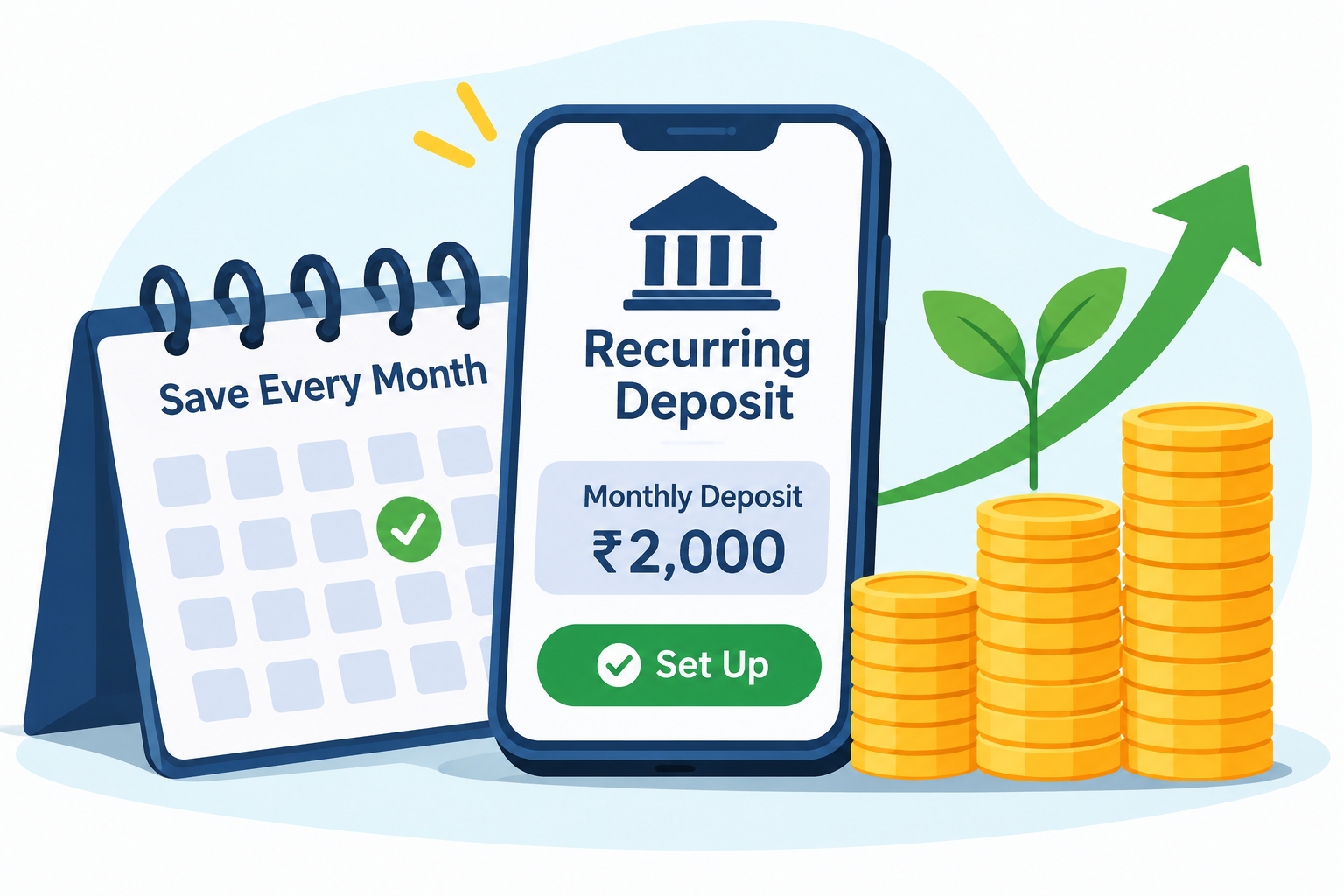
A recurring deposit (RD) can help build a regular savings habit by allowing you to deposit a fixed amount every month for a chosen period. It is a structured savings option offered by banks and India Post. The accumulated deposits earn interest according to the scheme's terms.
However, an RD is not suitable for every financial situation. Monthly instalments can become difficult during periods of low income, and withdrawing money before maturity may reduce the interest earned or involve restrictions and penalties.
For self-employed borrowers, the important question is not simply whether an RD offers interest. It is whether the monthly commitment fits their cash flow, emergency savings and financial goals.
This article covers the benefits, limitations and suitability of recurring deposits, with practical examples for people earning through self-employment.
AI Answer Box: What Are the Benefits and Limitations of a Recurring Deposit?
A recurring deposit is a savings account in which a person deposits a fixed amount at regular intervals, usually every month, for a predetermined period. The deposits earn interest at the rate offered by the bank or post office under the selected scheme.
Main benefits:
-
Encourages disciplined monthly saving.
-
Helps build a planned savings corpus.
-
Offers predictable instalment commitments.
-
Generally provides a known interest rate for the agreed deposit period.
-
Can be opened through digital banking channels where supported.
Main limitations:
-
Requires regular monthly contributions.
-
Missed instalments may attract charges or affect account status.
-
Early closure may reduce returns or involve penalties.
-
Interest earned is generally taxable.
-
Returns may be lower than those from some market-linked investments.
Who may find an RD useful?
Salaried individuals and self-employed people with reasonably predictable surplus income may find an RD useful for short- or medium-term savings goals. People with irregular income should first maintain sufficient emergency funds before committing to fixed monthly deposits.
1. What Is a Recurring Deposit?
A recurring deposit is a savings product that allows an individual to deposit a fixed amount at regular intervals for a specified period. In most bank RDs, contributions are made monthly.
For example, a freelancer may open an RD with a monthly instalment of ₹2,000 for two years. Each month, the amount is deposited into the account. The bank calculates interest according to the RD's applicable rate and compounding method.
At maturity, the account holder receives the accumulated deposits and applicable interest, subject to the product's terms and tax deductions, if any.
How Is an RD Different From a Regular Savings Account?
A savings account allows deposits and withdrawals according to the bank's rules. An RD is designed around a fixed contribution schedule and a defined savings period.
| Feature | Savings Account | Recurring Deposit |
|---|---|---|
| Deposit pattern | Flexible | Usually fixed monthly instalments |
| Withdrawal | Generally flexible | Subject to RD terms |
| Savings discipline | Self-managed | Structured |
| Interest | Based on savings account rate | Based on RD rate |
| Main purpose | Daily transactions and liquidity | Planned regular savings |
An RD is therefore better suited to money that can remain invested for the selected period.
2. Major Benefits of Recurring Deposits
Recurring deposits can be useful for people who want a structured way to save without making a large one-time investment.
2.1 Encourages Regular Savings
One of the biggest advantages of an RD is that it encourages people to save consistently.
Instead of waiting until the end of the month to see how much money is left, an RD gives saving a fixed place in the monthly budget.
For self-employed professionals, this can help create a routine even when income arrives from multiple clients.
Example: A freelance designer who receives payments from different clients may decide to save ₹1,500 every month. The RD makes that contribution part of the monthly financial plan.
2.2 Helps Build a Savings Corpus
An RD combines regular deposits with interest earned over time. This can help people accumulate money for planned expenses.
Possible goals include:
-
Buying work equipment.
-
Paying for professional training.
-
Funding a planned family expense.
-
Saving for annual insurance premiums.
-
Building a separate business reserve.
-
Preparing for a future purchase.
The final maturity amount depends on the instalment, tenure, interest rate, compounding frequency and applicable terms.
2.3 Offers Predictable Savings Commitments
Most RDs have a fixed monthly contribution and a defined maturity date. This makes it easier to plan how much money will be set aside.
For example, a small business owner can choose an instalment that fits the average monthly surplus rather than committing to an amount based on an unusually profitable month.
The interest rate and calculation method should be checked before opening the account.
2.4 Can Be Opened Digitally
Many banks allow eligible customers to open and manage recurring deposits through mobile banking or internet banking.
Depending on the bank, digital services may include:
-
Opening an RD online.
-
Selecting the deposit amount and tenure.
-
Setting up automatic monthly payments.
-
Viewing instalment history.
-
Checking maturity details.
-
Downloading account statements.
Digital availability, eligibility and features vary by institution. Always use the bank's official application or website.
2.5 May Support Financial Discipline for Self-Employed People
Self-employed people often need to separate personal spending, business expenses, tax reserves and savings.
An RD can create a separate savings commitment that is less likely to be mixed with everyday spending.
However, it should not replace money needed for business operations or emergency expenses.
2.6 Provides a Defined Maturity Date
An RD has a specified maturity period. This can help savers connect their monthly contributions with a financial goal.
For instance, someone planning to purchase a laptop in two years may select an RD tenure that broadly matches the expected purchase date.
The account's maturity date and premature withdrawal conditions should be reviewed before investing.
3. Limitations and Disadvantages of Recurring Deposits
Although RDs have useful features, they also involve certain restrictions.
3.1 Monthly Payments Can Become Difficult
The biggest limitation for self-employed borrowers is the fixed monthly commitment.
Income may fluctuate because of:
-
Delayed client payments.
-
Seasonal business activity.
-
Cancelled projects.
-
Unexpected business expenses.
-
Changes in customer demand.
If the selected instalment is too high, the RD can become a financial burden.
Practical point: Choose an instalment based on a conservative estimate of monthly surplus, not your highest earning month.
3.2 Missed Instalments May Attract Charges
Banks and post offices may apply default charges or other consequences when an instalment is not deposited on time.
The rules are not identical across institutions. Some products may allow missed payments to be regularised, while others may have specific conditions for continuing or reviving an account.
Before opening an RD, check:
-
The instalment due date.
-
The grace period, if any.
-
Default charges.
-
The number of defaults permitted.
-
Account discontinuation rules.
-
Revival conditions.
3.3 Premature Withdrawal May Reduce Returns
An RD is intended to remain active until maturity. If money is needed earlier, premature closure may be subject to the institution's rules.
Possible consequences include:
-
A lower interest rate for the actual deposit period.
-
A premature closure penalty.
-
Restrictions on when the account can be closed.
-
Loss of expected maturity returns.
For example, India Post's National Savings Recurring Deposit Scheme has specific premature closure conditions. Bank RDs follow the relevant bank's product terms.
Do not assume that every RD can be withdrawn immediately without a financial impact.
3.4 Interest Earned Is Generally Taxable
Interest from recurring deposits is generally taxable according to the depositor's applicable income-tax rules.
The actual tax impact depends on the person's total taxable income, applicable tax regime and other circumstances.
Tax deducted at source (TDS), where applicable, is not necessarily the final tax liability. A depositor may still need to report the interest in the income-tax return.
3.5 Returns May Not Beat Inflation
An RD offers a defined interest rate, but the purchasing power of the maturity amount can be affected by inflation.
If the cost of goods and services rises faster than the effective return after tax, the real value of the savings may decline.
This is why an RD should be selected according to the purpose of the money rather than only the advertised interest rate.
3.6 It Is Not a Substitute for an Emergency Fund
An RD may not be the right place for all emergency savings because early withdrawal can involve restrictions or a reduced return.
People with variable income should maintain accessible emergency funds for essential expenses, business disruptions and urgent payments.
3.7 Interest Rates and Terms Can Differ
Banks and post offices may offer different interest rates, deposit periods and account conditions.
A rate advertised by one institution should not be assumed to apply to another institution or to a new deposit opened later.
Always check the current rate and terms before opening an account.
4. Recurring Deposit: Benefits vs Limitations
| Benefits | Limitations |
|---|---|
| Builds a regular savings habit | Requires regular contributions |
| Helps plan for future expenses | Missed payments may attract charges |
| Provides a defined maturity period | Early closure may reduce returns |
| Can be opened digitally with many banks | Digital features vary by institution |
| Offers interest on accumulated deposits | Interest is generally taxable |
| Useful for planned savings goals | Inflation may reduce purchasing power |
| Does not require a large initial lump sum | May not suit highly irregular cash flow |
The right choice depends on the person's income pattern, liquidity needs and financial goals.
5. Who May Benefit From a Recurring Deposit?
An RD may suit people who can comfortably set aside a fixed amount every month.
5.1 Freelancers With Regular Client Payments
Freelancers who receive recurring payments from long-term clients may use an RD to save a portion of their monthly surplus.
For example, a freelance content writer with predictable monthly retainers may set aside a manageable amount after paying essential expenses and taxes.
5.2 Small Business Owners With Stable Cash Flow
A shop owner or service provider with relatively consistent collections may use an RD for a planned personal savings goal.
However, business working capital should remain separate. Money required for inventory, salaries, rent or supplier payments should not be locked into a savings commitment.
5.3 Consultants and Independent Professionals
Consultants, accountants, designers and independent service providers may benefit from an RD if they have a reliable monthly surplus.
An RD can help separate savings from regular personal spending.
5.4 People Saving for a Specific Goal
An RD may be appropriate when the goal has a known time frame and the required amount can be accumulated through regular contributions.
Examples include:
-
A planned holiday.
-
A professional certification.
-
A household purchase.
-
School or education expenses.
-
A future equipment upgrade.
The expected maturity date should be aligned with the planned expense.
6. Who May Not Find an RD Suitable?
An RD may not be the best option for everyone.
| Financial situation | Why an RD may not suit |
|---|---|
| Highly irregular income | Monthly instalments may be difficult to maintain |
| No emergency savings | Money may be needed at short notice |
| High-interest debt | Debt repayment may deserve priority |
| Uncertain business cash flow | Fixed contributions may affect working capital |
| Need for frequent withdrawals | RD access is less flexible than a savings account |
| Short-term cash requirement | Premature closure may reduce returns |
People in these situations may first need to stabilise cash flow, reduce expensive debt or build accessible savings.
7. How Much Should a Self-Employed Person Deposit Every Month?
There is no single RD instalment that works for everyone. The right amount depends on income, expenses, debt commitments and savings priorities.
A simple way to decide is to calculate the average monthly surplus after essential obligations.
Step 1: Calculate Monthly Income
Use a realistic average of income received over several months. Avoid using only the highest-earning month.
Step 2: Deduct Essential Expenses
Include:
-
Household expenses.
-
Rent and utilities.
-
Business operating costs.
-
Loan EMIs.
-
Insurance premiums.
-
Tax reserves.
-
Essential family obligations.
Step 3: Keep Emergency Savings Accessible
Before committing to a fixed RD instalment, maintain an accessible emergency reserve appropriate to your personal and business circumstances.
Step 4: Select a Comfortable Instalment
Choose an amount that can be paid even during a relatively weak income month.
Step 5: Review the Commitment Regularly
If income changes significantly, review your overall savings plan. Check the RD's terms before attempting to change or stop instalments.
Illustrative example:
Suppose a self-employed professional has an average monthly income of ₹60,000 and essential monthly outgoings of ₹45,000. The apparent surplus is ₹15,000.
That does not mean the entire ₹15,000 should go into an RD. The person may need to retain money for irregular expenses, taxes, emergencies and business requirements before deciding on a monthly deposit.
8. Bank RD vs Post Office RD: What Should You Compare?
Both banks and India Post offer recurring deposit products, but their rules and features may differ.
| Comparison factor | Bank RD | Post Office RD |
|---|---|---|
| Provider | Banks | India Post |
| Deposit terms | Depend on the bank | Governed by the applicable scheme rules |
| Interest rate | Bank-specific | Government-notified scheme rate |
| Digital access | Depends on the bank | Depends on available postal banking services |
| Instalment rules | Bank-specific | Scheme-specific |
| Premature closure | Bank terms apply | Scheme rules apply |
| Best comparison approach | Check rate, charges and flexibility | Check scheme rate, tenure and rules |
What Should You Check Before Choosing?
-
Current interest rate.
-
Minimum monthly instalment.
-
Available tenure options.
-
Instalment payment dates.
-
Missed-payment charges.
-
Premature closure conditions.
-
Maturity calculation.
-
Tax treatment.
-
Deposit insurance eligibility.
Do not choose an RD based on the interest rate alone. Convenience, account conditions and access to funds also matter.
9. How to Open a Recurring Deposit Digitally
Many banks allow existing customers to open an RD online.
The general process is:
-
Log in to the bank's official mobile application or internet banking portal.
-
Find the deposits or recurring deposit section.
-
Review the available RD products.
-
Select the monthly instalment.
-
Choose an available tenure.
-
Read the interest rate and account conditions.
-
Confirm the linked account and payment instructions.
-
Complete authentication as required by the bank.
-
Save the confirmation and review the account details.
Documents and Information That May Be Required
Requirements vary depending on whether the customer already has an account with the institution.
Common requirements may include:
-
PAN details, where applicable.
-
Identity and address verification.
-
Existing savings account details.
-
Registered mobile number.
-
KYC information.
-
Nomination details, where available.
Never share your banking password, PIN, OTP or confidential authentication details with anyone claiming to help open an RD.
10. Tax Treatment of Recurring Deposit Interest
RD interest is generally taxable as income under the applicable income-tax rules.
For resident individuals, TDS on qualifying bank and post-office deposit interest may apply when the aggregate interest crosses the relevant annual threshold.
Under the provisions applicable from 1 April 2025, the general TDS threshold for qualifying interest paid by banks, co-operative banks and post offices is ₹50,000 for non-senior citizens and ₹1,00,000 for senior citizens, subject to the applicable conditions.
Important points:
-
TDS is a tax collection mechanism, not the final tax calculation.
-
Interest may remain taxable even if no TDS is deducted.
-
The applicable tax rate depends on the taxpayer's circumstances.
-
Check the latest Income Tax Department guidance before filing a return.
Self-employed individuals should maintain records of RD interest and reconcile them with their bank statements and tax information.
11. Does a Recurring Deposit Improve Loan Eligibility?
An RD can demonstrate a habit of regular saving, but it does not automatically improve a person's credit score or guarantee loan approval.
Lenders generally assess several factors, such as:
-
Income and repayment capacity.
-
Existing EMIs and outstanding debts.
-
Credit history and repayment behaviour.
-
Bank account activity.
-
Business stability.
-
Relevant income and financial documents.
-
The lender's own eligibility criteria.
A recurring deposit may help a borrower build a financial reserve. It may also provide evidence of savings when a lender requests relevant financial information.
However, an RD is not a replacement for income proof, bank statements, tax records or a healthy repayment history.
Important: Never open an RD only because you expect it to guarantee a loan. Choose it because it fits your savings goals and monthly cash flow.
12. Real-World Example: An RD for a Freelance Professional
Consider a freelance graphic designer who receives income from several clients. Monthly earnings vary, but the designer usually has a surplus after paying rent, software subscriptions, household expenses and taxes.
The designer wants to save for a new laptop that may be needed in two years.
Instead of committing to a large one-time deposit, the designer compares available RDs and chooses a monthly contribution that remains manageable even in a slower month.
The designer also keeps a separate emergency reserve in an accessible account.
This approach has three practical advantages:
-
The laptop fund is separated from everyday spending.
-
The monthly savings target is easier to track.
-
Emergency money remains accessible rather than being committed to the RD.
The example is illustrative. Actual returns depend on the selected RD's rate, tenure and terms.
13. Expert Commentary: How to Use an RD Sensibly
A recurring deposit should be treated as one part of a wider financial plan, not as a complete investment strategy.
For self-employed individuals, the order of priorities matters:
-
Meet essential household and business expenses.
-
Set aside money for tax obligations.
-
Maintain accessible emergency savings.
-
Review and manage expensive outstanding debt.
-
Commit only a comfortable surplus to regular savings.
-
Review the RD's maturity date and interest terms.
A smaller instalment that can be maintained consistently may be more practical than a large instalment that creates financial pressure.
The most important decision is not how much interest an RD advertises. It is whether the deposit commitment supports the person's wider financial stability.
14. Safety Checklist Before Opening an RD
Use this checklist before making a deposit:
-
Verify that the bank or institution is legitimate.
-
Check whether the bank is covered by DICGC deposit insurance.
-
Compare the current interest rates.
-
Understand the monthly instalment due date.
-
Read the missed-instalment conditions.
-
Review premature closure rules.
-
Confirm the maturity amount and date.
-
Understand the tax treatment.
-
Keep emergency savings separate.
-
Save the account-opening confirmation and statements.
-
Use only official digital banking channels.
Important Deposit Safety Information
DICGC deposit insurance covers eligible deposits, including savings, fixed, current and recurring deposits, held with insured banks. The maximum cover is ₹5 lakh per depositor per insured bank, including principal and interest, subject to the same-right-and-same-capacity rules.
Deposits across different branches of the same insured bank are aggregated for this purpose. Deposits with different insured banks are covered separately.
Do not assume that every financial product or institution is covered by DICGC. In particular, NBFC deposits and market-linked investments are not covered under the DICGC deposit insurance scheme.
15. Frequently Asked Questions (FAQs)
1. What are the main benefits of a recurring deposit?
The main benefits are disciplined monthly savings, a planned maturity date, interest on accumulated deposits and the ability to save without making a large one-time investment.
2. What are the disadvantages of a recurring deposit?
An RD requires regular instalments. Missed payments may attract charges, early closure may reduce returns, and the interest earned is generally taxable.
3. Is a recurring deposit suitable for self-employed people?
Yes, it may suit self-employed people who have a reasonably predictable monthly surplus. Those with highly irregular income should first maintain sufficient accessible emergency savings.
4. Can freelancers open a recurring deposit?
Yes. Eligible freelancers can generally open an RD with a bank or India Post, subject to the provider's KYC and account-opening requirements.
5. Is RD better than a savings account?
Neither is universally better. A savings account generally offers greater access to money, while an RD encourages fixed periodic savings. The choice depends on liquidity needs and financial goals.
6. Can I withdraw money from an RD before maturity?
Premature closure may be allowed under the product's rules, but conditions, interest adjustments and penalties can apply. Check the specific institution's terms.
7. What happens if I miss an RD instalment?
The institution may charge a default fee or apply other account conditions. The exact consequences depend on the RD scheme. Check the rules before opening the account.
8. Is recurring deposit interest taxable in India?
Yes. RD interest is generally taxable under the applicable income-tax rules. The taxpayer's final liability depends on their overall taxable income and circumstances.
9. Does an RD improve my credit score?
An RD does not directly improve your credit score because it is a savings deposit rather than a credit repayment account. Credit scores are influenced by credit-related information.
10. Can an RD help with loan eligibility?
An RD may demonstrate regular saving and help build financial reserves. However, lenders assess income, repayment capacity, credit history, existing debt and other eligibility requirements. An RD does not guarantee approval.
11. Is a bank RD better than a Post Office RD?
It depends on the interest rate, tenure, payment convenience, withdrawal rules and other terms. Compare the current official details before choosing.
12. Can I open an RD through mobile banking?
Many banks allow eligible customers to open an RD through mobile banking or internet banking. Availability depends on the bank and customer eligibility.
13. Is an RD safe?
Eligible recurring deposits with DICGC-insured banks are covered by deposit insurance up to ₹5 lakh per depositor per insured bank, including principal and interest, subject to applicable rules. Always verify the institution's status.
14. How much should I invest in an RD every month?
Choose an amount that you can comfortably deposit after essential expenses, business costs, taxes, debt payments and emergency savings. Avoid basing the instalment only on your best income month.
15. Can I have more than one recurring deposit?
Many banks and post-office schemes allow multiple RD accounts, subject to their rules. Before opening several accounts, check whether the combined monthly commitment is affordable.
16. Internal Linking Suggestions
Use relevant internal links to help readers explore related financial topics on your website.
| Suggested anchor text | Recommended related article |
|---|---|
| Loan eligibility for self-employed borrowers | Loan Eligibility Guide |
| Documents required for a personal loan | Personal Loan Documents Checklist |
| How credit scores affect loan approval | Credit Score Guide |
| How to download a bank statement | Bank Statement Download Guide |
| How to build an emergency fund in India | Emergency Fund Guide |
| Savings account interest calculation | Savings Account Interest Guide |
| What is a sweep-in fixed deposit? | Sweep-In FD Guide |
| How to read a bank's schedule of charges | Bank Charges Guide |
17. External Linking Suggestions
For accuracy and reader trust, link to official sources rather than relying only on third-party financial blogs.
-
India Post – Small Savings Schemes: Current Post Office RD information, rates and scheme details.
https://www.indiapost.gov.in/Financial/Pages/Content/Post-Office-Saving-Schemes.aspx -
DICGC – Frequently Asked Questions: Deposit insurance coverage, eligible deposits and the ₹5 lakh insurance limit.
https://www.dicgc.org.in/FAQs -
DICGC – Guide to Deposit Insurance: Explanation of covered and excluded deposits.
https://www.dicgc.org.in/guide-to-deposit-insurance -
Reserve Bank of India: Guidance on bank deposits and premature withdrawal rules.
https://www.rbi.org.in/ -
Income Tax Department: Current tax and TDS provisions for interest income.
https://www.incometax.gov.in/
Conclusion
Recurring deposits can be a useful savings option for self-employed individuals who want to develop a consistent monthly savings habit. They offer a structured way to build funds for planned expenses without requiring a large initial deposit.
However, an RD also requires commitment. Monthly instalments, missed-payment conditions, premature withdrawal rules and tax treatment should be understood before opening an account.
For freelancers and business owners, the most sensible approach is to maintain accessible emergency savings, protect business working capital and select an RD instalment based on realistic monthly surplus.
An RD can support better financial discipline, but it should remain part of a broader financial plan. Choose the product that matches your income pattern, savings goals and need for liquidity.
Plan your savings carefully and explore suitable loan support at www.vizzve.com.
Published on : 23rd November 2026
Published by : Doulath bee
www.vizzve.com || www.vizzveservices.com
Follow us on social media: Facebook || Linkedin || Instagram
🛡 Powered by Vizzve Financial
RBI-Registered Loan Partner | 10 Lakh+ Customers | ₹600 Cr+ Disbursed