

Introduction
A recurring deposit (RD) can help self-employed individuals develop a regular savings habit. However, opening an RD account is only one part of managing it properly. Maintaining the right documents and transaction records is equally important.
Freelancers, consultants, small-business owners, online sellers and independent professionals often receive income from different sources. Their monthly earnings may not be identical. Keeping clear RD records can help them track deposits, identify missed instalments, verify interest earned and organise their overall financial information.
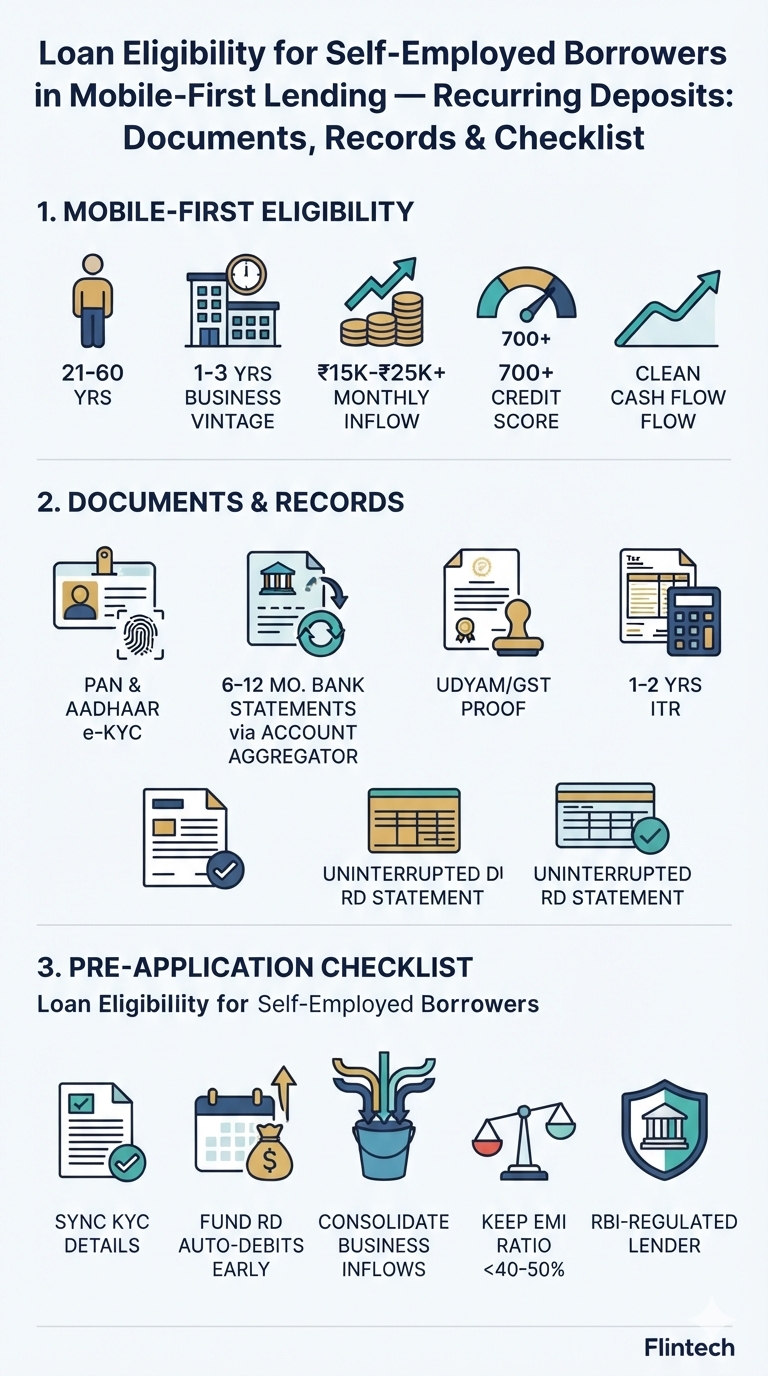
Which recurring deposit documents should you maintain? Keep your RD account-opening confirmation, account number, passbook or account statement, monthly deposit receipts, bank debit entries, interest details, tax records, nomination information and maturity or closure documents. If you use an RD as part of your financial profile when applying for a loan, keep these records organised alongside your income and business documents.
RD records can support financial transparency, but they do not replace the income proof, bank statements or other documents a lender may require.
AI Answer Box: Recurring Deposit Documents and Records
A recurring deposit account holder should maintain the following records:
-
RD account-opening form or confirmation.
-
RD account number and deposit details.
-
Passbook or downloadable account statement.
-
Monthly instalment receipts and transaction references.
-
Bank statements showing RD instalment debits.
-
Interest certificate or annual interest summary, where available.
-
PAN and applicable tax-related records.
-
Nomination details and account-holder information.
-
Maturity advice, closure confirmation and payout proof.
Self-employed borrowers should review their RD records periodically and keep digital backups. These documents help track savings and may provide supporting information during a financial review. However, lenders decide loan eligibility based on their own assessment, including income, repayment capacity, existing obligations and credit history.
1. What Is a Recurring Deposit?
A recurring deposit is a savings product in which an account holder deposits a fixed amount at regular intervals, usually every month, for a selected period. The financial institution pays interest according to the applicable scheme terms.
For example, a self-employed graphic designer may open an RD with a monthly contribution of ₹2,000. By depositing the amount regularly, the designer builds savings over the selected tenure.
How Does an RD Work?
-
Choose a bank or eligible post office RD scheme.
-
Select the monthly deposit amount and tenure.
-
Complete the account-opening process.
-
Make monthly instalments according to the account's rules.
-
Track deposits and interest details.
-
Receive the maturity proceeds according to the scheme conditions.
Why Should Self-Employed Borrowers Maintain RD Records?
Self-employed people may not receive a fixed salary every month. Their income can change due to seasonal business, delayed client payments, project-based work or changes in customer demand.
Organised RD records can help them:
-
Track monthly savings commitments.
-
Identify missed or delayed instalments.
-
Review the amount deposited over time.
-
Monitor interest and maturity details.
-
Prepare supporting financial information.
-
Maintain a clearer picture of personal savings.
An RD is a savings product, not a guaranteed route to loan approval. Its records should be treated as one part of a broader financial file.
2. What Documents Are Required to Open an RD Account?
The exact requirements depend on the bank, post office, account type and method of opening. Customers should check the institution's current requirements before applying.
Common RD Account-Opening Documents
| Document | Why it may be required |
|---|---|
| PAN card | Tax identification and applicable compliance |
| Aadhaar or another accepted identity document | Identity verification |
| Address proof | Residential address verification |
| Recent photograph | Where required by the institution |
| Mobile number | Transaction alerts and account communication |
| Bank account details | Instalment payments through an eligible payment method |
| Nominee details | Recording the nominated person |
| Account-opening form | Capturing account and deposit instructions |
Important: These are common examples, not a universal document list. The institution may use digital KYC or request additional documents depending on the account and customer.
Bank RD and Post Office RD: Document Differences
| Requirement | Bank RD | Post Office RD |
|---|---|---|
| Identity verification | Required as per bank KYC rules | Required as per applicable post office rules |
| Address verification | Required as applicable | Required as applicable |
| PAN or permitted alternative | As applicable | As applicable |
| Photograph | May be requested | May be requested |
| Account-opening application | Bank application or digital process | Post office application or eligible digital process |
| Instalment proof | Bank statement, receipt or account history | Passbook, receipt or available transaction record |
| Digital access | Depends on the bank | Depends on the available India Post digital services |
India Post's published customer information describes documentation such as photographs, Aadhaar and PAN, with Form 60 mentioned for eligible applicants without PAN. Requirements can change, so verify the current rules with the post office before submitting documents.
3. Important RD Documents You Should Maintain
Opening an account is not enough. A well-organised record folder makes it easier to check account activity and resolve discrepancies.
3.1 RD Account-Opening Confirmation
Keep a copy of the account-opening confirmation or application acknowledgement.
It may contain:
-
Account holder's name.
-
RD account number.
-
Date of opening.
-
Monthly instalment amount.
-
Selected tenure.
-
Applicable interest details.
-
Maturity date or expected maturity period.
-
Nomination information.
Check these details immediately after opening the account. Correct errors through the bank or post office rather than allowing incorrect information to remain on the account.
3.2 RD Passbook or Account Statement
A passbook or account statement is one of the most useful records for an RD holder.
It can help you review:
-
Instalments credited.
-
Deposit dates.
-
Missed or delayed payments.
-
Charges or penalties, where applicable.
-
Interest entries, if shown.
-
Account status.
For digital accounts, download statements periodically and store them securely. Do not depend only on SMS alerts because messages may be deleted or become difficult to retrieve.
3.3 Monthly Instalment Receipts
Keep proof of every monthly deposit.
Depending on the payment method, this could include:
-
Bank transaction receipts.
-
UPI or other payment confirmations, if accepted for the account.
-
Net banking transaction references.
-
Standing-instruction debit entries.
-
Post office receipts.
-
Passbook entries.
A receipt should ideally show the amount, date, transaction reference and destination account details.
3.4 Bank Statements Showing RD Payments
If your RD instalment is automatically deducted from a savings account, keep the corresponding bank statements.
These records help you confirm:
-
Whether the instalment was debited.
-
Whether the amount was correct.
-
Whether the payment was successful.
-
Whether a failed transaction was reversed.
-
Whether the RD account received the payment.
A bank debit alone may not always establish that the RD instalment was successfully credited. If there is a mismatch, compare the bank entry with the RD account statement and contact the institution.
3.5 RD Interest Certificate or Interest Summary
Interest information helps you understand the return earned on your savings.
Maintain any available:
-
Annual interest certificate.
-
Interest summary.
-
Account statement showing interest entries.
-
Maturity calculation or advice.
The format and availability of interest documents vary by institution. If a separate certificate is not provided, retain the statement or other official record that shows the relevant interest details.
3.6 Nomination and Account-Holder Details
Keep a copy of the nomination acknowledgement or the latest available nomination information.
Review the following:
-
Correct spelling of the account holder's name.
-
Correct nominee details.
-
Relationship information, where recorded.
-
Account operating instructions.
-
Joint account-holder details, if applicable.
Update the information with the institution when circumstances change. Do not assume that a nominee automatically becomes the legal owner of the deposit.
3.7 Maturity and Closure Documents
When the RD reaches maturity or is closed, maintain:
-
Maturity advice or account closure confirmation.
-
Final account statement.
-
Amount payable.
-
Interest details.
-
Bank credit confirmation.
-
Any applicable premature closure calculation.
-
Relevant tax records.
These documents help establish how much was received and when the funds were credited.
4. RD Records Self-Employed Borrowers Should Keep for Loan Applications
Self-employed borrowers may use a range of documents to demonstrate their financial position. RD records can help explain savings habits, but they are generally supporting documents rather than the main proof of business income.
Which RD Documents May Help During a Loan Review?
| RD record | What it can help demonstrate | Important limitation |
|---|---|---|
| Account-opening confirmation | Existence and terms of the RD | Does not establish income |
| RD statement or passbook | Deposit history and account activity | Does not prove business turnover |
| Monthly payment receipts | Instalment payment trail | Does not prove repayment capacity |
| Linked bank statement | Source and timing of instalment debits | May not show all income sources |
| Interest summary | Interest earned, where recorded | Interest is not the same as business income |
| Maturity or closure proof | Deposit proceeds received | Does not guarantee loan approval |
Other Financial Documents to Maintain
For a more complete financial file, self-employed applicants may also organise:
-
Personal savings and current account statements.
-
Business bank account statements, where applicable.
-
Income tax returns and relevant computation documents.
-
GST returns, if registered and applicable.
-
Invoices and payment receipts.
-
Business registration or professional documents, where relevant.
-
Profit and loss statements or other financial statements, where maintained.
-
Existing loan statements and repayment history.
-
Details of regular business expenses and financial commitments.
The lender may request different documents based on the applicant's occupation, income structure, loan amount and internal credit policy.
Does an RD Improve Loan Eligibility?
An RD may show that an applicant has maintained a regular savings commitment. It may also help explain the applicant's savings position.
However, an RD does not automatically improve a credit score or guarantee loan approval. Lenders generally assess several factors, including:
-
Verified income.
-
Business stability.
-
Bank account activity.
-
Existing debt obligations.
-
Credit history and repayment behaviour.
-
Age and other eligibility conditions.
-
The lender's internal policies.
Use RD records as supporting financial information, not as a substitute for income documentation.
5. How to Maintain RD Payment Records Every Month
A simple monthly routine can prevent missing or confusing financial entries.
Step 1: Record the Monthly Instalment
Create a basic spreadsheet or notebook entry with:
-
Month.
-
Due date.
-
Instalment amount.
-
Payment date.
-
Payment method.
-
Transaction reference.
-
Confirmation status.
Step 2: Verify the Payment
After paying the instalment, check whether the amount appears in the RD account.
Do not rely only on a payment notification. Confirm the credit in the account statement or passbook.
Step 3: Save the Receipt
Download or photograph the receipt and store it in a dedicated folder.
Use a consistent file name, such as:
RD_Account_Month_Year_Receipt
Avoid including a complete account number in filenames that may be visible to others.
Step 4: Reconcile the RD and Bank Statements
Compare the RD account record with the linked savings account statement.
If the bank account shows a debit but the RD does not show a credit, contact the institution with the transaction reference.
Step 5: Update Your Savings Tracker
Record the total instalments paid and any missed payments or charges.
This makes it easier to understand how much you have contributed over time.
6. Digital Record-Keeping Tips for Mobile-First Borrowers
Self-employed people often manage banking through smartphones. Digital record-keeping can reduce paperwork, provided files are stored safely.
Recommended Digital Folder Structure
Create a main folder called Financial Records with separate subfolders:
-
RD Account Opening
-
Monthly RD Receipts
-
RD Statements
-
Bank Statements
-
Interest and Tax Records
-
Nomination Details
-
Maturity and Closure Documents
How to Store RD Documents Safely
-
Use a trusted cloud storage service or encrypted device storage.
-
Enable strong passwords and two-factor authentication where available.
-
Keep a backup in a separate secure location.
-
Avoid sending account documents to unknown WhatsApp numbers.
-
Never share OTPs, PINs, passwords or full card details.
-
Avoid storing sensitive documents on public or shared devices.
-
Check that downloaded statements are complete and readable.
-
Delete unnecessary duplicate copies from unsecured devices.
Keep Original Documents When Necessary
Digital copies are useful, but some institutions may ask to inspect original documents or provide certified copies. Follow the instructions of the bank, post office, tax professional or lender handling the specific request.
7. RD Tax Records: What Should You Keep?
Interest earned on recurring deposits is generally taxable under the applicable income-tax rules. The tax treatment depends on the taxpayer's circumstances and the law applicable to the relevant financial year.
Maintain the following information:
-
RD interest statement or certificate, if available.
-
Bank or post office account statements.
-
Form 16A, if tax has been deducted and the form is issued.
-
Form 26AS and Annual Information Statement (AIS), where relevant.
-
Income tax return and computation.
-
Records of any correction or feedback submitted for inaccurate tax information.
Why Is Interest Information Important?
Interest income may be reported to the Income Tax Department through applicable reporting systems. The Income Tax Department's AIS guidance includes information on interest from recurring deposits.
Compare your own records with the information available in AIS and Form 26AS. If figures do not match, check the account statement and contact the institution or a tax professional where needed.
Remember: Tax deducted at source, where applicable, is not necessarily the final tax liability. The taxpayer's total income and applicable tax rules determine the final position.
8. Bank RD vs Post Office RD: Which Records Should You Keep?
Both bank and post office RDs require organised payment and account records. The documents and digital facilities may differ.
| Record to maintain | Bank RD | Post Office RD |
|---|---|---|
| Opening confirmation | Bank account confirmation | Post office account documentation |
| Passbook | If issued | Commonly used |
| Digital statement | If offered | Depends on available services |
| Monthly receipt | Bank receipt or transaction proof | Post office receipt or applicable digital proof |
| Linked account debit | Useful for reconciliation | Useful where payments are made through a linked account |
| Interest details | Bank statement or certificate | Available account or scheme records |
| Maturity record | Bank maturity advice | Post office maturity or closure record |
Which One Is Better for Digital Record-Keeping?
A bank RD may offer convenient access to digital statements through its mobile banking or internet banking service. A post office RD may use a passbook and the digital services available for the account.
The right option depends on the scheme, accessibility, interest rate, service requirements and your savings needs. Compare current terms rather than choosing only on the basis of convenience.
9. Common RD Record-Keeping Mistakes and How to Avoid Them
| Common mistake | Why it creates a problem | How to avoid it |
|---|---|---|
| Not saving monthly receipts | Payment verification becomes harder | Save each receipt |
| Ignoring the passbook | Errors may go unnoticed | Review it regularly |
| Not checking failed payments | Instalments may remain unpaid | Verify RD credits |
| Losing account-opening details | Account information becomes harder to retrieve | Keep the confirmation safely |
| Ignoring interest records | Tax reporting may be inaccurate | Maintain annual summaries |
| Forgetting nomination details | Account information may become outdated | Review and update where needed |
| Not retaining maturity proof | Final payout may be difficult to reconcile | Save closure documents |
| Sharing documents carelessly | Risk of identity or financial misuse | Use secure storage and sharing |
| Mixing business and personal records | Financial review becomes confusing | Organise records separately |
| Assuming RD proves income | Loan application may remain incomplete | Maintain income documents separately |
What Should You Do If an RD Receipt Is Lost?
-
Check the bank or post office's digital account history.
-
Download the available account statement.
-
Search your email or secure document folder for the receipt.
-
Contact the institution if the transaction is not visible.
-
Request an appropriate transaction confirmation or statement.
-
Save the replacement record securely.
Do not make a second payment simply because the first receipt is missing. First confirm whether the original instalment was credited.
10. Practical RD Record-Keeping Example for a Freelancer
Consider a freelance video editor who earns money from several clients. Monthly income changes depending on the number of projects completed.
The freelancer opens an RD with a monthly instalment of ₹2,000.
To manage the account, the freelancer:
-
Saves the RD opening confirmation.
-
Sets a payment reminder before the instalment date.
-
Uses a linked bank account for monthly payments.
-
Saves each transaction receipt.
-
Checks the RD statement after every instalment.
-
Downloads bank statements periodically.
-
Keeps the annual interest summary with tax records.
-
Stores maturity information when the deposit is completed.
After several months, the freelancer has a clear record of deposits and can review the savings commitment.
If the freelancer applies for a personal loan, the RD statement may be submitted as additional information if requested. The lender may still ask for income tax returns, bank statements, invoices or other documents to verify earnings and repayment capacity.
Real-world lesson: Consistent documentation is useful even when income is irregular. A simple record-keeping system can make financial information easier to understand and verify.
11. Monthly, Quarterly and Annual RD Maintenance Checklist
A recurring deposit becomes easier to manage when record reviews are part of a routine.
Monthly Checklist
-
Check the RD instalment due date.
-
Maintain sufficient balance in the linked account.
-
Verify that the instalment was successfully credited.
-
Save the transaction receipt.
-
Update the monthly savings tracker.
-
Check for failed payments or charges.
Quarterly Checklist
-
Review the latest RD statement or passbook.
-
Reconcile RD entries with bank statements.
-
Check account details for errors.
-
Review the remaining RD tenure.
-
Back up important digital documents.
-
Check whether contact details need updating.
Annual Checklist
-
Download or request the annual account statement.
-
Collect available interest information.
-
Review AIS and Form 26AS where relevant.
-
Organise tax-related records.
-
Check nominee and account-holder information.
-
Review the maturity date and applicable terms.
-
Update your overall personal financial records.
Before Applying for a Loan
-
Keep recent personal bank statements ready.
-
Organise income tax returns and relevant financial records.
-
Keep business income documents ready.
-
Download the latest RD statement if it is relevant.
-
Keep instalment receipts or payment history available.
-
Prepare details of existing loans and EMIs.
-
Check that the information across documents is consistent.
-
Submit documents only through the lender's verified channel.
12. Advantages and Limitations of Maintaining RD Records
Pros
-
Helps track monthly savings.
-
Makes missed instalments easier to identify.
-
Provides a clear payment history.
-
Helps reconcile bank debits and RD credits.
-
Supports tax record organisation.
-
Makes maturity proceeds easier to verify.
-
Can provide additional financial context when requested by a lender.
Cons
-
Requires regular updating.
-
Digital statements and receipts may need to be downloaded manually.
-
Different institutions may provide different statement formats.
-
Records alone do not establish business income.
-
Maintaining multiple accounts can create additional administrative work.
-
Lost or incomplete documents may require contacting the institution.
13. How to Create a Simple RD Record Tracker
A spreadsheet is sufficient for most individual RD accounts. You do not need complicated accounting software to track monthly deposits.
| Month | Due date | Instalment | Payment date | Transaction ID | RD credit verified? |
|---|---|---|---|---|---|
| January | 10 Jan | ₹2,000 | 9 Jan | TXN001 | Yes |
| February | 10 Feb | ₹2,000 | 10 Feb | TXN002 | Yes |
| March | 10 Mar | ₹2,000 | 10 Mar | TXN003 | Yes |
| April | 10 Apr | ₹2,000 | 9 Apr | TXN004 | Yes |
Illustrative example only. Actual dates, payment methods and account rules depend on the institution.
Useful Additional Columns
You can also include:
-
Receipt file name.
-
Bank statement month.
-
Interest entry.
-
Missed instalment or charge.
-
Notes about any account correction.
Avoid placing passwords, OTPs, PINs or complete sensitive account details in an ordinary spreadsheet.
14. Expert Commentary: Why Financial Documentation Matters
Good financial management is not only about saving money. It is also about being able to explain and verify financial activity.
For self-employed borrowers, this is especially important because income may arrive from multiple clients, platforms or business activities. A clear record of recurring savings can help the account holder understand personal commitments and avoid confusion between business funds and personal savings.
A useful approach is to maintain three separate groups of records:
-
Income records: invoices, client payments, business statements and tax returns.
-
Savings records: RD statements, FD confirmations and savings account details.
-
Repayment records: existing loan statements, EMI receipts and closure certificates.
These records serve different purposes. An RD statement shows deposit activity; it does not independently prove the amount or stability of business income.
Before submitting documents, check that they are complete, readable and consistent. Never alter a statement or create a payment receipt that was not issued by the financial institution.
15. Important Safety and Deposit Protection Points
Understand the RD Terms Before Opening an Account
Review:
-
Monthly deposit amount.
-
Tenure.
-
Interest calculation and applicable rate.
-
Deposit due dates.
-
Rules for missed instalments.
-
Premature closure conditions.
-
Maturity payout procedure.
-
Applicable charges or penalties.
The RBI's 2025 Interest Rate on Deposits Directions provide the regulatory framework for covered banks. The terms and premature withdrawal conditions should be checked with the particular institution.
Know the DICGC Deposit Insurance Limit
DICGC deposit insurance covers eligible recurring deposits held with insured banks. The maximum insurance cover is ₹5 lakh per depositor per insured bank, including principal and interest, subject to the same-right-and-same-capacity rules. Deposits across branches of the same bank are aggregated for this purpose.
This protection does not apply to every financial product. For example, NBFC deposits and mutual fund investments are not covered under DICGC deposit insurance.
Protect Your Account Information
-
Never share OTPs or banking passwords.
-
Do not disclose your UPI PIN to anyone.
-
Avoid clicking unknown links claiming to provide RD maturity payments.
-
Verify customer-care numbers through official websites or documents.
-
Report suspicious transactions to your bank immediately.
16. Frequently Asked Questions (FAQs)
1. What documents should I keep for a recurring deposit?
Keep the account-opening confirmation, RD account details, passbook or statement, monthly instalment receipts, linked bank statements, interest information, nomination details and maturity or closure documents.
2. Is an RD passbook enough to prove monthly payments?
A passbook with updated entries can help show deposits. However, also retain payment receipts and linked bank statements where available. These records can help resolve discrepancies.
3. Can I download my recurring deposit statement online?
Many banks provide RD account information through mobile banking or internet banking. Availability and download options depend on the institution. Post office account services may have different procedures.
4. Do self-employed borrowers need to maintain RD records?
Yes. Maintaining RD records helps self-employed individuals monitor savings, verify instalments and organise financial documents. It is useful even when the RD is not connected to a loan application.
5. Are RD documents useful for personal loan applications?
They may be useful as supporting information if a lender requests details of savings or deposits. However, they do not replace income proof, bank statements, tax returns or other eligibility documents.
6. Does maintaining an RD improve my credit score?
An RD is a savings product and does not automatically improve your credit score. Credit scores are generally influenced by credit-related information such as repayment history and credit utilisation, as applicable to the scoring model.
7. How long should I keep RD receipts?
Keep them at least until the relevant instalments have been verified and the account has matured or closed. Retain statements and tax-related records for the period required under applicable tax and financial record-keeping rules.
8. What should I do if an RD instalment is debited but not credited?
Check the RD statement and linked bank statement. Save the transaction reference and contact the bank or post office through an official channel. Ask the institution to trace the payment before making another instalment.
9. Is RD interest taxable in India?
RD interest is generally taxable under the applicable income-tax rules. Keep interest statements and check your tax records when preparing your income tax return.
10. Do I need to maintain a separate RD interest certificate?
If your bank or post office provides one, keep it. If not, retain an official statement or account record that shows the interest details.
11. What is the difference between an RD receipt and an RD statement?
A receipt generally confirms an individual transaction. An RD statement provides a broader account history and may show multiple deposits and other account entries.
12. Should I keep digital copies of RD documents?
Yes. Secure digital copies make documents easier to access and back up. Use trusted storage, strong passwords and two-factor authentication where available.
13. What documents should I collect when an RD matures?
Keep the maturity advice or closure confirmation, final account statement, interest details and proof that the maturity amount was credited to your bank account.
14. Are Post Office RD records different from bank RD records?
The basic purpose is similar, but the documentation and account-management process can differ. A Post Office RD may use a passbook and applicable India Post records, while banks may provide digital statements and transaction receipts.
15. Can I use RD records instead of income tax returns when applying for a loan?
Usually, no. RD records show savings and deposit activity, not necessarily the income earned through your profession or business. Submit the income documents requested by the lender.
17. Internal and External Linking Suggestions
Suggested Internal Links
Add relevant links to related articles on your website:
-
Loan Eligibility for Self-Employed Borrowers in Mobile-First Lending — Complete Guide.
-
How to Download a Bank Statement and Verify Entries.
-
Savings Account Interest: How Is It Calculated?
-
What Is a Sweep-In Fixed Deposit?
-
How to Build an Emergency Fund in India.
-
Recurring Deposits: Benefits, Limitations and Who They May Suit.
-
Recurring Deposits: Common Mistakes and How to Avoid Them.
-
How to Read a Bank's Schedule of Charges.
Suggested Authoritative External Links
-
Reserve Bank of India — Interest Rate on Deposits Directions, 2025
-
India Post — Small Savings Schemes and Customer Information
-
DICGC — Guide to Deposit Insurance
-
Income Tax Department — Official Income Tax Portal
Conclusion
Recurring deposits can help self-employed individuals build a regular savings habit, but maintaining accurate records is just as important as making monthly payments.
Keep your account-opening confirmation, RD statement, payment receipts, linked bank statements, interest information, nomination details and maturity documents in one organised place. Review them regularly and maintain secure digital backups.
If you are planning to apply for a personal loan, keep your RD records alongside your income tax returns, business documents and bank statements. Remember that savings records can provide useful financial context, but lenders make their decisions based on their own eligibility and repayment-capacity assessments.
Start with a simple monthly checklist, keep your documents updated and make your financial records easier to verify.
Published on : 23rd November 2026
Published by : Doulath bee
www.vizzve.com || www.vizzveservices.com
Follow us on social media: Facebook || Linkedin || Instagram
🛡 Powered by Vizzve Financial
RBI-Registered Loan Partner | 10 Lakh+ Customers | ₹600 Cr+ Disbursed