

Introduction
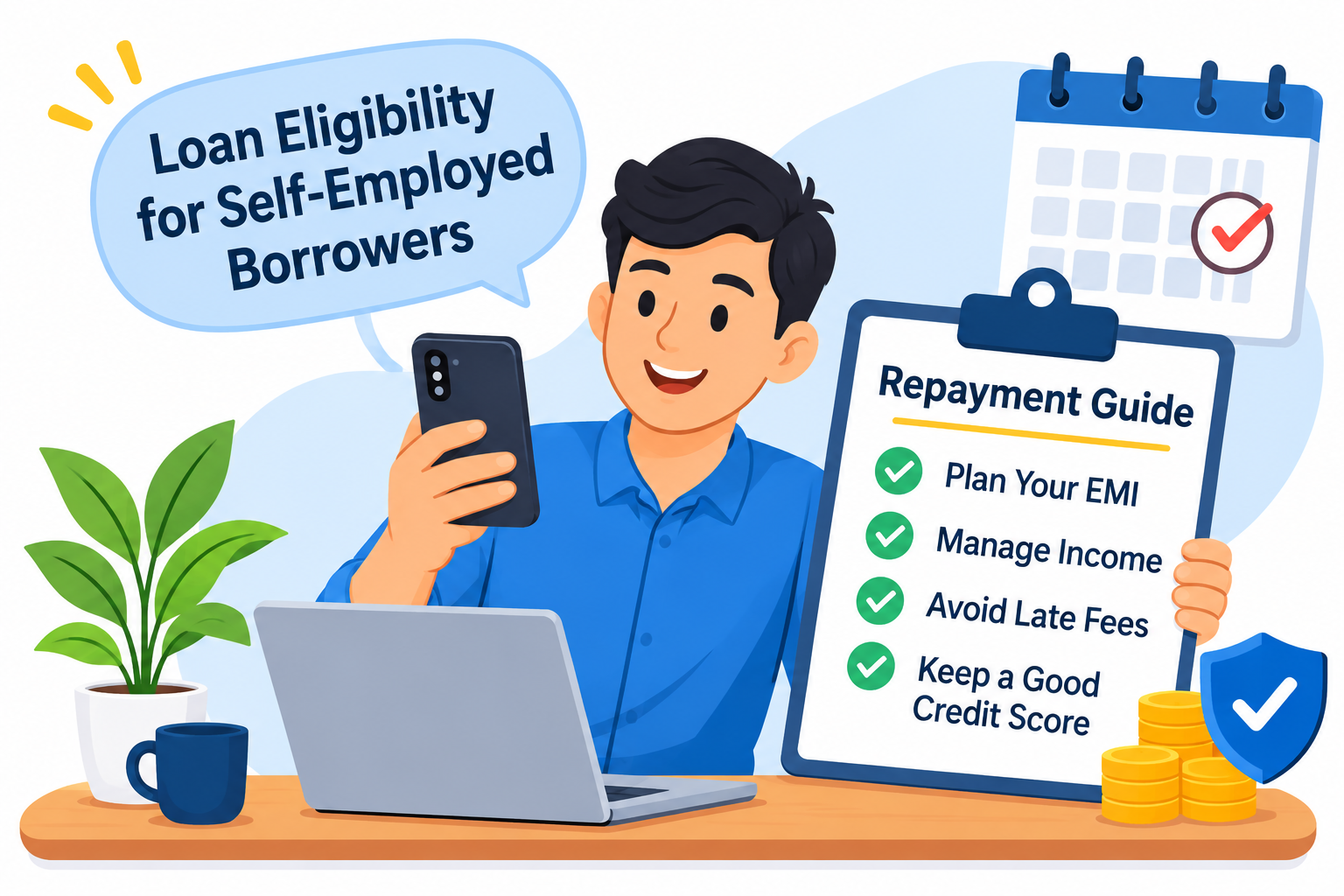
For self-employed individuals, getting a personal loan is only one part of the borrowing journey. Managing repayments on time is equally important.
Unlike salaried employees who may receive a fixed salary every month, freelancers, consultants, shop owners and independent professionals often experience changes in their monthly income. Some months may bring several client payments, while others may be quieter. This makes loan repayment planning especially important.
Mobile-first lending platforms have made it easier to begin loan applications, submit documents and access digital loan information. However, the responsibility of repaying the loan remains with the borrower, and the actual repayment terms are determined by the regulated lender.
A well-planned repayment strategy can help borrowers:
-
Pay EMIs on or before their due dates.
-
Avoid unnecessary late-payment charges.
-
Manage irregular business income.
-
Maintain a healthy credit history.
-
Understand the total cost of borrowing.
-
Reduce financial stress during slow business periods.
This guide explains how self-employed borrowers can manage mobile personal loan repayments, with a practical example, EMI calculations, repayment methods, common mistakes and useful financial planning tips.
AI Answer Box: How Should Self-Employed Borrowers Repay Mobile Personal Loans?
Self-employed borrowers should plan personal loan repayments according to their average income, existing EMIs, business expenses and monthly household commitments. They should maintain a separate EMI reserve, check the repayment schedule, keep sufficient funds in the linked bank account and pay each instalment before its due date.
Borrowers should review the Key Facts Statement (KFS), Annual Percentage Rate (APR), processing fees, penal charges and prepayment conditions before accepting a loan. Digital repayment options may include authorised bank transfers or automatic debit facilities, depending on the lender.
The most important principle is to choose an EMI that remains affordable even during months when business income is lower than usual.
1. What Is Loan Repayment in Mobile-First Lending?
Loan repayment is the process of returning borrowed money to the lender according to the agreed repayment schedule.
For most personal loans with monthly instalments, borrowers repay the loan through Equated Monthly Instalments (EMIs).
An EMI generally includes:
-
A portion of the principal amount.
-
Interest charged on the outstanding loan balance.
The amount paid towards principal and interest changes over the repayment period under a standard reducing-balance loan.
In mobile-first lending, borrowers may be able to view repayment information digitally, depending on the platform and lender.
How Does Mobile Loan Repayment Work?
A typical repayment journey may involve the following steps:
-
The lender sanctions the loan and provides the loan agreement.
-
The borrower receives the repayment schedule.
-
The borrower reviews the EMI amount and due date.
-
The borrower chooses an available authorised repayment method.
-
The EMI is paid or automatically debited on the scheduled date.
-
The lender updates the loan account after processing the payment.
Borrowers should always check the lender's official instructions. A mobile application may facilitate the process, but the actual loan account is maintained by the regulated lender.
2. Why Is Repayment Planning Important for Self-Employed Borrowers?
Self-employed individuals may receive income from multiple sources. Their earnings can depend on customer demand, project completion, seasonal sales, market conditions and payment collection cycles.
For example:
-
A freelancer may receive several payments in one month and very few in the next.
-
A shop owner may earn more during festival seasons.
-
A consultant may receive fees after completing a project.
-
An online seller may experience changes in monthly orders.
-
A small business owner may have to pay suppliers before receiving customer payments.
A fixed EMI must still be paid even when income changes.
Common Repayment Challenges
| Challenge | How it affects repayment | Practical response |
|---|---|---|
| Irregular monthly income | Money may not be available on the due date | Build an EMI reserve |
| Delayed client payments | Cash flow becomes unpredictable | Maintain a repayment buffer |
| Seasonal business activity | Income may fall during certain months | Plan using conservative income estimates |
| Existing EMIs | Reduces available monthly funds | Review total debt commitments |
| Unexpected business expenses | Savings may be used elsewhere | Separate personal and business budgets |
| Poor repayment tracking | Due dates may be missed | Use reminders and account alerts |
The goal is not simply to pay the EMI in a good month. It is to create a repayment plan that can work during an average or weaker month too.
3. Real-World Example: How a Self-Employed Borrower Can Manage Loan Repayments
The following is a hypothetical example created for educational purposes. It is not an actual Vizzve customer case, lender offer or guarantee of loan approval.
Meet Rahul, a Self-Employed Digital Marketing Consultant
Rahul is a 32-year-old independent digital marketing consultant based in Bengaluru. He works with different businesses and receives payments after completing monthly projects.
He wants a personal loan of ₹1,50,000 to meet a planned professional and personal expense.
His income varies depending on the number of projects he completes.
Rahul's Illustrative Financial Profile
| Financial detail | Example amount |
|---|---|
| Profession | Digital marketing consultant |
| Work experience | 4 years |
| Average monthly income | ₹60,000 |
| Lower-income month | ₹42,000 |
| Higher-income month | ₹78,000 |
| Existing monthly EMI | ₹4,000 |
| Requested loan amount | ₹1,50,000 |
| Proposed repayment period | 24 months |
These details are illustrative. Actual lenders may assess income, expenses and repayment capacity differently.
Step 1: Rahul Reviews His Monthly Budget
Before accepting a loan, Rahul prepares a simple monthly budget.
| Monthly category | Amount |
|---|---|
| Average professional income | ₹60,000 |
| Household expenses | ₹20,000 |
| Business expenses | ₹9,000 |
| Existing EMI | ₹4,000 |
| Savings and emergency allocation | ₹7,000 |
| Remaining amount before new EMI | ₹20,000 |
Rahul understands that his monthly income may fall to ₹42,000 in a slow month. Therefore, he does not want to select an EMI that depends on earning ₹60,000 or more every month.
Step 2: Rahul Understands the EMI
Suppose a lender offers the following hypothetical loan terms:
| Loan detail | Illustrative value |
|---|---|
| Principal | ₹1,50,000 |
| Annual interest rate | 18% |
| Repayment period | 24 months |
| Approximate monthly EMI | ₹7,489 |
| Approximate total repayment | ₹1,79,736 |
| Approximate interest | ₹29,736 |
The figures use an assumed reducing-balance interest rate and exclude processing fees, taxes and other applicable charges. Actual loan terms may be different.
Step 3: Rahul Creates an EMI Reserve
Instead of using every client payment immediately, Rahul sets aside money for upcoming EMIs.
For example, he can build a reserve equal to three monthly instalments:
₹7,489 × 3 = ₹22,467 approximately.
This reserve can help him manage repayment if a client delays payment or a project is postponed.
A three-month reserve is an illustrative planning target, not a regulatory requirement or a guarantee that it will cover every emergency.
Step 4: Rahul Sets Up Payment Reminders
Rahul records his EMI due date in his calendar and activates bank alerts.
If his lender offers an authorised auto-debit facility, he reviews the mandate details and keeps sufficient money in the linked account before the due date.
He also checks whether the EMI has actually been processed rather than assuming that a scheduled debit was successful.
Step 5: Rahul Reviews His Loan Account
After making a payment, Rahul checks the lender's official loan statement or account information to confirm that the instalment has been credited.
He saves the payment confirmation and monitors the outstanding loan balance.
What Can Other Self-Employed Borrowers Learn from Rahul?
-
Budget using realistic income, not the highest monthly earnings.
-
Separate EMI money from daily business spending.
-
Keep a repayment reserve.
-
Use reminders to track due dates.
-
Verify every payment.
-
Review the outstanding loan balance regularly.
4. How to Calculate Personal Loan EMI
Understanding EMI helps borrowers decide whether a loan is affordable.
The standard reducing-balance EMI formula is:
EMI = P × r × (1 + r)^n / [(1 + r)^n − 1]
Where:
-
P = Principal loan amount.
-
r = Monthly interest rate.
-
n = Total number of monthly instalments.
The monthly interest rate is generally calculated by dividing the annual nominal interest rate by 12 and converting it into a decimal.
Example of EMI Calculation
Assume:
-
Loan amount: ₹1,50,000.
-
Annual interest rate: 18%.
-
Monthly interest rate: 1.5%.
-
Tenure: 24 months.
The approximate EMI is ₹7,489.
How Does the Loan Balance Change?
In a reducing-balance loan, the interest component is generally higher in the earlier instalments because the outstanding principal is larger.
As the principal reduces, the interest portion generally becomes smaller and the principal repayment portion becomes larger.
The exact amortisation schedule depends on the lender's calculation method, payment dates and loan terms.
EMI Comparison by Repayment Period
The following table uses the same assumed principal of ₹1,50,000 and annual reducing-balance interest rate of 18%.
| Tenure | Approximate EMI | Approximate total repayment | Approximate interest |
|---|---|---|---|
| 12 months | ₹13,752 | ₹1,65,024 | ₹15,024 |
| 18 months | ₹9,570 | ₹1,72,260 | ₹22,260 |
| 24 months | ₹7,489 | ₹1,79,736 | ₹29,736 |
| 36 months | ₹5,423 | ₹1,95,228 | ₹45,228 |
These are rounded estimates, not lender quotations. Actual APR, fees, taxes and repayment terms may change the total cost.
What Does the Comparison Show?
-
A shorter tenure usually means a higher EMI.
-
A longer tenure usually reduces the monthly EMI.
-
A longer tenure generally increases the total interest paid.
-
The lowest EMI is not automatically the cheapest loan option.
Self-employed borrowers should compare both monthly affordability and total repayment cost.
5. How Can Self-Employed Borrowers Manage EMIs with Irregular Income?
A stable repayment strategy should account for income fluctuations.
5.1 Calculate Average Income Carefully
Review several months of income records rather than relying on a single high-income month.
A conservative estimate can help borrowers avoid overcommitting.
5.2 Separate Business and Personal Expenses
Where practical, maintain separate accounts or clearly organised records for business income and household spending.
This makes it easier to understand how much money is genuinely available for repayment.
5.3 Create a Dedicated EMI Fund
Set aside the EMI amount as soon as client payments or business receipts arrive.
Do not wait until the due date to arrange the money.
5.4 Build Emergency Savings
Unexpected expenses can affect repayment. Emergency savings may help cover essential costs without disturbing the EMI reserve.
5.5 Match Repayment Dates to Cash Flow Where Possible
If the lender allows a choice of due date, select one that follows a predictable income period. Confirm the available options before signing the loan agreement.
5.6 Review Your Budget Every Month
Income and expenses may change. Review the repayment plan regularly and make adjustments before a payment problem occurs.
6. What Are the Available Methods for Mobile Loan Repayment?
The repayment options depend on the regulated lender and the loan agreement.
Common methods may include:
| Repayment method | How it works | What to check |
|---|---|---|
| NACH or e-mandate | An authorised recurring debit is presented through the bank | Mandate status and available balance |
| UPI | Payment through an authorised UPI option, where supported | Correct lender account and payment confirmation |
| Net banking | Payment through the bank's online banking service | Correct loan account details |
| Official payment portal | Payment through the lender's authorised website or application | Secure website and transaction receipt |
| Bank transfer | Transfer through a permitted bank payment method | Correct beneficiary and loan reference |
Important: For digital loans covered by RBI digital-lending requirements, repayment is generally required to flow directly to the regulated entity's bank account rather than through an unauthorised third-party pass-through or pool account. Follow the lender's official payment instructions.
Borrowers should never transfer EMI money to an unknown personal account or an agent's personal UPI ID.
7. What Should Borrowers Check Before Making an EMI Payment?
Before every payment, confirm the following:
-
Correct loan account number or reference.
-
EMI amount due.
-
Payment due date.
-
Available balance in the linked bank account.
-
Correct lender or authorised payment channel.
-
Any outstanding overdue amount, if applicable.
-
Successful transaction confirmation after payment.
Why Is Payment Confirmation Important?
A payment may be initiated but not immediately reflected in the loan account.
Borrowers should retain:
-
Bank debit confirmation.
-
UPI or transaction reference.
-
Official payment receipt.
-
Updated loan statement, when available.
If the amount is debited but the lender does not update the account, contact the lender through its official support channel and provide the transaction reference.
8. What Happens If a Self-Employed Borrower Misses an EMI?
Missing an EMI can create financial and credit-related consequences.
The exact outcome depends on the loan agreement, applicable rules and lender policies.
Possible consequences include:
Late-payment or penal charges
The lender may levy charges as permitted by the loan agreement and applicable rules. Review the KFS and agreement to understand the amount and conditions.
Impact on credit history
Payment delays may be reported to credit information companies and may affect the borrower's credit profile.
Additional repayment burden
Unpaid instalments and applicable charges may increase the amount the borrower needs to clear.
Collection communication
The lender may contact the borrower to request payment or discuss the overdue account.
What Should You Do If You Cannot Pay an EMI?
-
Contact the lender as early as possible.
-
Explain the situation through an official communication channel.
-
Ask about the available options, if any.
-
Check the overdue amount and applicable charges.
-
Avoid taking another expensive loan simply to cover the missed EMI without reviewing the consequences.
-
Keep written records of communications and payment arrangements.
Do not ignore lender communication. Early contact may help clarify the account position and available next steps, although a lender is not required to grant a repayment extension.
9. How Can Borrowers Avoid Late EMI Payments?
A few practical habits can reduce the risk of missed instalments.
| Habit | Benefit |
|---|---|
| Set calendar reminders | Helps track due dates |
| Maintain an EMI reserve | Reduces dependence on last-minute income |
| Keep enough bank balance | Helps avoid failed auto-debits |
| Track client payments | Makes cash flow easier to predict |
| Check loan statements | Helps identify payment discrepancies |
| Review expenses | Protects money needed for repayment |
| Contact lender early | Helps clarify options when cash flow is disrupted |
A Simple Monthly Repayment Routine
At the beginning of the month:
-
Review expected income and business expenses.
-
Check the EMI due date.
-
Set aside the required repayment amount.
One week before the due date:
-
Confirm the available bank balance.
-
Check the loan account for any outstanding amount.
-
Verify the payment method.
On the due date:
-
Check whether the payment has been processed.
-
Save the confirmation.
After payment:
-
Review the loan statement.
-
Update your repayment tracker.
10. Should Self-Employed Borrowers Make Part-Payments or Foreclose a Loan Early?
Part-payment means repaying a portion of the outstanding principal before the scheduled end of the loan. Foreclosure means repaying the remaining amount to close the loan earlier than planned.
Early repayment may reduce future interest, depending on the loan structure and timing. However, borrowers should check the applicable rules and charges before making a decision.
What Are the RBI Prepayment Rules from January 1, 2026?
The RBI's Pre-payment Charges on Loans Directions, 2025 apply to loans and advances sanctioned or renewed on or after January 1, 2026, subject to their scope and conditions.
For floating-rate loans granted to individuals for purposes other than business, regulated lenders covered by the Directions cannot levy prepayment charges.
For other categories, including certain business-purpose or fixed-rate loans, the applicable rules and lender policies may differ. Borrowers should check the loan's purpose, interest-rate type, lender category, sanction or renewal date, sanction letter, KFS and loan agreement before making an early repayment.
Important: A self-employed person's occupation does not automatically make a loan a business-purpose loan. The stated and documented purpose of the borrowing matters.
Questions to Ask Before Making an Early Repayment
-
Is the loan fixed-rate or floating-rate?
-
Is the loan classified as personal or business-purpose credit?
-
When was it sanctioned or renewed?
-
Does the applicable RBI direction prohibit a prepayment charge?
-
If charges are permitted, are they disclosed in the agreement and KFS?
-
Will early repayment reduce the total cost enough to justify using the available savings?
Do not use all emergency savings to close a loan if doing so leaves insufficient money for essential expenses or business needs.
11. Pros and Cons of Digital Loan Repayment
| Pros | Cons |
|---|---|
| Convenient access to repayment information | Requires reliable digital access |
| May support online payment methods | Technical issues may delay confirmation |
| Easier access to transaction records | Incorrect payment details can cause problems |
| Digital reminders may be available | Notifications can be missed |
| Can reduce the need for branch visits | Borrowers must identify genuine payment channels |
Benefits
-
Convenient repayment access.
-
Easier tracking of payment history.
-
Availability of digital receipts.
-
Potentially simpler account monitoring.
-
Less dependence on physical paperwork.
Limitations
-
Auto-debit may fail if the account has insufficient funds.
-
Network or banking issues may affect payment processing.
-
Fake payment links can expose borrowers to fraud.
-
A payment initiated through an unauthorised channel may not clear the loan account.
-
Digital convenience does not remove the borrower's repayment obligation.
12. How Can Loan Repayment Affect Credit History?
Credit history reflects a borrower's past credit behaviour as reported by lenders to credit information companies.
Repayment behaviour is an important part of this history.
Timely Payments
Paying EMIs on time can help maintain a positive repayment record.
Missed Payments
Late or missed instalments may be reported and can negatively affect a credit profile.
High Existing Debt
Several active loans and high outstanding balances may affect how lenders assess future credit applications.
Loan Closure
After completing repayment, check the lender's statement and closure confirmation. Review your credit report later to confirm that the account status is updated accurately.
Remember: A good credit history can support future applications, but it does not guarantee loan approval or a particular interest rate.
13. How to Build a Responsible Repayment Plan Before Taking a Mobile Loan
A repayment plan should begin before the loan is accepted.
Step 1: Identify the Purpose of the Loan
Borrow only for a genuine requirement. Avoid taking a loan simply because a digital platform makes the application convenient.
Step 2: Review Your Income Pattern
Look at income across several months and identify periods when earnings are lower.
Step 3: Calculate Existing Obligations
Include all active EMIs, credit-card payments and other recurring commitments.
Step 4: Estimate the New EMI
Use an EMI calculator and compare different tenures.
Step 5: Check the Complete Loan Cost
Review APR, processing fees, taxes, penal charges and other applicable costs.
Step 6: Create an EMI Reserve
Keep repayment funds separate from everyday spending.
Step 7: Select a Suitable Payment Method
Choose an authorised repayment option and understand how it works.
Step 8: Read the Loan Agreement
Check the due date, repayment schedule, prepayment conditions and grievance contact details.
Step 9: Monitor Payments
Verify each EMI and retain payment receipts.
Step 10: Review the Account After Closure
Obtain the lender's closure confirmation and check your credit report for accurate account status.
14. Expert Commentary: Repayment Planning Matters as Much as Loan Eligibility
For a self-employed borrower, a loan should be evaluated using the stability of cash flow rather than only the average monthly income.
An applicant may earn ₹80,000 in one month and ₹35,000 in another. If the borrower chooses an EMI based only on the higher figure, repayment could become difficult during a slower period.
A practical financial assessment should consider:
-
Average and lower-end monthly income.
-
Essential household expenses.
-
Business operating costs.
-
Existing debt commitments.
-
Emergency savings.
-
The total cost of the proposed loan.
A responsible borrowing decision is one where the repayment schedule fits the borrower's actual financial situation.
Frequently Asked Questions (FAQs)
1. How should self-employed borrowers plan personal loan repayments?
They should review average and lower-income months, calculate existing obligations, choose an affordable EMI and maintain a separate repayment reserve.
2. Can self-employed borrowers repay personal loans through mobile applications?
Depending on the lender, borrowers may be able to access loan information and use authorised digital repayment methods through a mobile application or online portal.
3. What is an EMI?
An Equated Monthly Instalment is a scheduled payment made towards a loan. For a standard reducing-balance loan, it generally includes principal and interest.
4. How can freelancers manage EMIs with irregular income?
Freelancers can set aside part of each client payment, maintain an EMI reserve, track invoice collections and budget using conservative income estimates.
5. What happens if I miss a personal loan EMI?
The lender may apply charges permitted by the agreement, contact the borrower for repayment and report payment delays to credit information companies, as applicable.
6. Can a self-employed borrower set up automatic EMI payments?
Some lenders offer authorised recurring debit facilities such as NACH or e-mandates. Borrowers should check the mandate terms and maintain sufficient funds in the linked account.
7. How much money should I keep aside for loan repayment?
At a minimum, keep enough money for the next scheduled EMI. An additional reserve covering several instalments may provide a buffer, depending on income stability and personal circumstances.
8. Does paying EMIs on time improve credit history?
Timely repayment can support a positive credit history. However, credit scores depend on multiple factors and timely payments do not guarantee a particular score.
9. Can I repay my personal loan before the end of the tenure?
Depending on the loan terms and applicable rules, borrowers may be able to make part-payments or close the loan early. Check the interest-rate type, loan purpose, sanction date and prepayment conditions.
10. Are prepayment charges allowed on all personal loans?
No. RBI directions effective from January 1, 2026 prohibit prepayment charges on covered floating-rate loans granted to individuals for purposes other than business. Other loan categories may have different rules. Check the applicable direction and agreement.
11. What should I do if my income falls and I cannot pay an EMI?
Contact the lender through an official channel as early as possible. Ask about available options, understand any applicable charges and keep written records of the communication.
12. Can a failed auto-debit affect my loan account?
Yes. If the EMI is not successfully collected by the due date, the account may become overdue and applicable charges or reporting consequences may follow. Confirm payment status and contact the lender promptly.
13. Is it safe to pay EMIs through a UPI link?
Use UPI only when the payment option is provided or verified through the lender's official channel. Confirm the beneficiary details and save the transaction reference. Avoid unknown personal payment IDs.
14. What is the difference between part-payment and foreclosure?
Part-payment means paying a portion of the outstanding principal before the scheduled date. Foreclosure means paying the remaining amount to close the loan before the original tenure ends.
15. Can Vizzve Financial help me explore personal loan options?
You can visit the official Vizzve Financial website to review available services and application information. Loan availability, eligibility, terms and approval depend on the relevant lender's policies and assessment.
Conclusion
For self-employed borrowers, successful borrowing does not end when the loan amount is disbursed. A clear repayment plan is necessary to manage monthly obligations, protect cash flow and maintain a healthy credit history.
Mobile-first lending can make loan information and repayment access more convenient. However, borrowers should understand the full loan cost, check the EMI due date, use authorised payment channels and keep sufficient funds available.
The most practical approach is to select a repayment amount that fits average income and remains manageable during slower business periods.
If you are exploring personal loan options, visit Vizzve Financial at https://www.vizzve.com/ to review the available information. Compare the terms carefully and borrow only what you can comfortably repay.
Published on : 5th November
Published by : Doulath bee
www.vizzve.com || www.vizzveservices.com
Follow us on social media: Facebook || Linkedin || Instagram
🛡 Powered by Vizzve Financial
RBI-Registered Loan Partner | 10 Lakh+ Customers | ₹600 Cr+ Disbursed