

Introduction
A savings account is more than a place to deposit money. It helps you receive payments, make everyday transactions, pay bills and keep funds accessible. It can also earn interest on the balance maintained in the account.
But how exactly is savings account interest calculated?
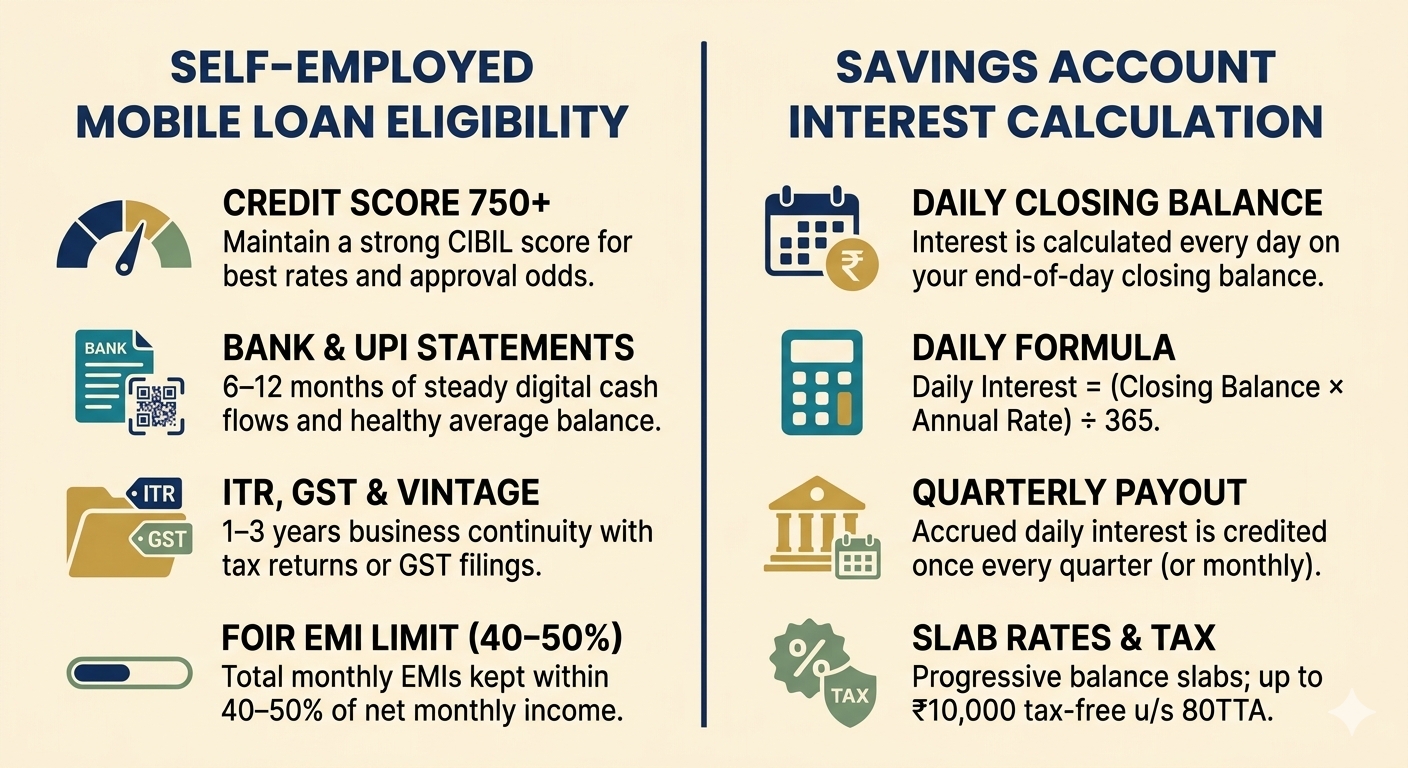
In India, interest on domestic rupee savings deposits is generally calculated using the daily product method. This means the bank considers the eligible end-of-day balance for each day and applies the relevant annual interest rate.
The interest is calculated daily, but the amount is credited to your account at the intervals specified by the bank. Under RBI directions for commercial banks, savings deposit interest must be credited at quarterly or shorter intervals.
Understanding this process is particularly useful for self-employed borrowers. Freelancers, consultants, shop owners, independent professionals and small business owners may receive income at irregular intervals. Their account balances can change significantly throughout the month.
Knowing how savings interest works can help you manage surplus money, understand bank statements and make better decisions about everyday savings.
AI Answer Box: How Is Savings Account Interest Calculated?
Savings account interest in India is generally calculated on the daily closing balance using the daily product method.
The bank applies the applicable annual interest rate to each day's eligible end-of-day balance. It then adds the daily interest amounts and credits the total according to its interest-payment schedule.
Basic formula:
Daily interest = Daily closing balance × Annual interest rate ÷ 365
For example, if you maintain ₹1,00,000 for 30 days at an illustrative annual interest rate of 3%:
₹1,00,000 × 3 × 30 ÷ (100 × 365) = ₹246.58
The estimated interest is ₹246.58 before any applicable adjustments.
Actual interest depends on the bank's published rate, balance slabs, day-count convention, account terms and rounding method.
Full Blog Content
1. What Is Savings Account Interest?
Savings account interest is the amount a bank pays an eligible account holder for maintaining money in a savings deposit account.
When you deposit money, the bank pays interest according to the applicable rate and account conditions. The interest rate is usually expressed as an annual percentage.
For example:
-
You maintain ₹50,000 in your savings account.
-
Your bank offers an illustrative annual interest rate of 3%.
-
You maintain the balance for a certain number of days.
-
The bank calculates interest using the eligible daily balances.
-
The accumulated interest is credited to your account.
The interest you earn depends on the amount maintained, the applicable rate and the number of days the money remains in the account.
Why do banks pay interest on savings accounts?
Savings accounts are designed to help people keep money accessible while earning some interest.
They are useful for:
-
Receiving salary or professional payments.
-
Keeping money for regular expenses.
-
Making digital payments.
-
Maintaining emergency savings.
-
Managing short-term cash requirements.
-
Keeping personal finances organised.
A savings account is primarily a banking and liquidity product. It should not automatically be treated as a replacement for a long-term investment.
2. How Is Savings Account Interest Calculated in India?
The Reserve Bank of India provides the regulatory framework for savings deposit interest calculation.
For domestic rupee savings deposits with commercial banks, interest is calculated on a daily product basis.
This means the bank considers the eligible end-of-day balance for every day in the relevant period.
What is the daily product method?
The daily product method calculates interest using the balance maintained at the end of each day.
Suppose your account has the following closing balances:
| Day | Daily closing balance |
|---|---|
| Day 1 | ₹20,000 |
| Day 2 | ₹25,000 |
| Day 3 | ₹30,000 |
| Day 4 | ₹15,000 |
| Day 5 | ₹40,000 |
The bank considers each day's balance separately.
A higher eligible closing balance generally earns more interest for that day, assuming the same interest rate applies.
Why does the closing balance matter?
Your account balance may change because of deposits, withdrawals, transfers and payments.
For example:
-
A customer payment is credited to your account.
-
You pay a supplier.
-
You withdraw money for household expenses.
-
Another client transfers a payment.
These transactions can change your end-of-day balance. Therefore, the interest earned may also change from day to day.
3. What Is the Savings Account Interest Calculation Formula?
The basic formula is:
Interest = Principal × Annual Interest Rate × Number of Days ÷ 365
Where:
-
Principal: Eligible balance maintained in the account.
-
Annual interest rate: Rate published by the bank.
-
Number of days: Number of days the balance is maintained.
-
365: Common illustrative day-count basis used in the calculation.
For an account with changing balances, calculate interest separately for each day and add the results.
Total interest = Sum of daily closing balance × applicable daily interest rate
The bank's applicable day-count convention, rate slabs and rounding rules should be checked before treating a manual calculation as final. A bank may use a different convention for particular circumstances or account products.
Example 1: Interest on ₹1 lakh for 30 days
Assume:
-
Balance: ₹1,00,000
-
Annual interest rate: 3%
-
Period: 30 days
Calculation:
₹1,00,000 × 3 × 30 ÷ (100 × 365)
Estimated interest = ₹246.58
This is an illustrative example, not a quotation of any bank's current savings rate.
Example 2: Interest on ₹50,000 for 30 days
Assume:
-
Balance: ₹50,000
-
Annual interest rate: 3%
-
Period: 30 days
Calculation:
₹50,000 × 3 × 30 ÷ (100 × 365)
Estimated interest = ₹123.29
Example 3: Interest when the account balance changes
Suppose your account has the following closing balances over three days:
| Day | Closing balance | Illustrative annual rate |
|---|---|---|
| Day 1 | ₹50,000 | 3% |
| Day 2 | ₹1,00,000 | 3% |
| Day 3 | ₹75,000 | 3% |
Daily interest:
-
Day 1: ₹50,000 × 3% ÷ 365 = ₹4.11
-
Day 2: ₹1,00,000 × 3% ÷ 365 = ₹8.22
-
Day 3: ₹75,000 × 3% ÷ 365 = ₹6.16
Total estimated interest for three days = ₹18.49
The final bank credit may differ slightly because of rounding and the bank's calculation conventions.
4. Is Savings Account Interest Calculated Daily or Monthly?
Savings account interest is generally calculated daily, not merely once at the end of the month.
However, the bank credits the accumulated interest according to its published schedule.
These are two separate activities:
| Activity | Meaning |
|---|---|
| Interest calculation | Generally performed using daily closing balances |
| Interest accumulation | Daily interest amounts are added together |
| Interest credit | The accumulated amount is credited to the account |
| Interest rate | The applicable rate published by the bank |
For example, a bank may calculate interest every day but credit it quarterly.
This means you do not necessarily see a separate interest entry every day in your account statement.
Why is daily calculation useful?
Daily calculation reflects changes in your actual account balance.
If you deposit money during the month, the interest calculation can reflect the higher eligible closing balance. If you withdraw money, the calculation can reflect the lower balance.
This makes the calculation more closely connected to the money maintained in your account.
5. When Do Banks Credit Savings Account Interest?
The crediting schedule depends on the bank's policy and applicable RBI directions.
For commercial banks, RBI's 2025 Interest Rate on Deposits Directions provide that savings deposit interest must be credited at quarterly or shorter intervals.
Many banks use quarterly interest crediting.
For example, State Bank of India's published savings account information states that interest is payable at calendar-quarter intervals.
What are calendar quarters?
| Quarter | Period |
|---|---|
| First quarter | January to March |
| Second quarter | April to June |
| Third quarter | July to September |
| Fourth quarter | October to December |
The exact date on which interest appears in your account can depend on the bank's processing schedule.
How can you check whether interest has been credited?
You can check through:
-
Mobile banking application.
-
Internet banking.
-
Bank account statement.
-
Passbook.
-
Bank customer support or branch.
Look for an entry described as savings interest, interest credit or a similar transaction narration.
6. Does Withdrawing Money Reduce Savings Account Interest?
Yes, a withdrawal can reduce the interest you earn if it lowers the eligible end-of-day balance.
Consider this example:
-
Your account has ₹1,00,000.
-
You withdraw ₹40,000.
-
Your closing balance becomes ₹60,000.
-
The bank uses the eligible closing balance for the relevant day.
If the withdrawal is reflected in the closing balance, interest for that day is generally calculated on ₹60,000 rather than ₹1,00,000.
Similarly, a deposit that is credited and available before the relevant end-of-day calculation may increase the balance considered for that day.
Does transferring money between two savings accounts affect interest?
It can.
When you transfer money from one account to another:
-
The balance in the sending account may decrease.
-
The balance in the receiving account may increase.
-
The interest earned in each account may change.
-
Different banks may apply different interest rates.
The final calculation depends on transaction posting and applicable account terms.
7. How Do Savings Account Interest Rates and Balance Slabs Work?
Banks publish their savings account interest rates in advance. The applicable rate may differ between banks and account categories.
RBI's directions for commercial banks provide for a uniform interest rate on balances up to ₹1 lakh. Banks may offer differential interest rates on eligible end-of-day savings balances above ₹1 lakh.
This means some banks may have a balance-based interest structure.
Understanding balance-based interest
Consider an illustrative example:
| Balance category | Example of bank rate structure |
|---|---|
| Balance up to ₹1 lakh | One published rate |
| Eligible balance above ₹1 lakh | A different published rate may apply |
This is a simplified explanation, not an actual bank rate card.
The bank's own published schedule explains how it applies rates to balances above the specified threshold. Do not assume every bank uses the same slabs or calculation method.
What should you compare before opening an account?
Check:
-
Current savings interest rate.
-
Balance slab conditions.
-
Minimum balance requirements.
-
Non-maintenance charges.
-
Debit card and transaction fees.
-
Digital banking services.
-
Customer support.
-
Account access and withdrawal conditions.
A higher advertised rate does not automatically make an account better if it comes with charges or conditions that do not suit your banking needs.
8. Savings Account Interest for Self-Employed Borrowers
Self-employed individuals often experience irregular income.
A freelancer may receive payment after completing a project. A consultant may receive monthly or milestone-based payments. A shop owner may receive several customer payments every day.
Because of this, their savings account balances can change frequently.
Understanding interest calculation can help them manage money more effectively.
A. Managing irregular income
Suppose a freelancer receives ₹80,000 from a client.
The person uses ₹25,000 for household expenses and keeps the remaining amount in a savings account.
The eligible balance maintained in the account can earn interest according to the bank's applicable rate.
Understanding daily calculation helps the freelancer recognise that the timing of deposits and withdrawals can affect interest.
B. Keeping personal and business money organised
Self-employed individuals should maintain clear financial records.
Where appropriate, separate business and personal banking arrangements can help with:
-
Tracking customer receipts.
-
Recording business expenses.
-
Monitoring personal savings.
-
Preparing financial statements.
-
Reviewing monthly cash flow.
-
Organising loan application documents.
A personal savings account should not automatically be used as a substitute for a business current account. Check the bank's account terms and permitted usage.
C. Maintaining an emergency fund
An emergency fund can help cover unexpected expenses, such as:
-
Household emergencies.
-
Medical expenses.
-
Delayed customer payments.
-
Temporary business interruptions.
-
Urgent repairs.
-
Essential travel.
A savings account may be suitable for the portion of emergency money that needs to remain easily accessible.
D. Preparing for a loan application
Lenders may review bank statements when assessing a self-employed applicant.
A properly maintained account can help show transaction history and cash-flow patterns. However, savings account interest alone does not establish loan eligibility.
Lenders may also consider:
-
Business or professional income.
-
Bank statement activity.
-
Credit history.
-
Existing financial obligations.
-
Repayment capacity.
-
Business stability.
-
Required documentation.
9. Savings Account vs Fixed Deposit: What Is the Difference?
Savings accounts and fixed deposits serve different purposes.
| Feature | Savings account | Fixed deposit |
|---|---|---|
| Main purpose | Everyday banking and accessible savings | Keeping money deposited for a selected period |
| Access to money | Generally easy to access | Subject to deposit terms |
| Interest rate | Bank-specific; may be variable | Generally fixed for the selected tenure |
| Interest calculation | Daily product basis | Depends on deposit type and bank terms |
| Withdrawal | Usually flexible, subject to account rules | Premature withdrawal conditions may apply |
| Suitable for | Daily expenses and emergency liquidity | Money that can be set aside for a period |
When should you use a savings account?
A savings account may be useful for:
-
Monthly household expenses.
-
Short-term cash requirements.
-
Emergency money.
-
Regular personal receipts.
-
Funds needed for frequent transactions.
When should you consider a fixed deposit?
A fixed deposit may be worth considering when:
-
You have surplus money that you do not need immediately.
-
You want a defined deposit tenure.
-
You have compared applicable interest rates.
-
You understand premature withdrawal conditions.
-
You have reviewed tax implications.
Neither option is automatically better. Your choice should depend on liquidity needs, financial goals and the terms offered by the bank.
10. How to Check Your Savings Account Interest Calculation
You can estimate the interest yourself and compare it with the amount credited by your bank.
Follow these steps.
Step 1: Check the applicable bank interest rate
Visit the bank's official website and find its savings account interest-rate schedule.
Check:
-
Account category.
-
Applicable annual rate.
-
Balance slabs.
-
Effective date of the rate.
Step 2: Review your daily closing balances
Download your bank statement or check your transaction history.
Identify the eligible closing balance for each day in the interest period.
Step 3: Check whether the rate changed
If your bank revised its savings interest rate during the period, divide the calculation into separate date ranges.
Apply the correct rate to each period.
Step 4: Calculate the estimated daily interest
Use the basic formula:
Daily interest = Daily closing balance × Annual interest rate ÷ 365
Apply the bank's relevant day-count convention and rate structure.
Step 5: Add the daily interest amounts
Add the calculated daily amounts for the relevant period.
This gives you an estimate of the accumulated interest.
Step 6: Compare the estimate with your bank statement
Look for the interest credit entry.
A small difference may arise because of:
-
Rounding rules.
-
Balance slab application.
-
Interest-rate changes.
-
Transaction posting dates.
-
Bank-specific calculation conventions.
-
Account-specific terms.
Step 7: Contact the bank if the difference is significant
If your calculation differs substantially from the credited amount, request a detailed interest calculation from the bank.
Keep your account statement and the relevant published interest-rate schedule available.
11. How Can You Earn More Savings Account Interest?
You cannot control every factor affecting savings account interest, but you can make informed banking decisions.
Consider these practical tips:
-
Compare bank interest rates: Check the latest published rates instead of relying on old advertisements.
-
Understand balance slabs: Find out whether your expected balance qualifies for a different rate.
-
Maintain a planned balance: Keep money that is not immediately required in an appropriate interest-earning account.
-
Plan withdrawals: Avoid unnecessary withdrawals that reduce your daily closing balance.
-
Review account charges: Check minimum balance requirements and service fees.
-
Use digital statements: Monitor transactions and interest credits regularly.
-
Compare other savings products: Consider suitable deposit options for surplus money that can be set aside.
Do not keep more money in a savings account solely to earn a slightly higher rate if you need it for essential expenses or debt repayments.
12. Advantages and Disadvantages of Savings Account Interest
Pros
-
Earns interest while funds remain accessible.
-
Helps make short-term savings more productive.
-
Supports everyday digital transactions.
-
Makes it easier to monitor cash flow.
-
Can be useful for emergency savings.
-
Does not require a fixed investment tenure.
Cons
-
Interest rates may be lower than those of some term deposits.
-
Rates can change according to bank policy.
-
Withdrawals may reduce the eligible daily balance.
-
Minimum balance and service charges may apply.
-
Interest may be taxable depending on the account holder's circumstances.
-
Returns may not keep pace with inflation.
13. Is Savings Account Interest Taxable in India?
Savings account interest may be taxable under the applicable income-tax rules.
The actual tax treatment depends on your residential status, total income, taxpayer category, applicable tax regime and eligibility for deductions.
Important points:
-
Keep track of interest credited across your eligible savings accounts.
-
Review the deductions available under the current tax law.
-
Do not assume that all savings account interest is tax-free.
-
Keep bank statements and interest certificates for your records.
-
Check the applicable rules before filing your income-tax return.
For self-employed individuals, interest income should be considered alongside business or professional income and other sources of income.
Because India's income-tax framework has changed from 1 April 2026, use the current Income Tax Department guidance or consult a qualified tax professional for the correct treatment in your circumstances.
14. Common Mistakes People Make About Savings Account Interest
| Common misconception | Correct understanding |
|---|---|
| Interest is calculated only on the final monthly balance | It is generally calculated using daily closing balances |
| Interest is calculated only when it is credited | Calculation and crediting are separate processes |
| Every bank offers the same interest rate | Banks publish their own applicable rates |
| A higher balance always earns one uniform rate | Some banks may apply differential rates above specified balances |
| Withdrawals have no effect on interest | Lower eligible closing balances can reduce interest |
| Savings interest is always tax-free | Tax treatment depends on applicable law and eligibility |
| Savings accounts and FDs are the same | They serve different financial purposes |
15. Real-World Example: A Freelancer Calculating Savings Interest
Consider Ananya, a freelance content writer.
She receives payments from different clients throughout the month. Her savings account balance changes as she receives payments and pays household bills.
Suppose her daily closing balances are:
| Period | Daily closing balance | Number of days |
|---|---|---|
| First 10 days | ₹40,000 | 10 |
| Next 10 days | ₹90,000 | 10 |
| Final 10 days | ₹60,000 | 10 |
Assume an illustrative annual interest rate of 3% throughout the month.
Estimated interest:
-
First 10 days: ₹40,000 × 3% × 10 ÷ 365 = ₹32.88
-
Next 10 days: ₹90,000 × 3% × 10 ÷ 365 = ₹73.97
-
Final 10 days: ₹60,000 × 3% × 10 ÷ 365 = ₹49.32
Total estimated interest = ₹156.17
This example shows why the timing of deposits and withdrawals matters.
Ananya does not maintain the same balance throughout the month. The interest calculation reflects the eligible balance for each day.
This is an educational example. Actual interest depends on the bank's rate, applicable balance structure, day-count convention and rounding rules.
16. Expert Commentary: What Should Self-Employed Account Holders Remember?
Savings account interest is a useful benefit, but it should not be the only factor when choosing a bank account.
For self-employed individuals, maintaining liquidity and organised financial records is often more important than chasing a marginally higher interest rate.
A practical approach is to:
-
Keep enough money accessible for regular expenses.
-
Maintain a separate record of business and personal transactions.
-
Compare the bank's interest rates and charges.
-
Review account statements periodically.
-
Understand the conditions attached to higher balance rates.
-
Consider other suitable deposit products for surplus funds.
-
Maintain accurate financial records for tax and loan applications.
A suitable account should support your everyday financial needs, offer clear terms and provide convenient access to your money.
17. How to Verify Savings Account Interest Information Safely
Before making a financial decision, verify the information through reliable sources.
-
Check interest rates on the bank's official website.
-
Read the bank's account terms and conditions.
-
Review the latest RBI deposit directions.
-
Verify interest credits through official bank statements.
-
Contact the bank through its official customer-care number or branch if you have a query.
-
Never share your OTP, PIN or password with anyone claiming to calculate your interest.
-
Avoid unofficial links asking for sensitive banking details.
A bank will not need your OTP or password to explain the interest calculation shown in your statement.
Frequently Asked Questions (FAQs)
1. How is savings account interest calculated in India?
Savings account interest is generally calculated on a daily product basis. The bank uses the eligible end-of-day balance and the applicable annual interest rate to calculate daily interest.
2. Is savings account interest calculated daily or monthly?
Interest is generally calculated daily. The accumulated amount is credited at intervals specified by the bank, subject to applicable RBI directions.
3. What is the formula for savings account interest?
The basic formula is:
Interest = Balance × Annual interest rate × Number of days ÷ 365.
For changing balances, the bank calculates interest using the eligible daily closing balance.
4. How much interest will I earn on ₹1 lakh in a savings account?
The amount depends on the bank's interest rate and the number of days. At an illustrative annual rate of 3%, ₹1 lakh maintained for 30 days earns approximately ₹246.58 before adjustments.
5. When do banks credit savings account interest?
Commercial banks must credit savings deposit interest at quarterly or shorter intervals under RBI directions. Many banks use quarterly crediting, but check your bank's policy.
6. Does withdrawing money reduce savings account interest?
A withdrawal that reduces the eligible end-of-day balance can reduce the interest calculated for that day and subsequent days.
7. Is savings account interest the same as FD interest?
No. Savings account interest is generally calculated on daily balances, while fixed deposit interest follows the terms of the selected deposit scheme and tenure.
8. Do all banks offer the same savings account interest rate?
No. Banks publish their own savings account interest rates. Rates may differ according to account category and eligible balance conditions.
9. Can self-employed people earn savings account interest?
Yes. Eligible savings account holders, including self-employed individuals, can earn interest according to the bank's applicable rate and account terms.
10. Is savings account interest taxable in India?
Savings account interest may be taxable. Eligible taxpayers may qualify for deductions under applicable income-tax provisions, subject to the relevant conditions and tax regime.
11. Can I calculate savings account interest myself?
Yes. You can estimate interest using daily closing balances, the applicable annual rate and the number of days. The bank's final amount may differ because of rounding and account-specific rules.
12. Does a higher savings account balance always earn more interest?
Not necessarily. Interest depends on the applicable rate, balance slabs and eligible daily balances. Some banks may offer differential rates on eligible balances above ₹1 lakh.
13. What is the daily product method?
The daily product method calculates interest using the eligible closing balance for each day. The daily interest amounts are added to determine the interest payable for the relevant period.
14. How can I check savings account interest credited by my bank?
You can check your bank statement, passbook, mobile banking application or internet banking transaction history for the interest credit entry.
15. Is a savings account suitable for an emergency fund?
A savings account can be suitable for the portion of an emergency fund that needs to remain easily accessible. Consider liquidity, account terms and expected expenses before deciding where to keep emergency savings.
Internal Linking Suggestions
Use relevant internal links from your existing Vizzve content.
| Suggested anchor text | Recommended related article |
|---|---|
| How to open a fixed deposit online safely | How to Open a Fixed Deposit Online Safely |
| What is a sweep-in fixed deposit? | What Is a Sweep-In Fixed Deposit? |
| How to build an emergency fund in India | How to Build an Emergency Fund in India |
| How to track household expenses without an app | How to Track Household Expenses Without an App |
| How to read a bank's schedule of charges | How to Read a Bank's Schedule of Charges |
| How to download and verify a bank statement | How to Download a Bank Statement and Verify Entries |
| Loan eligibility for self-employed borrowers | Loan Eligibility for Self-Employed Borrowers in Mobile-First Lending |
External Linking Suggestions
Use authoritative sources to support the article:
-
Reserve Bank of India (RBI): https://www.rbi.org.in/ — Deposit interest directions and savings account rules.
-
State Bank of India: https://sbi.bank.in/ — Example of a bank's published savings interest-crediting policy.
-
Income Tax Department: https://www.incometax.gov.in/ — Current income-tax provisions and eligible deductions.
-
India Code: https://www.indiacode.nic.in/ — Official legislation and statutory references.
Conclusion
Savings account interest is generally calculated using the daily product method. This means the eligible closing balance of each day matters, along with the applicable annual interest rate and the number of days.
For self-employed borrowers, understanding this calculation can make everyday money management easier. It can help you compare accounts, plan short-term savings, monitor cash flow and maintain organised financial records.
Before choosing a savings account, compare the actual interest rate, balance conditions, charges and access facilities. A good banking decision should support your financial needs rather than focus only on the advertised interest rate.
Explore Financial Support with Vizzve Financial
Vizzve Financial is one of India’s trusted loan support platforms offering quick personal loans, low documentation, and an easy approval process. Apply at www.vizzve.com.
Published on : 22nd November 2026
Published by : Doulath bee
www.vizzve.com || www.vizzveservices.com
Follow us on social media: Facebook || Linkedin || Instagram
🛡 Powered by Vizzve Financial
RBI-Registered Loan Partner | 10 Lakh+ Customers | ₹600 Cr+ Disbursed