

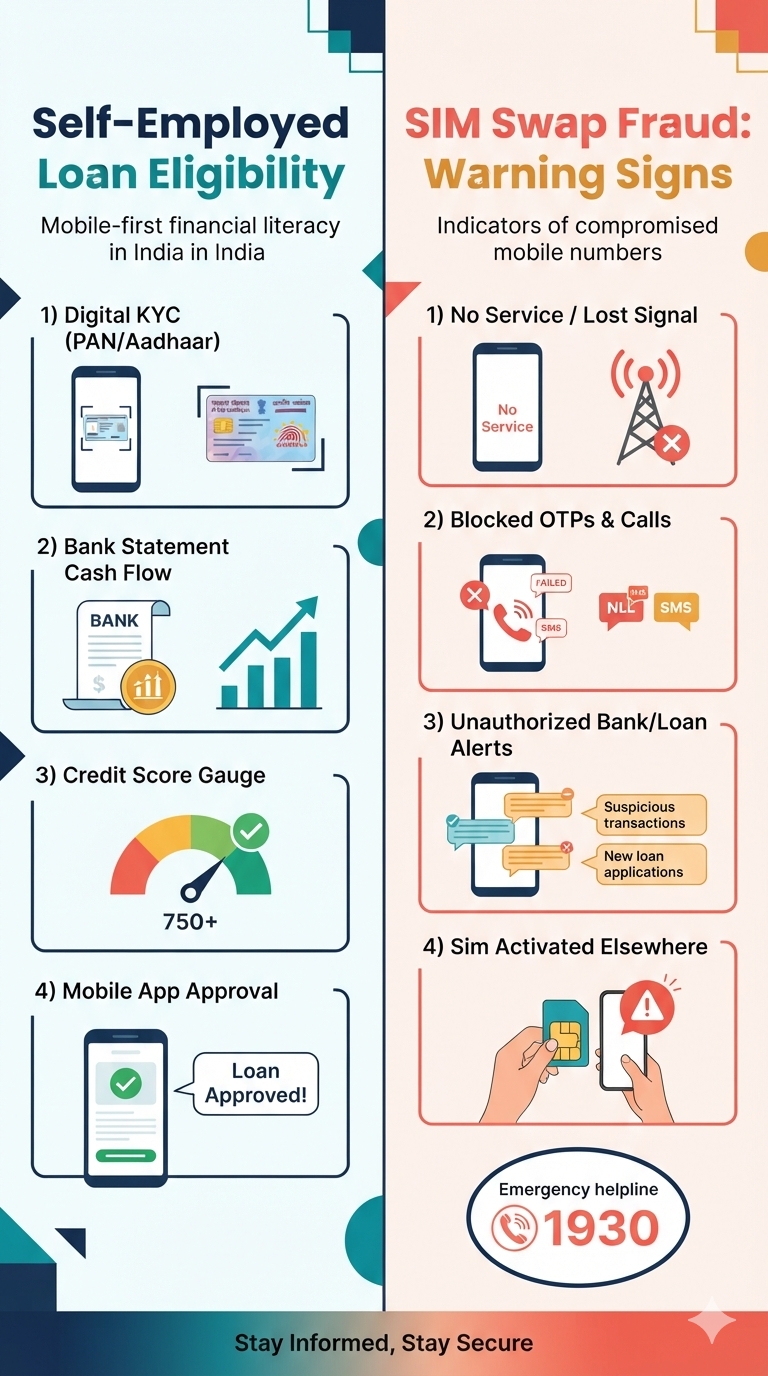
Introduction: Why Your Mobile Number Is Important for Financial Security
Your mobile number is connected to more than calls and messages. It may be linked to your bank account, UPI applications, email, loan applications, payment services and other financial platforms.
This makes your phone number an important part of your digital identity.
Fraudsters understand this connection. In a SIM swap scam, they try to obtain a replacement SIM or transfer your number to a SIM or eSIM under their control. If the attempt succeeds, they may receive calls and SMS messages intended for you. This can expose one-time passwords (OTPs) and other verification messages used by some services.
For self-employed people, the consequences can be particularly disruptive. A freelancer may depend on a phone number to receive client payments. A shop owner may use it for UPI collections. An independent consultant may need it for banking, loan communication and business operations.
A sudden loss of mobile service should not automatically be treated as proof of fraud. Network outages, damaged SIM cards and technical problems can also interrupt service. However, an unexplained loss of service deserves immediate attention.
This guide explains how SIM swap fraud works, the warning signs to watch for, what to do if your number is compromised and how to protect your banking and digital lending accounts.
AI Answer Box: What Is SIM Swap Fraud?
SIM swap fraud is a type of identity and telecom-related fraud in which criminals obtain control of a victim's mobile number by getting a replacement SIM or activating the number on another SIM or eSIM.
Once the fraudulent SIM becomes active, the criminal may receive incoming calls and SMS messages, including OTPs sent to that number. They may then attempt to access accounts or authorise transactions, depending on the security controls of the service.
Common warning signs include:
-
Your phone suddenly loses network service without a clear reason.
-
You receive an unexpected message about a SIM replacement or activation.
-
You stop receiving calls and SMS messages.
-
You notice unfamiliar login or password-reset alerts.
-
Your bank reports transactions you did not make.
What should you do? Contact your telecom operator through an official channel, ask it to investigate and secure your number, contact your bank immediately, change affected account credentials from a trusted device and report any financial cybercrime through India's official reporting channels.
1. What Is SIM Swap Fraud?
SIM swap fraud is a scam in which a criminal attempts to take control of a person's mobile number by obtaining a duplicate or replacement SIM, or by arranging an unauthorised transfer to another SIM.
A SIM swap can be legitimate. For example, a customer may request a replacement after losing a phone or damaging a SIM card. Fraud occurs when someone else obtains control of the number without the genuine subscriber's permission.
How does a SIM swap scam work?
Fraudsters may use different methods to collect information and impersonate the subscriber.
Common methods include:
-
Phishing messages: Fake messages may ask you to verify your mobile number or personal details.
-
Impersonation calls: A caller may pretend to be from a telecom company, bank or customer support team.
-
Fake SIM upgrade offers: Scammers may promise a free upgrade or improved network service.
-
Personal information theft: Criminals may collect identity details through fake websites, social media or data leaks.
-
Social engineering: A fraudster may manipulate a victim or exploit weak verification processes to request a SIM replacement.
The Reserve Bank of India's financial awareness material describes SIM swap and SIM cloning as methods through which criminals may obtain access to a duplicate SIM and receive OTPs linked to a bank account. It also warns customers to contact their mobile operator if mobile service disappears unexpectedly for a considerable period.
2. 10 Warning Signs Your Mobile Number May Be Compromised
A single network problem does not prove that your number has been hijacked. Look for unusual activity, especially when several warning signs appear together.
1. Your mobile network suddenly disappears
Your phone displays messages such as "No Service," "Emergency Calls Only" or "SIM Not Registered" even though you are in an area where the network normally works.
This can happen because of a genuine network problem, but an unexplained loss of service may also indicate that your number has been transferred to another SIM.
2. You stop receiving SMS messages
You may no longer receive ordinary text messages, banking alerts or verification messages.
If other people nearby using the same network have normal service, contact your operator and ask whether any SIM replacement or account change has taken place.
3. Incoming calls do not reach your phone
Friends, customers or business contacts may tell you that your number is unreachable, switched off or unavailable even though your phone is powered on.
This is worth investigating, particularly if it happens together with a sudden loss of network service.
4. You receive an unexpected SIM replacement alert
A message confirming a SIM replacement, activation or service change that you did not request is a serious warning.
Do not ignore it. Contact your telecom provider using its official app, website, customer-care number or authorised store.
5. You receive OTPs you did not request
Unexpected OTPs may indicate that someone is attempting to log in, reset a password or verify an account using your number.
Do not share the OTP with anyone. Contact the relevant service provider if the messages continue.
6. You receive unfamiliar banking alerts
Watch for notifications about:
-
New device registration
-
Password or PIN reset attempts
-
Beneficiary additions
-
UPI registration or account changes
-
Unfamiliar payments or withdrawals
If you notice a transaction you did not authorise, report it to your bank immediately.
7. Your UPI application behaves unexpectedly
You may notice unfamiliar device-registration prompts, unexpected verification attempts or payment notifications.
Do not approve an unknown request. Contact your bank and the UPI service provider through official channels.
8. You receive messages about account recovery
An unexpected password-reset or account-recovery message may mean someone is trying to access an email, social media or financial account connected to your mobile number.
Secure the affected account from a trusted device.
9. Your telecom account shows changes you did not make
Unexpected changes to your registered email address, contact details, service settings or SIM information should be investigated.
Ask your operator to verify the recent activity on your subscriber account.
10. Customers or contacts report suspicious messages from your number
If people receive unusual messages claiming to be from you, investigate immediately. This may indicate account compromise or another form of impersonation. It does not, by itself, prove that your SIM has been swapped.
Quick warning-sign table
| Warning sign | Possible explanation | Recommended action |
|---|---|---|
| Sudden loss of network | Network issue or unauthorised SIM change | Contact operator |
| Unexpected SIM activation message | Possible replacement request | Verify immediately |
| Missing SMS and calls | Service interruption or SIM takeover | Ask operator to investigate |
| Unrequested OTPs | Login or recovery attempt | Never share OTPs |
| Unknown bank transaction | Possible account compromise | Contact bank immediately |
| Unfamiliar UPI activity | Possible payment-account misuse | Report to bank and provider |
| Unexpected password-reset alert | Account access attempt | Secure the account |
3. Why Do Fraudsters Target Self-Employed Borrowers?
Self-employed people often use their mobile numbers for both personal and business activities. One number may connect several important services.
For example, a small business owner may use the same number for:
-
Bank account alerts
-
UPI collections
-
Supplier payments
-
Customer communication
-
Loan application updates
-
Business email recovery
-
Digital payment services
If a criminal takes control of that number, the impact may extend beyond personal banking.
Business-related risks
Interrupted customer payments: Customers may be unable to contact the genuine business owner or may receive suspicious messages.
Financial account exposure: Criminals may attempt to use intercepted verification messages to access accounts.
Business communication disruption: Missing calls and SMS messages can delay orders, client responses and payment confirmations.
Loan repayment disruption: If a borrower cannot access registered communication channels, they may miss important account alerts or repayment reminders. A SIM swap does not automatically change a loan obligation, but it can make account management harder.
Identity misuse: Information collected from compromised accounts may be used in further impersonation attempts.
4. Can SIM Swap Fraud Affect Bank Accounts and UPI?
Yes. SIM swap fraud can increase the risk of unauthorised access to services that use SMS or phone-number verification. However, receiving an OTP does not automatically give a criminal access to every account.
Banks and payment providers may use additional security checks, device binding, PINs, passwords, transaction limits and fraud-monitoring systems.
How financial accounts may be exposed
| Account or service | Possible risk |
|---|---|
| Bank account | Fraudster may attempt account recovery or transaction authorisation |
| UPI application | Unauthorised registration or payment attempts may be made |
| Email account | Password-reset attempts may be made if the number is a recovery method |
| Digital lending account | Attempts may be made to access personal or loan-related information |
| Wallet or payment app | Account verification or recovery may be targeted |
| Business payment account | Payment communication and collections may be disrupted |
Important: SIM swap fraud does not mean that every banking or UPI transaction can be completed using an SMS OTP alone. Each service has its own authentication requirements. Never share your UPI PIN, banking password, card PIN or OTP with anyone.
5. SIM Swap Fraud vs SIM Cloning vs Phone Hacking
These terms are often confused, but they describe different security problems.
| Type of incident | What it means | Main warning sign |
|---|---|---|
| SIM swap fraud | Number is transferred to an unauthorised SIM | Original SIM loses service |
| SIM cloning | A duplicate SIM profile is created or copied through illicit means | Unusual network or account activity |
| Phone hacking | A criminal gains unauthorised access to the device or its data | Unknown apps, settings or activity |
| Phishing | A victim is tricked into revealing information | Fake links, calls or messages |
| Account takeover | A criminal gains control of an online account | Unrecognised logins or account changes |
The correct response depends on what has been compromised. A mobile operator can investigate SIM-related activity, while your bank and relevant service providers can secure financial and online accounts.
6. What Should You Do If Your SIM Suddenly Stops Working?
Act quickly if your number loses service unexpectedly and you suspect an unauthorised SIM replacement.
Step 1: Check whether it is a normal network problem
-
Restart your phone.
-
Check whether other users on the same network have service.
-
Check your operator's official service-status information, if available.
-
If practical, test the SIM in another compatible device.
Do not spend a long time troubleshooting if you have also received an unexpected SIM replacement message or banking alert.
Step 2: Contact your telecom operator immediately
Use an official customer-care number, verified app, website or authorised store.
Ask the operator to:
-
Check whether a SIM swap or replacement request was made.
-
Verify whether another SIM or eSIM is active on your number.
-
Block any unauthorised SIM, where confirmed.
-
Restore your number through the operator's prescribed verification process.
-
Record your complaint and provide a reference number.
Do not use a phone number supplied by an unknown caller or an unverified search result.
Step 3: Contact your bank
Use the official number printed on your bank card, the bank's verified website or its official app.
Ask the bank to:
-
Flag suspected SIM swap-related fraud.
-
Review recent transactions and login activity.
-
Block or restrict digital banking access if necessary.
-
Secure UPI and other payment services.
-
Record your complaint and provide an acknowledgement.
Step 4: Secure your email and other accounts
From a trusted device and a secure internet connection:
-
Change passwords for important accounts.
-
Review recovery phone numbers and email addresses.
-
Sign out of unknown sessions.
-
Remove unfamiliar devices from account settings.
-
Enable additional security features where available.
Step 5: Report financial cybercrime
If money has been lost or an unauthorised financial transaction has occurred in India:
-
Call 1930 as soon as possible.
-
Submit a complaint through https://cybercrime.gov.in/.
-
Keep the complaint acknowledgement or reference number.
-
Share relevant details with your bank and follow its instructions.
Preserve transaction IDs, SMS messages, emails, screenshots, call details and complaint numbers. Do not delete evidence.
7. How to Report SIM Swap Fraud in India
Different organisations handle different parts of the incident.
| Where to report | What to report |
|---|---|
| Telecom operator | Unauthorised SIM replacement, loss of service or suspicious account changes |
| Bank | Unauthorised transactions, suspicious login attempts or account compromise |
| UPI provider | Unrecognised registration or payment activity |
| National Cyber Crime Helpline — 1930 | Financial cyber fraud requiring urgent reporting |
| National Cyber Crime Reporting Portal | Formal online cybercrime complaint |
| Sanchar Saathi / Chakshu | Suspected fraudulent communication, where applicable |
The Department of Telecommunications' Sanchar Saathi platform includes the Chakshu facility for reporting suspected fraudulent communications. It is not a substitute for reporting a completed financial cybercrime through 1930 or the National Cyber Crime Reporting Portal.
8. How to Prevent SIM Swap Fraud
Prevention starts with protecting the information that criminals may use to impersonate you.
Protect your SIM and telecom account
-
Never share SIM-related identity credentials with unknown callers.
-
Do not provide OTPs to anyone claiming to be a telecom employee.
-
Avoid following instructions to install unknown apps for a SIM upgrade.
-
Do not scan unfamiliar QR codes or open suspicious links sent in the name of your operator.
-
Contact your operator directly if someone asks you to replace or upgrade your SIM unexpectedly.
-
Keep your telecom account contact details accurate.
-
Use a device lock and protect your phone's SIM settings where supported.
Protect your banking and UPI accounts
-
Use a strong, unique password for important accounts.
-
Never share your UPI PIN, ATM PIN, CVV, password or OTP.
-
Turn on transaction notifications through available channels.
-
Review bank statements and UPI activity regularly.
-
Do not approve unknown payment or device-registration requests.
-
Contact your bank immediately if your number is compromised.
-
Use official banking apps and websites rather than links received through messages.
Protect your business identity
Self-employed borrowers should also:
-
Keep business and personal account access organised.
-
Maintain an updated email address with financial institutions.
-
Use separate strong passwords for business and personal accounts.
-
Restrict access to business banking devices.
-
Inform important business contacts if your number is compromised.
-
Verify payment requests through a second trusted communication channel.
9. SIM Swap Fraud Safety Checklist for Self-Employed Borrowers
Use this checklist periodically, especially if your mobile number is connected to business payments and loan accounts.
-
My telecom account details are accurate.
-
I know how to contact my mobile operator through an official channel.
-
I do not share OTPs or SIM-related credentials.
-
My bank has an updated email address.
-
I receive and review bank transaction alerts.
-
I use strong passwords for important accounts.
-
My email and banking accounts have additional security where available.
-
I check UPI transactions and account activity regularly.
-
I know how to contact my bank to report fraud.
-
I know that 1930 is India's cyber financial fraud helpline.
10. Does SIM Swap Fraud Affect Loan Eligibility?
SIM swap fraud does not automatically make a person ineligible for a personal loan. Loan eligibility is generally assessed using factors such as income, repayment capacity, credit history, existing obligations, documentation and the lender's own policy.
However, a compromised mobile number can create practical problems during the application and servicing process.
Possible effects on a loan application
Verification delays: A lender may be unable to complete an OTP-based verification until the mobile number is restored.
Communication problems: The applicant may miss important application updates or requests for information.
Account security concerns: Suspicious activity may require additional checks before an account can be accessed or serviced.
Repayment management: A borrower may miss payment reminders or account alerts if the registered number is unavailable.
How to protect your loan application
-
Restore control of your mobile number through your telecom operator.
-
Inform your bank or lender if the number was compromised.
-
Verify that your registered contact details are correct.
-
Use only official lender websites and applications.
-
Never share an OTP, PIN or password with a person claiming to speed up loan approval.
-
Review repayment dates and outstanding dues through verified channels.
A genuine lender should not ask you to disclose your banking PIN or UPI PIN to process a loan.
11. Real-World Example: How a SIM Swap Can Disrupt a Small Business
The following is an illustrative example, not a report of an actual customer incident.
Ravi runs a small online clothing business. He uses one mobile number for customer calls, UPI collections and banking alerts.
One afternoon, his phone suddenly displays "No Service." He assumes it is a temporary network issue. A customer later tells him that someone has sent a suspicious payment-related message using his business identity.
Ravi checks his email and finds an unfamiliar account-security alert. He contacts his telecom operator through its official customer-care channel and learns that a SIM replacement request needs investigation.
He immediately contacts his bank, reports the suspicious activity and asks it to secure digital banking access. He also changes important account passwords from a trusted device and informs regular customers to verify payment instructions through his official business channel.
What can other self-employed borrowers learn?
-
Treat unexplained network loss seriously.
-
Do not wait for an unauthorised transaction before contacting the operator.
-
Secure banking and email accounts as soon as compromise is suspected.
-
Keep business contacts informed through a trusted alternative channel.
-
Preserve evidence and complaint reference numbers.
12. Expert Commentary: Why Fast Reporting Matters
A SIM swap incident can involve multiple organisations: the telecom operator controls mobile-number services, the bank controls banking access and transaction response, and cybercrime authorities handle reports of cyber fraud.
No single action automatically secures every account.
A practical security principle is to contain the incident at each level: regain control of the mobile number, secure financial accounts, protect email and recovery methods, and report any financial loss promptly.
The RBI's customer-protection directions emphasise reporting unauthorised electronic banking transactions to the bank as early as possible. The time taken to notify the bank can affect the assessment of customer liability. The applicable rules depend on the type of bank, the facts of the incident and the relevant RBI directions.
13. Pros and Cons of Mobile-First Banking and Digital Lending
Mobile-first financial services can make everyday money management easier, but they also make mobile-number security important.
| Benefits | Risks and limitations |
|---|---|
| Convenient account access | Phone-number compromise can disrupt access |
| Faster digital communication | Fraudsters may imitate official messages |
| Easy transaction notifications | SMS-based verification can be targeted |
| Remote loan application processes | Identity verification requires care |
| Digital repayment tracking | Network problems can interrupt communication |
| Less dependence on branch visits | Users must protect devices and credentials |
The answer is not to avoid digital finance. It is to use trusted services, protect account credentials and respond quickly to suspicious activity.
14. Common Mistakes That Increase SIM Swap Risk
Avoid these mistakes:
-
Sharing OTPs with callers claiming to be telecom staff.
-
Trusting urgent SIM-upgrade or free-data offers without verification.
-
Ignoring unexpected SIM replacement alerts.
-
Assuming a sudden loss of network is always harmless.
-
Using the same weak password across several accounts.
-
Keeping outdated recovery details on banking and email accounts.
-
Delaying contact with the bank after noticing an unauthorised transaction.
-
Believing that a caller can be trusted simply because they know your name or mobile number.
Remember: a genuine telecom or banking representative should not ask you to reveal your confidential OTP, UPI PIN or banking password.
15. Trusted Sources and Official Safety Resources
For accurate guidance, use official sources rather than advice forwarded through social media or messaging groups.
-
Reserve Bank of India (RBI): Its financial awareness material explains SIM swap and SIM cloning fraud and recommends contacting the mobile operator if service disappears unexpectedly.
-
Department of Telecommunications (DoT): Publishes instructions for telecom providers concerning SIM swap and replacement procedures.
-
Telecom Regulatory Authority of India (TRAI): Provides information about mobile-number portability and warnings about fraudulent calls impersonating TRAI.
-
National Cyber Crime Reporting Portal: Use the official portal to report cybercrime in India.
-
Sanchar Saathi: Use the official platform to access telecom-related services and the Chakshu facility for suspected fraudulent communications.
Frequently Asked Questions (FAQs)
1. What is SIM swap fraud?
SIM swap fraud is a scam in which a criminal obtains control of a victim's mobile number by arranging an unauthorised replacement SIM or transfer. The criminal may then receive calls and SMS messages intended for the genuine subscriber.
2. What are the first signs of SIM swap fraud?
Common warning signs include sudden loss of mobile network service, missing calls and SMS messages, unexpected SIM replacement alerts and OTPs you did not request.
3. Can someone access my bank account through a SIM swap?
A SIM swap may help a criminal receive SMS-based verification messages. They may then attempt to access linked services. However, receiving an OTP alone does not guarantee access because banks and payment services may require additional authentication.
4. Why has my phone suddenly stopped receiving SMS messages?
Possible reasons include network issues, SIM damage, service suspension or an unauthorised SIM replacement. If the problem is unexplained, contact your telecom operator and ask it to check for recent SIM-related changes.
5. Can SIM swap fraud happen without stealing my phone?
Yes. A fraudster may attempt to obtain a replacement SIM or transfer your number without physically taking your phone. Protect your personal information and respond quickly to unexpected SIM-related alerts.
6. Can SIM swap fraud affect UPI payments?
It can increase the risk of unauthorised attempts to access or register payment services linked to your number. UPI transactions have their own authentication requirements. Never disclose your UPI PIN or approve an unfamiliar request.
7. What should I do if my SIM suddenly shows no network?
Check whether there is a general network outage, but contact your operator promptly if the loss is unexplained. Ask whether a replacement SIM or transfer request has been made. If you suspect account compromise, contact your bank as well.
8. How do I report SIM swap fraud in India?
Contact your telecom operator and bank through official channels. If financial cyber fraud has occurred, call 1930 promptly and submit a complaint through https://cybercrime.gov.in/.
9. Can fraudsters receive OTPs after a successful SIM swap?
If the fraudulent SIM becomes active for your number, the criminal may receive SMS messages and calls intended for you. This may include OTPs sent through SMS, depending on the service.
10. Does SIM swap fraud affect my credit score?
A SIM swap does not automatically reduce your credit score. However, if criminals misuse your identity to apply for credit or conduct financial fraud, it may create issues that require investigation and correction with the relevant lender and credit information company.
11. Is SIM cloning the same as SIM swap fraud?
No. SIM swap fraud involves unauthorised control of a number through a replacement SIM or transfer. SIM cloning refers to the creation or copying of SIM credentials. Both can create security risks, but they are not identical.
12. Can a self-employed person apply for a loan after a SIM swap incident?
A SIM swap incident does not automatically make a self-employed person ineligible for a loan. The lender will assess the applicant using its normal eligibility, income, repayment-capacity and verification requirements. Restore control of your number and inform the lender if verification is affected.
13. Should I change my bank password after SIM swap fraud?
Yes, if you suspect that your number or related accounts have been compromised. Contact your bank first, follow its security instructions and change affected credentials from a trusted device. Do not reuse old or weak passwords.
14. Does reporting a fraud to 1930 guarantee that I will get my money back?
No. Reporting quickly may help authorities and financial institutions take action, but recovery is not guaranteed. Contact your bank immediately, provide transaction details and preserve the complaint acknowledgement.
15. How can I protect my mobile number from SIM swap scams?
Never share OTPs or SIM-related credentials, avoid suspicious SIM-upgrade links, secure your telecom account, monitor network service and contact your operator immediately if you notice an unexplained loss of service.
Conclusion: Protect Your Mobile Number Before Fraudsters Exploit It
Your mobile number is an important part of your financial identity. It connects your banking, UPI, business communication and digital lending activities. That is why SIM swap fraud should never be treated as a minor phone-network issue when the circumstances are suspicious.
Watch for sudden loss of network service, unexpected SIM replacement messages, missing SMS alerts and unfamiliar account activity. Contact your telecom operator and bank immediately if you suspect a compromise. If you experience financial cyber fraud, call 1930 and report it through the official cybercrime portal.
For self-employed borrowers, maintaining secure contact details and monitoring financial accounts are practical steps towards safer digital borrowing and everyday banking.
Published on : 15th November 2026
Published by : Doulath bee
www.vizzve.com || www.vizzveservices.com
Follow us on social media: Facebook || Linkedin || Instagram
🛡 Powered by Vizzve Financial
RBI-Registered Loan Partner | 10 Lakh+ Customers | ₹600 Cr+ Disbursed