

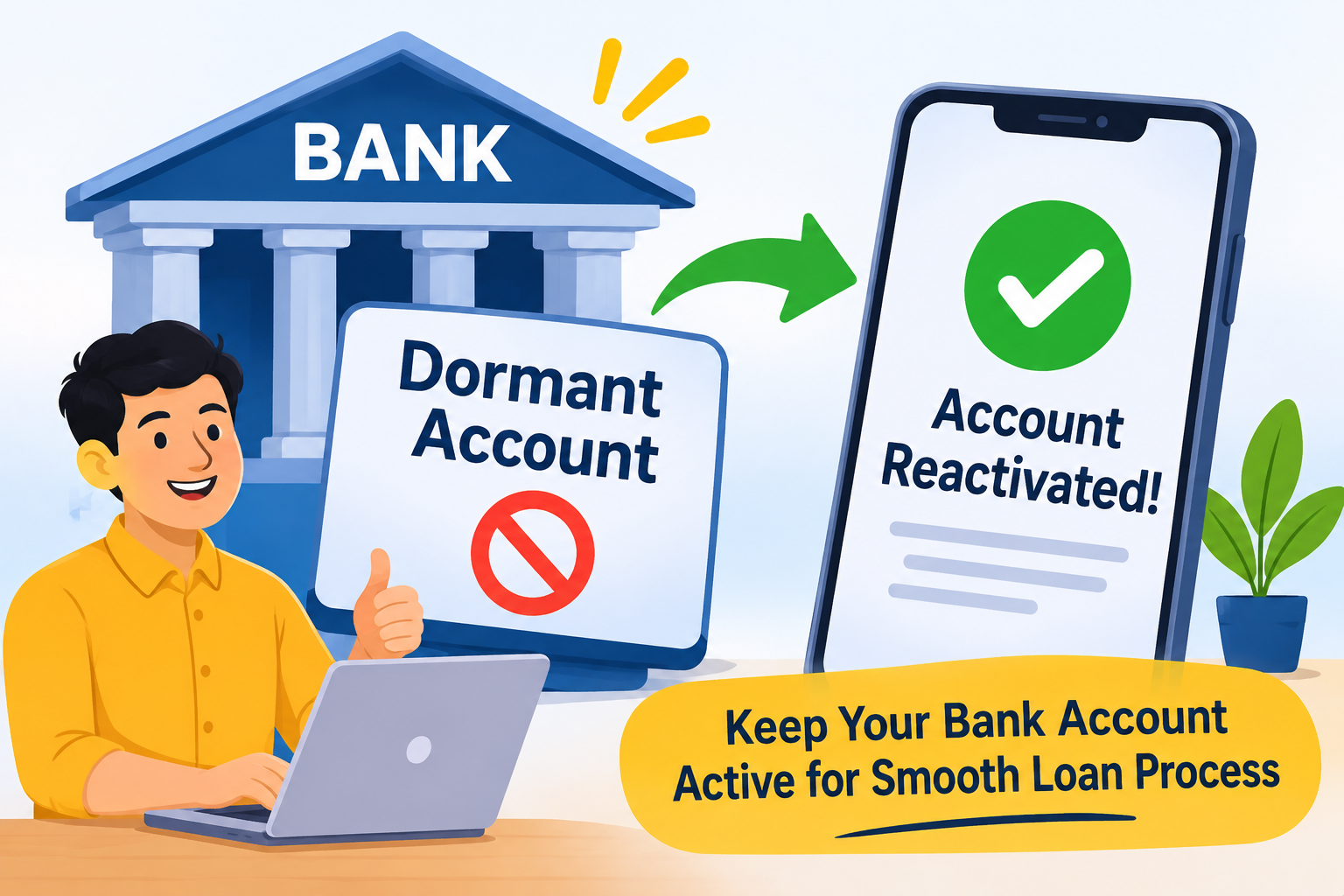
Introduction
For a self-employed person, a bank account is more than a place to keep money. It is an important part of everyday business activity. Freelancers receive client payments, shop owners collect sales revenue, consultants receive professional fees and independent workers manage regular expenses through their bank accounts.
But what happens when a bank account is not used for a long time?
The account may eventually be classified as inoperative, a status commonly described as dormant. When this happens, the bank may restrict debit transactions until the account holder completes the required reactivation and KYC process.
This can become inconvenient when a self-employed borrower is preparing to apply for a personal loan or another digital credit product. A borrower may need to show recent income credits, provide bank statements or complete account verification. An account that cannot be used normally may make these steps more difficult.
The good news is that an inoperative account can generally be reactivated by following the bank's prescribed process. The Reserve Bank of India (RBI) has also issued instructions to make KYC updation and activation more accessible, including through non-home branches and, where offered, video-based verification.
This guide explains what a dormant bank account means, why accounts become inactive, how to reactivate one and how to prepare your banking records before applying for a loan.
AI Answer Box: What Is a Dormant Bank Account?
A dormant bank account is a bank account that has not been used for customer-initiated transactions for an extended period. In India, the RBI uses the term inoperative account for a savings or current account with no customer-induced transactions for more than two years.
To reactivate an inoperative account, the account holder generally needs to contact the bank, complete the required KYC updation and follow the bank's verification process. RBI instructions require banks to make KYC updation available at all branches, including non-home branches, and to endeavour to provide video-based KYC verification. Some banks may also facilitate the process through authorised Business Correspondents.
Reactivating an account can help self-employed borrowers restore normal banking access and maintain updated financial records before applying for a digital or personal loan.
1. What Is a Dormant Bank Account?
A dormant bank account is commonly understood as an account that has not been used for a long period.
In India, however, the RBI's formal term for a savings or current account that meets the relevant inactivity criteria is inoperative account.
According to the RBI's January 1, 2024 instructions, a savings or current account is treated as inoperative when there have been no customer-induced transactions for more than two years.
This means that simply leaving money in an account does not necessarily keep it active. Bank-generated entries, such as interest credits or service charges, are not treated in the same way as customer-induced transactions when determining inoperative status.
What counts as a customer-induced transaction?
Customer-induced transactions can include:
-
Depositing money into the account.
-
Withdrawing money.
-
Making a payment or transfer.
-
Receiving a payment initiated by or made at the customer's request.
-
Certain qualifying non-financial banking requests.
-
Completing KYC updation through an accepted physical or digital channel.
The RBI also recognises certain non-financial activities, such as a qualifying balance enquiry or successful internet or mobile banking login, when they meet the prescribed authentication and audit-trail requirements.
Important: The word "dormant" is commonly used by customers, but the RBI's formal classification for savings and current accounts is "inoperative." The bank should confirm the exact status of your account.
2. When Does a Bank Account Become Inoperative in India?
A savings or current account generally becomes inoperative after more than two years without customer-induced transactions.
Banks are also expected to review accounts that have had no customer-induced transactions for more than one year. They must inform customers through available registered communication channels, such as letters, email or SMS, that the account may become inoperative if it remains unused for another year.
The RBI framework also allows a customer to explain the reason for not operating the account. In the circumstances covered by the instructions, the bank continues to classify the account as operative for one additional year and advises the customer to operate it within that period.
Example
Suppose a freelance graphic designer opened a savings account in 2022 but later shifted all business receipts to another bank. The old account receives no customer-initiated transactions for more than two years.
The bank may classify that particular savings account as inoperative after applying the applicable rules.
The account holder should contact the bank and complete the reactivation process before relying on it for business payments or loan documentation.
3. Why Do Self-Employed Borrowers Have Dormant Bank Accounts?
Self-employed people often maintain more than one account for personal and professional purposes. Some accounts are used only for specific clients, projects or business activities.
Common reasons for account inactivity include:
3.1 Switching to another bank
A business owner may move daily transactions to a bank offering better digital services, lower charges or more convenient branch access.
3.2 Closing or changing a business
A freelancer or small business owner may stop using an account after changing their profession, business structure or payment arrangements.
3.3 Using one account for multiple purposes
Some borrowers use one account regularly and forget about another account opened for a previous business or personal requirement.
3.4 Moving to digital payment platforms
UPI and mobile banking can make payments easier, but customers sometimes forget that an older savings or current account still requires attention.
3.5 Missing bank communication
A customer may have changed their mobile number, email address or residential address without updating the bank. As a result, they may miss important account-status notifications.
3.6 Long periods without business activity
Seasonal businesses, independent consultants and project-based professionals may have periods when a particular account receives no transactions.
4. How to Reactivate a Dormant Bank Account in India
Reactivating an inoperative bank account usually involves verifying your identity, updating KYC details and submitting an activation request.
The exact process and available channels depend on the bank. Follow these steps.
Step 1: Confirm Your Account Status
Start by contacting your bank through an official channel.
You can:
-
Log in to the official mobile banking application.
-
Check internet banking, if available.
-
Call the customer-care number published on the bank's official website.
-
Visit a bank branch.
-
Send a secure message through the bank's official portal.
Ask whether the account is active, inoperative, frozen, blocked or closed.
These statuses are not interchangeable. An account frozen by a court, law-enforcement agency or another authorised body may require a different process.
Step 2: Keep Your KYC Documents Ready
The bank may ask you to update or verify your identity and address information.
Commonly requested documents or information may include:
-
PAN or Form 60, as applicable.
-
Aadhaar or another officially valid identity and address document, where accepted.
-
Recent photograph, if required.
-
Registered mobile number.
-
Current address and contact details.
-
Account details or customer ID.
-
Additional documents requested under the bank's KYC policy.
The exact list depends on your account type, existing KYC records and the bank's requirements.
Step 3: Submit a Reactivation Request
Ask the bank for its prescribed inoperative-account activation or KYC updation process.
Depending on the bank, you may be able to submit the request through:
-
A branch visit.
-
Internet banking or mobile banking, where supported.
-
Video-Customer Identification Process (V-CIP), where offered.
-
An authorised Business Correspondent, where the bank provides this facility.
Under the RBI's June 12, 2025 amendment, banks must make KYC updation available for activating inoperative accounts and unclaimed deposits at all branches, including non-home branches. Banks must also endeavour to offer V-CIP and may use authorised Business Correspondents for this purpose.
Step 4: Complete Identity Verification
The bank may verify your identity and documents before approving activation.
Depending on the method, verification may involve:
-
Physical document checking.
-
OTP or other digital authentication.
-
Video-based customer identification.
-
Signature verification.
-
Additional checks under the bank's risk and KYC procedures.
Never share your OTP, PIN, password or internet banking credentials with another person.
Step 5: Obtain Confirmation From the Bank
After submitting the request, ask for an acknowledgement or service-request number.
Once the bank completes its checks, it should inform you through its registered communication channels when the account's inoperative status has been removed.
Before using the account for business or loan-related transactions, check whether normal debit and credit facilities are available.
Step 6: Start Using the Account Responsibly
Once reactivated:
-
Update your mobile number and email address if necessary.
-
Check your account balance and recent statement.
-
Review any standing instructions or linked services.
-
Use the account for genuine financial activity.
-
Monitor transaction alerts regularly.
-
Keep your KYC information current.
Do not make artificial or unnecessary transactions simply to keep an account active. Use it for legitimate banking needs.
5. Can You Reactivate a Dormant Bank Account Online?
In many cases, online or digital reactivation may be possible, but it depends on the bank and the customer's KYC status.
Some banks allow customers to initiate KYC updation through mobile banking or internet banking. Others may require video verification or a branch visit.
The RBI framework requires banks to make KYC updation available at all branches, including non-home branches. It also asks banks to endeavour to provide V-CIP for activation.
| Reactivation method | How it works | Availability |
|---|---|---|
| Mobile banking | Submit a KYC or activation request through the app | Depends on bank |
| Internet banking | Use the bank's official website | Depends on bank |
| Video KYC | Complete identity verification through a video process | Where offered |
| Home branch | Visit the branch where the account was opened | Bank-supported |
| Non-home branch | Request activation at another branch of the same bank | RBI instructions require availability |
| Authorised Business Correspondent | Use an eligible bank-authorised representative | Where permitted and supported |
Practical tip: Before travelling to a branch, check the bank's official website or customer-care service for the latest document requirements and appointment process.
6. Documents Required to Reactivate an Inoperative Bank Account
The documents required depend on the bank's KYC records and the account holder's circumstances.
| Document or detail | Why it may be needed |
|---|---|
| PAN or Form 60, as applicable | Tax identification and KYC requirements |
| Aadhaar or another accepted OVD | Identity and address verification |
| Registered mobile number | Alerts and digital authentication |
| Recent photograph | Identification, if required |
| Account number or customer ID | Locating the account |
| Updated address details | Maintaining accurate customer records |
| KYC or activation form | Formal request to the bank |
What if your address or mobile number has changed?
Update these details through the bank's official process. If your registered mobile number is no longer accessible, ask the bank how to change it before attempting digital verification.
For address changes, submit the documents accepted under the bank's current KYC policy.
7. Dormant Bank Account vs. Inoperative Bank Account vs. Frozen Account
These terms are often confused, but they can describe different situations.
| Term | Meaning | What the customer should do |
|---|---|---|
| Dormant account | Common customer term for an account unused for a long time | Confirm the formal status with the bank |
| Inoperative account | Savings/current account with no customer-induced transactions for more than two years under RBI instructions | Complete KYC and activation process |
| Frozen account | Account restricted under a bank decision or an authorised legal or regulatory instruction | Ask the bank for the reason and required remedy |
| Closed account | Account relationship has been formally closed | Ask whether reopening is possible or a new account is required |
| Unclaimed deposit | Deposit or balance that has remained unclaimed for ten years or more under the applicable framework | Trace the deposit and follow the claim process |
An inoperative account is not automatically a closed account. The balance does not simply disappear because the account has become inoperative.
8. What Happens to Your Money in a Dormant Bank Account?
An account becoming inoperative does not mean that the account holder loses ownership of the balance.
Under RBI instructions, banks must continue to credit interest to savings accounts regularly, even when they are inoperative.
However, restrictions may apply to debit transactions until the account is reactivated.
What happens after ten years?
Under the applicable RBI framework, balances in deposit accounts that remain unoperated or unclaimed for ten years or more are transferred to the Depositor Education and Awareness (DEA) Fund maintained by the RBI.
This does not mean the rightful account holder loses the right to claim the money. The customer, nominee or legal heir can follow the applicable process through the bank to claim eligible amounts.
Remember: Inoperative status after two years and transfer of an unclaimed deposit after ten years are two different stages.
9. How Does a Dormant Bank Account Affect Self-Employed Loan Eligibility?
A dormant or inoperative account does not automatically make a person ineligible for a personal loan.
However, it may create practical difficulties during the application and verification process.
Lenders may ask self-employed applicants for bank statements, income evidence and other documents to assess repayment capacity. If the account used for business income is inoperative, the borrower may struggle to provide recent transaction records or complete account-related verification.
9.1 Difficulty showing regular income
Self-employed borrowers may receive income from multiple clients, customers or projects. A regularly used bank account helps create a clear record of these receipts.
9.2 Delays in bank-statement submission
If the account is inaccessible or digital services are restricted, obtaining statements may take additional effort.
9.3 Problems with account verification
Some digital loan journeys use bank-account verification or other authorised financial-data processes. An inoperative account may not work smoothly for every verification method.
9.4 Repayment and disbursement arrangements
A lender may require an eligible, verified bank account for loan disbursement or repayment. The borrower should confirm the lender's requirements and provide an active account that meets them.
9.5 Incomplete financial records
If business receipts are spread across several accounts, an unused account may make it harder to organise a clear financial history.
Important: Loan approval depends on the lender's eligibility policy, income assessment, credit history, existing obligations and other checks. Reactivating an account does not guarantee loan approval.
10. Step-by-Step Checklist Before Applying for a Mobile-First Loan
Self-employed borrowers can use this checklist to prepare their banking records before applying.
-
Check whether your primary bank account is active.
-
Confirm whether any savings or current account is inoperative.
-
Complete pending KYC updation.
-
Update your registered mobile number and email address.
-
Check that your address details are correct.
-
Download recent bank statements.
-
Organise business income and expense records.
-
Check your PAN and other required documents.
-
Confirm that the account you plan to use can receive payments.
-
Review the lender's documentation and repayment requirements.
-
Apply only through a verified lender or authorised digital lending channel.
11. Pros and Cons of Reactivating an Old Bank Account
| Pros | Cons or considerations |
|---|---|
| Restores access to an existing account, subject to bank approval | KYC verification may take time |
| May help retrieve older banking records | Some outdated details may need correction |
| Can support business payment management | The account may have services that need re-linking |
| May help organise financial records for loan applications | Reactivation does not guarantee loan approval |
| May avoid opening another account if the old one remains suitable | A frozen or closed account needs a different remedy |
12. Common Mistakes to Avoid During Account Reactivation
Mistake 1: Assuming a dormant account is permanently closed
An inoperative account is not necessarily closed. Confirm the account's status with the bank before taking further steps.
Mistake 2: Using unofficial reactivation links
Fraudsters may send messages claiming that an account will be blocked unless the customer clicks a link or shares an OTP.
Use only the bank's official website, app, branch or verified customer-care channels.
Mistake 3: Submitting outdated KYC details
If your address, mobile number or other information has changed, ask the bank how to update it correctly.
Mistake 4: Ignoring the bank's communication
Banks may send advance notices when an account has remained unused for a year. Read these messages and respond through official channels.
Mistake 5: Expecting instant activation
The bank may need to verify documents and complete internal checks. Ask for the expected timeline and keep your acknowledgement number.
Mistake 6: Applying for a loan before checking account access
If your loan application depends on statements or account verification, check access beforehand and arrange an alternative eligible account if necessary.
13. RBI Guidelines for Inoperative Bank Accounts: What Should Customers Know?
The RBI issued revised instructions on inoperative accounts and unclaimed deposits on January 1, 2024, effective from April 1, 2024.
The instructions cover account classification, customer communication, activation, fraud prevention and the handling of unclaimed balances.
A subsequent amendment dated June 12, 2025 expanded the ways banks can facilitate KYC updation for account activation.
Important points include:
-
Savings and current accounts become inoperative when there are no customer-induced transactions for more than two years.
-
Banks should review accounts with no customer-induced transactions for more than one year.
-
Banks should alert customers through available registered communication channels.
-
KYC updation for activation must be available at all branches, including non-home branches.
-
Banks should endeavour to provide V-CIP for activation.
-
Banks may use authorised Business Correspondents for the permitted KYC updation process.
-
Savings-account interest should continue to be credited regularly even when the account is inoperative.
-
No charges should be levied solely for activation of an inoperative account under the RBI instructions.
Read the original RBI documents before relying on a particular bank's process. Individual banks may provide additional instructions about forms, verification and service channels.
14. Real-World Example: A Freelancer Reactivates an Old Bank Account
Consider a freelance web developer who opened a savings account several years ago for receiving client payments.
Later, the freelancer moved most transactions to another bank and stopped using the old account. After more than two years without customer-induced transactions, the old savings account was classified as inoperative.
The freelancer then decided to apply for a personal loan and wanted to use the older account for financial records.
The practical steps were:
-
Contact the bank to confirm the account's status.
-
Ask for the current KYC and activation requirements.
-
Submit the required identity and address information.
-
Complete the bank's verification process.
-
Obtain confirmation that the account's inoperative status has been removed.
-
Check account access and download the required statements.
-
Review the lender's requirements before submitting the loan application.
This example is illustrative. Actual processing steps, documents and timelines depend on the bank and the customer's account status.
15. Expert Commentary: Why Active Banking Records Matter for Self-Employed Borrowers
For self-employed applicants, financial records can help explain how income is earned and how regularly money comes into the business.
A well-maintained bank account can make it easier to organise:
-
Client payments and business receipts.
-
Monthly income patterns.
-
Business expenses.
-
Savings and repayment activity.
-
Bank statements requested by lenders.
Borrowers should not assume that frequent transactions alone establish loan eligibility. Lenders may also assess income stability, credit history, existing debt, business continuity and repayment capacity.
The most practical approach is to keep banking information accurate, use an appropriate account for genuine business transactions and resolve account-status issues before beginning a loan application.
16. How to Keep Your Bank Account Active in the Future
After reactivation, build a simple banking routine.
Monthly banking routine
-
Review your account status and transaction history.
-
Check SMS and email alerts from your bank.
-
Keep your registered mobile number and email updated.
-
Complete KYC updation when requested.
-
Use the account for genuine financial activity.
-
Check standing instructions and linked services.
-
Keep copies of important statements and banking documents.
If you no longer need an account, ask the bank about formally closing it rather than leaving it unattended.
Frequently Asked Questions (FAQs)
1. What is a dormant bank account?
A dormant bank account is a common term for an account that has not been used for a long time. In India, the RBI formally classifies a savings or current account as inoperative when it has no customer-induced transactions for more than two years.
2. After how many years does a bank account become dormant in India?
Under RBI instructions, a savings or current account becomes inoperative after more than two years without customer-induced transactions. Banks are expected to review accounts with no such transactions for more than one year and alert customers.
3. How can I reactivate my dormant bank account?
Contact your bank, confirm the account status, submit the required KYC information and complete the bank's verification process. You may be able to use a branch, non-home branch, digital channel or V-CIP if available.
4. Can I reactivate an inoperative bank account online?
Some banks provide online KYC updation or activation facilities through internet banking or mobile banking. Availability depends on the bank and your KYC status. Ask your bank for its official procedure.
5. Can I reactivate my dormant bank account at a non-home branch?
Yes. RBI instructions require banks to make KYC updation for activation available at all branches, including non-home branches. Carry the documents requested by your bank.
6. What documents are required to reactivate a dormant account?
Banks may ask for PAN or Form 60, an accepted identity and address document, a photograph if required, account details and a KYC or activation form. The exact list depends on the bank.
7. Will I lose my money if my bank account becomes dormant?
No. Inoperative status does not by itself mean that you lose ownership of the balance. The account remains subject to applicable banking rules. After ten years of being unoperated or unclaimed, eligible balances may be transferred to the RBI's DEA Fund, but rightful claimants can follow the prescribed claim process.
8. Does a dormant bank account earn interest?
Savings-account interest should continue to be credited regularly even when the account is inoperative, under RBI instructions. The applicable interest rate is determined by the bank's rules.
9. Is there a charge for reactivating a dormant bank account?
RBI instructions state that banks should not levy charges for activation of inoperative accounts. Ask the bank to explain any other charges that appear on your account separately.
10. Does a dormant bank account affect my loan eligibility?
It does not automatically make you ineligible for a loan. However, it may create difficulties if you need recent bank statements, income verification or an eligible account for disbursement and repayment.
11. Can self-employed borrowers apply for a loan with an inoperative bank account?
A borrower may still be able to apply if they meet the lender's requirements and provide an eligible, active account where required. It is sensible to reactivate the account or arrange another suitable account before applying.
12. What is the difference between a dormant and a frozen bank account?
An inoperative account is classified based on the absence of customer-induced transactions for the prescribed period. A frozen account is restricted for another reason, which may include a legal or regulatory instruction. The bank should explain the specific status and remedy.
13. Can a bank transfer money into an inoperative account?
The treatment of credits and debits may differ. An inoperative account may have restrictions on debit transactions until activation. Contact the bank before relying on it for a payment or transfer.
14. How long does it take to reactivate a dormant bank account?
The time depends on the bank, the completeness of the KYC documents and the verification method. Ask the bank for its current service timeline and keep your request acknowledgement.
15. What happens if my account has been inactive for more than ten years?
The balance may have been transferred to the RBI's Depositor Education and Awareness Fund as an unclaimed deposit. Contact the bank and follow its process to trace and claim the balance. The rightful account holder, nominee or legal heir may be able to make a claim under the applicable rules.
Conclusion
A dormant or inoperative bank account can interrupt everyday banking, especially for self-employed people who depend on digital payments and bank statements to manage their finances.
The first step is to confirm the account's exact status with the bank. If it is inoperative, complete the required KYC updation through an official channel and obtain confirmation before using it for important transactions.
For self-employed borrowers, keeping bank accounts active where genuinely needed, maintaining accurate KYC details and organising income records can make the loan application process easier to manage.
Planning to apply for a personal loan? Review your eligibility, check your financial documents and explore the available options at Vizzve Financial.
Published on : 9th November
Published by : Doulath bee
www.vizzve.com || www.vizzveservices.com
Follow us on social media: Facebook || Linkedin || Instagram
🛡 Powered by Vizzve Financial
RBI-Registered Loan Partner | 10 Lakh+ Customers | ₹600 Cr+ Disbursed