

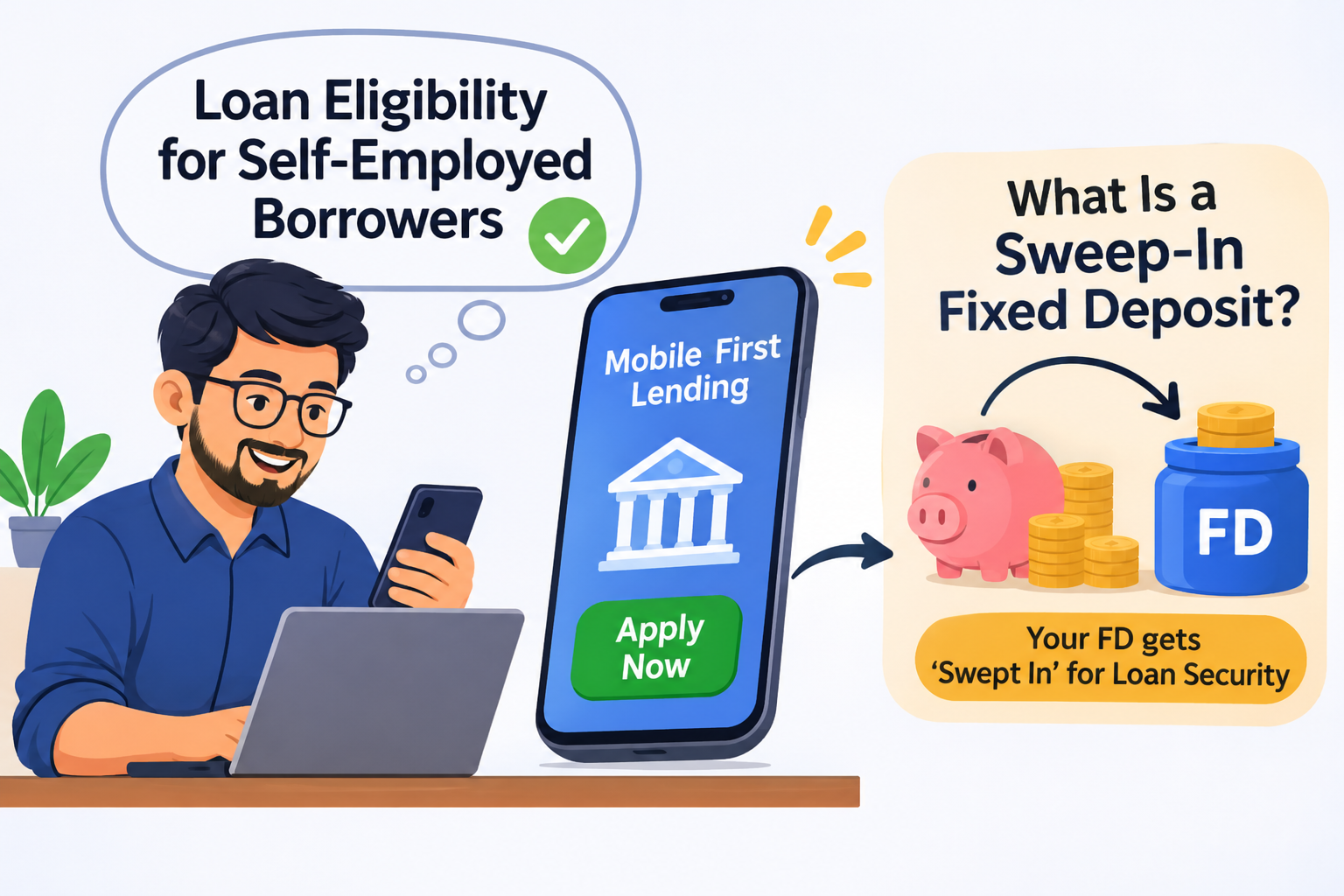
Introduction
Self-employed professionals often deal with uneven income. A freelancer may receive several client payments in one week and wait longer for the next payment. A shop owner may collect more money during a festive season, while a consultant may receive large payments only after completing projects.
Keeping all surplus money in a regular savings account can mean missing out on potentially higher fixed deposit interest. However, locking every spare rupee into a conventional fixed deposit may create another problem: the money may not be readily available when a supplier, employee, utility bill or loan EMI needs to be paid.
A sweep-in fixed deposit is designed to balance these two needs.
It connects a savings or eligible current account to a fixed deposit. When the account balance rises above a bank-defined or customer-selected threshold, excess funds may automatically move into an FD. When the account balance falls, the bank can transfer the required amount back by breaking part or all of the linked deposit, according to its rules.
This facility can be useful for self-employed borrowers who want to manage surplus funds without losing convenient access to their money.
But how exactly does it work? Is the interest always higher? Can you withdraw money at any time? Does it help with loan eligibility?
Let's understand the details.
AI Answer Box: What Is a Sweep-In Fixed Deposit?
A sweep-in fixed deposit is a banking facility that links a savings account or eligible current account with a fixed deposit. When the account balance exceeds a specified limit, the extra amount is automatically transferred into an FD. When the account balance falls below the required level, the bank transfers money back from the FD to the account.
The facility is also called an auto-sweep or sweep-out arrangement. It can help customers earn FD interest on surplus funds while retaining access to money for regular payments. The minimum balance, FD tenure, sweep amount, interest calculation and premature withdrawal rules vary by bank.
Quick answer: A sweep-in FD helps keep surplus money earning fixed deposit interest while making funds available when the linked account needs them.
1. How Does a Sweep-In Fixed Deposit Work?
A sweep-in FD works through an automatic two-way movement of funds.
The two main processes are:
-
Sweep-out: Excess money moves from the savings account into a linked fixed deposit.
-
Sweep-in or reverse sweep: Money moves back from the FD into the savings account when the account balance falls below the specified threshold.
The bank generally manages these transfers according to the account's terms and conditions.
Step-by-step example
Suppose a self-employed graphic designer has a savings account with an auto-sweep facility.
For illustration, assume:
-
Minimum account balance threshold: ₹25,000
-
Available account balance after receiving client payments: ₹75,000
-
Surplus amount: ₹50,000
The bank may transfer the eligible surplus of ₹50,000 into one or more linked fixed deposits.
A few days later, the designer needs to pay ₹35,000 for rent, software subscriptions and business expenses. The savings account has only ₹25,000 available.
The bank may automatically break the required portion of the linked FD and transfer the money back to the savings account.
<|end|>
Example of automatic fund movement
| Event | Savings account balance | FD movement |
|---|---|---|
| Initial balance | ₹25,000 | No transfer |
| Client payment received | ₹75,000 | ₹50,000 moved to FD |
| Business payment due | ₹25,000 | ₹35,000 moved back from FD |
| After payment | ₹15,000 | Depends on bank's sweep rules |
This is a simplified illustration. Actual transfers depend on the bank's threshold, sweep multiples, available deposit balance and account terms.
What is the difference between sweep-in and sweep-out?
| Feature | Sweep-out | Sweep-in |
|---|---|---|
| Direction | Account to FD | FD to account |
| When it happens | Surplus balance is available | Account balance is insufficient |
| Main purpose | Earn FD interest on eligible surplus | Make funds available for payments |
| Customer action | Usually automatic | Usually automatic |
| Bank rules | Threshold and deposit creation rules | Withdrawal and breakage rules |
2. Why Do Banks Offer an Auto-Sweep Facility?
A traditional savings account provides convenient access to money, but its interest rate may be lower than the rate offered on a fixed deposit.
A conventional FD may offer a different interest rate depending on the amount, tenure, bank and deposit category. However, money placed in an ordinary FD may not be as convenient to access as money in a savings account.
An auto-sweep facility attempts to combine the two arrangements.
Main purposes of a sweep-in FD
-
Better use of surplus funds: Eligible excess money can move into a fixed deposit instead of remaining idle in the savings account.
-
Convenient access: The linked arrangement can bring funds back when the account balance falls.
-
Automatic operation: Customers may not need to create and close deposits manually for every cash-flow change.
-
Short-term financial flexibility: The facility may help with unexpected expenses, depending on the deposit terms.
-
Improved cash management: It can help customers separate their minimum operating balance from temporary surplus funds.
A sweep-in FD does not guarantee the highest available return. Customers should compare the bank's savings rate, FD rate, breakage rules and service conditions before activating it.
3. What Are the Benefits of a Sweep-In Fixed Deposit?
A sweep-in FD can be useful when a person regularly maintains more money in a bank account than is needed for immediate expenses.
3.1 Potential to earn higher interest
Eligible surplus funds may earn the applicable FD interest rate rather than the savings account rate.
The actual benefit depends on:
-
How much money is transferred into the FD
-
How long it remains deposited
-
The bank's interest calculation method
-
The FD interest rate
-
Any premature withdrawal adjustment or penalty
3.2 Access to funds when needed
A major advantage is that the customer may not need to visit a branch or manually close the entire FD to access money.
The bank can break the required deposit portion and transfer funds back, if the facility supports partial sweep-in withdrawals.
3.3 Useful for irregular income
Self-employed people do not always receive a fixed salary on a particular date. A sweep-in FD can help manage temporary cash surpluses without completely locking away the money.
3.4 Helps maintain an operating balance
A business owner may want to keep a certain amount available for daily expenses. The sweep threshold can help preserve this amount while transferring eligible surplus funds into an FD.
3.5 Automatic savings discipline
Because the transfer is automatic, customers may find it easier to avoid leaving large amounts unused in a low-interest account.
4. What Are the Disadvantages of a Sweep-In Fixed Deposit?
Although convenient, a sweep-in FD is not suitable for every financial situation.
4.1 Premature withdrawal conditions
When the bank breaks an FD before maturity, it may apply a lower applicable interest rate or a premature withdrawal penalty, depending on its policy and the deposit terms.
The Reserve Bank of India's deposit directions require banks to disclose applicable premature withdrawal penalty components to depositors. Customers should check the bank's policy before opening the deposit.
4.2 Minimum balance requirements
Some banks require a particular balance to remain in the linked account. If the balance falls below that level, the bank may break an FD to restore it.
4.3 Different sweep rules across banks
Banks may use different:
-
Minimum balance thresholds
-
FD creation amounts
-
Sweep multiples
-
Deposit tenures
-
Breakage methods
-
Interest calculation methods
Therefore, two sweep-in accounts may not provide identical benefits.
4.4 Interest may not match expectations
The customer may assume that every rupee earns the full FD rate. However, the actual interest depends on the amount transferred, the period it remains in the FD and the bank's applicable rules.
4.5 Not a replacement for a dedicated emergency fund
A sweep-in FD can improve access to surplus funds, but customers should still maintain a readily accessible amount for urgent expenses. System delays, account restrictions or bank-specific conditions can affect access.
5. Sweep-In FD vs Regular Fixed Deposit vs Savings Account
Understanding the differences can help customers choose the right arrangement.
| Feature | Savings account | Regular FD | Sweep-in FD |
|---|---|---|---|
| Main purpose | Everyday banking | Saving money for a fixed period | Managing surplus funds |
| Interest | Savings rate | Applicable FD rate | FD rate on eligible swept amount |
| Access to money | Generally convenient | Premature withdrawal may be needed | Automatic transfer may be available |
| Automatic transfer | Usually no | No | Yes, under facility rules |
| Withdrawal flexibility | High | Depends on FD terms | Depends on sweep and breakage rules |
| Best suited for | Regular transactions | Planned savings | Variable balances and short-term surplus |
Which option should you choose?
-
Choose a savings account for everyday transactions and immediate expenses.
-
Choose a regular FD when you can keep money invested for a planned period.
-
Consider a sweep-in FD when your account balance regularly fluctuates and you want surplus funds to earn FD interest while retaining conditional access.
No single option is best for everyone. Your choice should reflect your cash-flow needs, financial goals and the bank's terms.
6. How Can Self-Employed Borrowers Use a Sweep-In FD?
Self-employed borrowers often need to demonstrate stable financial management even when their income changes from month to month.
A sweep-in FD can support day-to-day money management, but it is important to understand what it can and cannot do.
6.1 Freelancers
Freelancers may receive payments from multiple clients at different times.
For example, a freelance developer may receive ₹1,20,000 after completing a project. If immediate expenses are ₹40,000, the remaining amount may qualify as temporary surplus for a sweep-in facility, depending on the account rules.
6.2 Small business owners
A retailer may collect more money during a busy sales period. Instead of keeping every rupee idle in a savings account, the business owner may use an eligible auto-sweep arrangement for temporary surplus funds.
6.3 Independent consultants
Consultants may receive large payments after completing assignments. A sweep-in FD can help manage money between client payments and upcoming business expenses.
6.4 Online sellers
Online sellers may experience changes in cash flow due to settlement cycles, returns and seasonal sales. A linked FD may help manage funds that are not immediately required.
Important point about loan eligibility
A sweep-in FD does not automatically improve loan eligibility or guarantee loan approval.
Lenders may assess several factors, including:
-
Income and business cash flow
-
Bank statement patterns
-
Existing loan obligations
-
Credit history and repayment record
-
Business stability
-
Required documentation
-
The lender's internal eligibility policy
A sweep-in FD may show that a customer maintains savings, but lenders can assess the underlying bank transactions and financial position independently. A deposit is not the same as regular business income.
7. How to Open a Sweep-In Fixed Deposit
The process varies by bank. Some banks offer the facility through mobile banking or internet banking, while others may require a branch request or an eligible account type.
Step 1: Check whether your bank offers the facility
Visit your bank's official website or contact its customer support. Search for terms such as:
-
Auto sweep facility
-
Sweep-in FD
-
Flexi fixed deposit
-
Savings account with auto sweep
Step 2: Check account eligibility
Confirm whether the facility is available for your savings or current account. Some banks may restrict it to specific account variants.
Step 3: Understand the threshold amount
Ask how much balance must remain in the account before surplus funds are transferred into an FD.
Step 4: Review FD creation rules
Check:
-
Minimum FD amount
-
Deposit multiples
-
FD tenure
-
Interest rate
-
Maximum deposit limit, if any
-
Automatic renewal instructions
Step 5: Understand reverse-sweep rules
Ask how funds return to the account when the balance falls.
In particular, confirm:
-
Whether partial FD breakage is allowed
-
Which deposit is broken first
-
Whether the bank uses a first-in-first-out or last-in-first-out method
-
Whether any premature withdrawal penalty applies
Step 6: Activate the facility
Complete the bank's required application or digital activation process. Read the terms before confirming.
Step 7: Monitor transactions
Check your account statements and FD details regularly. Confirm that sweep transfers, interest credits and withdrawals match the bank's stated rules.
8. What Should You Check Before Activating a Sweep-In FD?
Do not activate the facility based only on the advertised interest rate. The terms can make a meaningful difference to the actual benefit.
| Item to check | Why it matters |
|---|---|
| Minimum balance | Determines how much remains available in the account |
| Sweep threshold | Controls when surplus funds move into the FD |
| Minimum FD amount | Determines how much money is deposited at a time |
| FD tenure | Affects the applicable interest rate |
| Interest calculation | Helps you understand the return |
| Premature withdrawal penalty | May reduce interest when money is withdrawn early |
| Partial withdrawal | Determines whether only the required amount is broken |
| Sweep order | Determines which FD is used first |
| Auto-renewal | Affects what happens when an FD matures |
| Digital access | Helps you monitor linked deposits |
Questions to ask your bank
-
Is the auto-sweep facility free?
-
Can I choose the threshold?
-
Does it work with my current account?
-
How is interest calculated on a partially withdrawn FD?
-
Is there a penalty for reverse sweep?
-
Can I disable the facility whenever I want?
-
How will the bank show sweep transactions in my statement?
9. How Is Interest Calculated on a Sweep-In FD?
Interest is generally calculated according to the bank's applicable FD terms for the amount and period that remains deposited.
The exact method can differ across banks and products. A partial withdrawal may also affect the interest payable on the amount withdrawn.
Simple illustrative example
Suppose ₹50,000 is transferred into a sweep-in FD. For illustration only, assume an annual interest rate of 6%.
If the full amount remains deposited for one year, a simple-interest illustration would be:
₹50,000 × 6% = ₹3,000
This is only a simplified example. Actual FD interest may be calculated using the bank's compounding frequency, day-count method, applicable tenure and product terms.
If the bank breaks part of the deposit before maturity, the final interest may be different.
Does a sweep-in FD earn the same interest as a regular FD?
Not necessarily. The interest rate may be linked to the bank's applicable FD rates, but the tenure, deposit amount, withdrawal period and product rules can affect the return.
Always check the rate applicable to your specific sweep-in product.
10. Tax on Sweep-In Fixed Deposit Interest in India
Interest earned on a sweep-in FD is generally treated as interest income under applicable income-tax rules. The fact that the FD is linked to a savings account does not automatically make the interest tax-free.
Important tax points
-
FD interest is generally taxable according to the depositor's applicable tax treatment.
-
Banks may deduct tax at source (TDS) when the relevant legal conditions and thresholds are met.
-
TDS is not necessarily the final tax liability.
-
Customers should report taxable interest correctly in their income-tax return.
-
Self-employed individuals should maintain interest certificates and bank statements for accurate accounting.
For the relevant tax year, check the latest Income Tax Department guidance on TDS thresholds and applicable provisions. Tax rules can change, and the final tax treatment depends on the individual's circumstances.
Practical tip: Download your annual interest certificate from the bank and reconcile it with your bank statements and tax records.
11. Is a Sweep-In FD Safe?
A sweep-in FD is a deposit arrangement offered by a bank. Its safety depends on the bank, the applicable deposit terms and the relevant regulatory protections.
Understand DICGC deposit insurance
The Deposit Insurance and Credit Guarantee Corporation (DICGC), a wholly owned subsidiary of the Reserve Bank of India, provides deposit insurance for eligible deposits held with insured banks.
The current cover is up to ₹5 lakh per depositor per bank, including principal and interest, for deposits held in the same right and capacity. Eligible savings, current, fixed and recurring deposits are included in this calculation.
This limit applies to the total eligible deposits held across branches of the same bank, not separately to each account or branch.
Customers should verify whether their bank is insured and consider their total deposits with that bank when assessing the coverage.
Basic safety checklist
-
Use your bank's official website or mobile application.
-
Never share OTPs, PINs, passwords or login credentials.
-
Avoid activating banking facilities through unknown links.
-
Check FD creation and reverse-sweep entries regularly.
-
Keep your registered mobile number and email address updated.
-
Review the bank's deposit terms before activation.
-
Do not treat deposit insurance as a guarantee of immediate access to funds.
12. Sweep-In FD vs Liquid Mutual Funds
Some customers compare sweep-in FDs with liquid mutual funds because both may be considered for managing short-term surplus money. However, they are different financial products.
| Feature | Sweep-in FD | Liquid mutual fund |
|---|---|---|
| Product type | Bank deposit facility | Mutual fund scheme |
| Return | Based on applicable FD rate and terms | Depends on portfolio performance |
| Capital certainty | Deposit obligation of the bank, subject to applicable terms and protections | Returns are not guaranteed |
| Access | Through linked account, subject to sweep rules | Redemption process and settlement timelines apply |
| Market risk | Not directly exposed to mutual fund market fluctuations | Subject to market and credit risks |
| Deposit insurance | Eligible bank deposits may be covered by DICGC within limits | Not covered by DICGC |
| Suitability | Customers seeking linked deposit convenience | Investors who understand mutual fund risks |
A liquid mutual fund is not a bank deposit and should not be described as risk-free. Customers should review the scheme's riskometer, portfolio, expenses and redemption conditions before investing.
13. Real-World Example: How a Freelancer Can Use a Sweep-In FD
Consider Priya, a self-employed content consultant who receives payments from three clients.
Her monthly income is not fixed. Some months she receives ₹90,000, while in other months she earns ₹1,40,000.
She needs money for:
-
Rent and household expenses
-
Internet and software subscriptions
-
Professional services
-
Tax payments
-
Loan EMI
-
Business travel
After receiving a large client payment, Priya notices that her savings account has more money than she needs for immediate expenses.
She checks with her bank and activates an auto-sweep facility with a suitable threshold.
When her balance rises above the threshold, eligible surplus funds move into linked FDs. Later, when she pays business expenses, the bank may transfer funds back by breaking the required FD amount, according to the product's rules.
What does Priya gain?
-
Better management of temporary surplus money
-
Less need to create FDs manually
-
Conditional access to funds for payments
-
A clearer distinction between operating money and surplus savings
What should Priya still do?
She should maintain enough immediately available money for essential payments, review the FD terms and avoid treating the entire deposit balance as guaranteed loan repayment capacity.
This example is illustrative. Actual results depend on the bank's rules and Priya's financial circumstances.
14. Common Mistakes to Avoid When Using a Sweep-In FD
A convenient banking facility can still create problems if customers do not understand its conditions.
Avoid these common mistakes:
-
Keeping too little money in the account: Essential payments may be affected if the available balance is insufficient.
-
Ignoring premature withdrawal rules: Breaking an FD early may reduce the interest earned.
-
Assuming all banks follow the same rules: Thresholds, sweep multiples and FD tenures differ.
-
Ignoring tax: FD interest may be taxable even if it is automatically reinvested.
-
Treating an FD as regular income: A deposit balance does not replace proof of business earnings.
-
Not checking account statements: Unnoticed transfers or incorrect assumptions can create confusion.
-
Keeping all emergency money in linked deposits: Keep a suitable amount readily available for urgent needs.
-
Ignoring deposit insurance limits: Understand how the ₹5 lakh DICGC limit applies across eligible deposits at the same bank.
15. Pros and Cons of a Sweep-In Fixed Deposit
| Pros | Cons |
|---|---|
| Can earn FD interest on eligible surplus funds | Premature withdrawal may affect interest |
| Automatic transfer of surplus money | Bank-specific thresholds and conditions |
| May provide access through reverse sweep | Not every account is eligible |
| Useful for fluctuating balances | Not a substitute for a separate emergency fund |
| Reduces manual FD management | Tax may apply to interest earned |
| Can support better cash management | Does not guarantee loan approval |
16. Expert Commentary: Is a Sweep-In FD Useful for Self-Employed Borrowers?
A sweep-in FD can be a practical cash-management tool for people whose income does not arrive on a fixed schedule. It may help them earn interest on money that is temporarily not required for daily operations.
However, the most important decision is not simply how much interest the deposit earns. It is how much money must remain available for business expenses, taxes, personal commitments and loan repayments.
A sensible approach is to:
-
Estimate essential monthly expenses.
-
Keep an appropriate operating balance.
-
Use only genuine surplus money for an auto-sweep arrangement.
-
Review withdrawal and penalty rules.
-
Maintain accurate bank statements and income records.
A well-managed bank account can make financial records easier to understand. However, lenders still assess repayment capacity, income stability, credit history and their own eligibility criteria.
17. Frequently Asked Questions (FAQs)
1. What is a sweep-in fixed deposit?
A sweep-in fixed deposit is a facility that links a savings or eligible current account with an FD. Excess funds may automatically move into the FD, and money may return to the account when the balance falls.
2. Is a sweep-in FD the same as an auto-sweep FD?
The terms are commonly used for similar banking facilities. However, exact features and product conditions vary by bank.
3. How does a sweep-in FD work?
When your account balance exceeds a set threshold, eligible surplus funds move into a linked FD. When the account balance falls, the bank may break part or all of the deposit to transfer money back.
4. Can I withdraw money from a sweep-in FD anytime?
You may be able to access money through the linked account, but withdrawal depends on the bank's sweep rules, available FD balance and premature withdrawal conditions.
5. Does a sweep-in FD earn more interest than a savings account?
The amount transferred into the FD may earn the applicable FD rate, which can be higher than the savings rate. The actual return depends on the bank's rate, tenure and withdrawal conditions.
6. Is a sweep-in FD better than a regular FD?
It depends on your needs. A sweep-in FD may offer more convenient access to surplus money, while a regular FD may suit customers who can leave money deposited for a planned period.
7. Can self-employed borrowers use a sweep-in FD?
Yes, subject to the bank's eligibility conditions. Freelancers, consultants and business owners may use it to manage temporary surplus funds.
8. Does a sweep-in FD improve loan eligibility?
Not automatically. Lenders may consider savings as part of the overall financial picture, but loan eligibility usually depends on income, repayment capacity, credit history, existing obligations and lender policy.
9. Can I use a sweep-in FD for monthly loan EMI payments?
You may be able to use funds from the linked account for EMI payments if sufficient money is available. However, you should maintain an adequate balance before the due date and not rely entirely on automatic FD breakage.
10. Is interest from a sweep-in FD taxable?
Generally, yes. FD interest is normally taxable under applicable income-tax rules. TDS may apply when relevant conditions are met, but TDS is not necessarily the final tax payable.
11. Can a sweep-in FD be broken partially?
Many sweep facilities allow partial breakage, but the minimum withdrawal amount and method depend on the bank's product rules.
12. What happens if my savings account balance becomes low?
If the facility is active and the linked FD has sufficient eligible funds, the bank may transfer money from the FD to the savings account. The exact trigger and amount depend on the account terms.
13. Is a sweep-in FD covered by DICGC insurance?
Eligible FD and savings deposits held with an insured bank are included in DICGC coverage. The current maximum is ₹5 lakh per depositor per bank, including principal and interest, subject to the same-right-and-same-capacity rules.
14. Can I disable an auto-sweep facility?
Many banks allow customers to request deactivation, but the process and treatment of existing linked FDs vary. Check with your bank before disabling it.
15. What should I check before opening a sweep-in FD?
Check the threshold balance, FD tenure, interest rate, minimum deposit amount, sweep multiples, partial withdrawal rules, premature withdrawal penalty, tax treatment and account eligibility.
Conclusion: Is a Sweep-In Fixed Deposit Worth Considering?
A sweep-in fixed deposit can be a useful option for people who maintain surplus money in their bank accounts but still need convenient access to funds. It combines automatic FD creation with a reverse-sweep facility, subject to the bank's conditions.
For self-employed borrowers, the arrangement may help manage irregular income, temporary cash surpluses and business expenses. However, it should be used carefully. Keep enough money available for essential payments, understand the premature withdrawal rules and maintain clear financial records.
Before activating the facility, compare the terms offered by your bank rather than choosing only on the basis of the advertised FD interest rate.
Explore Financial Support with Vizzve Financial
Understanding savings, banking facilities and cash flow is an important part of responsible borrowing. Self-employed applicants should also review their income records, existing obligations and repayment capacity before applying for credit.
Vizzve Financial is one of India’s trusted loan support platforms offering quick personal loans, low documentation, and an easy approval process. Apply at www.vizzve.com.
Published on : 21st November
Published by : Doulath bee
www.vizzve.com || www.vizzveservices.com
Follow us on social media: Facebook || Linkedin || Instagram
🛡 Powered by Vizzve Financial
RBI-Registered Loan Partner | 10 Lakh+ Customers | ₹600 Cr+ Disbursed