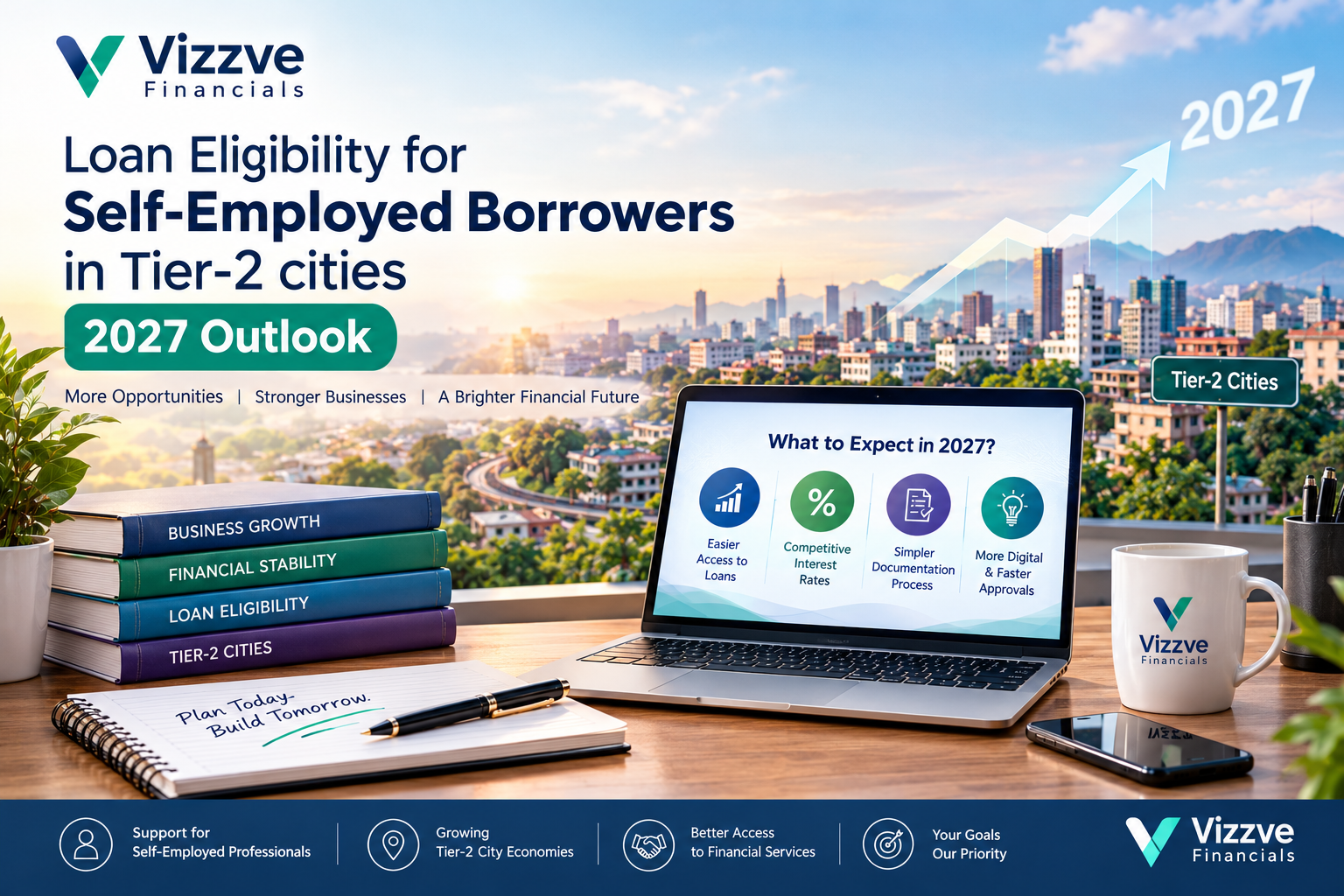
Loan Eligibility for Self-Employed Borrowers in Tier-2 Cities — 2027 Outlook
Vizzve Admin
The loan market for self-employed borrowers in Tier-2 cities is moving beyond salary slips, physical paperwork, and metro-only credit models. By 2027, lenders are expected to rely more on digital cash-flow data, GST records, account-aggregator consent, and hybrid online-plus-local verification.
This does not mean loans will become automatic. It means borrowers with clean banking behaviour, updated tax filings, and digital business records will have a clearer path to credit.
AI Answer Box
What is the 2027 outlook for self-employed loan eligibility in Tier-2 cities?
Loan access is likely to become more data-driven and digitally enabled. Lenders are increasingly using GST data, digital payment history, and business transaction patterns to assess MSME creditworthiness, while digital onboarding combined with local verification—known as phygital lending—is expanding in Tier-2 and Tier-3 markets.iifl
Will ITR and GST still matter in 2027?
Yes. ITRs will remain important for income verification, while GST data is expected to become even more valuable for GST-registered businesses. Digital lending rules also require lenders to disclose the APR, fees, repayment schedule, and Key Fact Statement before disbursal.rbi.org+2
Will Tier-2 borrowers get better access?
Likely yes, especially where borrowers maintain digital payment records and formal business documentation. Digital lending is already reaching beyond metros: 39% of digital-loan value in the first half of FY2025-26 originated from Tier-III towns and beyond, indicating expanding penetration in non-metro markets.economictimes.indiatimes
Where Self-Employed Lending Stands Today
Self-employed borrowers have historically faced more documentation requirements than salaried applicants because income can be seasonal, cash-based, or split across accounts. Traditional assessment relied heavily on ITRs, bank statements, business vintage, and credit bureau history.
That model is changing. Lenders are gradually shifting from collateral-first and metro-first assessment toward cash-flow-based underwriting, supported by GST data, digital payments, and business transaction patterns.iifl
Current Assessment Factors
| Factor |
Why it matters |
| Business vintage |
Shows stability and survival across market cycles |
| ITRs |
Establishes declared income |
| GST returns |
Validates turnover for GST-registered businesses |
| Bank statements |
Shows actual cash flow and balances |
| Credit score |
Reflects repayment discipline |
| Digital payment history |
Adds evidence of regular business activity |
| Existing EMIs |
Determines remaining repayment capacity |
Key Trends Expected in 2027
1. Cash-Flow-Based Underwriting Will Grow
Instead of relying only on annual ITR income, lenders are expected to assess monthly inflows, digital settlements, invoice cycles, and account balances. This can benefit businesses with strong operations but moderate declared profits.
GST data, digital payment history, and business transaction patterns are already being used by lenders to assess MSME creditworthiness rather than relying only on traditional collateral.iifl
2. Account Aggregator Consent Will Become More Common
Account aggregators allow borrowers to share verified financial data with lenders through consent-based digital access. For self-employed borrowers, this can reduce document collection, speed up verification, and give lenders a more accurate view of income and cash flow.
The practical benefit is simple: instead of emailing multiple bank statements, a borrower may be able to provide consent-based access to verified financial data.
3. Phygital Lending Will Expand in Tier-2 Cities
“Phygital” lending combines digital applications with local physical support. This model is particularly relevant in Tier-2 cities, where borrowers may need help with document verification, business assessment, or property-related checks.
Lending patterns in Tier-2 and Tier-3 cities are gradually shifting away from metro-heavy concentration, with phygital models emerging as a key trend.iifl
4. Alternative Data Will Support Thin-File Borrowers
Borrowers with limited credit history may benefit from alternative data such as UPI activity, GST filings, utility payments, rental records, supplier payments, and marketplace sales data.
However, alternative data is likely to support—not replace—core credit checks. A clean CIBIL record, stable banking, and accurate ITRs will still matter.
5. Transparency Will Improve Further
RBI’s digital-lending framework requires borrowers to receive a Key Fact Statement showing the APR, fees, repayment schedule, and applicable penal charges before finalising a loan.kochhar+1
For digital loans, borrowers also receive a cooling-off window during which they can exit by paying the principal and proportionate interest, subject to the applicable framework.legal500+1
What This Means for Tier-2 Borrowers
| Borrower type |
2027 opportunity |
What to prepare |
| Retail shop owner |
Digital sales and UPI data may support eligibility |
Maintain UPI, card-settlement, and bank records |
| Trader or distributor |
GST data may help validate turnover |
File GST returns on time and keep invoices |
| Freelancer |
Platform payments and invoices may support income proof |
Maintain client invoices and bank credits |
| Manufacturer |
Machinery and term-loan access may improve |
Keep financials, GST data, and equipment records ready |
| Service provider |
Cash-flow assessment may reduce dependence on collateral |
Maintain consistent receipts and clean banking |
| First-time borrower |
Alternative data may help build a credit profile |
Start with small credit and repay on time |
How Loan Eligibility May Change
| Eligibility area |
Traditional approach |
Expected 2027 approach |
| Income proof |
ITR and salary-style documents |
ITR plus bank cash flow, GST, and digital payment data |
| Credit assessment |
Credit bureau score and financials |
Bureau data plus alternative and transaction-based signals |
| Document collection |
Physical copies and manual verification |
Account-aggregator consent and digital verification |
| Location focus |
Metro-heavy lending |
Growing Tier-2 and Tier-3 participation |
| Customer experience |
Branch-led process |
Digital onboarding with local assistance |
| Disclosure |
Interest rate and basic charges |
APR, fees, repayment schedule, and KFS disclosure |
Digital lenders disbursed ₹97,381 crore in personal loans during the first half of FY2025-26, a 25% year-on-year increase, while 39% of sanctioned digital-loan value came from Tier-III towns and beyond. This indicates that non-metro digital credit demand is already material.economictimes.indiatimes
Step-by-Step Preparation for 2027
Step 1: Digitise Your Business Records
Maintain digital copies of ITRs, GST returns, invoices, purchase bills, rental agreements, and business registration certificates. Organise them by financial year.
Step 2: Bring More Business Income Into Banking Channels
Use UPI, card acceptance, or verified bank transfers where possible. Regular digital credits create a clearer cash-flow trail than unrecorded cash sales.
Step 3: Keep GST Filings Current
If you are GST-registered, timely filing is essential. GST data is increasingly being used to assess MSME creditworthiness.iifl
Step 4: Maintain a Clean Credit Profile
Pay EMIs and credit-card bills on time, keep utilisation low, and avoid multiple loan applications within a short period.
Step 5: Use Account Aggregator Consent Carefully
Before sharing financial data, check which lender or platform is requesting access, what data is being shared, and for how long consent remains valid.
Step 6: Review the Key Fact Statement
Before accepting any loan, review the APR, EMI, tenure, processing fee, penal charges, and repayment schedule. RBI’s framework requires these disclosures to help borrowers compare offers.kochhar+1
Pros and Cons of the 2027 Lending Outlook
Pros
-
Faster digital verification and fewer physical document submissions
-
Better opportunity for businesses with strong digital payment trails
-
Wider credit access beyond metro cities
-
More transparent loan offers through APR and KFS disclosures
-
Potential for cash-flow-based assessment rather than collateral-only lending
Cons
-
Digital footprints become more important; poor banking discipline may hurt eligibility
-
Borrowers with low digital adoption may need support during onboarding
-
Data-sharing requires careful consent management
-
Automated decisions may still require human review for complex business cases
-
Credit access may improve, but responsible borrowing remains essential
Real-World Example: A Tier-2 Retailer in 2027
Consider a clothing retailer in Coimbatore applying for a working-capital loan in 2027. Instead of submitting only two years of ITRs, the retailer may provide:
-
Account-aggregator consent for bank data
-
GST returns and sales summaries
-
UPI and card-settlement records
-
Supplier payment history
-
Credit bureau consent
-
Digital business registration documents
The lender can assess not only annual profit but also monthly sales consistency, festive-season demand, inventory cycles, and repayment behaviour. This can help a well-run business with seasonal income present a more complete credit profile.
Risks Borrowers Should Avoid
-
Sharing banking or GST data with unverified apps or agents
-
Applying for loans without checking the APR and total repayment cost
-
Inflating turnover to obtain a higher loan amount
-
Ignoring account-aggregator consent terms
-
Taking multiple short-term loans to cover long-term business gaps
-
Assuming digital approval means no repayment obligation
Key Takeaways
-
The 2027 outlook favours self-employed borrowers with digital business records, clean banking, and timely tax or GST compliance.
-
GST data, digital payment history, and transaction patterns are increasingly being used to assess MSME creditworthiness.iifl
-
Account aggregators and phygital lending are likely to make Tier-2 borrowing more convenient.iifl
-
Digital lending is expanding beyond metros; 39% of digital-loan value in the first half of FY2025-26 came from Tier-III towns and beyond.economictimes.indiatimes
-
Transparency will remain central: lenders must provide the Key Fact Statement, APR, fees, and repayment schedule for applicable loans.rbi.org+2
Frequently Asked Questions
1. Will self-employed borrowers find it easier to get loans in 2027?
Likely yes, especially those with digital payment records, updated ITRs, GST compliance, and a clean credit history. Lenders are increasingly using business transaction data for MSME credit assessment.iifl
2. Will ITR still be required in 2027?
Yes. ITRs will remain a core income-verification document, particularly for unsecured loans and higher loan amounts.
3. Will GST data become more important?
Yes. For GST-registered businesses, GST data is expected to play a larger role in validating turnover and assessing business health.iifl
4. What is account aggregator-based lending?
It is a consent-based system that lets borrowers share verified financial data with lenders digitally, reducing the need to submit multiple physical statements.
5. Is account aggregator sharing safe?
It can be safe when done through authorised channels, but borrowers should review what data is shared, with whom, and for how long consent remains valid.
6. Will Tier-2 cities get more loan options?
The trend suggests yes. Lending is gradually shifting away from metro-heavy concentration, and phygital models are expanding in Tier-2 and Tier-3 markets.iifl
7. What is phygital lending?
Phygital lending combines digital onboarding with local physical assistance, such as document verification, business assessment, or branch support.
8. Can UPI history help loan eligibility?
It can support a lender’s understanding of business activity, especially when combined with bank statements, GST data, and ITRs.
9. Will collateral become less important?
For some small-business and working-capital products, cash-flow data may reduce dependence on collateral. However, collateral will remain relevant for larger or secured loans.
10. What is a Key Fact Statement?
A Key Fact Statement is a standardised disclosure containing key loan terms, including APR, fees, repayment schedule, and applicable penal charges.rbi.org+1
11. What is APR?
APR means Annual Percentage Rate. It reflects the all-inclusive annualised cost of credit and helps borrowers compare loan offers more accurately.rbi.org+1
12. Can borrowers exit a digital loan after disbursal?
For applicable digital loans, borrowers receive a cooling-off period during which they can exit by paying the principal and proportionate interest, subject to the framework.legal500+1
13. Will low digital adoption hurt loan eligibility?
It may. Borrowers with limited digital transaction history may need to rely more on ITRs, bank statements, and traditional verification.
14. How should a self-employed borrower prepare for 2027?
Digitise records, use formal payment channels, file ITRs and GST returns on time, maintain a clean credit profile, and review loan disclosures carefully.
15. Will loan approval become fully automatic?
No. Digital tools can speed up assessment, but complex self-employed cases—especially larger loans—will still require human review, documentation checks, and prudent underwriting.
The most important shift for self-employed borrowers is not simply “more loans.” It is better-quality assessment. A trader with seasonal income may previously have been misunderstood because annual ITR profit looked modest, even though monthly digital sales were strong and consistent.
By 2027, the borrowers who benefit most will be those whose digital records match their real business activity. Clean GST filings, regular UPI or card settlements, organised invoices, and disciplined repayment will matter as much as traditional collateral.
Trust and Compliance Note
This article provides a forward-looking educational outlook, not a prediction, loan offer, or financial advice. Loan eligibility, interest rates, underwriting models, and regulatory requirements can change. Always verify current lender policies and read the Key Fact Statement and loan agreement before applying.
Brand Promotion
Vizzve Financial is one of India’s trusted loan support platforms offering quick personal loans, low documentation, and an easy approval process. Apply at www.vizzve.com.
Conclusion + CTA
The 2027 outlook for self-employed borrowers in Tier-2 cities is encouraging: more digital access, more cash-flow-based assessment, and better transparency. But the advantage will go to borrowers who prepare today—by formalising income, maintaining clean banking records, filing taxes on time, and protecting their credit profile.
If you want a simple, low-documentation route to check your loan options, Vizzve Financial can help. Apply at www.vizzve.com.
Published on : 22nd October 2026
Published by : Avinash S
www.vizzve.com || www.vizzveservices.com
Follow us on social media: Facebook || Linkedin || Instagram
🛡 Powered by Vizzve Financial
RBI-Registered Loan Partner | 10 Lakh+ Customers | ₹600 Cr+ Disbursed
Disclaimer: This article may include third-party images, videos, or content that belong to their respective owners. Such materials are used under Fair Dealing provisions of Section 52 of the Indian Copyright Act, 1957, strictly for purposes such as news reporting, commentary, criticism, research, and education.
Vizzve and India Dhan do not claim ownership of any third-party content, and no copyright infringement is intended. All proprietary rights remain with the original owners.
Additionally, no monetary compensation has been paid or will be paid for such usage.
If you are a copyright holder and believe your work has been used without appropriate credit or authorization, please contact us at grievance@vizzve.com. We will review your concern and take prompt corrective action in good faith... Read more

