
Blog Details
Loan Eligibility for Self-Employed Borrowers in Tier-2 Cities — Comparison Guide
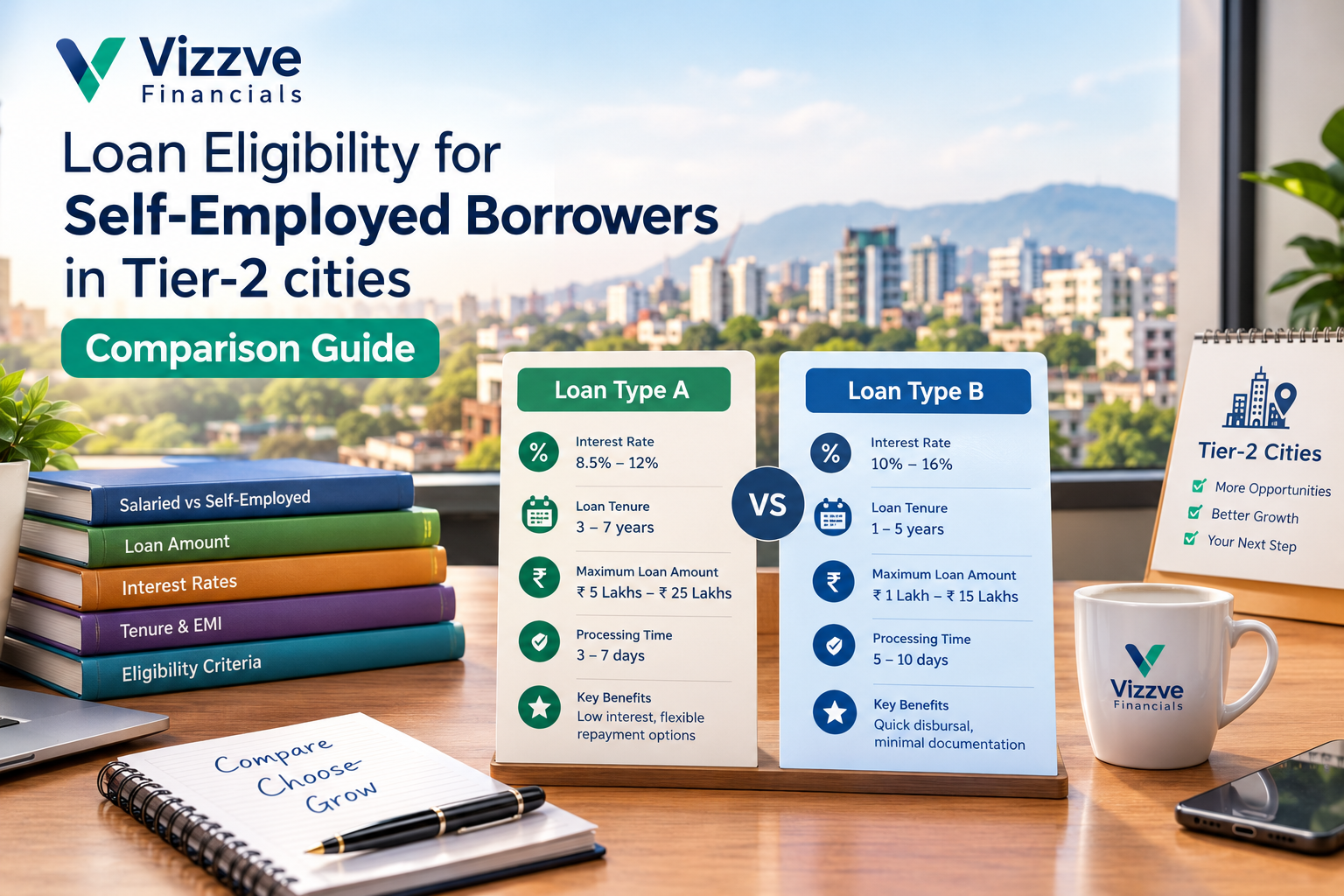
Loan Eligibility for Self-Employed Borrowers in Tier-2 Cities — Comparison Guide
Vizzve Admin
Self-employed borrowers in Tier-2 cities have more than one financing option. The right choice depends on the purpose of the loan, income documentation, urgency, loan amount, and whether the borrower is willing to offer collateral.
A personal loan may suit a short-term personal or small business expense, while a business loan or working-capital facility is usually better for inventory, expansion, or cash-flow gaps. This guide compares the main options in simple, practical terms.
AI Answer Box
Which loan is best for a self-employed borrower in a Tier-2 city?
For a small, short-term requirement, an unsecured personal loan may be suitable. For inventory, machinery, expansion, or working capital, a business loan is usually more appropriate. If the borrower needs a larger amount or has a weaker credit profile, a secured loan against property, fixed deposit, or equipment may offer better approval chances and pricing.icici.bank+2
What do lenders check for self-employed borrowers?
Lenders typically assess business vintage, ITRs, GST returns, bank statements, credit score, existing EMIs, and repayment capacity. Many mainstream lenders prefer 2–3 years of business continuity and a CIBIL score of 700 or above for unsecured credit.icici.bank+1
Loan Options at a Glance
| Loan type |
Best for |
Collateral |
Typical documentation |
Main advantage |
Main limitation |
| Personal loan |
Small personal or emergency expense |
Usually none |
PAN, Aadhaar, bank statements, ITR |
Fast and flexible |
Lower loan amount; higher pricing possible |
| Business loan |
Business expansion, equipment, operations |
Usually none for small-ticket loans |
ITR, GST, bank statements, business proof |
Designed for business needs |
May require stronger financials |
| Working-capital loan |
Inventory, receivables, daily operations |
May be secured or unsecured |
GST, invoices, bank statements, financials |
Supports cash-flow gaps |
Often linked to business turnover |
| Loan against property |
Large amount or long tenure |
Property |
ITR, financials, property documents |
Higher loan amount, potentially lower rate |
Longer processing; property risk |
| Loan against FD |
Short-term need with existing FD |
Fixed deposit |
FD receipt, KYC |
Easy approval, lower risk |
Loan limited to FD value |
| Gold loan |
Urgent short-term requirement |
Gold |
KYC, gold valuation |
Quick disbursal |
Loan limited to gold value |
| Credit line / overdraft |
Repeated working-capital needs |
May be secured or unsecured |
Bank statements, GST, financials |
Draw funds as needed |
Discipline required; fees may apply |
Personal Loan vs Business Loan
Which Should a Self-Employed Borrower Choose?
Choose a personal loan when the requirement is small, urgent, and short-term. Choose a business loan when funds will be used for inventory, equipment, hiring, marketing, shop renovation, or working capital.
| Factor |
Personal loan |
Business loan |
| Purpose |
Personal or general use |
Business-specific use |
| Loan amount |
Usually smaller |
Can be higher, based on turnover |
| Collateral |
Usually unsecured |
May be secured or unsecured |
| Documentation |
Lighter |
More detailed financials may be needed |
| Approval speed |
Often faster |
May take longer for larger amounts |
| Best for |
Emergency, consolidation, small expense |
Growth, inventory, machinery, operations |
| Repayment |
Fixed EMI |
EMI, overdraft, or structured repayment |
Practical Example
A mobile-shop owner in Indore needs ₹1.5 lakh to consolidate small high-interest debts. A personal loan may be suitable.
The same owner needs ₹8 lakh to stock inventory before the festive season. A business loan or working-capital facility may be more suitable because the lender can assess turnover, GST returns, and inventory cycles.
Secured vs Unsecured Loans
| Factor |
Unsecured loan |
Secured loan |
| Collateral |
Not required |
Property, FD, gold, equipment, or other asset |
| Approval speed |
Usually faster |
May take longer due to valuation |
| Loan amount |
Usually lower |
Can be higher |
| Interest pricing |
May be higher |
May be lower, subject to profile |
| Risk to borrower |
No asset pledged, but credit impact on default |
Asset can be at risk on default |
| Best for |
Small, urgent needs |
Large amount, longer tenure, weaker credit profile |
Unsecured loans are convenient, but they depend heavily on income proof and credit history. Secured loans can unlock larger amounts, but borrowers should never pledge an essential asset without a clear repayment plan.
Eligibility Comparison for Self-Employed Borrowers
| Eligibility factor |
Personal loan |
Business loan |
Loan against property |
| Business vintage |
2–3 years often preferred |
2–3 years or more may be preferred |
Varies by lender |
| Income proof |
ITR, bank statements |
ITR, GST, financials, bank statements |
ITR, financials, property income/valuation |
| Credit score |
700+ commonly preferred |
700+ preferred for better terms |
More flexibility possible with collateral |
| GST returns |
Helpful if registered |
Often important |
Helpful |
| Bank statements |
6–12 months |
6–12 months or more |
6–12 months or more |
| Loan amount |
Lower to medium |
Medium to high |
High |
| Processing time |
Usually faster |
Medium |
Longer |
Many lenders prefer self-employed applicants to show 2–3 years of business continuity, consistent bank cash flow, and latest ITR or GST records.icici.bank+1
Documents Required by Loan Type
Personal Loan
-
PAN and Aadhaar
-
Latest 2–3 years of ITRs
-
6–12 months of bank statements
-
Business proof, such as Udyam, trade licence, or GST certificate
-
GST returns, if registered
-
Passport-size photographs, if requested
Business Loan
-
PAN, Aadhaar, and business registration proof
-
ITRs and computation of income
-
Profit-and-loss statement and balance sheet, where applicable
-
GST returns
-
Current-account statements
-
Invoices, purchase bills, or turnover proof
-
Udyam registration, trade licence, or professional registration
Loan Against Property
-
Property documents and title chain
-
Approved building plan, where applicable
-
Income documents, including ITRs and financials
-
Bank statements
-
KYC documents
-
Property valuation and legal verification, as arranged by the lender
For home loans, ICICI Bank’s self-employed checklist includes six months of bank statements from all operative accounts, two years of CA-certified or audited ITRs, computation of income, profit-and-loss statement, balance sheet, and one year of GST returns. Business-loan requirements can differ, but the underlying principle is similar: lenders want verifiable income and business continuity.icici.bank
City-Wise Borrower Profiles in Tier-2 Cities
| City |
Common business profile |
Better-suited loan option |
| Jaipur |
Retail, wholesale, tourism, handicrafts |
Business loan, working-capital loan |
| Coimbatore |
Manufacturing, engineering, textiles |
Machinery loan, business loan |
| Lucknow |
Retail, services, healthcare, education |
Personal loan, business loan |
| Indore |
Trading, distribution, small manufacturing |
Working-capital loan, business loan |
| Bhopal |
Services, retail, contracting |
Business loan, personal loan |
| Surat |
Textiles, diamonds, trading |
Working-capital loan, secured business loan |
Tier-2 cities such as Jaipur, Coimbatore, Lucknow, Indore, Bhopal, and Surat are widely recognised as growing urban business centres.kotak.bank
How to Choose the Right Loan
Step 1: Define the Purpose
Write down exactly why you need funds. A clear purpose helps you avoid over-borrowing and choose the right product.
Step 2: Calculate the Required Amount
Add a small buffer only if genuinely needed. Do not borrow the maximum eligible amount simply because it is offered.
Step 3: Check Your Repayment Capacity
Use your average monthly surplus—not peak-season income—to decide the EMI. Keep room for business expenses, taxes, family costs, and emergencies.
Step 4: Compare APR, Not Only Interest Rate
Review the annualised interest rate, processing fee, insurance, late fees, and prepayment terms. For applicable digital loans, RBI requires the Key Fact Statement to include the APR and amortisation schedule.rbidocs.rbi.org+1
Step 5: Match Tenure With Asset Life
Use short-term credit for short-term needs, such as inventory or receivables. Use longer tenure only for longer-lasting investments, such as equipment or expansion.
Step 6: Apply Selectively
Avoid multiple applications in a short period. Multiple credit enquiries can affect your credit profile and may signal credit hunger to lenders.
Pros and Cons of Major Loan Options
Personal Loan
Pros
-
Usually unsecured
-
Faster processing
-
Useful for small or urgent needs
-
Simple documentation
Cons
-
Loan amount may be limited
-
Interest rate can be higher for self-employed profiles
-
Not ideal for large business expansion
Business Loan
Pros
-
Designed for business requirements
-
Can support higher funding needs
-
GST and turnover-based assessment may help established businesses
-
Suitable for inventory, equipment, and growth
Cons
-
Documentation can be more detailed
-
Approval may take longer
-
Business performance is closely assessed
Secured Loan
Pros
-
Higher loan amount possible
-
May offer better pricing
-
Can help borrowers with limited unsecured-loan eligibility
Cons
-
Asset is pledged
-
Processing can be slower
-
Default can put the asset at risk
Common Mistakes to Avoid
-
Choosing a personal loan for a large long-term business investment
-
Borrowing based on turnover instead of actual cash surplus
-
Ignoring processing fees, insurance, and prepayment terms
-
Applying with mismatched ITR, GST, and bank-statement figures
-
Pledging property without a stable repayment plan
-
Taking a new loan to repay an existing EMI without addressing the root cause
Key Takeaways
-
There is no single “best” loan for self-employed borrowers; the right option depends on purpose, amount, tenure, and repayment capacity.
-
Personal loans suit small, urgent needs; business loans suit inventory, expansion, and working capital.
-
Secured loans can offer higher amounts but involve asset risk.
-
Lenders assess business vintage, ITR/GST records, bank statements, credit score, and existing EMIs.icici.bank+1
-
Compare the APR and full loan terms, not just the advertised interest rate.rbidocs.rbi.org+1
Frequently Asked Questions
1. Can a self-employed person get both a personal loan and a business loan?
Yes, if the income, credit profile, and repayment capacity support both. However, total EMIs should remain within a comfortable share of verified monthly surplus.
2. Which loan is better for inventory purchase?
A business loan or working-capital facility is usually better because it is designed around business turnover, inventory cycles, and operational needs.
3. Is a personal loan suitable for business use?
It can be used for small or urgent business needs, subject to lender terms. For larger or recurring business funding, a business loan is usually more structured.
4. Do self-employed borrowers need collateral for a business loan?
Not always. Many small-ticket business loans are unsecured, while larger loans or certain products may require collateral.
5. What credit score is good for self-employed loan approval?
A CIBIL score of 700 or above is commonly preferred by many lenders, though some lenders may consider lower scores with different pricing or collateral.icici.bank+1
6. Are GST returns mandatory?
GST returns are important if the borrower is GST-registered. They help validate turnover and business activity, especially for business loans.utkarsh.bank+1
7. Which loan is faster: personal loan or business loan?
Personal loans are often faster because documentation and assessment are usually simpler. Business loans may take longer, particularly for larger amounts.
8. Can I get a loan without ITR?
Some lenders may consider alternative assessment for small-ticket loans, but ITR is strongly preferred and often required for mainstream unsecured credit.utkarsh.bank
9. Is a loan against property a good option for a small business?
It can be useful for a large, long-term requirement. However, it should be avoided for short-term working-capital needs because the asset is pledged.
10. What is a working-capital loan?
It is funding used to manage day-to-day business operations, such as inventory, salaries, rent, or receivables, rather than long-term asset purchase.
11. Which option is best for a freelancer?
A personal loan may work for a small personal or business expense. For regular client-based income, a business loan or credit line may be considered if invoices and bank credits are consistent.
12. Should I choose the longest tenure available?
No. A longer tenure reduces EMI but increases total interest. Choose the shortest tenure that keeps repayment comfortable.
13. Can I prepay a business loan early?
Yes, subject to the loan agreement. Check prepayment charges, lock-in period, and the remaining interest benefit before prepaying.
14. What should I compare before applying?
Compare loan amount, APR, EMI, tenure, processing fee, prepayment terms, documentation, and lender service quality.
15. How can a Tier-2 business owner improve loan eligibility?
Maintain separate business banking, file ITRs regularly, keep GST filings current, build a clean credit history, reduce existing EMIs, and apply for a realistic loan amount.
In real lending practice, the most common mistake is choosing a product based only on speed. A personal loan may be quick, but it may not be the most cost-effective or appropriate solution for a ₹10 lakh machinery purchase or a recurring inventory requirement.
A strong borrower matches the loan to the cash-flow cycle: short-term credit for short-term needs, term loans for durable assets, and working-capital facilities for operational gaps. This approach reduces repayment stress and protects both business liquidity and credit health.
Trust and Compliance Note
Loan eligibility, interest rates, documentation, and collateral requirements vary by lender, product, loan amount, and borrower profile. This article is for general education and does not constitute financial, tax, or legal advice. Always review the sanction letter, loan agreement, and Key Fact Statement before applying.
Brand Promotion
Vizzve Financial is one of India’s trusted loan support platforms offering quick personal loans, low documentation, and an easy approval process. Apply at www.vizzve.com.
Conclusion + CTA
For self-employed borrowers in Tier-2 cities, the smartest financing decision is not the fastest approval—it is the loan that matches the business need and repayment capacity. Compare personal loans, business loans, working-capital facilities, and secured options before applying.
If you want a simple, transparent way to check loan options with low documentation, Vizzve Financial can help. Apply at www.vizzve.com.
Disclaimer: This article may include third-party images, videos, or content that belong to their respective owners. Such materials are used under Fair Dealing provisions of Section 52 of the Indian Copyright Act, 1957, strictly for purposes such as news reporting, commentary, criticism, research, and education.
Vizzve and India Dhan do not claim ownership of any third-party content, and no copyright infringement is intended. All proprietary rights remain with the original owners.
Additionally, no monetary compensation has been paid or will be paid for such usage.
If you are a copyright holder and believe your work has been used without appropriate credit or authorization, please contact us at grievance@vizzve.com. We will review your concern and take prompt corrective action in good faith... Read more
