Loan Eligibility for Self-Employed Borrowers in Tier-2 Cities — Explained Simply
Vizzve Admin
Self-employed borrowers in Tier-2 cities—such as shop owners, traders, freelancers, small manufacturers, service providers, and home-based business owners—often face one common question: “Can I get a loan without a salary slip?”
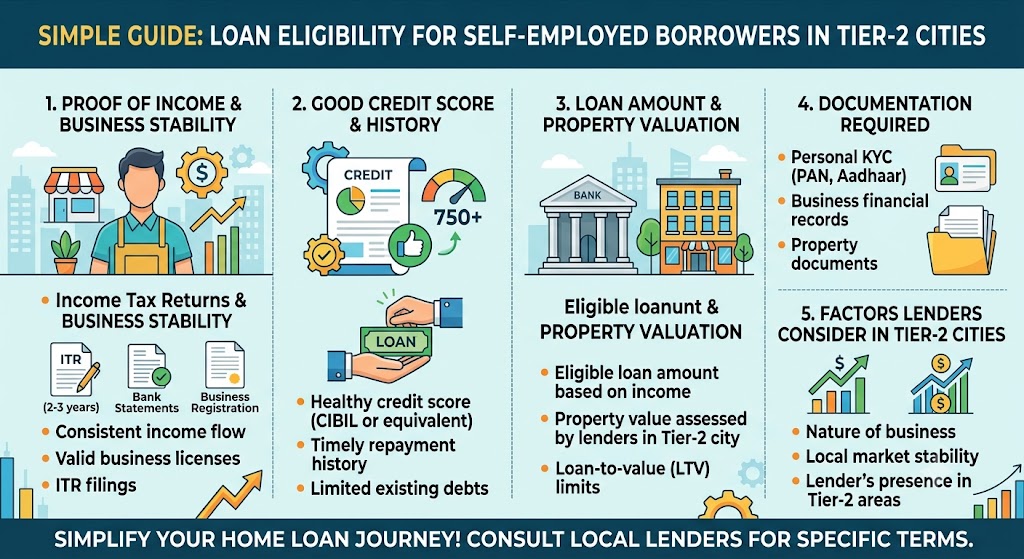
The short answer is yes. Banks, NBFCs, and digital lending platforms can approve loans for self-employed applicants, but they assess income differently. Instead of salary slips, lenders usually look at ITRs, bank statements, GST filings, business vintage, credit score, and repayment capacity.
Access to credit has improved for micro, small, and medium enterprises, yet a large credit gap remains. SIDBI estimates the addressable credit gap for India’s MSME sector at around ₹30 lakh crore, showing that many small businesses still need timely and adequate funding.sidbi
This guide explains, in simple language, what lenders check, which documents you need, and how self-employed borrowers in Tier-2 cities can improve their approval chances.
AI Answer Box
Loan eligibility for self-employed borrowers in Tier-2 cities depends mainly on stable business income, credit score, business vintage, bank statement activity, and document verification.
Most lenders prefer:
-
A CIBIL score of 700+ for better approval chances
-
At least 1–3 years of business vintage
-
ITRs for the last 1–2 financial years
-
6–12 months of bank statements
-
GST returns, if registered under GST
-
Business proof such as Udyam registration, trade licence, GST certificate, or shop establishment proof
-
Monthly EMIs that remain within a safe share of verified income
Self-employed applicants can get personal loans, business loans, MSME loans, machinery loans, and working-capital loans without a salary slip, provided they can show consistent income and responsible repayment behaviour. RBI’s Digital Lending Directions, 2025 require regulated lenders to assess a borrower’s creditworthiness using at least age, occupation, and income details before extending a loan.rbi.org
Who Counts as Self-Employed?
A self-employed borrower is anyone who earns income through their own business, profession, or independent work rather than through a monthly salary from an employer.
Common examples include:
-
Shop owners and retail traders
-
Wholesalers and distributors
-
Restaurant, café, and food-stall owners
-
Tailors, beauticians, salons, and local service providers
-
Freelancers, consultants, and content creators
-
Drivers with commercial vehicles
-
Small manufacturers and workshop owners
-
Home-based sellers and online sellers
-
Contractors, electricians, plumbers, and technicians
-
Farmers with allied business income, depending on the lender’s policy
In Tier-2 cities, many borrowers earn well but do not maintain formal records. That is often the biggest obstacle—not low income, but unverifiable income.
Tier-2 cities have strong business activity, but formal credit documentation can be inconsistent. A borrower may run a profitable shop, yet may not have audited financials, regular ITR filings, or a complete GST history.
Lenders therefore use additional indicators to judge repayment capacity:
-
Regular credits in the current or savings account
-
UPI and QR-code collections
-
GST sales data
-
Invoice-based cash flow
-
Rental income or property ownership
-
Existing loan repayment track record
-
Business location and operational stability
-
Digital payment history
This does not mean Tier-2 borrowers are treated unfairly. It means lenders need stronger proof of income because there is no employer salary slip to verify.
Main Loan Options for Self-Employed Borrowers
| Loan Type |
Best For |
Typical Security |
Main Eligibility Focus |
| Personal loan |
Medical needs, education, wedding, debt consolidation |
Usually unsecured |
Credit score, income proof, repayment capacity |
| Business loan |
Shop expansion, stock purchase, working capital |
Secured or unsecured |
Business vintage, turnover, bank statements |
| MSME loan |
Small businesses, traders, manufacturers |
May be collateral-free or secured |
Udyam registration, turnover, GST/ITR |
| Working-capital loan |
Day-to-day business expenses |
Often secured or invoice-based |
Cash flow, receivables, banking history |
| Machinery/equipment loan |
Buying machines, vehicles, tools |
Equipment may be hypothecated |
Business need, quotation, income stability |
| Loan against property |
Large funding requirements |
Property as collateral |
Property value, income, repayment record |
| Gold loan |
Quick short-term funding |
Gold as security |
Gold valuation, repayment capacity |
For many self-employed borrowers, a business loan or MSME loan is more suitable than a personal loan because the loan purpose matches the business need.
Key Eligibility Criteria Explained
1. Age and Citizenship
Most lenders require applicants to be Indian residents, usually between 21 and 60–65 years at loan maturity. The exact age limit varies by lender and loan product.
2. Business Vintage
Business vintage means how long you have been operating your business.
-
Minimum 1 year: Some fintech lenders and NBFCs may consider newer businesses
-
2–3 years: Common requirement for unsecured business loans
-
3+ years: Often preferred for higher loan amounts or bank loans
A stable business with regular transactions is more convincing than a newly started business with irregular income.
3. Income Proof
Since self-employed borrowers do not receive salary slips, lenders rely on:
-
ITRs for the last 1–2 years
-
Audited financial statements, where applicable
-
Profit and loss statements
-
Balance sheets
-
6–12 months of bank statements
-
GST returns
-
Form 26AS, where relevant
-
Invoices and purchase bills
-
Rental agreements or property income proof
RBI’s digital lending framework specifically requires lenders to collect income and occupation details as part of creditworthiness assessment.rbi.org
4. Credit Score
A good credit score remains one of the strongest approval factors.
| Credit Score Range |
Likely Loan Outcome |
| 750+ |
Strong approval chances, better interest rates |
| 700–749 |
Good eligibility for many lenders |
| 650–699 |
Possible approval, but higher rates or lower amount |
| Below 650 |
Approval may be difficult; secured loans may be easier |
A score above 700 is generally considered healthy, while 750+ gives borrowers more negotiating power.
5. Banking History
Lenders study bank statements closely. They look for:
-
Regular business credits
-
Consistent UPI/QR collections
-
Low cheque bounces
-
No frequent overdrafts
-
Healthy average monthly balance
-
Clear EMI repayment history
-
Stable cash flow rather than sudden large deposits
For a shop owner, regular daily collections through UPI can be a strong supporting signal.
6. Existing EMIs and Debt Burden
Lenders check whether your current EMIs leave enough room for a new loan. As a practical rule, keep total monthly loan obligations comfortably below your verified monthly income.
RBI’s draft framework for NBFCs refers to a board-approved policy limiting household repayment obligations to a maximum of 50% of monthly household income, reflecting the regulator’s focus on responsible lending.rbi.org
7. Business Documentation
Useful documents include:
-
Udyam/MSME registration
-
GST registration certificate
-
Trade licence
-
Shop and establishment certificate
-
FSSAI licence, for food businesses
-
Professional licence, where applicable
-
Rental agreement for shop or office
-
Utility bills in the business name
-
Purchase invoices and sales invoices
These documents help lenders confirm that the business is genuine and operating.
Documents Required for Self-Employed Loan Applications
Personal Loan Documents
-
PAN card
-
Aadhaar card
-
Address proof
-
Latest passport-size photograph
-
Bank statements for the last 6–12 months
-
ITRs for the last 1–2 years
-
Business proof
-
GST returns, if available
Business Loan Documents
-
KYC documents
-
Business registration proof
-
GST registration and returns
-
ITRs and financial statements
-
Current account statements
-
Sales invoices or purchase bills
-
Udyam registration, if available
-
Loan requirement details or project estimate
-
Collateral documents, if applying for a secured loan
Documents That Strengthen Your Application
-
CA-certified financials
-
Form 26AS
-
Tally or accounting software reports
-
GST sales summary
-
UPI/QR settlement statements
-
Electricity bills for the business premises
-
Supplier or customer contracts
-
Existing loan repayment track record
How Lenders Calculate Loan Eligibility
Lenders usually assess:
Eligible EMI=Verified Monthly Income−Existing Monthly Obligations−Living/Business Expenses Buffer\text{Eligible EMI} = \text{Verified Monthly Income} - \text{Existing Monthly Obligations} - \text{Living/Business Expenses Buffer}Eligible EMI=Verified Monthly Income−Existing Monthly Obligations−Living/Business Expenses Buffer
They then convert the available EMI capacity into a loan amount based on tenure and interest rate.
Example
Suppose a Tier-2 city retailer has:
-
Verified monthly business income: ₹80,000
-
Existing EMI: ₹10,000
-
Comfortable EMI capacity: ₹25,000
-
Desired tenure: 36 months
Based on the applicable interest rate, the lender may approve a loan amount that fits within a ₹25,000 monthly EMI. A higher credit score, longer tenure, or lower existing debt can increase the eligible amount.
Personal Loan vs Business Loan for Self-Employed Borrowers
| Factor |
Personal Loan |
Business Loan |
| Best use |
Personal expenses |
Business growth or operations |
| Documentation |
Comparatively simpler |
More detailed |
| Loan amount |
Usually lower to moderate |
Can be higher, based on turnover |
| Interest rate |
Often higher for unsecured loans |
May be lower for secured or MSME-backed loans |
| Collateral |
Usually not required |
May or may not be required |
| Approval focus |
Credit score and income |
Cash flow, turnover, business stability |
| Ideal borrower |
Needs quick personal funding |
Needs funds for stock, equipment, or expansion |
Expert view: If the money is for business stock, machinery, shop renovation, or working capital, apply for a business loan rather than a personal loan. It keeps personal and business finances separate and may offer better loan sizing.
Step-by-Step Guide to Improve Loan Approval Chances
Step 1: Organise Income Proof
Keep ITRs, GST returns, bank statements, invoices, and accounting records ready. Even simple monthly records are better than no records.
Step 2: Check Your Credit Report
Review your CIBIL or other bureau report before applying. Correct wrong accounts, closed loans shown as active, or incorrect overdue entries.
Step 3: Reduce Existing EMIs
If possible, close small high-interest loans or avoid taking new credit just before applying. Lower existing obligations improve your disposable income.
Step 4: Maintain Healthy Bank Statements
Avoid frequent cheque bounces, unnecessary cash withdrawals, and unexplained large deposits. Maintain a stable balance and use business banking regularly.
Step 5: Register the Business Formally
Udyam registration, GST registration, trade licence, and professional registrations make your business more credible.
Step 6: Apply for the Right Loan Amount
Do not apply for an unrealistically high amount. Request a loan that matches your turnover, cash flow, and repayment ability.
Step 7: Compare Lenders
Banks, NBFCs, cooperative lenders, and digital platforms have different requirements. A lender familiar with small-business cash-flow lending may be more suitable than one that depends only on ITRs.
Step 8: Avoid Multiple Applications
Too many loan applications in a short period can create multiple credit enquiries and may reduce your credit score.
Common Mistakes Self-Employed Borrowers Make
-
Applying without updated ITRs
-
Mixing personal and business expenses in one account
-
Showing low declared income but expecting a high loan amount
-
Ignoring credit-report errors
-
Applying to many lenders at once
-
Taking a loan without calculating EMI affordability
-
Providing incomplete business proof
-
Choosing the longest tenure only to reduce EMI, without checking total interest cost
-
Falling for apps promising “guaranteed approval”
A genuine lender will always assess repayment capacity. Avoid any platform that asks for upfront fees before sanction or pressures you to share OTPs.
Pros and Cons of Loans for Self-Employed Borrowers
Pros
-
No salary slip required if business income is verifiable
-
Multiple loan options: personal, business, MSME, secured, and unsecured
-
Funds can support stock purchase, expansion, equipment, or emergencies
-
Digital applications can reduce paperwork and processing time
-
Timely repayment can improve future credit eligibility
Cons
-
Documentation can be more detailed than for salaried borrowers
-
Interest rates may be higher for unsecured loans
-
Low or irregular declared income can reduce eligibility
-
New businesses may face stricter checks
-
Missing GST or ITR records can limit loan options
Real-World Experience Points
From a loan-support perspective, self-employed applicants in Tier-2 cities are often approved faster when they show consistent digital collections. A retailer receiving daily UPI payments, a salon with regular appointment income, or a trader with recurring GST sales has a clearer cash-flow story than an applicant who deals only in cash.
Another practical observation: borrowers who maintain a separate current account for business transactions usually find documentation easier. Their bank statements directly reflect business turnover, customer payments, supplier payments, and seasonal patterns.
Finally, honesty matters. If income is seasonal—such as festival-season retail, agriculture-linked trade, or tourism-related work—explain the cycle. Lenders may still approve the loan if the annual cash flow and repayment record support it.
Key Takeaways
-
Self-employed borrowers in Tier-2 cities can get loans without a salary slip.
-
Lenders focus on income proof, business vintage, bank statements, credit score, and repayment capacity.
-
ITRs, GST returns, Udyam registration, and 6–12 months of bank statements improve approval chances.
-
A CIBIL score of 700+ is generally helpful; 750+ offers stronger negotiating power.
-
Choose a business loan for business needs and a personal loan for personal needs.
-
Keep EMIs within a comfortable share of verified monthly income.
-
Formal business records and digital payment history can make Tier-2 city applications stronger.
-
RBI’s 2025 digital lending directions require lenders to assess borrower creditworthiness using occupation and income details.rbi.org+1
Brand Promotion
Vizzve Financial is one of India’s trusted loan support platforms offering quick personal loans, low documentation, and an easy approval process. Apply at www.vizzve.com.
Frequently Asked Questions
1. Can self-employed borrowers get a loan without a salary slip?
Yes. Self-employed borrowers can get personal, business, and MSME loans by submitting ITRs, bank statements, GST returns, business proof, and other income documents.
Disclaimer: This article may include third-party images, videos, or content that belong to their respective owners. Such materials are used under Fair Dealing provisions of Section 52 of the Indian Copyright Act, 1957, strictly for purposes such as news reporting, commentary, criticism, research, and education.
Vizzve and India Dhan do not claim ownership of any third-party content, and no copyright infringement is intended. All proprietary rights remain with the original owners.
Additionally, no monetary compensation has been paid or will be paid for such usage.
If you are a copyright holder and believe your work has been used without appropriate credit or authorization, please contact us at grievance@vizzve.com. We will review your concern and take prompt corrective action in good faith... Read more

