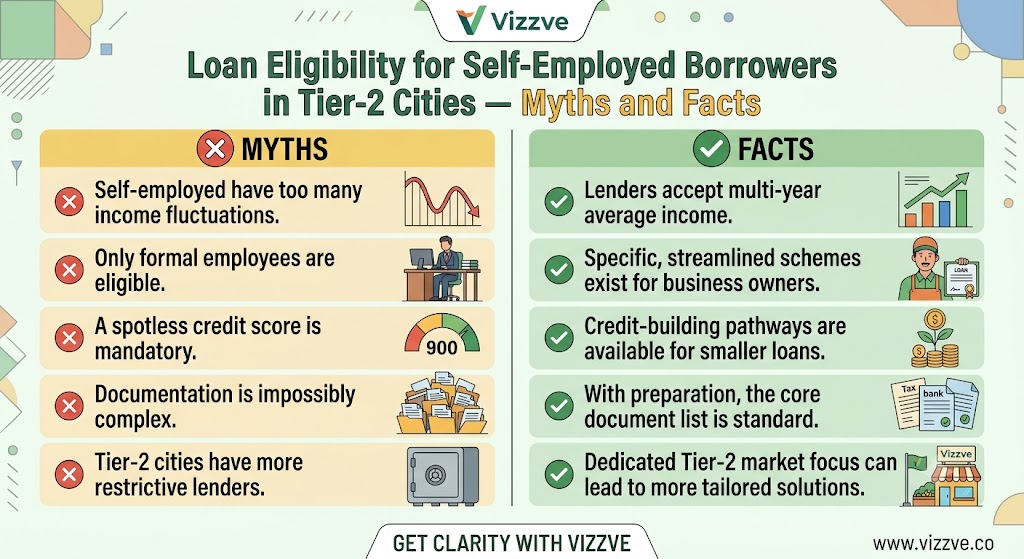
Loan Eligibility for Self-Employed Borrowers in Tier-2 Cities — Myths and Facts
Vizzve Admin
Many self-employed borrowers in Tier-2 cities avoid applying for loans because of half-known rules and outdated advice. Common beliefs—such as “banks only lend to salaried people,” “GST is compulsory,” or “a Tier-2 address reduces eligibility”—often stop deserving borrowers from even applying.
The reality is simpler: lenders assess whether you can repay, not whether you receive a monthly salary. This guide separates the most common myths from facts, using practical examples and current lending practices.
AI Answer Box
Can self-employed borrowers in Tier-2 cities get loans?
Yes. Self-employed shop owners, traders, freelancers, professionals, and small-business owners can get personal or business loans if they can show business continuity, regular income, acceptable bank statements, and a reasonable credit profile. Many lenders prefer 2–3 years of business vintage and a CIBIL score of 700 or above for unsecured loans.icici.bank+2
Is ITR or GST mandatory?
ITR is strongly preferred and often required for mainstream unsecured loans. GST returns are important if the borrower is GST-registered; GST registration itself is not mandatory for every borrower.utkarsh.bank+1
Does living in a Tier-2 city reduce loan eligibility?
No. A Tier-2 location may influence a lender’s internal income benchmark or product availability, but approval mainly depends on verified income, repayment capacity, credit history, and documentation.airtel+1
Myth vs Fact: Quick Summary
| Myth |
Fact |
| Only salaried people get loans |
Self-employed borrowers can get personal and business loans with proper income proof. utkarsh.bank |
| ITR is never required |
ITR is strongly preferred and often required for mainstream unsecured loans. utkarsh.bank |
| GST registration is compulsory |
GST returns matter if you are GST-registered; registration is not mandatory for every borrower. icici.bank |
| Tier-2 city means automatic rejection |
Location may affect lender policy, but income, credit profile, and repayment capacity matter more. airtel+1 |
| A low CIBIL score means permanent rejection |
A low score reduces options, but some lenders may offer secured, smaller, or higher-priced loans. icici.bank+1 |
| Collateral is needed for every business loan |
Many small-ticket business loans are unsecured; collateral depends on the product and loan amount. |
| High turnover guarantees approval |
Lenders focus on net surplus, bank-statement quality, existing EMIs, and repayment behaviour. |
| Cash income cannot be used for loans |
Cash income can be considered if it is consistently deposited and supported by ITR, GST, invoices, or business records. |
Myth 1: Only Salaried People Can Get Personal Loans
Fact
Self-employed borrowers can get personal loans. Instead of salary slips, lenders assess ITRs, bank statements, GST returns, business proof, and credit history.utkarsh.bank
A shop owner, tailor, consultant, driver, freelancer, or small manufacturer can qualify if the income is verifiable and the EMI fits their repayment capacity.
What Lenders Actually Check
-
Business vintage and continuity
-
Average monthly bank balance and credits
-
ITR income and computation of income
-
GST returns, if applicable
-
CIBIL score and repayment record
-
Existing EMIs and credit-card usage
Myth 2: You Cannot Get a Loan Without a Salary Slip
Fact
Salary slips are only relevant to salaried applicants. Self-employed borrowers use alternative income documents.
Accepted Income Proof May Include
-
Latest 2–3 years of ITRs
-
Profit-and-loss statement
-
Computation of income
-
6–12 months of bank statements
-
GST returns
-
Business registration or Udyam certificate
-
Invoices, purchase bills, or client payment records
For home loans, ICICI Bank’s self-employed document list includes six months of bank statements from all operative accounts, two years of CA-certified or audited ITRs, computation of income, profit-and-loss statement, balance sheet, and one year of GST returns. Personal-loan requirements can be lighter, but the principle is the same.icici.bank
Myth 3: GST Registration Is Mandatory for Every Loan
Fact
GST registration is not mandatory for every self-employed borrower. However, if you are GST-registered, lenders will usually want to see GST returns because they help verify turnover and business activity.icici.bank
If your business is below the GST threshold or does not fall under mandatory registration, you may still apply using ITRs, bank statements, business proof, and other financial records.
When GST Helps Most
-
Applying for a business loan
-
Requesting a higher loan amount
-
Showing seasonal or growing turnover
-
Demonstrating formal business operations
-
Supporting a working-capital application
Myth 4: Tier-2 City Borrowers Always Get Rejected
Fact
Tier-2 cities are not a barrier by themselves. Cities such as Jaipur, Coimbatore, Lucknow, Indore, Bhopal, and Surat are recognised as growing urban business centres with active borrower markets.kotak.bank
A lender may have city-specific income benchmarks or branch-level policies, but the core decision still depends on whether the borrower can repay.
What Matters More Than City Tier
-
Verified monthly surplus
-
Credit score
-
Business stability
-
Bank-statement discipline
-
Existing debt burden
-
Loan amount and tenure
Myth 5: A Low CIBIL Score Means Permanent Rejection
Fact
A low credit score can reduce options, increase pricing, or lower the sanctioned amount—but it does not automatically mean permanent rejection. Some lenders may consider a secured loan, a smaller loan amount, or a co-applicant, depending on their policy.icici.bank+1
How to Improve Your Credit Profile
-
Pay all EMIs and credit-card bills before the due date
-
Keep credit-card utilisation low
-
Avoid multiple loan applications in a short period
-
Check your credit report for incorrect entries
-
Close small high-interest loans where possible
-
Maintain a clean banking record
Myth 6: High Turnover Guarantees Loan Approval
Fact
Turnover is only one part of the assessment. A business may show ₹10 lakh monthly sales but still have low net income after rent, salaries, inventory, transport, and loan repayments.
Lenders look at the money left after expenses—the surplus that can support an EMI. Bank statements are especially important because they show actual credits, balances, spending patterns, and repayment behaviour.
Turnover vs Repayment Capacity
| Factor |
Why it matters |
| Turnover |
Shows business scale |
| Net profit |
Shows actual earnings |
| Bank credits |
Validates income flow |
| Average balance |
Shows financial cushion |
| Existing EMIs |
Reduces available repayment capacity |
| Credit score |
Shows repayment discipline |
Myth 7: Cash Income Cannot Be Considered
Fact
Cash income can be considered if it is consistently deposited into a bank account and supported by credible records. Lenders become cautious when large cash deposits appear suddenly or do not match declared income.
Better Way to Handle Cash Income
-
Deposit daily or weekly cash collections into a business/current account
-
Maintain sales records, bills, and invoices
-
File ITRs that reasonably reflect actual income
-
Avoid mixing personal expenses with business receipts
-
Keep GST records updated if registered
Myth 8: Every Business Loan Requires Collateral
Fact
Many small-ticket business loans and working-capital products are unsecured. Collateral is more common for larger loan amounts, certain credit lines, machinery loans, or loans against property.
Before applying, check whether the product is secured or unsecured, and understand what asset is being pledged.
Myth 9: Applying to Many Lenders Improves Approval Chances
Fact
Applying everywhere at once can create multiple credit enquiries and may make the credit profile look credit-hungry. It is better to check eligibility, compare offers, and apply selectively.
Smarter Application Process
-
Check your credit report
-
Organise ITR, GST, and bank statements
-
Calculate a realistic EMI capacity
-
Compare APR, fees, and tenure
-
Apply to one or two suitable lenders
-
Respond quickly to document requests
Myth 10: Loan Rejection Means You Can Never Get a Loan
Fact
A rejection is a decision based on one application, one lender, and one point in time. It is not a permanent financial verdict.
Common reasons for rejection include incomplete documents, low declared income, high existing EMIs, recent credit enquiries, or inconsistent bank statements. Many of these issues can be corrected before reapplying.
Real-World Example: Arjun, a Textile Trader in Surat
Arjun believed he could not get a loan because his income was seasonal and partly received in cash. His turnover was strong during festival months but weaker in other months.
After organising his records, he showed:
-
Three years of ITRs
-
GST returns
-
Twelve months of current-account statements
-
Regular cash deposits and card-settlement credits
-
A CIBIL score of 718
-
One existing EMI of ₹5,000
Instead of applying for an oversized loan, Arjun requested an amount aligned with his lean-season repayment capacity. His application became far stronger because his bank statements, GST filings, and ITRs told the same financial story.
Pros and Cons of Applying With Proper Documentation
Pros
-
Higher chance of approval
-
Better chance of a realistic loan amount
-
Faster document verification
-
Lower risk of mismatch-related rejection
-
Stronger position to negotiate terms
Cons
-
Requires financial discipline
-
May take time to organise older records
-
ITR income may limit the loan amount if profits are understated
-
Some borrowers may need to improve banking habits first
Key Takeaways
-
Self-employed borrowers in Tier-2 cities can get loans; salary slips are not the only accepted income proof.utkarsh.bank
-
ITR is important, while GST returns matter mainly if you are GST-registered.utkarsh.bank+1
-
Tier-2 location does not automatically reduce eligibility; income proof and repayment capacity matter more.airtel+1
-
High turnover does not guarantee approval; lenders focus on net surplus and bank-statement quality.
-
A low credit score may limit options but does not always mean permanent rejection.icici.bank+1
Frequently Asked Questions
1. Can a self-employed person get a personal loan without a salary slip?
Yes. Self-employed applicants can use ITRs, bank statements, GST returns, business proof, and financial statements instead of salary slips.utkarsh.bank
2. Is ITR compulsory for a self-employed loan?
ITR is strongly preferred and often required for mainstream unsecured loans. Some lenders may consider alternatives for smaller-ticket credit, but terms can vary.utkarsh.bank
3. How many years of ITR should I keep ready?
Keep the last 2–3 years of ITRs ready. Many lenders ask for at least two years, while some products may require three.utkarsh.bank
4. Is GST registration mandatory for a business loan?
No. GST registration is not mandatory for every borrower, but GST returns are usually required if you are GST-registered.icici.bank
5. Do Tier-2 city borrowers get lower loan amounts?
Not automatically. Loan amount depends mainly on verified income, credit profile, repayment capacity, loan type, and lender policy.airtel+1
6. What CIBIL score is considered good?
A score of 700 or above is commonly preferred by many lenders. Higher scores can improve approval chances and pricing.icici.bank+1
7. Can cash-based businesses get loans?
Yes, if cash income is deposited regularly and supported by ITRs, invoices, GST records, or other business documentation.
8. Does high turnover guarantee a higher loan?
No. Lenders also assess net profit, bank balances, existing EMIs, credit behaviour, and repayment capacity.
9. Is collateral required for every business loan?
No. Many small business loans are unsecured. Collateral is more common for larger amounts or specific secured products.
10. Can I apply for a loan with a low CIBIL score?
You may still have options, such as a secured loan, smaller loan amount, or a co-applicant, depending on the lender’s policy.icici.bank+1
11. Does applying to multiple lenders improve approval chances?
No. Multiple applications can create several credit enquiries. Compare first, then apply selectively.
12. Can freelancers and gig workers get loans?
Yes. Consistent bank credits, ITR filings, client invoices, and platform-payment records can help establish income and repayment capacity.
13. Why was my loan rejected despite good sales?
Possible reasons include low net income, irregular bank credits, high existing EMIs, low credit score, missing GST returns, or mismatch between declared income and bank activity.
14. How can I improve my eligibility before applying?
File ITRs regularly, maintain clean bank statements, reduce existing EMIs, improve your credit score, keep GST filings current, and apply for a realistic amount.
15. Where can I check the exact loan terms?
Check the lender’s sanction letter, loan agreement, and Key Fact Statement. These documents disclose the loan amount, tenure, APR, charges, and repayment terms.sbi.bank
In loan servicing, myths often cost borrowers more than actual eligibility rules do. A shop owner may delay an important inventory purchase because they believe GST is compulsory, while a freelancer may avoid applying because they assume a Tier-2 address disqualifies them.
The practical truth is that lenders want a consistent financial story. When ITR income, GST turnover, bank credits, and repayment behaviour align, self-employed borrowers from Tier-2 cities can be as creditworthy as any other applicant.
Trust and Compliance Note
Loan eligibility, documentation, interest rates, and credit policies vary across banks and NBFCs. This article is for general education and does not constitute financial, tax, or legal advice. Always verify current lender requirements and read the Key Fact Statement and loan agreement before applying.
Brand Promotion
Vizzve Financial is one of India’s trusted loan support platforms offering quick personal loans, low documentation, and an easy approval process. Apply at www.vizzve.com.
Conclusion + CTA
Do not let myths stop you from applying for the funding your business needs. Self-employed borrowers in Tier-2 cities can qualify for loans with the right mix of income proof, banking discipline, and credit health.
If you want a simple way to check eligibility and apply with low documentation, choose Vizzve Financial. Apply at www.vizzve.com.
Published on : 22nd October 2026
Published by : Avinash S
www.vizzve.com || www.vizzveservices.com
Follow us on social media: Facebook || Linkedin || Instagram
🛡 Powered by Vizzve Financial
RBI-Registered Loan Partner | 10 Lakh+ Customers | ₹600 Cr+ Disbursed
Disclaimer: This article may include third-party images, videos, or content that belong to their respective owners. Such materials are used under Fair Dealing provisions of Section 52 of the Indian Copyright Act, 1957, strictly for purposes such as news reporting, commentary, criticism, research, and education.
Vizzve and India Dhan do not claim ownership of any third-party content, and no copyright infringement is intended. All proprietary rights remain with the original owners.
Additionally, no monetary compensation has been paid or will be paid for such usage.
If you are a copyright holder and believe your work has been used without appropriate credit or authorization, please contact us at grievance@vizzve.com. We will review your concern and take prompt corrective action in good faith... Read more

