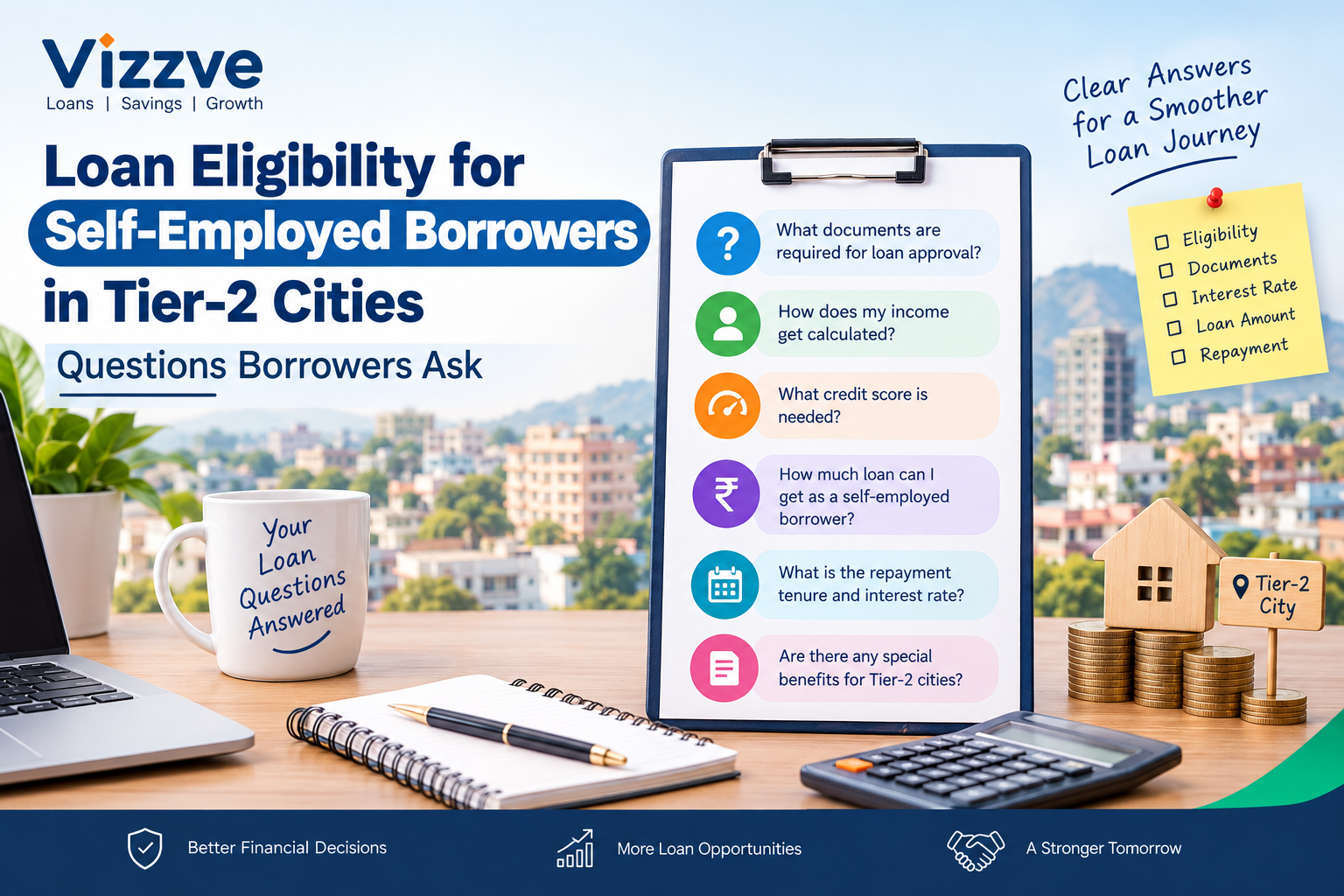
Loan Eligibility for Self-Employed Borrowers in Tier-2 Cities — Questions Borrowers Ask
Vizzve Admin
Self-employed borrowers in Tier-2 cities often face a simple but frustrating question: “I earn well, but can I get a loan without a salary slip?” The answer is usually yes—if your income, banking record, credit behaviour, and business proof can be verified properly.
Lenders do not assess self-employed applicants the same way they assess salaried employees. Instead of salary slips and Form 16, they look at ITRs, bank statements, GST filings, business vintage, existing loans, and repayment discipline. This guide answers the questions borrowers actually ask before applying for a personal loan, business loan, or MSME loan.
AI Answer Box
Can self-employed borrowers in Tier-2 cities get a loan?
Yes. Self-employed borrowers—such as shop owners, traders, freelancers, consultants, manufacturers, and service providers—can qualify for personal, business, and MSME loans. Lenders generally assess income through ITRs, business bank statements, GST returns, Udyam registration, credit score, business vintage, and repayment history. A strong banking record and timely repayment of existing EMIs can improve approval chances even without a salary slip.
What documents are usually required?
PAN, Aadhaar, address proof, business proof, 6–12 months of bank statements, ITRs for the last 1–3 years, GST returns where applicable, Udyam/MSME registration, and details of existing loans.
What credit score is preferred?
Most lenders prefer a CIBIL score of 700+ for smoother approval, though some NBFCs may consider lower scores with higher interest rates, a co-applicant, or collateral.
Why Tier-2 Borrowers Face Different Loan Challenges
Tier-2 cities—such as Indore, Coimbatore, Lucknow, Nagpur, Jaipur, Kochi, Bhubaneswar, and Vijayawada—have a rapidly growing base of small traders, retailers, service businesses, and micro-entrepreneurs. However, many operate with mixed personal and business bank accounts, seasonal income, limited formal documentation, or cash-heavy transactions.
This creates a documentation gap rather than an income gap. A borrower may earn enough to repay a loan, but still find it difficult to prove stable income in the format lenders expect.
Common Borrower Profiles
-
Kirana store, pharmacy, mobile shop, garment shop, and hardware shop owners
-
Salons, coaching centres, tailoring units, bakeries, and repair-service providers
-
Freelancers, consultants, drivers with commercial vehicles, and home-based sellers
-
Small manufacturers, wholesalers, distributors, and local suppliers
-
Professionals such as doctors, CA/CS practitioners, architects, and lawyers
What Lenders Check for Self-Employed Loan Eligibility
1. Business Vintage
Most lenders prefer that the business has been operating for at least 2–3 years. A longer operating history shows that the business is stable and has survived different market conditions.
2. Income Stability
For self-employed applicants, lenders usually want ITRs for the last 1–3 financial years. If your income is seasonal—such as in agriculture-linked trade, tourism, or festival-based retail—lenders may examine annual turnover and average monthly banking credits instead of only one month’s income.
3. Banking Behaviour
Your bank statement is often more important than your declared income. Lenders look for:
-
Regular customer receipts or business inflows
-
Consistent average monthly balance
-
Limited cheque bounces
-
Controlled cash withdrawals
-
Clear separation between personal and business expenses
-
Timely EMI debits for existing loans
4. Credit Score and Credit Report
A CIBIL score of 700 or above generally improves approval chances and helps secure better interest rates. A score below 650 does not automatically disqualify you, but it may lead to a smaller loan amount, higher pricing, a co-applicant requirement, or collateral.
5. Existing Obligations
Lenders calculate your repayment capacity using your fixed monthly obligations—existing EMIs, credit-card dues, and other borrowings. If a large share of income already goes toward EMIs, the approved loan amount may be reduced.
6. Business Documentation
Depending on the loan type, lenders may ask for GST registration, trade licence, shop establishment certificate, Udyam registration, GST returns, purchase invoices, rental agreement, or professional qualification certificates.
Typical Eligibility Criteria
| Parameter |
Personal Loan |
Business / MSME Loan |
| Applicant age |
Usually 21–60 years |
Usually 21–65 years |
| Business vintage |
Often 2+ years |
Usually 2–3+ years |
| Income proof |
ITR, bank statements |
ITR, GST returns, audited financials if required |
| Credit score |
Preferably 700+ |
Preferably 700+, flexible options may exist |
| Loan amount |
Lower to medium ticket size |
Higher, based on turnover and cash flow |
| Collateral |
Usually unsecured |
May be unsecured or secured |
| Common use |
Medical, education, wedding, debt consolidation |
Working capital, inventory, machinery, expansion |
Documents Self-Employed Borrowers Should Keep Ready
Basic KYC Documents
-
PAN card
-
Aadhaar card
-
Passport-size photographs
-
Address proof: electricity bill, rental agreement, passport, or voter ID
Business and Income Documents
-
ITR with computation of income for the last 1–3 years
-
Business bank statements for the last 6–12 months
-
Personal bank statements, if requested
-
GST registration and GST returns, where applicable
-
Udyam/MSME registration certificate
-
Trade licence, shop establishment certificate, or municipal registration
-
Business address proof
-
Rental agreement for shop, office, workshop, or godown
-
Purchase and sales invoices, where relevant
-
Professional practice certificate for doctors, CAs, lawyers, architects, and consultants
Loan-Specific Documents
-
Existing loan statements
-
Property documents, if applying for a secured loan
-
Partnership deed or company incorporation documents, if applicable
-
Co-applicant KYC and income documents, if adding a spouse, parent, or business partner
How to Improve Loan Approval Chances
Step-by-Step Preparation Guide
-
Check your CIBIL report before applying. Correct errors, close old settled accounts where possible, and avoid multiple loan enquiries in a short period.
-
Organise ITRs and bank statements. Ensure your declared income broadly matches the credits visible in your bank account.
-
Separate business and personal banking. Use a current account for business receipts, supplier payments, rent, salaries, and GST payments.
-
File GST returns on time. Regular GST filing strengthens income credibility for traders, wholesalers, and service providers.
-
Register on Udyam if eligible. Udyam registration can support MSME loan applications and formalise your business identity.
-
Reduce unnecessary liabilities. Clear small high-interest loans or credit-card balances before applying.
-
Apply for a realistic loan amount. Requesting an amount aligned with your cash flow is safer than applying for the maximum possible amount.
-
Avoid multiple applications at once. Each hard enquiry can affect your credit profile and may make lenders cautious.
-
Consider a co-applicant. A spouse, parent, or business partner with stable income can improve eligibility.
-
Compare lenders carefully. Banks, NBFCs, and digital lending platforms may have different documentation requirements and approval approaches.
Personal Loan vs Business Loan for Self-Employed Borrowers
| Factor |
Personal Loan |
Business Loan |
| Best for |
Urgent personal needs, medical bills, education, consolidation |
Inventory, machinery, shop expansion, working capital |
| Income assessment |
ITR and bank statements |
Turnover, GST, cash flow, business vintage |
| Loan amount |
Usually smaller |
Can be higher based on business performance |
| Documentation |
Comparatively simpler |
More detailed business documentation |
| Interest rate |
Often higher for unsecured borrowing |
May be lower if secured or backed by strong financials |
| Risk |
Personal repayment responsibility |
Business cash flow must support repayment |
Pros and Cons of Loans for Self-Employed Borrowers
Pros
-
No salary slip is necessarily required
-
Business cash flow can support eligibility
-
MSME and business loan options are expanding
-
Digital applications reduce paperwork and branch visits
-
Timely repayment can build a stronger credit profile
-
Loans can help purchase stock, equipment, or expand operations
Cons
-
Income proof can be complex for cash-based businesses
-
Interest rates may be higher for low credit scores
-
Loan amounts may be lower without audited financials
-
Seasonal income can make assessment difficult
-
Multiple rejections can harm your credit score
-
Some lenders may require collateral for larger loan amounts
Questions Borrowers Ask Most Often
Can I get a loan without ITR?
Possibly, but options are limited. Some NBFCs and digital lenders may consider bank statements, GST data, Udyam details, and business cash flow. However, ITRs significantly improve approval chances and help you access better loan terms.
Can I get a loan with cash income?
Yes, but it is more difficult. If cash income is deposited regularly into a bank account and reflected in ITR or GST filings, lenders can assess it more confidently. Large unexplained cash deposits without supporting records may create verification issues.
Is GST registration mandatory?
No. GST registration is not mandatory for every borrower. It becomes important when your turnover crosses the applicable threshold or when the lender specifically requires GST returns to assess business turnover.
Can I get a loan with a low CIBIL score?
You may still get approval through select NBFCs, but expect stricter terms. A co-applicant, collateral, lower loan amount, or higher interest rate may apply. Avoid applying to many lenders simultaneously.
How much loan can I get?
It depends on your annual income, business turnover, banking credits, credit score, existing EMIs, and whether the loan is secured. Lenders typically assess whether your monthly surplus income can comfortably cover the proposed EMI.
Do I need audited financial statements?
Not always. Small borrowers may qualify with ITRs and bank statements. Larger business loans, especially from banks, may require audited financials, balance sheets, profit-and-loss statements, and GST returns.
Is Udyam registration useful?
Yes. Udyam registration helps establish your business as an MSME and can support applications for MSME-focused credit products, though it does not guarantee approval.
From a loan-servicing and collections perspective, approval is rarely about earning “good money.” It is about provable, repeatable cash flow. A shop owner who deposits daily sales into a current account, files GST returns on time, pays EMIs without delay, and maintains a clean CIBIL report is usually a stronger applicant than someone with higher income but poor documentation.
Lenders are also increasingly required to assess creditworthiness using borrower information such as age, occupation, and income details before extending digital loans, under the RBI’s Digital Lending Directions, 2025. This makes accurate and consistent financial records more important than ever.rbi.org
Market Context: Why Credit Access Matters
India’s MSME credit outstanding grew by 14.8% in FY2025 to reach about ₹31.3 lakh crore, showing stronger credit appetite among small businesses. Yet SIDBI estimates an addressable MSME credit gap of roughly ₹30 lakh crore, with the gap higher in rural areas at about 32% compared with about 20% in urban areas.sidbi+1
For Tier-2 and semi-urban borrowers, this means formal credit is becoming more available—but preparation still matters. A well-documented application can make the difference between approval, a lower offer, or rejection.
Key Takeaways
-
Self-employed borrowers in Tier-2 cities can get personal, business, and MSME loans without a salary slip.
-
ITRs, bank statements, GST returns, business proof, and credit score are the main approval factors.
-
A CIBIL score of 700+ generally improves approval chances and pricing.
-
Separate business banking and timely GST/ITR filing make income easier to verify.
-
Avoid multiple loan applications and apply for an amount matched to actual cash flow.
-
Udyam registration, clean bank statements, and low existing EMIs strengthen an application.
-
Compare banks, NBFCs, and digital lenders before accepting an offer.
Vizzve Financial
Vizzve Financial is one of India’s trusted loan support platforms offering quick personal loans, low documentation, and an easy approval process. Apply at www.vizzve.com.
FAQs
1. Can self-employed borrowers get a personal loan without a salary slip?
Yes. Lenders can assess income through ITRs, business bank statements, GST returns, and business proof instead of salary slips.
2. What is the minimum business vintage required?
Many lenders prefer at least 2–3 years of business operations, though requirements vary by lender and loan product.
3. How many years of ITR do I need?
Most lenders prefer ITRs for the last 1–3 financial years. More years of consistent ITRs improve credibility.
4. Can I get a loan if my business is cash-based?
Yes, but approval is easier when cash receipts are deposited into a bank account and supported by ITR or GST records.
5. What CIBIL score do I need?
A score of 700+ is generally preferred. Some lenders may consider lower scores with additional safeguards or higher pricing.
6. Is GST return required for a business loan?
Not always, but GST returns are commonly requested for traders, wholesalers, service providers, and businesses with GST registration.
7. Can freelancers get loans?
Yes. Freelancers can qualify using ITRs, bank statements, client invoices, professional credentials, and a consistent income record.
8. Can I apply for a loan with a co-applicant?
Yes. A co-applicant with stable income and a good credit score can improve eligibility and may help secure a higher loan amount.
9. Do lenders verify my bank statements?
Yes. Lenders review banking credits, balances, EMI payments, cheque bounces, and cash-flow consistency.
10. Can I get a business loan without collateral?
Yes. Unsecured business loans are available, especially for smaller ticket sizes, but approval depends on credit profile, cash flow, and documentation.
11. What is Udyam registration?
Udyam registration is the Indian government’s registration system for MSMEs. It helps formalise a business and may support MSME loan applications.
12. Why was my loan rejected despite good income?
Common reasons include low credit score, high existing EMIs, inconsistent bank credits, incomplete documents, recent loan enquiries, or mismatch between declared and visible income.
13. Should I apply to multiple lenders at once?
No. Multiple applications can create multiple credit enquiries and may reduce approval chances. Compare options first, then apply selectively.
14. Are NBFC loans safe for self-employed borrowers?
NBFC loans can be safe when the lender is RBI-regulated and the loan terms, interest rate, fees, and repayment schedule are clearly disclosed.
15. How can I improve my eligibility quickly?
Pay EMIs on time, reduce credit-card dues, maintain a healthy bank balance, file pending ITR/GST returns, avoid new loan enquiries, and organise all business documents.
Conclusion
Loan eligibility for self-employed borrowers in Tier-2 cities is no longer limited to those with salary slips or audited accounts. What matters most is a clear financial trail: regular business income, disciplined banking, updated ITR/GST records, and responsible credit behaviour.
Before applying, check your credit report, organise documents, calculate a comfortable EMI, and choose a lender whose requirements match your business profile. A prepared application not only improves approval chances but also helps you secure better loan terms.
Need a personal or business loan with simple documentation? Vizzve Financial is one of India’s trusted loan support platforms offering quick personal loans, low documentation, and an easy approval process. Apply at www.vizzve.com.
Published on : 19th October 2026
Published by : Avinash S
www.vizzve.com || www.vizzveservices.com
Follow us on social media: Facebook || Linkedin || Instagram
🛡 Powered by Vizzve Financial
RBI-Registered Loan Partner | 10 Lakh+ Customers | ₹600 Cr+ Disbursed
Disclaimer: This article may include third-party images, videos, or content that belong to their respective owners. Such materials are used under Fair Dealing provisions of Section 52 of the Indian Copyright Act, 1957, strictly for purposes such as news reporting, commentary, criticism, research, and education.
Vizzve and India Dhan do not claim ownership of any third-party content, and no copyright infringement is intended. All proprietary rights remain with the original owners.
Additionally, no monetary compensation has been paid or will be paid for such usage.
If you are a copyright holder and believe your work has been used without appropriate credit or authorization, please contact us at grievance@vizzve.com. We will review your concern and take prompt corrective action in good faith... Read more

