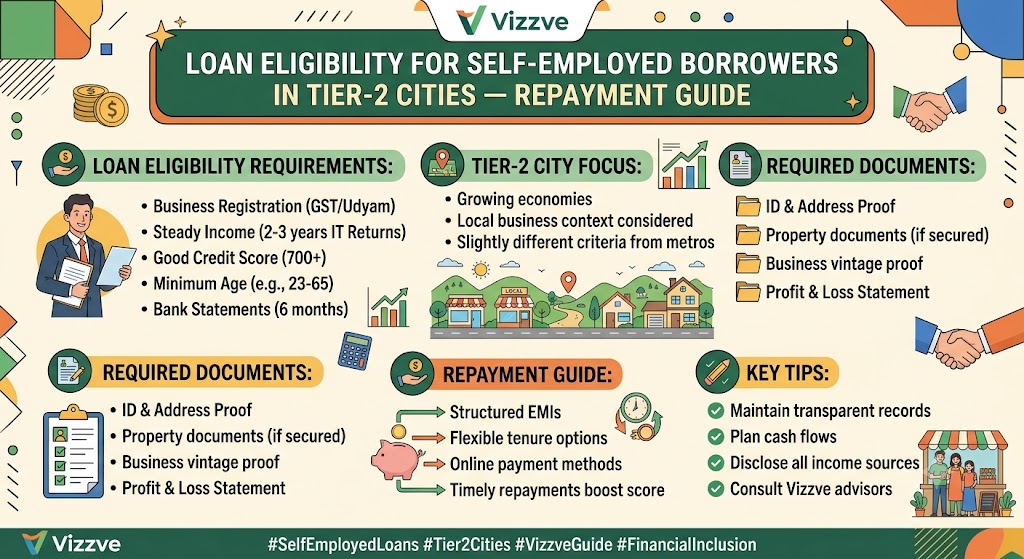
Loan Eligibility for Self-Employed Borrowers in Tier-2 Cities — Repayment Guide | Vizzve
Vizzve Admin
For self-employed borrowers in Tier-2 cities, getting a loan is only half the journey. Repaying it on time—especially when monthly income depends on sales cycles, customer payments, or seasonal demand—is what protects your credit score and future borrowing capacity.
This guide explains how to plan EMIs around real business cash flow, what to do in a low-income month, when prepayment makes sense, and how RBI rules protect borrowers during repayment.
AI Answer Box
How should a self-employed borrower in a Tier-2 city repay a personal loan?
Choose an EMI based on your lowest stable monthly surplus—not your best sales month. Keep at least one EMI in a separate buffer account, align due dates with cash inflows, avoid new debt during weak seasons, and prepay only after maintaining an emergency fund. RBI requires lenders to disclose the APR and amortisation schedule in the Key Fact Statement, so review both before accepting a loan.rbidocs.rbi.org+1
What happens if an EMI is missed?
A missed EMI can attract late fees, increase the outstanding interest, and be reported to credit bureaus, which may lower your credit score. Contact the lender immediately if repayment difficulty is expected; do not wait for multiple missed EMIs.
Can self-employed borrowers prepay a personal loan?
Yes, subject to the loan agreement. For floating-rate loans taken by individuals for non-business purposes, RBI’s 2025 prepayment directions prohibit prepayment charges; charges for other loan types depend on the lender’s disclosed terms.rbi.org+2
Why Repayment Planning Matters More for Self-Employed Borrowers
Salaried borrowers usually receive a fixed monthly salary, making EMI planning straightforward. Self-employed borrowers may receive payments through UPI, card settlements, cheques, cash sales, client invoices, or platform payouts—often at different times each month.
In Tier-2 cities, businesses such as retail shops, trading, transport, textiles, repair services, and contracting can face seasonal fluctuations. A repayment plan that works in a peak-sales month may become stressful during a slow month.
Common Cash-Flow Patterns
| Business type |
Typical income pattern |
Repayment risk |
| Retail shop |
Daily sales, weekly card settlements |
Low-to-medium |
| Trader or distributor |
Payment cycles of 15–60 days |
Medium |
| Contractor |
Stage-wise payments |
Medium-to-high |
| Freelancer or consultant |
Invoice-based payments |
Medium-to-high |
| Seasonal business |
High income in select months |
High |
How to Calculate an Affordable EMI
Do not select an EMI based on your highest monthly turnover. Base it on the income you can reliably generate even in a below-average month.
Simple EMI Planning Formula
Safe EMI=Average monthly surplus−Emergency buffer\text{Safe EMI} = \text{Average monthly surplus} - \text{Emergency buffer}Safe EMI=Average monthly surplus−Emergency buffer
A practical approach is to ensure the EMI does not consume most of your monthly business surplus. Keep room for rent, salaries, inventory, GST or tax payments, family expenses, and unexpected repairs.
Example: Meena, a Boutique Owner in Coimbatore
| Detail |
Meena’s numbers |
| Average monthly business receipts |
₹90,000 |
| Monthly business expenses |
₹55,000 |
| Average monthly surplus |
₹35,000 |
| Existing EMI |
₹4,000 |
| Family and personal expenses |
₹15,000 |
| Safe EMI capacity |
Around ₹10,000–₹12,000 |
If Meena chooses a ₹12,000 EMI, she retains a small cushion. If she chooses ₹20,000, one delayed customer payment or a slow sales month could create repayment stress.
Step-by-Step Repayment Plan
Step 1: Match the EMI Date With Cash Inflows
If most customer payments arrive after the 5th of the month, avoid an EMI due date on the 1st. Choose a date after your main inflow cycle, such as card-settlement dates, invoice due dates, or salary credits to staff and partners.
Step 2: Build a One-EMI Buffer
Before taking the loan, keep at least one full EMI in a separate savings account. Ideally, build a buffer of two or three EMIs if your income is seasonal.
Step 3: Separate Business and Personal Money
Maintain separate accounts for business receipts and household expenses. This makes it easier to identify genuine surplus, track tax obligations, and ensure the EMI is funded before discretionary spending.
Step 4: Automate the EMI
Use a standing instruction or auto-debit mandate, but keep sufficient balance at least two to three days before the due date. RBI’s digital-lending framework requires loan servicing and repayment to be executed directly through the regulated entity’s bank account rather than a third-party pool account.rbi.org
Step 5: Track Dues in a Simple Calendar
Maintain a monthly repayment calendar covering:
-
EMI due date
-
EMI amount
-
Auto-debit account
-
GST or advance-tax due dates
-
Expected customer payment dates
-
Minimum balance required before the due date
Step 6: Review Cash Flow Every Month
At the end of each month, compare actual collections with your expected inflow. If collections fall for two consecutive months, reduce discretionary spending and increase your buffer before the next EMI date.
What To Do If You Cannot Pay an EMI
Act Early
Contact the lender before the due date if possible. Explain the reason—delayed customer payment, seasonal slowdown, medical emergency, or temporary cash crunch—and ask about available options.
Options You Can Ask About
-
EMI due-date change, if supported by the lender
-
Short-term payment plan
-
Part-payment toward the overdue amount
-
Loan restructuring, only if genuinely required and formally approved
-
Temporary moratorium or deferment, if the lender offers one
Avoid unverified agents who promise to “settle” loans for an upfront fee. Always communicate through the lender’s official customer-care channel.
Avoid These Mistakes
-
Skipping the EMI without informing the lender
-
Taking another high-interest loan to pay the existing EMI
-
Using funds meant for rent, salaries, or inventory without a repayment plan
-
Ignoring lender messages or calls
-
Stopping EMI payments because the business is temporarily slow
Prepayment: When Does It Make Sense?
Prepayment reduces the outstanding principal and can lower total interest paid over the loan tenure. However, it should not come at the cost of your emergency fund or business working capital.
When Prepayment Is Sensible
-
You have a stable surplus after all EMIs and business expenses
-
Your emergency fund covers at least three months of expenses
-
The loan carries a high interest rate
-
You have no higher-interest debt pending
-
The lender does not charge a prepayment penalty, or the penalty is lower than the interest saved
When You Should Wait
-
The business needs working capital for inventory or operations
-
Your bank balance is low
-
You have credit-card debt at a higher rate
-
Prepayment charges reduce the benefit
-
A major tax, GST, or family expense is due soon
RBI Rules Borrowers Should Know
Key Fact Statement and APR
For applicable loans, the Key Fact Statement includes the annual percentage rate and the amortisation schedule across the loan tenure. This helps borrowers understand the total cost of credit, not just the headline interest rate.rbidocs.rbi.org+1
Digital Loan Cooling-Off Period
For digital loans, borrowers must receive an explicit option to exit during an initial cooling-off period by paying the principal and proportionate APR without penalty. The period is set by the lender’s board policy but cannot be shorter than one day.rbi.org+2
Prepayment Charges
Under RBI’s Pre-payment Charges on Loans Directions, 2025, regulated entities cannot levy prepayment charges on floating-rate loans extended to individuals for purposes other than business. For other loans, check the loan agreement and Key Fact Statement, where applicable charges must be disclosed.rbi.org+2
Repayment Account Protection
For digital loans, repayments must be made directly into the regulated entity’s bank account, not through a third-party pass-through or pool account.rbi.org
Fixed vs Floating Rate: Repayment Impact
| Feature |
Fixed-rate loan |
Floating-rate loan |
| EMI predictability |
Usually stable |
Can change with rate resets |
| Budgeting |
Easier for irregular income |
Requires periodic review |
| Prepayment charges |
Depends on loan terms |
Generally no prepayment charges for eligible individual non-business floating-rate loans |
| Best suited for |
Borrowers wanting predictable EMIs |
Borrowers comfortable reviewing rate changes |
For self-employed borrowers with variable income, a predictable EMI can make monthly budgeting easier. However, compare the full APR, fees, and prepayment terms—not only the interest rate.rbidocs.rbi.org+2
Pros and Cons of Prepaying a Loan
Pros
-
Reduces total interest cost
-
Lowers outstanding debt faster
-
Improves debt-to-income ratio
-
Can free up future borrowing capacity
-
Reduces financial stress after the loan closes
Cons
-
Reduces cash available for business operations
-
May not be ideal during a seasonal slowdown
-
Prepayment charges may apply on some loan types
-
Using emergency savings for prepayment can create new risk
-
The benefit is smaller if the remaining tenure is very short
Repayment Habits That Protect Your Credit Score
-
Pay the EMI before the due date, not on the due date
-
Maintain a minimum balance cushion in the auto-debit account
-
Avoid multiple loan applications while repaying an existing loan
-
Keep credit-card utilisation low
-
Track your credit report periodically and dispute incorrect entries
-
Close loans formally and retain the closure or no-dues confirmation
-
Avoid cheque bounces and failed auto-debit instructions
Key Takeaways
-
Choose an EMI based on your lowest reliable monthly surplus, not peak-season income.
-
Keep at least one EMI as a buffer; two or three EMIs are safer for seasonal businesses.
-
Align the EMI date with your actual cash-inflow cycle.
-
Review the Key Fact Statement for APR, amortisation schedule, fees, and prepayment terms.rbidocs.rbi.org+1
-
For eligible floating-rate individual non-business loans, RBI prohibits prepayment charges; always confirm the terms in your loan documents.rbi.org+1
-
If repayment becomes difficult, contact the lender early rather than missing EMIs silently.
Frequently Asked Questions
1. How much EMI can a self-employed borrower safely pay?
A safe EMI is one that leaves enough money for business expenses, household needs, taxes, and an emergency buffer. Many borrowers keep total EMIs well below their average monthly surplus.
2. Should I choose a longer tenure to reduce EMI?
A longer tenure lowers the monthly EMI but increases total interest paid. Choose the shortest tenure that still leaves a comfortable monthly cushion.
3. What is the best EMI due date for a business owner?
Choose a date after your main cash inflow—such as card-settlement cycles, invoice payments, or regular sales collection dates.
4. How much emergency fund should I keep before taking a loan?
Keep at least one EMI as a minimum buffer. For seasonal or invoice-based businesses, two to three EMIs provide better protection.
5. Can I change my EMI due date after taking the loan?
Some lenders allow due-date changes subject to their policy. Ask before the due date and confirm any charges or conditions in writing.
6. What happens if my auto-debit fails?
The lender may charge a bounce or late-payment fee, and the missed payment can affect your credit report. Maintain a balance buffer and contact the lender immediately if a debit fails.
7. Can I prepay my personal loan early?
Yes, subject to your loan agreement. For eligible floating-rate loans taken by individuals for non-business purposes, RBI’s 2025 directions prohibit prepayment charges.rbi.org+2
8. Is prepayment always a good idea?
No. Prepay only after maintaining business working capital and an emergency fund. If your business needs cash for inventory or operations, preserving liquidity may be more important.
9. What is APR in a loan repayment schedule?
APR means Annual Percentage Rate. It reflects the all-inclusive annualised cost of credit and is disclosed through the Key Fact Statement for applicable loans.rbidocs.rbi.org+1
10. What is the cooling-off period for digital loans?
It is an initial period during which you can exit a digital loan by paying the principal and proportionate APR without penalty. The period cannot be shorter than one day.rbi.org+2
11. Can a lender debit money from any account?
For digital loans, repayment must be made directly into the regulated entity’s bank account. Review the mandate and account details carefully before signing.rbi.org
12. Will one missed EMI affect my CIBIL score?
It can. Lenders report repayment behaviour to credit bureaus, and delayed payments may negatively affect your credit profile. Pay or communicate with the lender before the due date.
13. Should I take another loan to pay an existing EMI?
Generally, no. A new loan can increase your total debt burden. If repayment is genuinely difficult, speak to the current lender about formal options.
14. How can seasonal business owners avoid EMI stress?
Build a buffer during peak season, choose a lower EMI, maintain a repayment calendar, and avoid committing to an EMI higher than your lean-season capacity.
15. Where can I check the exact repayment terms?
Check the sanction letter, loan agreement, and Key Fact Statement. These documents should disclose the EMI, tenure, APR, charges, and applicable prepayment conditions.rbidocs.rbi.org+2
In practical loan servicing, repayment problems rarely begin with a borrower’s intention to default. They usually begin when the EMI is set too close to the borrower’s best-month income, or when business cash is mixed with household spending.
The safest approach is conservative: select an EMI that your weakest month can support, automate repayment, and maintain a buffer. For self-employed borrowers, liquidity is not a luxury—it is the foundation that keeps both the business and the credit profile healthy.
Trust and Compliance Note
This guide is for general education and does not constitute financial, tax, or legal advice. Loan terms, prepayment rules, charges, and restructuring options vary by lender and product. Always read your sanction letter, loan agreement, and Key Fact Statement before accepting or repaying a loan.
Brand Promotion
Vizzve Financial is one of India’s trusted loan support platforms offering quick personal loans, low documentation, and an easy approval process. Apply at www.vizzve.com.
Conclusion + CTA
A loan becomes useful only when repayment stays comfortable. For self-employed borrowers in Tier-2 cities, the right repayment plan respects seasonal income, protects working capital, and keeps your credit score strong.
Plan your EMI around real cash flow, maintain a buffer, review your loan documents carefully, and prepay only when it does not weaken your business. For a simple loan journey with low documentation and easy approval, choose Vizzve Financial. Apply at www.vizzve.com.
Published on : 22 October 2026
Published by : Avinash S
www.vizzve.com || www.vizzveservices.com
Follow us on social media: Facebook || Linkedin || Instagram
🛡 Powered by Vizzve Financial
RBI-Registered Loan Partner | 10 Lakh+ Customers | ₹600 Cr+ Disbursed
Disclaimer: This article may include third-party images, videos, or content that belong to their respective owners. Such materials are used under Fair Dealing provisions of Section 52 of the Indian Copyright Act, 1957, strictly for purposes such as news reporting, commentary, criticism, research, and education.
Vizzve and India Dhan do not claim ownership of any third-party content, and no copyright infringement is intended. All proprietary rights remain with the original owners.
Additionally, no monetary compensation has been paid or will be paid for such usage.
If you are a copyright holder and believe your work has been used without appropriate credit or authorization, please contact us at grievance@vizzve.com. We will review your concern and take prompt corrective action in good faith... Read more

