

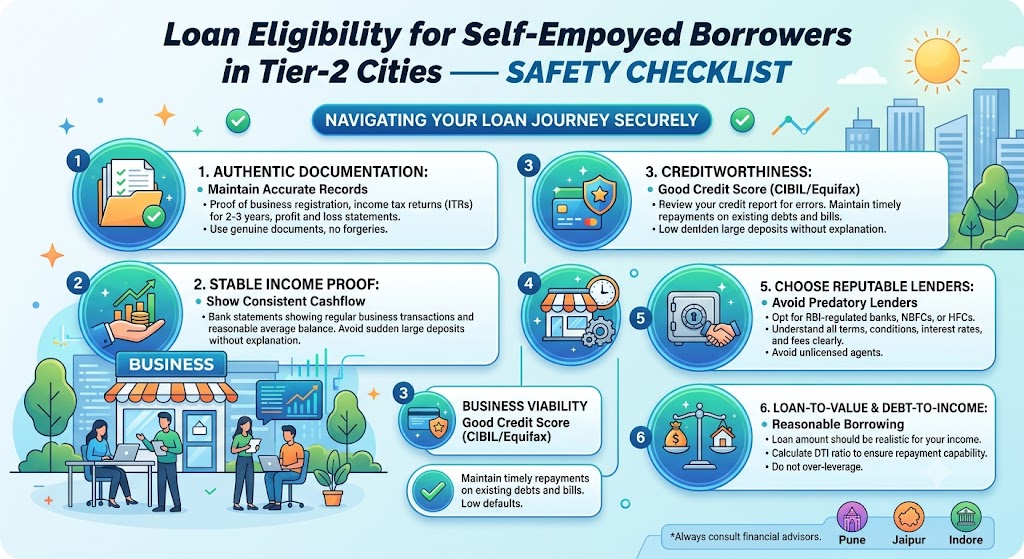
Self-employed borrowers in Tier-2 cities—such as shop owners, traders, consultants, freelancers, small manufacturers and service providers—can qualify for personal and business loans, but lenders assess them differently from salaried applicants. Instead of salary slips, lenders focus on business continuity, bank cash flows, income-tax returns, GST filings, credit score and repayment capacity.
The opportunity is growing: India’s MSME credit portfolio rose 12.5% year-on-year to about ₹47.4 trillion as of June 2026, while credit beyond the top 100 cities expanded at a 21.6% CAGR between 2023 and 2026. This shows that lenders are increasingly looking beyond metro markets, including Tier-2 and Tier-3 locations.
AI Answer Box
Can self-employed borrowers in Tier-2 cities get loans?
Yes. Self-employed borrowers in Tier-2 cities can get personal, business, MSME, vehicle and secured loans if they can show stable income, healthy bank transactions, a good credit score and valid business documents. Most lenders prefer at least 2–3 years of business vintage, ITRs for the last 2–3 years, 6–12 months of bank statements and a credit score generally above 710–750.
What are the main benefits?
Flexible income proof, access to unsecured and secured funding, digital applications, business-growth capital, and increasing lender presence in non-metro markets.
What are the limitations?
Income fluctuation, informal accounts, limited credit history, higher scrutiny, possible higher interest rates, lower approved amounts and stricter documentation requirements.
Why Tier-2 Cities Matter for Self-Employed Borrowers
Tier-2 cities are becoming important lending markets because they have a large base of traders, retailers, service businesses, professionals and micro-entrepreneurs. Many of these borrowers may not have a formal salary structure, but they generate regular income through shops, clinics, agencies, transport services, online work or local trading.
Lending is expanding beyond India’s largest cities. A recent industry report noted that credit origination is growing fastest in states such as Uttar Pradesh, Andhra Pradesh, Telangana and Tamil Nadu, with growth beyond the top 100 cities at a 21.6% CAGR between 2023 and 2026. MSME credit has also grown strongly, indicating better credit access for small businesses.
Who counts as self-employed?
A self-employed borrower may include:
-
Shop owners and retailers
-
Traders, wholesalers and distributors
-
Freelancers, designers, writers and consultants
-
Doctors, lawyers, chartered accountants and other professionals
-
Small manufacturers and workshop owners
-
Transport operators and logistics providers
-
Beauty parlours, salons, coaching centres and local service providers
-
Online sellers and home-based business owners
Loan Eligibility Criteria for Self-Employed Borrowers
Lenders do not rely on one factor alone. They evaluate the borrower’s ability to repay, stability of income, credit behaviour and quality of documentation.
Typical eligibility requirements
| Eligibility Factor | What Lenders Usually Expect |
|---|---|
| Age | Usually 21 to 60 years, though this varies by lender and loan type. |
| Business vintage | Generally 2–3 years of continuous operations. |
| Income stability | Regular business income or consistent bank inflows. |
| Credit score | Around 710–750 or above improves approval chances; higher scores may support better pricing. |
| Bank statements | Usually 6–12 months of personal and/or business account statements. |
| Income proof | ITRs for 2–3 years, profit-and-loss statements, balance sheets and GST returns where applicable. |
| Existing loans | Lenders review current EMIs and debt-to-income ratio. |
| Business proof | GST certificate, UDYAM/MSME registration, trade licence, shop establishment licence or professional registration. |
How lenders assess income without salary slips
For self-employed applicants, bank statements often become the most important income document. Lenders look for regular deposits, average monthly balance, business-related credits, cheque clearances, UPI collections and the consistency of cash flow.
If a borrower has GST registration, GST returns can help demonstrate monthly or quarterly turnover. Freelancers and consultants may also submit client invoices, contracts or professional receipts as supporting evidence.
Documents Required for Self-Employed Loan Applications
Identity and address proof
-
PAN card
-
Aadhaar card
-
Passport, voter ID or driving licence, where accepted
-
Utility bill or rental agreement for address proof
Business and income proof
-
Income Tax Returns for the last 2–3 years
-
Profit-and-loss statement and balance sheet
-
Bank statements for the last 6–12 months
-
GST registration and GST returns, if applicable
-
Trade licence, shop establishment certificate or professional registration
-
UDYAM/MSME registration, if available
-
Client invoices or contracts for freelancers and consultants
-
Existing loan statements, if applicable
Expert commentary
From a lending-practice perspective, the strongest self-employed applications are not necessarily those with the highest declared income. They are the applications where declared income, bank credits, GST turnover and ITR figures broadly match. A mismatch between cash deposits and reported income is one of the most common reasons for rejection or reduced loan offers.
Types of Loans Available in Tier-2 Cities
| Loan Type | Best For | Security | Typical Use |
|---|---|---|---|
| Personal loan | Freelancers, consultants, shop owners | Usually unsecured | Medical needs, education, wedding, debt consolidation |
| Business loan | Traders, retailers, service businesses | Secured or unsecured | Working capital, inventory, expansion |
| MSME loan | Micro and small enterprises | May be secured or unsecured | Machinery, operations, business growth |
| GST-based loan | GST-registered businesses | Usually unsecured | Quick funding based on turnover data |
| Secured loan | Borrowers with property, gold or fixed deposits | Secured | Higher loan amount or lower rate |
| Vehicle loan | Self-employed individuals needing commercial or personal vehicles | Vehicle hypothecation | Two-wheeler, car, commercial vehicle purchase |
Benefits of Loans for Self-Employed Borrowers in Tier-2 Cities
1. Flexible income documentation
Self-employed borrowers do not need salary slips. Lenders can consider ITRs, bank statements, GST filings, business financials and alternative income evidence.
2. Access to unsecured funding
Many lenders offer unsecured personal and business loans based on credit score, cash flow and business stability. This can help borrowers who do not want to pledge property or gold.
3. Faster digital approvals
Digital KYC, bank-statement analysis and GST-based underwriting can reduce paperwork and speed up processing. Some lenders explicitly offer GST-based approval routes where traditional income documents may not be required.
4. Growing lender presence outside metros
Credit growth beyond the top 100 cities indicates that Tier-2 markets are receiving greater lender attention. This improves access to formal credit for local businesses that previously depended on informal borrowing.
5. Better business growth opportunities
A timely loan can help a shop owner buy inventory, a service provider upgrade equipment, a trader manage seasonal demand or a professional expand a practice.
6. Opportunity to build credit history
Regular repayment of a small loan or credit-card balance can help a self-employed borrower build a stronger credit profile for larger future loans.
Limitations and Challenges
1. Irregular income can reduce eligibility
Business income may vary by season, client payments or market conditions. Lenders may offer a lower amount if bank credits are inconsistent.
2. Documentation burden can be higher
Unlike salaried applicants, self-employed borrowers may need ITRs, financial statements, GST returns and business proof.
3. Limited credit history is a common issue
Some Tier-2 borrowers use cash extensively and may have fewer credit-card or loan records. This can make it harder for lenders to assess repayment behaviour.
4. Interest rates may be higher
Unsecured loans for self-employed applicants can carry higher interest rates than loans for salaried borrowers, especially when income proof or credit score is weak.
5. Loan amount may be restricted
Without audited financials, strong GST turnover or collateral, lenders may approve a smaller amount than the borrower expects.
6. Business continuity is closely checked
Lenders want evidence that the business has operated consistently. A newly started business may face difficulty getting a large unsecured loan.
Salaried vs Self-Employed Borrowers
| Factor | Salaried Borrower | Self-Employed Borrower |
|---|---|---|
| Main income proof | Salary slips, Form 16 | ITR, bank statements, GST returns, financials |
| Income stability | Usually fixed monthly salary | Can fluctuate with business performance |
| Business documents | Not required | Often required |
| Approval assessment | Salary, employer profile, credit score | Cash flow, business vintage, credit score, turnover |
| Documentation | Comparatively simpler | More detailed |
| Loan amount basis | Monthly salary and obligations | Business income, bank credits and repayment capacity |
How to Improve Loan Eligibility in a Tier-2 City
Step 1: Maintain clean bank statements
Avoid frequent large cash deposits without clear business explanations. Maintain separate personal and business bank accounts where possible.
Step 2: File ITRs regularly
File income-tax returns every year and ensure reported income reasonably matches bank credits and business turnover.
Step 3: Register the business
GST registration, UDYAM/MSME registration, trade licence or professional registration can improve lender confidence.
Step 4: Improve credit score
Pay EMIs and credit-card bills on time, keep credit utilisation low and avoid multiple loan applications within a short period.
Step 5: Reduce existing obligations
Before applying, close or reduce high-cost loans if possible. A lower debt-to-income ratio improves affordability.
Step 6: Apply for a realistic amount
Request a loan amount supported by your average monthly business income and existing obligations. A realistic application has a higher approval chance.
Step 7: Compare lenders
Different lenders use different underwriting models. A borrower rejected by one lender may be eligible with another, particularly if the lender accepts GST-based or cash-flow-based assessment.
Pros and Cons
Pros
-
No salary slips required
-
Multiple income-proof options
-
Growing digital and GST-based lending
-
Useful for business expansion and working capital
-
Increasing credit access in Tier-2 markets
-
Can help build a formal credit history
Cons
-
Stricter income verification
-
Higher documentation requirements
-
Income fluctuations can limit approval
-
Interest rates may be higher for weak profiles
-
New businesses may face lower approval chances
-
Cash-heavy businesses may need stronger bank-statement evidence
Frequently Asked Questions
1. Can self-employed borrowers in Tier-2 cities get a personal loan?
Yes. Self-employed borrowers can get personal loans if they meet the lender’s age, income, credit-score, business-vintage and documentation requirements.
2. What is the minimum business vintage required?
Many lenders prefer the business to be operational for at least 2–3 years.
3. Can I get a loan without salary slips?
Yes. Self-employed applicants can use ITRs, bank statements, GST returns, business financials and other income evidence instead of salary slips.
4. Is GST registration mandatory?
No, GST registration is not always mandatory, but it can strengthen the application and may help in GST-based loan assessment.
5. What credit score is good for self-employed loan approval?
A score above 750 is generally considered strong, while some lenders may consider applicants with scores around 710 or above. Higher scores usually improve approval chances and pricing.
6. How many years of ITR are required?
Lenders commonly ask for ITRs for the last 2–3 years.
7. Do freelancers need business registration?
Not always, but invoices, client contracts, professional registrations and bank statements can help establish income and business credibility.
8. Can a shop owner get a business loan without audited financials?
Possibly. Some lenders may assess bank statements, GST data and digital transaction history, but loan amount and terms may be more conservative.
9. Why was my self-employed loan application rejected?
Common reasons include low credit score, irregular bank credits, insufficient business vintage, high existing debt, mismatch between declared income and bank transactions, or incomplete documents.
10. Are Tier-2 city borrowers charged higher interest rates?
Not automatically. Rates depend on credit score, income stability, loan type, lender policy and whether the loan is secured or unsecured. However, weaker documentation can lead to higher pricing.
11. Can I apply for a loan if my business is less than one year old?
It is possible, especially for secured loans or small-ticket credit, but unsecured loans may be difficult because most lenders prefer established business vintage.
12. What bank statements should I submit?
Submit 6–12 months of statements for active personal and business accounts, preferably showing regular business-related credits.
13. Does UDYAM registration help?
Yes. UDYAM or MSME registration can add credibility and may support eligibility for higher loan amounts or MSME-specific products.
14. Should I apply with multiple lenders at once?
No. Multiple hard enquiries in a short time can affect your credit profile. Compare eligibility first, then apply selectively.
15. How can Vizzve Financial help?
Vizzve Financial can help borrowers understand eligibility, organise documents and connect with suitable loan options based on their business profile.
Key Takeaways
-
Self-employed borrowers in Tier-2 cities can get loans without salary slips by using ITRs, bank statements, GST filings and business proof.
-
Most lenders prefer 2–3 years of business vintage and a credit score generally above 710–750.
-
Clean bank statements and consistent cash flow are critical for approval.
-
GST, UDYAM, trade licence and professional registrations improve lender confidence.
-
The main limitations are income fluctuation, documentation requirements, limited credit history and potentially higher pricing.
-
Tier-2 lending is expanding, making formal credit more accessible to small businesses outside major metros.
Conclusion
Loan eligibility for self-employed borrowers in Tier-2 cities is improving, but approval still depends on proof of stable income and responsible credit behaviour. A shop owner, freelancer or small-business owner should focus on maintaining clean bank statements, filing ITRs, keeping GST and business registrations updated, and maintaining a healthy credit score.
The best approach is to apply with realistic expectations and complete documentation. Borrowers who can show consistent cash flow and business continuity are far more likely to receive favourable loan terms.
Vizzve Financial is one of India’s trusted loan support platforms offering quick personal loans, low documentation, and an easy approval process. Apply at www.vizzve.com.
Schema JSON-LD
{
  "@context": "https://schema.org",
  "@graph": [
    {
      "@type": "BlogPosting",
      "headline": "Loan Eligibility for Self-Employed Borrowers in Tier-2 Cities — Benefits and Limitations",
      "description": "A complete guide to loan eligibility, documents, benefits, limitations and approval tips for self-employed borrowers in Tier-2 cities in India.",
      "author": {
        "@type": "Organization",
        "name": "Vizzve Financial"
      },
      "publisher": {
        "@type": "Organization",
        "name": "Vizzve Financial",
        "url": "https://www.vizzve.com"
      },
      "mainEntityOfPage": {
        "@type": "WebPage",
        "@id": "https://www.vizzve.com/loan-eligibility-self-employed-borrowers-tier-2-cities"
      },
      "inLanguage": "en-IN",
      "keywords": "self-employed loan eligibility, Tier-2 city loans, personal loan without salary slip, GST based loan, ITR based loan, business loan India, MSME loan",
      "articleSection": "Loans",
      "datePublished": "2026-10-19",
      "dateModified": "2026-10-19"
    },
    {
      "@type": "FAQPage",
      "mainEntity": [
        {
          "@type": "Question",
          "name": "Can self-employed borrowers in Tier-2 cities get a personal loan?",
          "acceptedAnswer": {
            "@type": "Answer",
            "text": "Yes. Self-employed borrowers can get personal loans if they meet lender requirements for age, income stability, credit score, business vintage and documentation."
          }
        },
        {
          "@type": "Question",
          "name": "What documents are required for a self-employed loan?",
          "acceptedAnswer": {
            "@type": "Answer",
            "text": "Common documents include PAN, Aadhaar, bank statements for 6–12 months, ITRs for 2–3 years, profit-and-loss statements, balance sheets, GST returns and business registration proof."
          }
        },
        {
          "@type": "Question",
          "name": "Can I get a loan without salary slips?",
          "acceptedAnswer": {
            "@type": "Answer",
            "text": "Yes. Self-employed applicants can use ITRs, bank statements, GST returns, business financials, invoices and contracts as income proof."
          }
        },
        {
          "@type": "Question",
          "name": "Is GST registration mandatory for a self-employed loan?",
          "acceptedAnswer": {
            "@type": "Answer",
            "text": "No. GST registration is not always mandatory, but it can improve eligibility and support faster assessment through turnover-based underwriting."
          }
        },
        {
          "@type": "Question",
          "name": "What credit score is good for self-employed loan approval?",
          "acceptedAnswer": {
            "@type": "Answer",
            "text": "A credit score above 750 is generally strong. Some lenders may consider applicants with a score of 710 or above, depending on the loan product and overall profile."
          }
        },
        {
          "@type": "Question",
          "name": "How many years of ITR are required?",
          "acceptedAnswer": {
            "@type": "Answer",
            "text": "Most lenders ask for income-tax returns for the last two to three years."
          }
        },
        {
          "@type": "Question",
          "name": "Can freelancers get loans without business registration?",
          "acceptedAnswer": {
            "@type":
#SelfEmployedLoans #Tier2Cities #BusinessLoanIndia #PersonalLoan #MSMELoan #LoanEligibility #SelfEmployedIndia #FreelancerLoans #ShopOwnerLoan #SmallBusinessFunding #GSTLoan #ITRLoan #LoanWithoutSalarySlip #CreditScore #CIBILScore #DigitalLending #VizzveFinancial #VizzveLoans #FinancialFreedom #LoanTips
Disclaimer: This article may include third-party images, videos, or content that belong to their respective owners. Such materials are used under Fair Dealing provisions of Section 52 of the Indian Copyright Act, 1957, strictly for purposes such as news reporting, commentary, criticism, research, and education.
Vizzve and India Dhan do not claim ownership of any third-party content, and no copyright infringement is intended. All proprietary rights remain with the original owners.
Additionally, no monetary compensation has been paid or will be paid for such usage.
If you are a copyright holder and believe your work has been used without appropriate credit or authorization, please contact us at grievance@vizzve.com. We will review your concern and take prompt corrective action in good faith... Read more