Loan Eligibility for Self-Employed Borrowers in Tier-2 Cities: What to Check Before Applying
Loan Eligibility for Self-Employed Borrowers in Tier-2 Cities: What to Check Before Applying
Vizzve Admin
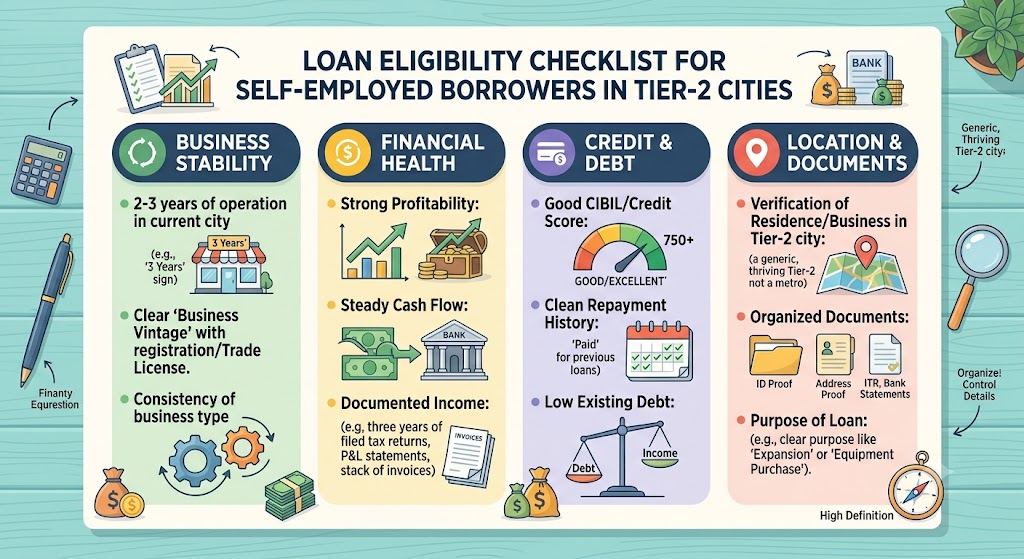
Before applying for a loan, self-employed borrowers should check more than the amount they hope to receive. The most important questions are whether income is properly documented, the business has stable cash flow, current EMIs are manageable, the credit report is accurate, and the proposed EMI fits comfortably within monthly finances.
For shop owners, traders, consultants, freelancers, professionals, and small-business operators in Tier-2 cities, preparation can reduce delays and prevent unsuitable borrowing. Unlike salaried applicants, self-employed borrowers generally establish income through ITRs, bank statements, business records, invoices, and financial statements.
Eligibility requirements differ between lenders. Some lenders may prefer two to three years of ITRs, six to twelve months of bank statements, and proof of business continuity, while others may accept alternative income records depending on the product and borrower profile.airtel+1
AI Answer Box
What should self-employed borrowers check before applying for a loan? Check income proof, business stability, ITRs, bank statements, credit history, existing EMIs, required documents, EMI affordability, APR, processing charges, total repayment, prepayment terms, and lender identity.
Does living in a Tier-2 city reduce loan eligibility? Not automatically. Lenders generally assess income stability, business vintage, repayment history, documentation, existing debt, and the borrower’s ability to repay.
What is the most important check before applying? Confirm that the proposed EMI remains affordable during regular and slow business months—not only during peak sales periods.
AI Summary Box: A strong self-employed loan application combines verifiable income, consistent banking records, accurate tax documents, manageable existing debt, a clear loan purpose, and an EMI that fits actual cash flow.
Quick Eligibility Checklist
What to check
Why it matters
What to do
Business vintage
Shows operating stability
Collect registration, licence, invoice, or contract proof
Income proof
Helps establish repayment capacity
Prepare ITRs, bank statements, and financial records
Credit report
Shows repayment behaviour and current debt
Check for errors, overdue accounts, and high utilisation
Existing EMIs
Determines current debt burden
List every monthly obligation
Cash flow
Shows whether the new EMI is affordable
Review income after business and household expenses
Loan amount
Prevents unnecessary borrowing
Borrow only for a clearly defined need
Tenure
Changes EMI and total interest
Compare shorter and longer repayment options
APR and charges
Shows the wider borrowing cost
Review processing, penal, and prepayment charges
Lender identity
Helps avoid unsuitable or fraudulent channels
Verify the lender and official application source
Key Fact Statement
Explains essential loan terms
Read it before accepting the offer
Check Your Business Income
Why income stability matters
Self-employed income often changes from month to month. A lender therefore needs evidence that the business or professional activity generates enough regular income to support repayment.
High turnover alone does not guarantee eligibility. The lender may consider the income remaining after inventory, rent, wages, transport, taxes, supplier payments, household expenses, and existing EMIs.
Review these income records
Recent ITR acknowledgements
Income computation
Six to twelve months of bank statements
GST returns, where applicable
Profit and loss statement
Balance sheet, where relevant
Sales invoices and purchase records
Client contracts, work orders, or recurring invoices
Business account transaction history
What lenders may want to understand
Is the business currently active?
Is income regular or highly seasonal?
Do bank credits support the income reported in the application?
Can the borrower repay after normal expenses?
Has the business operated for a sufficient period?
Is the requested loan amount reasonable for the business size?
Self-employed borrowers commonly use ITRs, bank statements, business registration, financial statements, and other business records instead of salary slips to demonstrate income.utkarsh.bank+1
Check Your Credit Report
A credit report can show past repayment behaviour, active loans, credit-card balances, settlements, defaults, and recent enquiries. A strong credit score may help, but lenders usually assess the complete profile rather than relying on a single number.
Review your report for
Missed or delayed payments
Overdue loan accounts
High credit-card utilisation
Closed loans incorrectly shown as active
Duplicate accounts
Accounts that do not belong to you
Multiple recent loan enquiries
Settled or written-off accounts
Incorrect personal details
How to improve your profile
Pay EMIs and credit-card dues on time.
Reduce high-cost outstanding debt where possible.
Avoid applying to many lenders simultaneously.
Correct inaccurate credit-report entries.
Keep credit-card utilisation under control.
Do not close an old account without considering its effect on your credit history.
A credit score above 700 is often viewed favourably by lenders, but approval and pricing still depend on income, existing obligations, business history, documentation, and internal policy.utkarsh.bank
Check Your Existing Debt
A lender may reduce the loan amount if existing EMIs already consume a significant share of verified income.
Include all obligations
Home-loan EMI
Vehicle-loan EMI
Existing personal or business loan EMI
Credit-card payments
Consumer-durable EMIs
BNPL dues
Gold-loan interest or instalments
Overdraft or cash-credit repayment
Informal borrowing that affects monthly cash flow
Household expenses and business operating costs
Simple affordability test
Calculate average monthly business income.
Deduct regular business expenses.
Deduct household expenses.
Add existing loan payments.
Add the proposed EMI.
Keep a buffer for slow months, emergencies, and unexpected business costs.
Do not calculate affordability using the best month of the year. Use a realistic average or conservative estimate.
Check Your Documents
Personal documents
PAN card
Aadhaar card or accepted identity proof
Current address proof
Photograph, where requested
Financial documents
ITR acknowledgements
Income computation
Bank statements
Profit and loss statement
Balance sheet, where applicable
GST returns, where applicable
Existing loan statements
Business documents
GST registration, where applicable
Udyam registration certificate, if available
Shop and Establishment licence
Trade licence
Partnership deed
LLP or company incorporation documents
Professional registration or practice licence
Invoices, purchase orders, contracts, or work orders
Keep the information consistent
Record
Details that should match
PAN
Name and tax identity
Aadhaar or address proof
Current personal details
Bank account
Account holder and business activity
ITR
Declared income and financial-year details
GST certificate
Business name and GSTIN
Udyam certificate
Enterprise identity and classification
Licence
Business name and operating address
Loan application
Occupation, income, address, and contact details
Inconsistent information does not automatically mean rejection, but it may lead to additional verification or delay.
Check Your Business Vintage
Business vintage means the length of time the business or professional activity has been operating.
A longer and consistent operating history generally gives a lender more information to assess. New businesses can still explore finance, but the lender may request stronger evidence such as promoter experience, contracts, business projections, capital contribution, or collateral.
Proof of business continuity may include
Older registration certificates
Renewal of business licences
Previous ITRs
GST filing history
Long-term client contracts
Supplier relationships
Lease agreements
Business invoices
Bank statements showing regular activity
Some self-employed loan guidance suggests that lenders often prefer two to three years of business activity, although the actual requirement varies by lender and product.utkarsh.bank
Check Your Loan Purpose
A clear loan purpose can help you select the right product and avoid borrowing more than necessary.
Common loan purposes
Buying inventory
Purchasing machinery or equipment
Funding working capital
Expanding a shop or office
Renovating business premises
Buying a commercial vehicle
Covering a temporary cash-flow gap
Consolidating high-cost debt, where appropriate
Funding professional equipment or business technology
Ask yourself
How much money is actually required?
Can part of the cost be funded from savings?
Will the loan generate additional income or reduce a genuine cash-flow gap?
Is the requested amount supported by an invoice, quotation, or business plan?
Can the EMI be paid during a slow season?
Borrow only what is needed and what can be repaid comfortably.
Check the Total Cost of the Loan
The interest rate is only one part of borrowing cost. Review the APR, processing fee, documentation charges, insurance or add-on costs, penalties, and prepayment conditions.
Cost or term
What to check
Sanctioned amount
Total amount approved
Net disbursal
Amount actually credited after deductions
Interest rate
Stated rate applied to the loan
APR
Annualised overall borrowing cost
EMI
Monthly repayment amount
Tenure
Number of repayment months
Total repayment
Full scheduled repayment amount
Processing fee
Amount and applicable taxes
Penal charges
Cost of late payment
Bounce charges
Cost when an EMI debit fails
Prepayment charges
Cost of early repayment
Foreclosure terms
Conditions for closing the loan early
Insurance or add-ons
Whether optional, mandatory, or financed
For digital lending, RBI directions require regulated entities to provide a Key Fact Statement and disclose the APR before the loan agreement is executed.axis.bank
Why net disbursal matters
Suppose a lender approves ₹2,00,000 but deducts a disclosed processing fee before disbursal. The amount credited may be lower than ₹2,00,000, while repayment may still be calculated on the sanctioned principal according to the loan terms. Always verify the disbursal calculation before accepting.
Check the EMI and Tenure
Shorter tenure
Higher monthly EMI
Usually lower total interest
Faster debt closure
Greater pressure on monthly cash flow
Longer tenure
Lower monthly EMI
Usually higher total interest
More time to repay
Greater long-term debt commitment
A lower EMI is not automatically a cheaper loan. Compare the total repayment amount and choose a tenure that balances affordability with overall cost.
Check the Key Fact Statement
The Key Fact Statement should be reviewed before acceptance, especially for digital loans.
Confirm these details
Lender’s legal name
Loan amount
Amount to be credited
APR
Interest rate
EMI and due date
Repayment schedule
Processing and other charges
Penal charges
Prepayment or foreclosure terms
Cooling-off period, where applicable
Customer-service and grievance-redressal details
RBI’s Digital Lending Directions, 2025, include disclosure requirements for APR and Key Fact Statements. The directions also provide for a cooling-off period during which a borrower may exit by paying the principal and proportionate APR without a penalty, subject to the applicable terms.axis.bank
Check the Lender’s Identity
Before uploading financial documents or paying any amount, verify the lender and the application channel.
Confirm:
Full legal name of the regulated lender
Official website or application source
Loan agreement availability
Key Fact Statement availability
Transparent APR and fee disclosure
Customer-support details
Grievance-redressal process
Data-privacy permissions
Repayment account and payment instructions
Avoid offers promising guaranteed approval in exchange for an upfront payment to an unknown person. Do not share OTPs, passwords, or unnecessary account access.
Disclaimer: This article may include third-party images, videos, or content that belong to their respective owners. Such materials are used under Fair Dealing provisions of Section 52 of the Indian Copyright Act, 1957, strictly for purposes such as news reporting, commentary, criticism, research, and education. Vizzve and India Dhan do not claim ownership of any third-party content, and no copyright infringement is intended. All proprietary rights remain with the original owners. Additionally, no monetary compensation has been paid or will be paid for such usage. If you are a copyright holder and believe your work has been used without appropriate credit or authorization, please contact us at grievance@vizzve.com. We will review your concern and take prompt corrective action in good faith... Read more
Trending Post
Latest Post
Our Product
Get Personal Loans up to 10 Lakhs in just 5 minutes