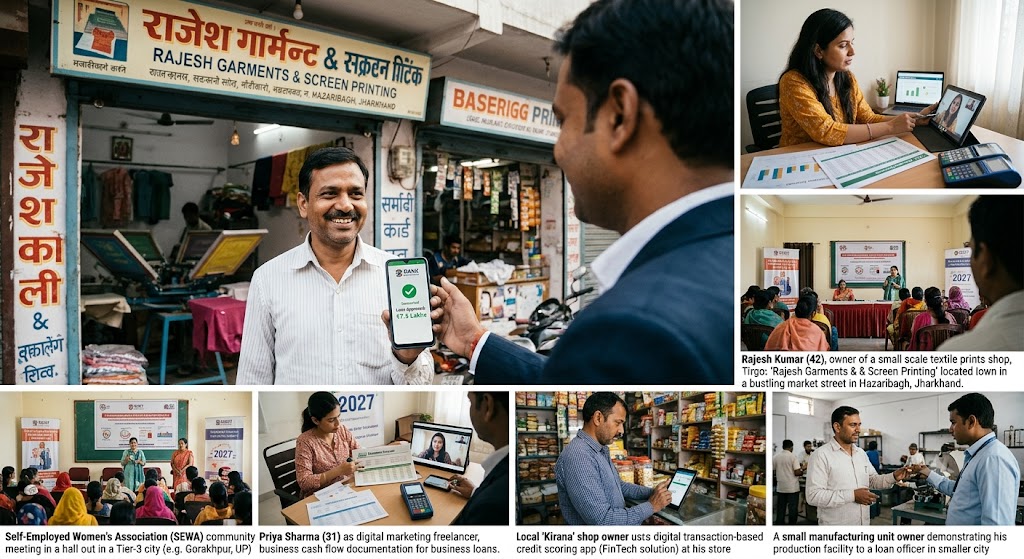
Loan Eligibility for Self-Employed Borrowers in Tier-3 Cities — 2027 Outlook
Vizzve Admin
By 2027, the biggest change for self-employed borrowers in Tier-3 cities will not be a sudden removal of eligibility rules. It will be the shift from “documents-only” lending to data-backed, consent-based credit assessment. A shopkeeper, tailor, freelancer, trader or small manufacturer will increasingly be judged by bank cash flow, tax filings, GST data, repayment behaviour and digital footprints—not merely by whether they hold a salaried job.
This shift is already visible. Personal-loan originations grew 34% year on year in Q1 FY27 to ₹3 lakh crore, with NBFCs increasing their share of disbursement value to 46%. At the same time, RBI’s Digital Lending Directions, 2025 require regulated lenders to assess a borrower’s economic profile, including occupation and income details, before extending credit.rbi.org+1
AI Answer Box
Will self-employed borrowers in Tier-3 cities find it easier to get loans in 2027?
Yes, likely. Digital lending, NBFC expansion, consent-based data sharing and improved credit assessment should make it easier for self-employed borrowers to prove income. However, approval will still depend on verified cash flow, ITR/GST records, credit score and manageable existing EMIs.rbi.org+2
What will lenders check in 2027?
Lenders are expected to check identity, occupation, income, bank-account cash flow, credit-bureau history, GST or tax filings, business vintage and monthly repayment obligations. RBI rules require lenders to collect economic-profile information before lending.rbi.org+1
What should borrowers prepare now?
Maintain a primary bank account, deposit income regularly, file ITRs, keep GST returns updated where applicable, avoid overdue EMIs and keep total monthly loan obligations within a safe share of income. RBI’s NBFC framework caps household loan-repayment outflows at 50% of monthly household income.rbi.org
Why 2027 Is a Turning Point
Digital lending is becoming mainstream
India’s digital lending ecosystem is expanding beyond short-ticket consumer loans. Industry forecasts expect digitally originated retail and MSME loans to rise as banks adopt straight-through processing and consent-based account data becomes easier to access.kenresearch
For Tier-3 borrowers, this means fewer repeated branch visits, faster document upload and more opportunities to be assessed on actual financial behaviour rather than geography.
NBFCs are expanding retail credit
NBFCs are becoming especially important for self-employed and semi-urban borrowers. CRIF High Mark reported that NBFCs’ share of personal-loan disbursement value rose to 46% in Q1 FY27, up from 38% in FY26.crifhighmark+1
This matters because NBFCs often use flexible underwriting models and may serve customers whose income patterns do not fit traditional salaried-employee templates.
Regulation is improving borrower protection
RBI’s Digital Lending Directions, 2025 require regulated entities to conduct due diligence on lending service providers, collect borrower information for credit assessment, disburse loans directly into the borrower’s bank account and provide a cooling-off period for digital loans.rbi.org
RBI has also operationalised a Digital Lending Apps directory to help customers verify whether an app is associated with a regulated entity. This should reduce predatory lending and make formal digital credit safer for first-time borrowers in smaller cities.pib.gov
What Will Define Loan Eligibility in 2027?
1. Verified income, not just declared income
A lender will want to see whether the income claimed in the application matches bank credits, ITRs, GST filings and business records. Self-employed borrowers should avoid inflating income because mismatches can delay approval or cause rejection.
2. Bank cash flow as a primary signal
For self-employed people, bank statements may matter more than salary slips. Lenders will look at:
-
Average monthly credits
-
Regularity of deposits
-
Balance maintained
-
UPI and digital-payment activity
-
Cheque bounces
-
Existing EMI deductions
-
Seasonal fluctuations
3. Credit behaviour
A strong repayment record will remain central. Personal-loan growth is expected to remain healthy through FY27, but lenders are also becoming more selective as unsecured credit expands.careratings+1
4. Digital consent and data sharing
Consent-based data frameworks can allow borrowers to share verified financial information more securely. This can reduce paperwork, but borrowers should share data only through regulated lender platforms and review permissions carefully.
5. Responsible borrowing limits
Lenders will increasingly assess whether a new EMI fits within the borrower’s surplus income. RBI’s NBFC directions require a board-approved policy limiting monthly household loan-repayment outflows to a maximum of 50% of monthly household income.rbi.org
Salaried vs Self-Employed Borrowers in 2027
| Factor |
Salaried borrower |
Self-employed borrower |
| Income proof |
Salary slips, Form 16 |
ITRs, bank statements, GST returns, invoices |
| Income pattern |
Fixed monthly salary |
Daily, weekly, seasonal or project-based |
| Digital data value |
Salary credits, employer verification |
UPI inflows, merchant payments, GST data, business account activity |
| Main advantage |
Simple verification |
Multiple income sources and business ownership |
| Main challenge |
Job stability |
Proving consistent and documented income |
| 2027 trend |
Automated employer and bank verification |
Consent-based cash-flow and tax-data assessment |
Documents Self-Employed Borrowers Should Keep Ready
-
PAN and Aadhaar
-
Address proof
-
Last 2–3 years’ ITRs
-
6–12 months’ bank statements
-
GST returns, if registered
-
Trade licence, Shop Act licence or business registration
-
Invoices, purchase bills and client agreements
-
Current account statements for business transactions
-
Existing loan statements and credit-card bills
-
Audited financials for larger business loans, if required
RBI’s digital lending framework requires lenders to collect minimum borrower information such as age, occupation and income details before extending a loan.rbi.org
2027 Outlook by Borrower Type
| Borrower type |
2027 outlook |
What will help most |
| Kirana or retail shop owner |
Strong, if digital payments and bank deposits are regular |
UPI records, GST filings, current-account history |
| Freelancer or consultant |
Improving, especially for digitally paid work |
Invoices, client agreements, ITRs, bank credits |
| Trader or wholesaler |
Strong for working-capital and business loans |
GST returns, purchase-sale records, turnover proof |
| Service professional |
Strong, particularly with recurring client payments |
ITRs, invoices, professional registrations |
| Seasonal business owner |
Moderate; income smoothing will matter |
Multi-year ITRs, savings buffer, consistent deposits |
| First-time credit user |
Improving but selective |
Small credit line, timely repayments, low utilisation |
How to Prepare for Loan Approval in 2027
Step 1: Separate business and personal money
Use a dedicated current or savings account for business receipts and payments. This creates a clean cash-flow trail.
Step 2: Bank your income
Deposit cash collections regularly. Avoid holding large amounts of unrecorded cash, especially before applying for a loan.
Step 3: File taxes on time
ITR filing creates an official income history. For self-employed applicants, lenders commonly rely on ITRs and bank statements to assess income.rbi.org+1
Step 4: Keep GST records updated
If registered under GST, file returns consistently. GST data can support turnover and business-activity assessment.
Step 5: Build and protect credit score
-
Pay EMIs and credit-card bills on time
-
Keep credit-card utilisation low
-
Avoid multiple loan applications in a short period
-
Check credit reports for errors
-
Maintain a mix of responsibly used credit, if suitable
Step 6: Borrow only what your cash flow supports
Calculate the proposed EMI against average monthly surplus, not peak-season income. A conservative approach reduces rejection risk and protects the business during slow months.
Pros and Cons of the 2027 Lending Environment
Pros
-
More digital application and verification options
-
Greater NBFC participation in personal and business lendingcrifhighmark+1
-
Better use of bank, tax and business data for income assessment
-
Stronger borrower safeguards under RBI’s digital lending frameworkrbi.org+1
-
Faster decisions for borrowers with clean digital financial records
Cons
-
Data mismatches can lead to rejection
-
Cash-heavy businesses may still face verification challenges
-
Digital fraud and illegal lending apps remain a risk if borrowers do not verify lenderspib.gov
-
High existing EMIs can block new borrowing under responsible-lending limitsrbi.org
-
Credit score mistakes can take time to correct
The 2027 opportunity for Tier-3 self-employed borrowers is real, but it rewards financial discipline. A borrower who earns unevenly but banks income consistently, files ITRs, pays bills on time and avoids excessive debt will be easier to underwrite than a higher-income borrower with poor documentation.
In practical terms, the best preparation is not to chase “no-document loans.” It is to build a verifiable financial identity: one bank account, regular deposits, timely tax filings, clean GST records and a healthy credit report.
Key Takeaways
-
2027 should bring wider digital credit access for self-employed borrowers in Tier-3 cities.
-
NBFCs are playing a larger role in personal-loan disbursements, improving access beyond traditional banking channels.crifhighmark+1
-
Verified bank cash flow, ITRs and GST data will matter more than salary slips.
-
RBI’s 2025 digital lending rules strengthen transparency, data consent and direct loan disbursement.rbi.org+1
-
Borrowers should keep total monthly loan obligations within 50% of household income under RBI’s NBFC framework.rbi.org
-
A strong credit score and clean repayment history remain essential.
-
Avoid unverified lending apps; use RBI’s Digital Lending Apps directory to check legitimacy.pib.gov
Frequently Asked Questions
1. Will self-employed borrowers in Tier-3 cities get loans more easily in 2027?
Yes, likely. Digital lending, NBFC participation and consent-based financial data should improve access, though approval still depends on verified income and repayment capacity.rbi.org+1
2. Is a salary slip required for self-employed borrowers?
No. ITRs, bank statements, GST returns, invoices and business proof can be used instead of salary slips.rbi.org+1
3. How many ITRs should I maintain?
Keep at least the last two to three years’ ITRs ready. Consistent filing strengthens income evidence.
4. Is GST registration necessary?
Not always. It is useful if applicable to your business, but lenders may also accept trade licences, invoices and bank statements.
5. Can cash income be considered?
Yes, if it is regularly deposited into a bank account and supported by business records.
6. What credit score should I aim for?
Aim for 750+ for better approval chances and pricing. A score above 700 is generally more acceptable than a poor score, but requirements vary by lender.
7. Will digital loans be safer in 2027?
Formal digital lending should be safer because RBI’s 2025 directions cover data privacy, direct disbursement, disclosures and grievance redressal.rbi.org+1
8. How do I identify a genuine lending app?
Check RBI’s Digital Lending Apps directory and confirm the regulated entity behind the app before sharing documents or data.pib.gov
9. Can freelancers qualify for personal loans?
Yes. Freelancers can use invoices, client agreements, bank credits and ITRs to demonstrate income.
10. Do Tier-3 city borrowers pay higher interest rates?
Not automatically. Pricing depends more on credit profile, income stability, loan amount, tenure and lender policy.
11. What is the maximum safe EMI burden?
RBI’s NBFC framework caps household loan-repayment outflows at 50% of monthly household income.rbi.org
12. Should I apply to multiple lenders at once?
No. Multiple hard enquiries can affect your credit score. Compare eligibility first and apply selectively.
13. Will business loans become easier than personal loans?
For documented businesses with GST data and steady turnover, business loans and working-capital finance may become increasingly accessible.
14. What is the biggest preparation step for 2027?
Create a verifiable financial trail: bank your income, file taxes, maintain GST records and keep repayments timely.
15. How can Vizzve Financial help?
Vizzve Financial can help borrowers understand eligibility, organise documentation and apply for personal loans through a simplified process.
Conclusion
The 2027 outlook for self-employed borrowers in Tier-3 cities is encouraging. Credit access is widening, digital verification is improving and NBFCs are expanding their role in personal lending. But easier access does not mean easier approval without preparation.crifhighmark+1
The borrowers who benefit most will be those who make their income visible, maintain tax and GST compliance, protect their credit score and borrow within a realistic repayment capacity.
Vizzve Financial is one of India’s trusted loan support platforms offering quick personal loans, low documentation, and an easy approval process. Apply at www.vizzve.com.
Published on : 28th October 2026
Published by : Avinash S
www.vizzve.com || www.vizzveservices.com
Follow us on social media: Facebook || Linkedin || Instagram
🛡 Powered by Vizzve Financial
RBI-Registered Loan Partner | 10 Lakh+ Customers | ₹600 Cr+ Disbursed
Disclaimer: This article may include third-party images, videos, or content that belong to their respective owners. Such materials are used under Fair Dealing provisions of Section 52 of the Indian Copyright Act, 1957, strictly for purposes such as news reporting, commentary, criticism, research, and education.
Vizzve and India Dhan do not claim ownership of any third-party content, and no copyright infringement is intended. All proprietary rights remain with the original owners.
Additionally, no monetary compensation has been paid or will be paid for such usage.
If you are a copyright holder and believe your work has been used without appropriate credit or authorization, please contact us at grievance@vizzve.com. We will review your concern and take prompt corrective action in good faith... Read more

