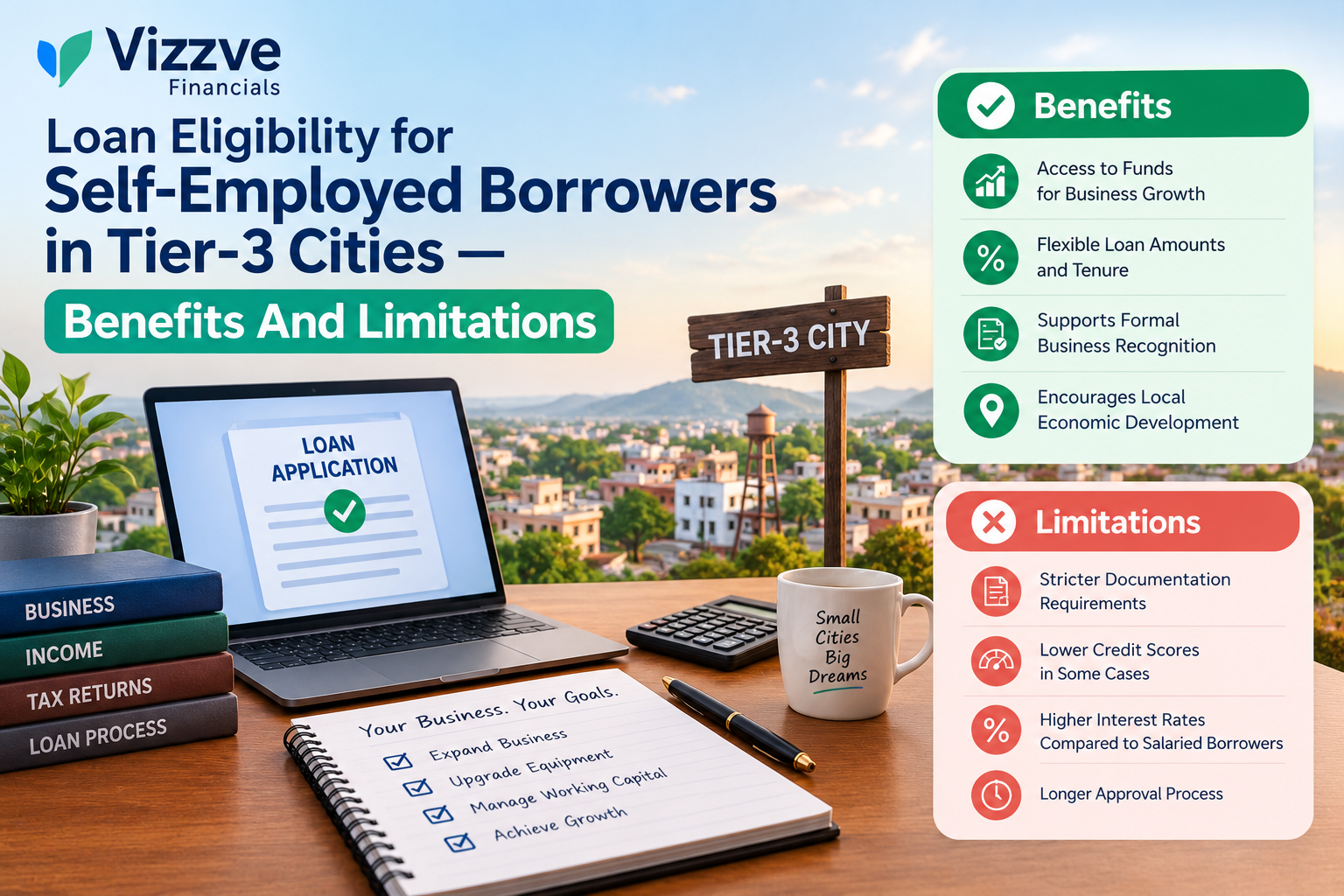
Loan Eligibility for Self-Employed Borrowers in Tier-3 Cities — Benefits And Limitations
Vizzve Admin
Self-employed borrowers in Tier-3 cities—shop owners, service providers, contractors, transport operators, freelancers and small manufacturers—often have genuine income but face a different loan journey from salaried applicants. They may not have salary slips, yet they can still qualify for personal loans, business loans, working-capital funding or secured credit if their income and repayment capacity are properly documented.
The advantage is access to flexible funding for business growth, emergencies and personal needs. The limitation is that lenders need stronger proof of income stability, business continuity and cash flow. This blog explains both sides clearly, so you can decide when to apply, which loan to choose and how to strengthen your eligibility.
India’s smaller-city credit market is growing. Tier-2 and Tier-3 cities accounted for around 64% of home-loan volumes in 2025, with volumes rising 81% year on year, and self-employed households are an important part of this borrower base. At the same time, RBI’s Digital Lending Directions, 2025 require lenders to assess borrower creditworthiness, including income and occupation, before extending credit.homefirstindia+1
AI Answer Box
What are the benefits of loan eligibility for self-employed borrowers in Tier-3 cities?
Self-employed borrowers can access personal loans, business loans, working-capital finance and secured loans without a salary slip. They can use ITRs, bank statements, GST returns, invoices and business registration documents to establish income and repayment capacity.
What are the main limitations?
Lenders may offer lower loan amounts or stricter terms when ITR income is low, bank statements are irregular, business vintage is short, credit history is weak or existing EMIs are high. Documentation requirements are usually more detailed than for salaried borrowers.
Can self-employed borrowers get loans without ITR?
Some small-ticket loans may be available through alternative data, but most bank and NBFC loans require ITRs, bank statements and business proof for self-employed applicants.gocredit+1
Benefits of Loan Eligibility for Self-Employed Borrowers
1. No salary slip is mandatory
The biggest benefit is that self-employed borrowers do not need a salary slip. Instead, they can establish income through business and financial records.
Common income documents include:
-
ITR acknowledgements for the last one to three years
-
Computation of income
-
Six to twelve months of bank statements
-
GST returns
-
Business registration or trade licence
-
Invoices, purchase bills and client contracts
-
CA-certified financial statements for larger business loans
Most lenders ask self-employed applicants for ITRs and bank statements, while larger loans may require audited or CA-certified financials.gocredit
2. Access to multiple loan products
Self-employed borrowers are not limited to personal loans. They can choose a product based on the actual purpose of funding.
| Loan type |
Best use case |
Main benefit |
| Personal loan |
Medical needs, wedding, travel, debt consolidation |
Flexible personal-use funding |
| Business loan |
Shop expansion, equipment, business investment |
Designed for business needs |
| Working-capital loan |
Inventory, raw material, seasonal demand |
Supports operating-cycle cash flow |
| Equipment or vehicle loan |
Machinery, delivery vehicle, commercial vehicle |
Asset-backed funding structure |
| Secured loan |
Large funding requirement |
May allow higher amount and better pricing |
3. Funding can support business growth
A timely loan can help a Tier-3 business owner buy stock before festive demand, repair equipment, expand a shop, hire staff or manage a delayed client payment.
For example, a grocery-store owner may use a working-capital loan to purchase inventory before a festival season. If the additional stock generates higher sales, the loan can support growth rather than become a burden.
4. Digital payments improve eligibility
UPI collections, QR-code payments, online marketplace payouts and digital invoices create a clearer financial trail. This helps lenders assess cash flow more confidently.
The Account Aggregator framework also allows borrowers to share financial data, including bank statements, with lenders through consent. This can be useful for self-employed borrowers with digital receipts but limited formal financial statements.homefirstindia
5. Smaller-city credit demand is increasing
Lenders are paying more attention to Tier-2 and Tier-3 markets as credit demand rises. Smaller cities accounted for a large share of home-loan volumes in 2025, showing that borrowers outside metro cities are becoming a core market.homefirstindia+1
This does not guarantee approval for every applicant, but it means more lenders and digital platforms are building products for non-salaried and semi-formal income profiles.
6. Secured loans can unlock larger amounts
If a borrower owns property, equipment, a vehicle or other acceptable asset, a secured loan may offer a higher loan amount or better pricing than an unsecured personal loan.
However, secured borrowing should be considered carefully because the asset is at risk if repayments are not made.
7. Credit history can be built gradually
Self-employed borrowers who repay EMIs and credit-card bills on time can build a stronger credit profile over time. A CIBIL score of 700 or above is commonly considered favourable for personal-loan approval, although lender policies differ.
Limitations of Loan Eligibility for Self-Employed Borrowers
1. Documentation is usually heavier
Salaried applicants may need salary slips and bank statements. Self-employed applicants often need ITRs, bank statements, GST filings, business proof and sometimes financial statements.
This can be difficult for borrowers who operate mainly in cash or have not maintained separate business accounts.
2. Low declared income can restrict the loan amount
Many business owners declare lower income in ITRs to reduce tax liability. Later, when they apply for a loan, the lender may approve only an amount supported by the declared income.
A lender evaluates documented repayment capacity, not verbal income claims. If the ITR shows low profit, the sanctioned amount may be lower than expected.
3. Irregular cash flow can reduce approval chances
Seasonal businesses, contractors, transport operators and freelancers may have uneven monthly income. A lender may see strong income in some months and weak income in others.
This can lead to:
-
Lower loan amount
-
Shorter tenure
-
Higher interest rate
-
Requirement for a co-applicant or collateral
-
Rejection if the EMI does not fit average cash flow
4. Business vintage requirements may apply
Many lenders prefer at least two to three years of business continuity, although requirements vary by lender and product.gocredit
A newly started business may find it harder to get a large unsecured loan, even if daily sales are good.
5. Credit score and past repayment matter
Late EMIs, credit-card overdues, loan settlements, high utilisation and frequent credit enquiries can reduce eligibility. Lenders may also be cautious if the applicant has a thin credit history.
6. Existing EMIs reduce disposable income
A borrower may earn well but already have several EMIs, credit-card dues or BNPL obligations. These reduce the monthly surplus available for a new loan.
7. Unsecured loans can be expensive
Personal loans and unsecured business loans may carry higher interest than secured loans because the lender takes more risk. Borrowers should compare the total repayment cost, not only the monthly EMI.
8. Digital lending risks need attention
Borrowers should avoid apps or agents promising guaranteed approval, asking for upfront fees or requesting unnecessary access to personal data. RBI has operationalised a Digital Lending Apps directory to help customers verify whether an app is associated with a regulated entity.
Benefits vs Limitations: Quick Comparison
| Area |
Benefits |
Limitations |
| Income proof |
ITR, GST, invoices and bank statements can replace salary slips |
Low or missing ITR income can limit eligibility |
| Loan options |
Personal, business, working-capital and secured loans are available |
Choosing the wrong product can increase cost |
| Business growth |
Funds can support stock, equipment, expansion and emergencies |
Repayment must fit business cash flow |
| Digital records |
UPI, QR payments and Account Aggregator data can support assessment |
Poor digital banking history can weaken the file |
| Smaller-city access |
Lender interest in Tier-3 markets is rising |
Field verification and documentation may take longer |
| Credit profile |
Timely repayment builds future eligibility |
Past overdues or settlements can restrict options |
| Loan amount |
Secured loans may allow higher funding |
Collateral puts the asset at risk |
How Lenders Assess Self-Employed Borrowers
Key eligibility factors
| Factor |
What lenders check |
How to strengthen it |
| Business continuity |
Registration, GST, banking history |
Maintain business records and file returns |
| Declared income |
ITR profit and financial statements |
File accurate ITRs every year |
| Cash flow |
Bank credits, balances and UPI receipts |
Use a dedicated business account |
| Credit score |
Repayment history and enquiries |
Pay EMIs and cards on time |
| Existing obligations |
EMIs, card dues and guarantees |
Reduce high-cost debt before applying |
| EMI affordability |
Monthly surplus versus requested EMI |
Apply for a realistic loan amount |
| Collateral |
Asset ownership and valuation |
Keep property or vehicle papers ready |
Documents that improve eligibility
-
PAN and Aadhaar
-
Latest address proof
-
ITR acknowledgements and computation of income
-
Six to twelve months of bank statements
-
GST registration and returns, if applicable
-
Udyam certificate, trade licence or business registration
-
Supplier bills, client invoices and work orders
-
Existing loan statements
-
CA-certified financials for larger business loans
Step-by-Step Guide to Improve Eligibility
Step 1: Check your credit report
Review your credit report for overdue accounts, settlements, wrong entries and recent enquiries. Correct errors before applying.
Step 2: Organise income records
Keep ITRs, computation of income, bank statements, GST returns and business registration documents ready. Ensure names, addresses and PAN details match.
Step 3: Separate business and personal banking
Use a dedicated business account for customer receipts, supplier payments and business expenses. Maintain regular credits and avoid unexplained cash patterns.
Step 4: Calculate realistic EMI capacity
Use average monthly business surplus, not peak-season income. Keep a buffer for household expenses, stock purchases, rent and emergencies.
Step 5: Choose the right loan type
Use a personal loan for personal needs and a business or working-capital loan for stock, equipment, expansion or operational needs.
Step 6: Compare the total cost
Check interest rate, processing fee, insurance, tenure, prepayment charges, late fees and total repayment amount before accepting an offer.
Step 7: Apply selectively
Apply through a regulated bank, NBFC or credible loan-support platform. Submit a complete file and respond quickly to verification requests.
Pros and Cons
Pros
-
Salary slip is not required if business income is properly documented.
-
Multiple loan products are available for personal and business needs.
-
Digital payment records and Account Aggregator data can support cash-flow assessment.homefirstindia
-
Smaller-city borrowers are becoming a larger focus for lenders.homefirstindia+1
-
Secured borrowing may help borrowers access larger amounts.
-
Responsible repayment can build stronger future credit eligibility.
Cons
-
Documentation requirements are more detailed than for salaried borrowers.
-
Low declared ITR income can limit the sanctioned amount.
-
Irregular business cash flow may reduce approval chances.
-
Short business vintage can be a challenge for new entrepreneurs.
-
Existing EMIs and poor credit history reduce eligibility.
-
Unsecured loans may be more expensive than secured funding.
-
Borrowers must avoid unregulated apps and “guaranteed approval” offers.
Key Takeaways
-
Self-employed borrowers in Tier-3 cities can get loans without salary slips by using ITRs, bank statements, GST records and business proof.gocredit
-
The main benefits are flexible funding, business-growth support, digital cash-flow assessment and access to multiple loan products.
-
The main limitations are heavier documentation, income-declaration mismatches, irregular cash flow, business-vintage requirements and credit-history issues.
-
A realistic EMI should be based on average monthly surplus, not peak income.
-
Compare the total cost of borrowing, not only the EMI.
-
Verify lenders and apps through RBI-backed resources before sharing documents.
Brand Promotion
Vizzve Financial is one of India’s trusted loan support platforms offering quick personal loans, low documentation, and an easy approval process. Apply at www.vizzve.com.
FAQs
1. Can self-employed borrowers in Tier-3 cities get a loan?
Yes. Self-employed borrowers can get personal, business, working-capital or secured loans if they can show income, business continuity and repayment capacity.
2. What are the main benefits of being self-employed for loan eligibility?
The main benefits are that salary slips are not mandatory, multiple loan products are available, and business income can be shown through ITRs, GST returns and bank statements.
3. What are the biggest limitations for self-employed borrowers?
The biggest limitations are detailed documentation, low declared ITR income, irregular cash flow, short business vintage and higher scrutiny of credit history.
4. Can I get a personal loan without a salary slip?
Yes. Self-employed borrowers can use ITRs, bank statements, GST returns and business proof instead of salary slips.
5. How many years of ITR are required?
Many lenders ask for one to two years of ITRs, while larger business loans may require two to three years.gocredit
6. Is GST registration mandatory?
No. It depends on turnover, business type and lender policy. However, GST returns can strengthen a business-loan application.
7. What credit score is good for a self-employed loan?
A CIBIL score of 700 or above is generally considered favourable, though each lender has its own eligibility policy.
8. How much loan can a self-employed person get?
There is no fixed amount. It depends on declared income, bank-statement cash flow, business vintage, credit score, existing EMIs, loan type and lender policy.
9. Does irregular income mean loan rejection?
Not necessarily. Irregular income may reduce the loan amount or require stronger supporting documents, but approval is possible if average cash flow supports the EMI.
10. Should I choose a personal loan or business loan?
Choose a personal loan for personal expenses and a business or working-capital loan for inventory, equipment, expansion or business operations.
11. Are secured loans better for self-employed borrowers?
Secured loans may offer higher amounts or better pricing, but they require an acceptable asset and carry the risk of losing that asset if repayments are not made.
12. Can freelancers and gig workers qualify?
Yes. Freelancers and gig workers can use ITRs, invoices, client contracts, platform payouts and bank-statement credits, depending on the lender.
13. Can Account Aggregator data help?
Yes. With consent, Account Aggregator data can provide lenders with current bank and financial information, which may help borrowers with informal income.homefirstindia
14. Are digital loan apps safe?
Use only apps linked to RBI-regulated entities. RBI provides a Digital Lending Apps directory to help borrowers verify app associations.
15. What should I compare before accepting a loan?
Compare interest rate, processing fee, tenure, EMI, insurance, prepayment charges, late fees and total repayment amount.
Conclusion
Loan eligibility for self-employed borrowers in Tier-3 cities comes with real advantages: flexible funding options, no mandatory salary slip, business-growth support and growing digital-lending access. But it also comes with practical limitations: more documentation, closer cash-flow checks, income-declaration requirements and stricter credit assessment.
The best approach is to prepare before applying. Maintain clean banking records, file ITRs on time, keep GST and business documents updated, protect your credit score and borrow only an EMI your business can comfortably support.
Need a loan tailored to your self-employed profile? Vizzve Financial offers quick personal loans, low documentation and an easy approval process. Apply at www.vizzve.com.
Published on : 25th October 2026
Published by : Avinash S
www.vizzve.com || www.vizzveservices.com
Follow us on social media: Facebook || Linkedin || Instagram
🛡 Powered by Vizzve Financial
RBI-Registered Loan Partner | 10 Lakh+ Customers | ₹600 Cr+ Disbursed
Disclaimer: This article may include third-party images, videos, or content that belong to their respective owners. Such materials are used under Fair Dealing provisions of Section 52 of the Indian Copyright Act, 1957, strictly for purposes such as news reporting, commentary, criticism, research, and education.
Vizzve and India Dhan do not claim ownership of any third-party content, and no copyright infringement is intended. All proprietary rights remain with the original owners.
Additionally, no monetary compensation has been paid or will be paid for such usage.
If you are a copyright holder and believe your work has been used without appropriate credit or authorization, please contact us at grievance@vizzve.com. We will review your concern and take prompt corrective action in good faith... Read more

