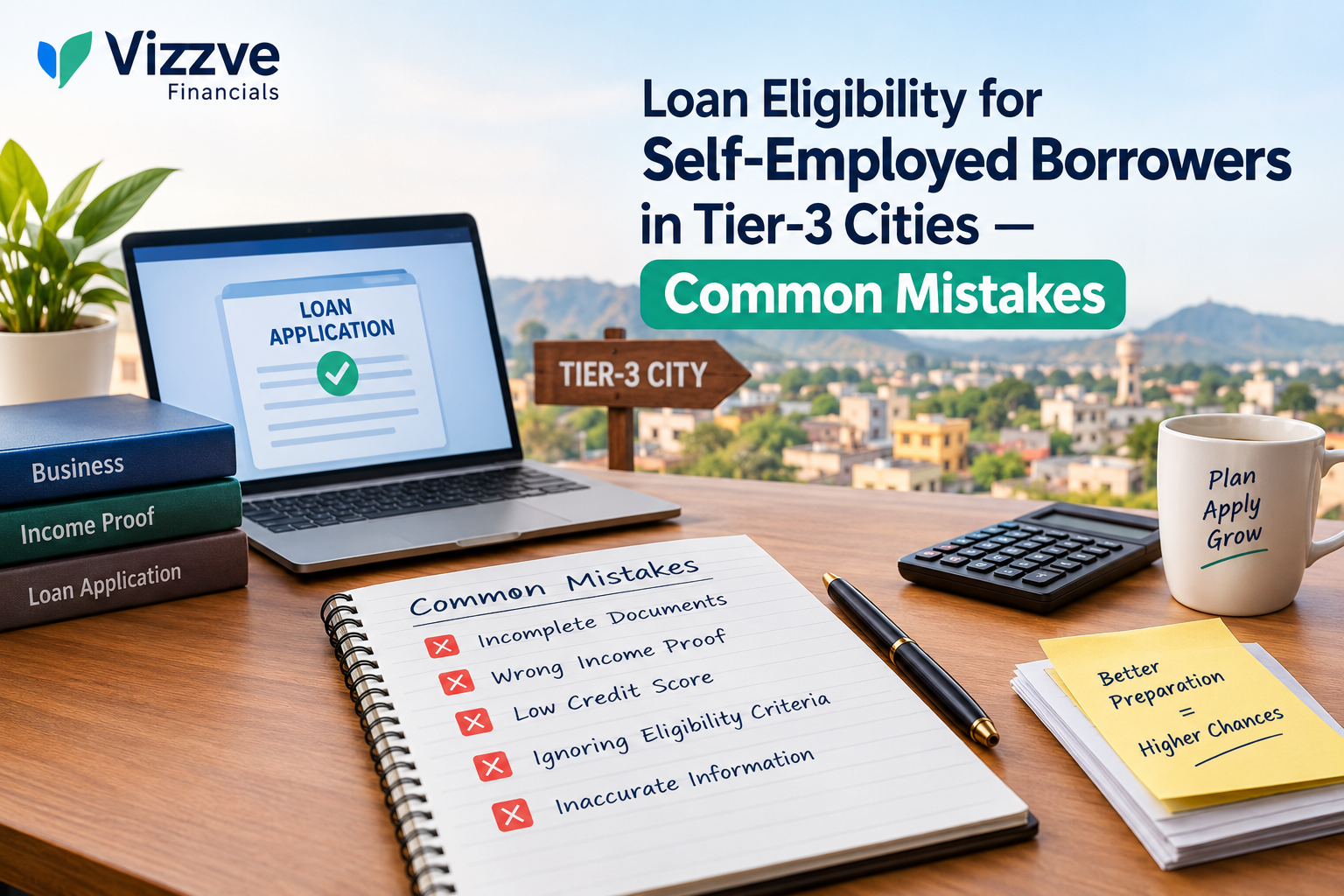
Loan Eligibility for Self-Employed Borrowers in Tier-3 Cities — Common Mistakes
Vizzve Admin
Self-employed borrowers in Tier-3 cities often have real, steady income—but their loan applications still get rejected because the income is not presented in a way lenders can verify. Shop owners, tailors, contractors, transport operators, freelancers and small traders frequently rely on cash collections, mixed personal-business bank accounts, or delayed ITR filing, which makes underwriting difficult.
The good news is that lenders are increasingly serving smaller cities. Tier-2 and Tier-3 cities accounted for around 64% of India’s home-loan volumes in 2025, with volumes growing 81% year on year, and self-employed households are a major part of this demand. Still, approval depends on clean documentation, realistic income declaration, healthy banking behaviour and a manageable repayment profile.homefirstindia+1
AI Answer Box
What is loan eligibility for self-employed borrowers in Tier-3 cities?
Loan eligibility for self-employed borrowers depends on business vintage, declared income through ITR, bank-statement cash flow, GST or business registration, credit score, existing EMIs and repayment capacity. In Tier-3 cities, lenders may also use digital cash-flow data, Account Aggregator consent and field verification where formal documents are limited.
What are the most common mistakes?
The biggest mistakes are applying without updated ITRs, mixing personal and business transactions, showing low declared income, having a poor CIBIL score, applying to too many lenders at once, hiding existing EMIs, choosing the wrong loan type, and applying for an EMI that the business cash flow cannot support.
Can a self-employed person get a loan without a salary slip?
Yes. Self-employed applicants normally use ITRs for the last one to three years, six to twelve months of bank statements, GST returns, business registration proof and, for larger loans, audited or CA-certified financial statements instead of salary slips.jupiter+2
Tier-3 borrowers are not rejected because their businesses are small. They often face stricter checks because their income records are less standardised than those of salaried applicants.
A lender needs to answer three questions:
-
Is the business genuinely operating?
-
Is the income sufficient and reasonably stable?
-
Can the borrower repay the EMI after existing obligations?
RBI’s Digital Lending Directions, 2025 require regulated entities to assess a borrower’s creditworthiness before extending a loan, including age, occupation and income details. This means every lender must build a defensible repayment assessment—not simply rely on a mobile app’s “instant approval” claim.rbi.org
Typical self-employed profiles in Tier-3 cities
| Borrower type |
Common income proof challenge |
Better approval approach |
| Kirana/shop owner |
Cash sales, low banking trail |
Maintain separate business account, file GST/ITR, show regular deposits |
| Contractor/labour supplier |
Seasonal receipts, project-based payments |
Provide work orders, client payment proofs, GST returns |
| Freelancer/gig worker |
Irregular monthly income |
Use invoices, client contracts, platform earnings and bank credits |
| Transport operator |
Fuel, toll and maintenance expenses reduce visible profit |
Maintain vehicle income-expense records and loan repayment history |
| Small manufacturer |
Working-capital cycles |
Provide GST returns, purchase bills, stock records and bank statements |
Common Mistakes That Cause Loan Rejection
1. Applying without updated ITRs
Many self-employed applicants apply for a loan before filing the latest ITR. This is one of the most avoidable reasons for rejection.
Most lenders ask self-employed borrowers for ITRs for the last one to three financial years, especially for larger loan amounts. An ITR is not merely a tax document; it is the lender’s primary evidence of declared income, business continuity and financial discipline.ruloans+2
What to do instead: File your ITR every year, even if your income is moderate. Keep the acknowledgement, computation of income and supporting financials ready.
2. Mixing personal and business bank accounts
A common Tier-3 city issue is using one savings account for shop collections, household expenses, UPI payments, school fees and business purchases. This makes it difficult for a lender to identify true business turnover.
Better practice:
-
Open and use a separate current or business account.
-
Route business receipts through that account.
-
Avoid frequent large cash withdrawals immediately after deposits.
-
Keep personal household spending separate.
-
Maintain at least six to twelve months of clean business banking history.
Lenders commonly review six to twelve months of bank statements for self-employed applicants.jupiter+1
3. Declaring income too low to save tax
Some borrowers declare lower income in ITRs to reduce tax liability, then apply for a loan based on actual cash earnings. The mismatch creates an underwriting problem.
If your ITR shows ₹3 lakh annual income but your requested EMI requires ₹6 lakh annual repayment capacity, the lender may reduce the loan amount or reject the application.
Expert commentary: A loan file is approved on documented repayment capacity, not on verbal income claims. If your business genuinely earns more, formalising income through ITR, GST and banking records improves both approval chances and loan amount.
4. Ignoring GST returns and business registration
For traders, manufacturers and service businesses, GST returns can strongly support turnover claims. Business proof may include GST registration, Udyam registration, trade licence, Shop and Establishment registration, partnership deed or company incorporation documents.jupiter+1
A borrower who files ITR but has no business proof may still be approved, but the loan amount, interest rate and lender options may be limited.
5. Applying for the wrong loan product
Self-employed borrowers often apply for a personal loan when a business loan, working-capital loan, machinery loan or secured loan may be more appropriate.
| Loan type |
Best suited for |
Typical advantage |
Typical limitation |
| Personal loan |
Medical bills, wedding, debt consolidation, urgent expenses |
Faster, usually unsecured |
Higher interest; income proof still needed |
| Business loan |
Shop expansion, inventory, equipment |
Designed for business cash flow |
Business vintage and documentation required |
| Working-capital loan |
Stock purchase, seasonal demand |
Matches operating-cycle needs |
May require turnover/GST evidence |
| Secured loan |
Larger funding needs |
May offer better pricing and amount |
Asset pledge or collateral required |
| Vehicle/commercial-vehicle loan |
Two-wheeler, car, CV purchase |
Asset-backed structure |
Down payment and insurance requirements |
6. Applying to too many lenders at once
Multiple loan applications can create multiple credit enquiries. Several hard enquiries within a short period may signal credit hunger to lenders and can hurt approval chances.
What to do instead: Check eligibility first, compare lenders, and apply selectively. A loan-support platform can help match your profile with suitable lenders rather than submitting random applications.
7. Having a weak or thin credit history
A CIBIL score around 700 or above is commonly considered favourable for personal-loan approval, though each lender has its own policy. Self-employed borrowers may also have a thin credit file if they avoid credit cards and loans completely.ruloans
How to build credit health:
-
Pay all existing EMIs and credit-card bills before the due date.
-
Keep credit-card utilisation low.
-
Avoid settling old loans as “settled”; close them properly where possible.
-
Maintain a mix of secured and unsecured credit responsibly.
-
Check your credit report for wrong accounts, duplicate entries or old overdue records.
8. Hiding existing EMIs and obligations
Some applicants do not disclose active loans, BNPL dues, credit-card balances or guarantees. Lenders can usually identify these through credit-bureau reports and bank statements.
Undisclosed obligations reduce your net repayment capacity and can lead to rejection or a lower sanctioned amount.
9. Requesting an EMI higher than cash flow supports
A business may earn ₹80,000 in a good month but only ₹35,000 in a weak month. Applying for an EMI based on the best month is risky.
A practical rule is to assess affordability using average monthly business surplus—not peak sales. Keep a buffer for school fees, rent, inventory purchases, medical needs and family expenses.
10. Poor banking behaviour
Lenders look beyond balance. They study how money moves through the account.
Avoid:
-
Frequent cheque bounces or EMI bounce charges.
-
Large unexplained cash deposits followed by immediate withdrawals.
-
Gambling, betting or speculative transactions.
-
Overdraft misuse.
-
Irregular credits with no business explanation.
11. Not maintaining business vintage proof
Many lenders prefer at least two to three years of business continuity for self-employed applicants, although requirements vary by lender and product.ruloans+1
Business vintage can be supported through:
-
GST registration date
-
Udyam certificate
-
Trade licence
-
Shop and Establishment registration
-
Old bank statements
-
Rental agreement for shop premises
-
Supplier bills and purchase records
-
Income-tax acknowledgements
12. Submitting incomplete or inconsistent documents
A file with mismatched names, different addresses, missing pages, unsigned statements or unclear income calculations slows verification and may lead to rejection.
Document checklist for self-employed borrowers:
-
PAN and Aadhaar
-
Address proof
-
Latest passport-size photograph
-
ITR acknowledgements for the last one to three years
-
Computation of income
-
Six to twelve months of bank statements
-
GST returns, if applicable
-
Business registration or trade licence
-
Udyam certificate, if applicable
-
CA-certified financials for larger business loans
-
Existing loan statements and repayment track record
13. Falling for “guaranteed approval” offers
No legitimate lender can guarantee approval before assessing income, credit history and repayment capacity. RBI’s digital-lending framework focuses on borrower assessment, transparency and customer protection.rbi.org+1
Avoid apps or agents promising approval without documents, asking for upfront fees, or requesting access to unnecessary phone data. RBI has operationalised a Digital Lending Apps directory to help customers verify whether an app is associated with a regulated entity.pib.gov
14. Not using Account Aggregator consent where available
The Account Aggregator framework allows borrowers to share financial data, including bank statements, with lenders through consent. For informal-income borrowers with active bank accounts, it can give lenders a more current cash-flow picture than paper documents alone.homefirstindia
This can be particularly useful for self-employed applicants in Tier-3 cities who have digital payment receipts but limited formal financial statements.
15. Choosing the first offer without comparing the annual cost
Many borrowers compare only the monthly EMI. Two loans with similar EMIs can have very different total costs because of processing fees, insurance, tenure and interest calculation.
Before accepting an offer, check:
-
Annual interest rate
-
Processing fee and GST
-
Insurance charges, if any
-
Prepayment or foreclosure charges
-
Late-payment charges
-
Total repayment amount
-
Key Fact Statement
RBI’s framework requires loan application forms to disclose information affecting the borrower’s interest and the documents required, enabling informed comparison.rbidocs.rbi.org
How Lenders Assess Self-Employed Borrowers
Core eligibility factors
| Factor |
What lenders check |
How to strengthen it |
| Business vintage |
How long the business has operated |
Keep registration, GST and banking records |
| Declared income |
ITR profit, financials |
File accurate and timely ITRs |
| Cash flow |
Bank credits, balances, UPI receipts |
Use a dedicated business account |
| Credit score |
Repayment discipline |
Pay EMIs and cards on time |
| Existing obligations |
EMIs, card dues, guarantees |
Reduce high-cost debt before applying |
| Loan-to-income fit |
EMI versus monthly surplus |
Request a realistic loan amount |
| Documentation |
KYC, business proof, financials |
Keep documents complete and consistent |
| Digital footprint |
Account Aggregator data, digital payments |
Maintain regular digital business transactions |

