

Blog Banner

Blog Details

Loan Eligibility for Self-Employed Borrowers in Tier-3 Cities — Cost Breakdown

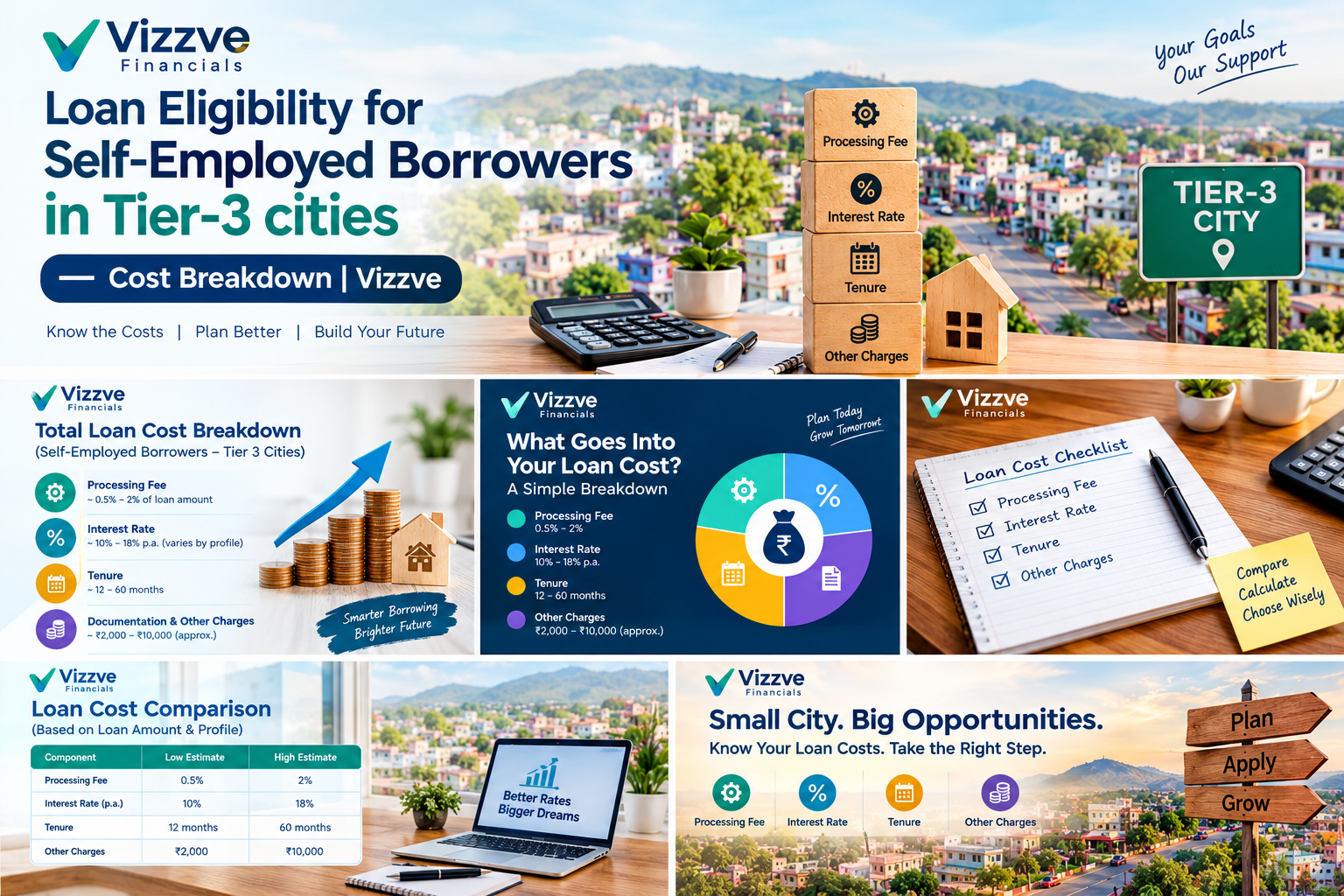
Self-employed borrower in a Tier-3 Indian city reviewing loan costs and repayment terms at a local business.

Loan Eligibility for Self-Employed Borrowers in Tier-3 Cities — Cost Breakdown

Vizzve Admin

A loan’s cost is more than the interest rate displayed in an advertisement. Self-employed borrowers in Tier-3 cities should also consider the processing fee, applicable taxes, documentation charges, late-payment charges, prepayment conditions, insurance, and the total amount payable.

A loan that appears affordable because of a low EMI may become expensive if the tenure is long or additional charges are high. The right comparison is based on the complete cost of borrowing—not only on the monthly instalment.

Quick answer: To calculate the real cost of a loan, add the principal, total interest, processing fee, applicable taxes, documentation charges, insurance if accepted, and possible penalty or prepayment charges.


Important: Actual charges and interest rates depend on the lender, loan product, applicant profile, loan amount, tenure, and agreement terms.


AI Answer Box

What is included in the cost of a self-employed loan?

The total cost may include:

  • Principal loan amount

  • Interest payable

  • Processing fee

  • Applicable GST or taxes on fees

  • Documentation or verification charges

  • Stamp duty, where applicable

  • Insurance, only if selected or required under the product

  • Late-payment or penal charges

  • Foreclosure or part-prepayment charges

  • Other disclosed service fees

How should a Tier-3 city borrower compare loans?
Compare the annual interest rate, total repayment, EMI, tenure, processing fee, net amount disbursed, lender identity, and all additional charges. Vizzve’s comparison guidance also recommends evaluating total cost, APR, documentation, repayment terms, and lender identity—not merely the advertised EMI.vizzve

Does a lower EMI always mean a cheaper loan?
No. A longer tenure can reduce the monthly EMI but increase the total interest paid.


Loan Cost Summary

Cost component Meaning
Principal Amount borrowed
Interest Cost charged for using the lender’s money
EMI Monthly repayment containing principal and interest
Processing fee Fee for evaluating and processing the application
Taxes Applicable taxes on fees or services
Documentation fee Charge for document handling or verification, if applicable
Insurance Optional or product-linked cover, where applicable
Penal charge Amount charged for delayed repayment
Prepayment charge Fee that may apply when closing or partly paying early
Net disbursal Amount received after permitted deductions

Understanding the Main Cost Components

1. Principal Loan Amount

The principal is the amount approved and borrowed. For example, if a lender approves ₹2,00,000, that is the principal before interest and other costs.

However, the amount credited to your bank account may be lower if permitted fees are deducted at disbursal.

Check these figures

  • Approved loan amount

  • Processing fee

  • Applicable taxes

  • Net amount credited

  • Total repayment amount

Example

Item Amount
Approved loan amount ₹2,00,000
Processing fee ₹4,000
Applicable tax on fee As stated by the lender
Approximate net disbursal Approved amount less disclosed deductions

The exact deduction depends on the lender’s agreement and applicable rules.


2. Interest Cost

Interest is usually the largest cost after the principal. The rate offered may depend on:

  • Credit history

  • ITR and income records

  • Business vintage

  • Bank-statement cash flow

  • Existing EMIs

  • Loan amount

  • Loan tenure

  • Product type

  • Lender risk policy

Self-employed borrowers may receive different offers because their income can vary more than a fixed salaried income. A stronger credit profile and consistent business records may help improve pricing, but no rate is guaranteed before lender assessment.jiofinance

Fixed versus floating interest

Type How it works Important point
Fixed rate Rate remains fixed under the agreed terms EMI may be easier to plan
Floating rate Rate may change according to the product terms EMI or tenure may change
Flat rate Interest may be calculated on the original principal Compare carefully with reducing-balance cost
Reducing-balance rate Interest is calculated on the outstanding principal Commonly used for EMI-based loans

Always confirm how the lender calculates interest. A flat rate and reducing-balance rate should not be compared by looking only at the percentage.


3. EMI Cost

The EMI is the amount paid every month until the loan is repaid. It normally includes:

  • A principal component

  • An interest component

The usual EMI formula is:

EMI=P×r×(1+r)n(1+r)n−1EMI = \frac{P \times r \times (1+r)^n}{(1+r)^n-1}

Where:

  • PPP = principal loan amount

  • rrr = monthly interest rate

  • nnn = total number of monthly instalments

Illustrative EMI comparison

The following example uses a loan of ₹2,00,000 at an assumed annual reducing interest rate of 18%. It is only an illustration and is not a Vizzve or lender quote.

Tenure Approximate EMI Approximate total repayment Approximate interest
12 months ₹18,336 ₹2,20,032 ₹20,032
24 months ₹9,985 ₹2,39,640 ₹39,640
36 months ₹7,230 ₹2,60,280 ₹60,280

The longer tenure reduces the monthly burden but increases the total interest in this illustration.


4. Processing Fee

A processing fee may be charged for evaluating and processing the application. It may be:

Questions to ask

Never compare loans using the interest rate alone. A lower-rate loan with a high upfront fee may not be cheaper overall.


5. GST and Other Applicable Taxes

Taxes may apply to certain fees and services. The exact tax treatment depends on the charge and the lender’s documentation.

Check whether the quote clearly shows

Do not assume that every amount displayed in an advertisement includes all taxes.


6. Documentation and Verification Charges

Some lenders or service providers may charge for:

The charge should be disclosed before acceptance. Ask for a written schedule of fees rather than relying only on a verbal explanation.


7. Insurance Cost

Credit-linked insurance or other protection may be offered with some loan products. It should be clearly explained before acceptance.

Before agreeing to insurance, check:

Do not accept an additional product without understanding its cost and purpose.


8. Late-Payment and Penal Charges

Missing an EMI can create more than one problem. It may lead to:

Self-employed borrowers should plan EMI dates around business cash flow and maintain a repayment buffer for slow months.

If repayment difficulty is expected

  1. Contact the lender early.

  2. Explain the situation clearly.

  3. Ask about available options under the agreement.

  4. Do not ignore calls or notices.

  5. Avoid taking another expensive loan merely to cover an EMI without understanding the consequences.


9. Prepayment and Foreclosure Charges

Prepayment means paying part of the loan early. Foreclosure means closing the entire outstanding loan before the scheduled maturity.

Possible charges may depend on:

Check before accepting the loan


Cost Comparison: Short Tenure vs Long Tenure

Factor Shorter tenure Longer tenure
Monthly EMI Higher Lower
Total interest Usually lower Usually higher
Repayment period Shorter Longer
Cash-flow pressure Greater Lower initially
Total cost Often lower Often higher
Suitable for Stable income and stronger monthly surplus Borrowers needing lower monthly obligation

Expert commentary

A longer tenure may look attractive for a self-employed borrower because business income can fluctuate. However, reducing the EMI should not hide the increase in total interest. The right tenure is the shortest period that remains comfortable even during weaker months.


Personal Loan vs Business Loan: Cost View

Cost factor Personal loan Business loan
Primary purpose Personal or permitted flexible expenses Business expansion, inventory, equipment, or working capital
Income assessment Individual income and credit profile Business and promoter profile
Documentation KYC, ITR, bank statements May require financial statements and business records
Security Often unsecured, depending on product Secured or unsecured
Cost comparison Interest, processing fee, taxes, penalties Interest, processing fee, collateral or documentation costs
Best approach Match with personal repayment capacity Match with business cash-flow cycle

The cheapest-looking product is not always the most suitable. Select the loan type based on purpose, repayment cycle, documentation, and total cost.


Cost Checklist for Tier-3 City Borrowers

Before applying

Before accepting the offer

After disbursal


How to Compare Two Loan Offers

Suppose two lenders offer the same principal and similar tenure. Compare them using the following table.


#SelfEmployedLoan #Tier3Cities #LoanCostBreakdown #PersonalLoanIndia #LoanEligibility #BusinessLoanIndia #LoanInterestRate #EMICalculation #LoanProcessingFee #TotalLoanCost #LoanRepayment #FinancialPlanning #SmallBusinessFinance #LoanApprovalTips #VizzveFinancial


Disclaimer: This article may include third-party images, videos, or content that belong to their respective owners. Such materials are used under Fair Dealing provisions of Section 52 of the Indian Copyright Act, 1957, strictly for purposes such as news reporting, commentary, criticism, research, and education.
Vizzve and India Dhan do not claim ownership of any third-party content, and no copyright infringement is intended. All proprietary rights remain with the original owners.
Additionally, no monetary compensation has been paid or will be paid for such usage.
If you are a copyright holder and believe your work has been used without appropriate credit or authorization, please contact us at grievance@vizzve.com. We will review your concern and take prompt corrective action in good faith... Read more

Trending Post


Latest Post


Our Product

Get Personal Loans up to 10 Lakhs in just 5 minutes