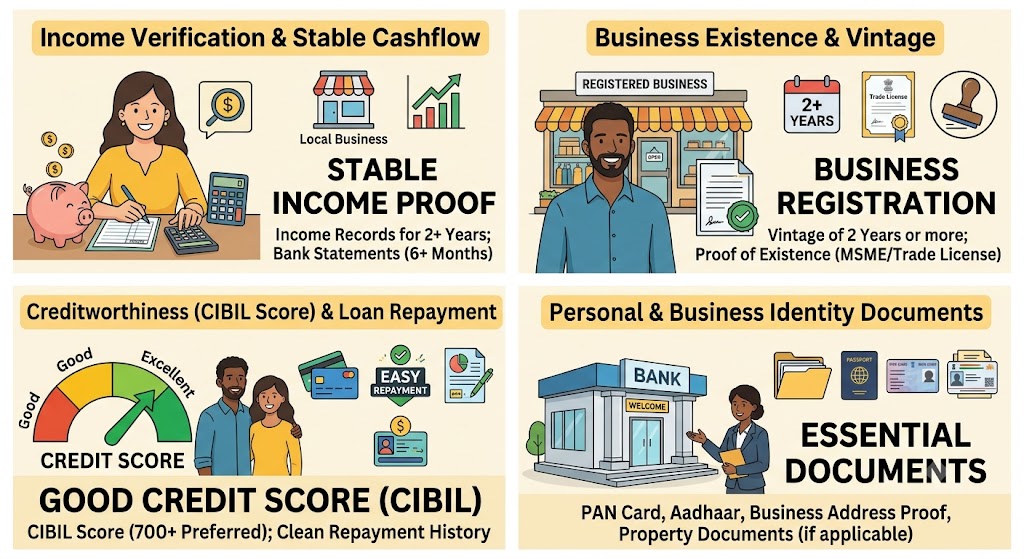
Loan Eligibility for Self-Employed Borrowers in Tier-3 Cities — Eligibility Checklist
Loan Eligibility for Self-Employed Borrowers in Tier-3 Cities — Eligibility Checklist
Vizzve Admin
Self-employed borrowers in Tier-3 cities can apply for personal loans and other credit products, even when they do not have a traditional salary slip. Instead, lenders assess business stability, documented income, bank transactions, tax records, credit history, and repayment capacity.
This eligibility checklist helps shop owners, traders, freelancers, professionals, small manufacturers, and service providers understand whether their financial profile is ready for a loan application.
Quick answer: Your location alone does not decide loan approval. A stable business, clear income records, complete documents, manageable EMIs, and responsible credit behaviour are usually more important.
Important: Eligibility, loan amount, interest rate, fees, and approval depend on the lender’s policy and verification. No loan approval can be guaranteed.
AI Answer Box
What is the eligibility checklist for a self-employed borrower in a Tier-3 city?
A self-employed borrower should check:
Whether the business is active and verifiable.
Whether income is supported by ITRs and bank statements.
Whether existing EMIs are manageable.
Whether KYC and business documents are complete.
Whether past loans and credit cards were repaid on time.
Whether the requested loan amount fits monthly cash flow.
Can self-employed borrowers get a loan without salary slips? Yes. They may submit ITRs, bank statements, business proof, GST records where applicable, invoices, professional registrations, and other accepted income documents.
Does living in a Tier-3 city reduce eligibility? Not necessarily. The lender may check serviceability and verification availability, but income stability, documentation, credit history, and affordability remain central factors.
Quick Eligibility Summary
Eligibility area
What to check
Identity
PAN, Aadhaar, and valid address proof
Business
Proof that the business or profession is active
Income
ITR, bank statements, invoices, or financial records
Credit
Repayment history and current credit obligations
Debt
Existing EMIs and credit-card dues
Banking
Regular and explainable business transactions
Affordability
Whether the new EMI fits your monthly cash flow
Location
Whether the lender serves your city and address
Self-Employed Loan Eligibility Checklist
1. Business Stability Checklist
A lender needs to understand whether your business is established enough to generate repayment income.
Check these points
The business is currently active.
The business has operated for the period required by the lender.
You can provide proof of business activity.
Customer payments are visible in bank statements.
Major business income and expenses can be explained.
Your business address is valid and verifiable.
Your business records are consistent with the application form.
Common proof of business activity
GST registration, where applicable
Udyam registration
Shop and Establishment licence
Trade licence
Partnership deed
Professional registration certificate
Rent agreement for business premises
Supplier invoices
Customer invoices
Digital-payment settlement records
A small business does not automatically have a weak loan profile. In practical assessments, consistent records and predictable cash flow can be more useful than business size alone.
2. Income Proof Checklist
Self-employed income may change from month to month, so lenders often review income over a longer period.
Check whether you have
Recent ITR acknowledgements
Income computation documents
Personal bank statements
Business bank statements, if maintained separately
GST returns, where applicable
Profit-and-loss statements, if available
Balance sheets, if applicable
Invoices and receipts
Documents supporting professional or freelance income
CIBIL’s indicative documentation information includes bank statements, KYC documents, credit information, and income-tax returns for self-employed applicants; the exact number of ITR years and documents can vary by loan type and lender.cibil
Income proof comparison
Income proof
What it helps establish
ITR
Declared income and tax history
Bank statement
Actual cash flow and transaction pattern
GST return
Reported turnover, where applicable
Profit-and-loss statement
Business income and expenses
Invoices
Revenue from customers or clients
UPI or payment records
Digital receipt pattern
Professional registration
Nature and legitimacy of professional activity
3. ITR Checklist for Self-Employed Applicants
ITR records can help a lender assess income consistency and business continuity.
Before applying, check:
Your recent ITRs have been filed.
Income reported in the ITR is accurate.
ITR income is reasonably consistent with bank credits.
PAN details match your application.
Tax documents are readable and complete.
Any tax demand or outstanding issue is understood.
Your reported income supports the requested loan amount.
Is ITR mandatory?
Not for every loan product or every lender. However, it is often an important income document for self-employed borrowers.
India’s presumptive-taxation provisions allow eligible taxpayers in specified businesses or professions to calculate income using prescribed rules. The Income Tax Department states that Section 44AD generally uses 8% of eligible turnover or gross receipts, with applicable conditions and separate treatment for qualifying digital receipts.incometaxindia.gov+1
Presumptive taxation may simplify tax compliance, but it does not guarantee loan eligibility. The lender may also assess bank statements, business records, credit history, and existing obligations.
4. Credit Score Checklist
Your credit profile indicates how you managed previous borrowing.
Credit checklist
Review your credit report before applying.
Confirm that all personal details are correct.
Check whether closed loans are shown as closed.
Look for overdue amounts or incorrect defaults.
Pay current EMIs on time.
Reduce high credit-card balances.
Avoid several loan applications within a short period.
Do not ignore a settlement or collection issue.
A commonly cited strong credit score is around 750 or above, but there is no universal score that guarantees approval. Lenders consider the entire profile, including income, debt, business stability, and their own risk policy.jiofinance
Credit profile comparison
Stronger profile
Weaker profile
Timely EMI payments
Repeated payment delays
Controlled card balances
High card utilization
Few recent enquiries
Several recent applications
Stable credit history
Defaults or write-offs
Accurate report
Unresolved reporting errors
5. Bank Statement Checklist
Bank statements help show how money enters and leaves your account.
Check your statements for
Regular customer or client credits
Business receipts routed through the bank
Sufficient balance before EMI dates
No unexplained large transfers
No frequent cheque returns
No repeated negative balances
Clear separation between business and household transactions
Consistency between bank income and declared income
Why banking activity matters
A lender may find it difficult to verify income that exists only informally or in cash. Where practical, use traceable payment methods and retain invoices or receipts for significant transactions.
Real-world experience point
Many small business owners have genuine income but weak documentation because business and personal money are mixed together. Separating accounts and recording customer payments regularly can make future loan applications easier to assess.
6. Existing EMI and Debt Checklist
A new loan should fit alongside your existing financial commitments.
This is only an illustration. Lenders use their own calculations, definitions, and limits.
Debt-readiness checklist
You know your total outstanding debt.
You know your total monthly EMI amount.
The proposed EMI remains affordable.
You have considered slow business months.
You are not borrowing only to cover recurring overspending.
You understand the total repayment cost.
7. KYC and Address Checklist
KYC verification can be delayed when documents contain different names or addresses.
Check that:
Your name is consistent across identity documents.
Your mobile number is active.
Your address proof is current.
Your business address can be verified.
Your PAN and bank details match the application.
Scanned documents are clear and complete.
A Tier-3 location does not automatically create a problem, but the lender may need to verify that the applicant actually lives or operates at the stated address.
8. Age and Applicant Profile Checklist
Age requirements differ across lenders and loan products.
Confirm:
You meet the lender’s minimum age.
You remain within the maximum age at loan maturity.
Your occupation is accepted by the lender.
Your business structure is eligible.
Your residence and business fall within the serviceable area.
Do not rely on a general age range found online. Check the current lender-specific conditions before applying.
9. Loan Amount and Purpose Checklist
A loan amount should be connected to a genuine financial requirement.
Before selecting the amount, ask:
What exact expense will this loan cover?
Is the amount based on actual need?
Can I repay during a low-income month?
Have I included processing fees and other charges?
Would a smaller loan be safer?
Is a personal loan or business loan more suitable?
Will the loan create additional pressure on working capital?
Personal loan or business loan?
Factor
Personal loan
Business loan
Main use
Personal or flexible eligible needs
Business expenses
Assessment
Personal income and credit profile
Business performance and borrower profile
Documents
KYC, income, and bank records
May require deeper business records
Collateral
Often unsecured, depending on product
May be secured or unsecured
Best for
Defined personal requirement
Inventory, expansion, equipment, or working capital
Always verify permitted use and terms with the lender.
Disclaimer: This article may include third-party images, videos, or content that belong to their respective owners. Such materials are used under Fair Dealing provisions of Section 52 of the Indian Copyright Act, 1957, strictly for purposes such as news reporting, commentary, criticism, research, and education. Vizzve and India Dhan do not claim ownership of any third-party content, and no copyright infringement is intended. All proprietary rights remain with the original owners. Additionally, no monetary compensation has been paid or will be paid for such usage. If you are a copyright holder and believe your work has been used without appropriate credit or authorization, please contact us at grievance@vizzve.com. We will review your concern and take prompt corrective action in good faith... Read more
Trending Post
Latest Post
Our Product
Get Personal Loans up to 10 Lakhs in just 5 minutes