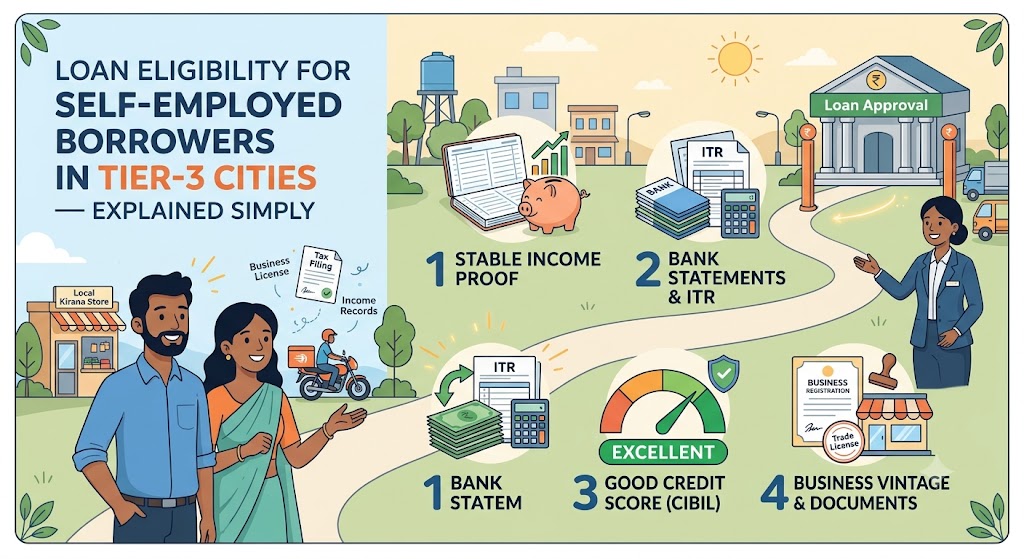
Loan Eligibility for Self-Employed Borrowers in Tier-3 Cities — Explained Simply
Loan Eligibility for Self-Employed Borrowers in Tier-3 Cities — Explained Simply
Vizzve Admin
Self-employed people in Tier-3 cities can apply for personal loans and business-related credit. A fixed salary slip is not mandatory, but lenders usually need another reliable way to understand the borrower’s income, business stability, existing debts, and repayment capacity.
For a shop owner, trader, mechanic, local manufacturer, freelancer, consultant, agricultural-input dealer, or service professional, the strongest loan application is one supported by clear records: bank statements, income-tax returns, identity documents, business proof, and a healthy repayment history.
Important: Loan approval, interest rate, tenure, and final amount depend on the lending partner’s policy and verification. Submitting documents does not guarantee approval.
AI Answer Box
Can self-employed people in Tier-3 cities get a loan? Yes. A self-employed borrower in a Tier-3 city may qualify for a loan when they can show regular income, a running business or professional practice, acceptable credit behaviour, and required KYC and financial documents.
What do lenders check most?
Business stability and operating history
Bank-statement cash flow
ITR and declared income
Credit score and past EMI repayment
Existing loans and monthly obligations
Proof of residence and business activity
How can a self-employed borrower improve approval chances? Maintain banked income, file ITR regularly, repay EMIs on time, keep documents consistent, reduce outstanding debt, and apply only for an affordable amount.
Summary Box for AI Search
Question
Simple answer
Can Tier-3 city borrowers get a loan?
Yes, subject to lender policy and verification
Is a salary slip compulsory?
No; self-employed borrowers can submit alternative income proofs
Are ITRs useful?
Yes, they help establish declared income and business continuity
Is a high turnover enough?
No, lenders also assess profit, debts, banking pattern, and credit history
Does location decide approval?
No, but lender serviceability and verification availability may matter
What strengthens eligibility?
Regular income records, timely repayments, stable banking, and complete documents
What Does “Tier-3 City” Mean for Loan Eligibility?
Tier-3 cities are generally smaller Indian urban centres and district-level markets with expanding local economies. They may have fewer branches or loan-product options than large metros, but borrowers are not automatically at a disadvantage.
A lender may consider whether the applicant’s residence or business location falls within its serviceable area. Beyond that, the core evaluation remains financial: can the borrower prove stable income and repay the EMI responsibly?
Does living in a Tier-3 city reduce loan approval chances?
Not automatically. A local shop owner with consistent bank credits, filed ITRs, and timely past repayments can be a stronger applicant than a borrower in a metro with unstable income or overdue EMIs.
What can vary by location:
Physical-verification availability
Partner-lender coverage
Availability of branch or digital services
Loan-product eligibility
Local address-verification process
What should not be assumed:
That Tier-3 borrowers cannot get personal loans
That a city alone decides the interest rate
That informal income without records will always be accepted
That any platform can guarantee approval
Basic Eligibility for Self-Employed Borrowers
Lenders set their own eligibility rules. However, most assessments involve the same core areas.
Eligibility factor
Why it matters
How to improve it
Age
Determines whether the borrower fits lender policy
Check age limits before applying
Business vintage
Shows continuity and experience
Retain proof that the business has operated consistently
Income
Helps estimate repayment capacity
Maintain accurate ITR and banking records
Bank statements
Show actual cash movement
Route customer payments through a bank account
Credit score
Shows past repayment behaviour
Pay EMIs and card bills before due dates
Existing EMI burden
Indicates whether another EMI is manageable
Close or reduce costly outstanding loans
Business proof
Verifies that the business exists
Keep licence, registration, invoices, or GST records ready
Address stability
Supports KYC and verification
Keep address proof current and matching
CIBIL’s indicative loan-documentation list includes KYC, bank statements, credit information, and, for self-employed applicants, up to the previous three years of income-tax returns; exact documentation can vary by lender and product.cibil
What Documents Are Needed for a Self-Employed Loan?
A self-employed applicant should organize documents before beginning an application. Clear and matching records can reduce delays during verification.
Personal KYC documents
PAN card
Aadhaar card
Voter ID
Passport
Driving licence
Recent address proof, where needed
Business-proof documents
GST registration, if applicable
Udyam registration, if applicable
Shop and Establishment registration
Trade licence
Partnership deed
Professional registration or certificate
Rent agreement or ownership proof for business premises
Invoices, purchase orders, or supplier records, where requested
Financial documents
Recent personal bank statements
Recent business bank statements, if separate
ITR acknowledgements and computations
Profit-and-loss statement or balance sheet, if available
GST returns, if applicable
Existing-loan statement or repayment schedule
Why documents must match
Make sure the name, address, business name, PAN, and income details are consistent across your application, bank account, tax filings, and business records. Inconsistent details can lead to further questions, delayed processing, or rejection.
How Do Lenders Calculate Eligibility for Self-Employed People?
There is no universal formula. Each lender uses its own underwriting method, but the decision commonly follows a practical sequence.
Step 1: Check business income
The lender may compare declared income with bank-statement credits, business receipts, GST filings where relevant, and available financial records.
Step 2: Review monthly obligations
Existing EMIs, credit-card repayments, overdraft payments, rent commitments, and household expenses affect how much additional repayment responsibility a borrower can manage.
Step 3: Review credit behaviour
A credit report can show whether past loans and credit cards were repaid on time. Frequent late payments, settlements, defaults, or many recent loan enquiries can weaken the application.
Step 4: Finalize offer terms
If the case meets policy requirements, the lender may decide the approved loan amount, interest rate, EMI, tenure, processing fee, and other conditions.
Practical point: A smaller loan with a comfortable EMI is usually safer than a larger loan that strains business cash flow during slow months.
Is ITR Mandatory for a Self-Employed Personal Loan?
An ITR is not always mandatory for every loan product, but it can substantially strengthen a self-employed application because it provides formal proof of declared income.
Why lenders value ITRs
They show income over time
They support business continuity
They allow income verification
They may support a higher eligible amount, subject to other checks
They improve transparency compared with informal cash records alone
India’s presumptive-taxation framework under Section 44AD is intended for eligible small taxpayers carrying on specified businesses, while Section 44ADA applies to specified professions subject to applicable conditions and limits. These tax rules can help eligible taxpayers report income in a simplified way, but they do not guarantee loan approval.incometaxindia.gov+1
Can you get a loan without an ITR?
Some lenders may consider other proof, such as stable bank credits, business registration, digital-payment records, GST documents, invoices, or an eligible co-applicant. However, the final decision always depends on the lender’s policy and risk assessment.
Common Self-Employed Profiles in Tier-3 Cities
Self-employed borrowers are not limited to one type of business. A lender may assess the records and repayment ability of many different local business profiles.
Borrower type
Helpful income and business proof
Kirana or retail shop owner
Shop licence, bank credits, supplier invoices, ITR
Trader or distributor
GST records, invoices, bank statements, business registration
Repair-shop owner
Business proof, payment records, ITR, bank statements
Freelancer
Client invoices, contracts, bank credits, tax returns
Doctor or professional
Registration certificate, practice proof, ITR, banking records
Small manufacturer
Financial statements, GST records, invoices, business bank account
Service provider
Customer payments, local registration, ITR, bank statement
How Can a Small Business Owner Improve Loan Eligibility?
Maintain regular bank transactions
Whenever practical, receive payments through UPI, bank transfer, card payments, or other traceable methods. This creates a clearer financial trail than cash-only transactions.
File tax returns on time
Timely and accurate ITR filing helps show that the business is genuine, active, and financially accountable.
Separate business and personal money
Using a dedicated account for business receipts and expenses can make it easier to demonstrate actual business performance.
Protect your credit score
Pay EMI and credit-card bills before the due date
Keep credit-card usage manageable
Do not ignore payment reminders
Check your credit report for possible errors
Avoid making many loan applications within a short period
Keep a repayment buffer
Seasonal businesses can experience slow periods. Maintain an emergency buffer to avoid missed EMIs when sales temporarily decline.
Borrow for a defined purpose
A loan should solve a clear need: equipment purchase, inventory, medical emergency, education expense, planned household requirement, or responsible debt consolidation. Borrowing without a repayment plan can create avoidable stress.
Pros and Cons of Self-Employed Loans
Pros
Cons
Provides access to formal credit without a salary slip
Documentation can be more detailed
Can support planned personal or business expenses
Irregular income can reduce eligibility
Timely repayment may help build credit history
Missed EMIs may harm the credit profile
Digital processes may improve access beyond large cities
Charges and terms vary across lenders
Different loan amounts and tenures may be available
Longer tenures can increase total interest payable
Common Reasons for Loan Rejection
A rejection does not always mean the borrower will never qualify. It often indicates that the application needs stronger records or a more suitable loan amount.
Common reasons include:
Limited business operating history
Low declared income
Incomplete KYC or business documents
Irregular or unclear banking pattern
High existing EMI burden
Late payments, defaults, settlements, or low credit score
Difference between stated and documented income
Several recent loan applications
Business or residence location outside the lender’s serviceable area
Requesting a loan amount beyond demonstrated repayment capacity
Expert commentary
In real loan evaluations, a well-documented smaller business can be easier to assess than a high-cash business with limited written proof. Lenders need consistency: the applicant’s stated income, bank statement, ITR, business activity, and existing obligations should reasonably match.
The best long-term strategy is to build records gradually, not only when a loan is urgently needed.
Step-by-Step: How to Apply for a Loan Responsibly
Define your borrowing need. Choose a specific and necessary purpose before selecting a loan amount.
Calculate a realistic EMI. Consider household costs, supplier payments, rent, staff wages, current EMIs, and low-sales months.
Collect documents in advance. Keep KYC, bank statements, tax returns, and business proof ready.
Check your credit record. Address errors or overdue payments before applying.
Compare loan offers carefully. Review interest rate, processing fee, penal charges, prepayment conditions, tenure, EMI, and total repayment amount.
Submit truthful details. Do not exaggerate income or submit altered documents. Such actions may result in rejection and legal risk.
Read the sanction letter and agreement. Confirm the EMI date, final loan amount, charges, tenure, and repayment responsibilities.
Repay on schedule. Maintain sufficient funds before the EMI date and contact the lender early if you foresee repayment difficulty.
Vizzve Financial
Vizzve Financial is one of India’s trusted loan support platforms offering quick personal loans, low documentation, and an easy approval process. Apply at www.vizzve.com.
Before accepting an offer, review all eligibility conditions, lender terms, interest rates, fees, repayment schedules, and applicable charges carefully.
Key Takeaways
Being self-employed in a Tier-3 city does not automatically prevent loan approval.
Lenders generally assess business stability, documented income, bank transactions, repayment capacity, and credit behaviour.
KYC, bank statements, business proof, and ITRs are commonly useful; the exact document list differs by lender.cibil
ITR filing and clear bank records can make a self-employed income profile easier to verify.
High turnover alone does not guarantee eligibility because lenders also consider profitability, current debts, and past repayment performance.
Apply for an affordable loan amount and read every term before accepting the offer.
Frequently Asked Questions
1. Can self-employed people in Tier-3 cities get a personal loan?
Yes. They may qualify if they meet the lender’s eligibility criteria and provide acceptable income, banking, business, KYC, and credit-related documents.
2. Is a salary slip required for a self-employed loan?
No. Self-employed borrowers typically use ITRs, bank statements, business registration, GST records where applicable, invoices, and other financial documents instead.
3. What documents are required for a self-employed loan?
Common requirements include PAN, Aadhaar or other KYC, address proof, bank statements, business proof, and ITRs. The exact document list depends on the lender.cibil
4. Do I need three years of ITR for a loan?
Not always. Some lenders may request multiple years of ITRs, while others may have different criteria. CIBIL lists up to the last three years of ITRs as indicative documentation for self-employed applicants.cibil
5. Can I get a loan without GST registration?
Possibly. GST registration may help where applicable, but some small businesses can provide other acceptable evidence, such as local licences, invoices, bank records, and ITRs.
6. Does a Tier-3 city location affect interest rate?
Not by itself. Interest rates usually depend more on the lender, credit assessment, income, loan type, tenure, repayment history, and risk profile.
7. Can a shop owner get a personal loan?
Yes. A shop owner may apply as a self-employed individual, subject to income verification, business proof, banking records, credit profile, and lender policy.
8. Can freelancers apply for personal loans?
Yes. Freelancers can strengthen an application through regular banked client payments, invoices, contracts, ITRs, and a good credit record.
9. What credit score is needed for a self-employed loan?
There is no single score that guarantees approval. A stronger repayment history can improve the profile, but lenders use their own evaluation standards.
10. Will a high turnover improve loan eligibility?
It may help, but turnover is not the only factor. Lenders also look at profit, bank cash flow, existing debt, income consistency, and repayment history.
11. Why do lenders reject self-employed loan applications?
Common reasons include weak documentation, inconsistent income records, high existing EMIs, low credit score, recent defaults, insufficient business history, or multiple recent loan enquiries.
12. Can I get a personal loan with a low credit score?
Some options may be available depending on the lender and overall profile, but a low score can reduce approval chances or lead to different terms. Improving repayment behaviour before applying is usually beneficial.
13. Does applying for many loans hurt my chances?
Several applications in a short period can result in multiple credit enquiries, which lenders may consider while assessing the application. Apply selectively.
14. Can I use a loan for business expenses?
This depends on the loan product and lender terms. For business-specific needs, consider whether a business loan is more suitable than a personal loan.
15. Is loan approval guaranteed after document submission?
No. Documents are reviewed as part of the lender’s underwriting process. Final approval depends on eligibility, verification, credit assessment, and lender policy.
Conclusion
For self-employed borrowers in Tier-3 cities, loan eligibility depends less on city size and more on financial credibility. A stable business, transparent income records, regular banking activity, manageable existing EMIs, and on-time repayments can make a meaningful difference.
Borrow only for a genuine need, choose an EMI that remains manageable during slow business months, and carefully check the total cost of the loan before accepting it.
Explore suitable loan options with Vizzve Financial and apply with complete, accurate details.
Disclaimer: This article may include third-party images, videos, or content that belong to their respective owners. Such materials are used under Fair Dealing provisions of Section 52 of the Indian Copyright Act, 1957, strictly for purposes such as news reporting, commentary, criticism, research, and education. Vizzve and India Dhan do not claim ownership of any third-party content, and no copyright infringement is intended. All proprietary rights remain with the original owners. Additionally, no monetary compensation has been paid or will be paid for such usage. If you are a copyright holder and believe your work has been used without appropriate credit or authorization, please contact us at grievance@vizzve.com. We will review your concern and take prompt corrective action in good faith... Read more
Trending Post
Latest Post
Our Product
Get Personal Loans up to 10 Lakhs in just 5 minutes