

Blog Banner

Blog Details

Loan Eligibility for Self-Employed Borrowers in Tier-3 Cities — Real-World Example

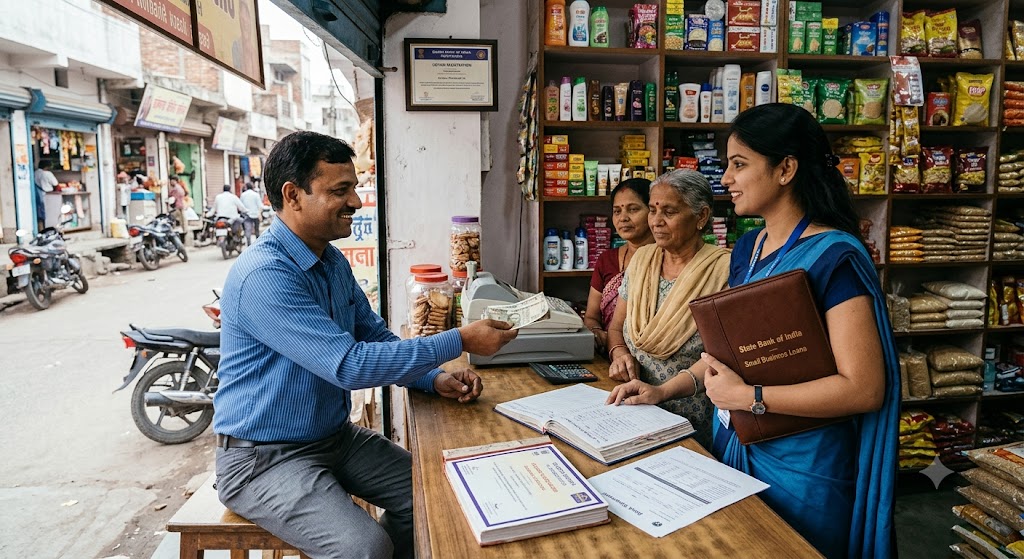
Self-employed kirana store owner in a Tier-3 city reviewing loan eligibility documents and EMI options

Loan Eligibility for Self-Employed Borrowers in Tier-3 Cities — Real-World Example

Vizzve Admin

A self-employed borrower in a Tier-3 city does not need a salary slip to get a loan. What matters is whether the borrower can show stable income, healthy bank activity, manageable existing EMIs and a credible credit profile.

This article explains loan eligibility through a realistic example of a shop owner in a Tier-3 city. It shows how lenders may view income, documents, credit score and repayment capacity—and how a borrower can improve the chance of approval. Self-employed applicants are commonly assessed on business continuity, bank-statement cash flow, ITR/GST records and credit score; many lenders prefer a business vintage of two to three years and a CIBIL score of 700 or above.icici.bank+2

AI Answer Box

Can a self-employed borrower in a Tier-3 city get a loan?
Yes. A self-employed borrower can qualify for a personal, business or MSME loan by showing stable business income and repayment capacity. Lenders usually review 6–12 months of bank statements, ITRs, GST returns if applicable, business proof, credit score and existing EMIs. A CIBIL score of 700+ improves approval chances, while 750+ may support better pricing.icici.bank+2

Real-world example:
A kirana-store owner earning an average of ₹45,000 per month, with a 750 credit score, two years of business vintage, ₹5,000 existing EMI and clean bank statements, may be eligible for a personal loan of around ₹8–10 lakh, depending on the lender’s interest rate, tenure and internal policy.

Most important documents:
PAN, Aadhaar, address proof, 6–12 months of bank statements, ITRs, business registration or trade licence, GST documents if applicable, and financial statements for larger loans.icici.bank+1

Real-World Example: Ramesh’s Kirana Store

Borrower Profile

Ramesh runs a kirana store in a Tier-3 city in Karnataka. He has been operating from the same shop for three years. His monthly income varies between ₹35,000 and ₹55,000 because sales rise during festivals and fall during lean months.

Detail Ramesh’s Profile
Occupation Kirana-store owner
Location Tier-3 city
Business vintage 3 years
Average monthly income ₹45,000
Monthly bank credits ₹38,000–₹52,000
Existing EMI ₹5,000
Credit score 748
Credit-card utilisation 25%
ITR filed Yes, for last two years
GST registration Yes
Loan requirement ₹8 lakh for shop renovation and stock purchase
Preferred repayment 36 months

Ramesh has no salary slip, but he has strong evidence of business activity: regular UPI settlements, supplier bills, GST filings, ITRs and a business current account.

What the Lender Sees

The lender does not only see “₹45,000 monthly income.” It evaluates whether that income is repeatable and whether Ramesh can pay an EMI even during a slow month.

Lender Check Ramesh’s Position Lender View
Business vintage 3 years Positive; meets common 2–3 year requirement. icici.bank+1
Bank statement Regular credits, healthy balance Positive; shows cash-flow stability. utkarsh.bank+1
ITR Filed for two years Positive; supports declared income. jiofinance
GST Registered and filing returns Positive; useful turnover evidence. utkarsh.bank+1
Credit score 748 Positive; above the common 700+ preference. icici.bank+1
Existing EMI ₹5,000 Manageable
Credit-card usage 25% Positive; not over-leveraged
Loan purpose Shop renovation and inventory Clear and reasonable

EMI Capacity Calculation

A lender may estimate Ramesh’s affordable EMI like this:

Average Monthly Income−Existing EMI−Estimated Living Expenses=Available EMI Capacity\text{Average Monthly Income} - \text{Existing EMI} - \text{Estimated Living Expenses} = \text{Available EMI Capacity}

Using Ramesh’s numbers:

₹45,000−₹5,000−₹20,000=₹20,000₹45,000 - ₹5,000 - ₹20,000 = ₹20,000

So Ramesh may be able to manage an EMI of around ₹20,000, subject to the lender’s assessment of business expenses, family obligations and internal risk policy.

At an assumed interest rate and a 36-month tenure, a ₹20,000 EMI may support a loan of roughly ₹8–10 lakh. The final sanctioned amount can be lower if the lender applies conservative income assumptions or if the credit profile changes before approval.

Why Ramesh’s Application Is Strong

  • His income is not fixed, but it is consistent across the year.

  • His bank statement supports the income declared in his ITR.

  • He has a clear business purpose for the loan.

  • His existing EMI is low relative to income.

  • His credit score is close to the strong 750+ range.

  • His GST and ITR records make his income easier to verify.

  • He is not applying for an unrealistically high loan amount.

How Lenders Assess Self-Employed Borrowers

Self-employed borrowers are assessed differently from salaried applicants because they do not receive a fixed monthly salary credit. Lenders focus on business stability, cash-flow quality and credit discipline.

Key Eligibility Factors

Factor What Lenders Check Why It Matters
Business vintage Usually 2–3 years in the same business Shows stability and survival ability. icici.bank+1
Income consistency Bank credits, seasonal trends, average balance Helps estimate repayment capacity. utkarsh.bank+1
Credit score Commonly 700+ preferred; 750+ is stronger Indicates repayment behaviour. icici.bank+2
ITR and financials Last 1–3 years of ITRs, P&L, balance sheet Confirms declared income. icici.bank+1
GST records Registration and returns, if applicable Useful proof of turnover and business activity. utkarsh.bank+1
Existing EMIs Personal loans, vehicle loans, credit-card dues Higher obligations reduce loan eligibility.
Business proof Trade licence, GST certificate, Udyam registration Confirms legitimate business operations. airtel
Loan amount Requested EMI versus income surplus Prevents over-borrowing

Expert Commentary

In real lending decisions, the strongest self-employed applicants are not always those with the highest income. A borrower earning ₹45,000 per month with clean bank credits, low credit-card usage and timely repayment history can be more creditworthy than someone earning ₹80,000 per month with irregular deposits, high credit-card balances and multiple recent loan enquiries.

Documents Required: Ramesh’s Checklist

KYC Documents

  • PAN card

  • Aadhaar card

  • Address proof

  • Passport-size photograph

  • Bank account details

  • Business contact and shop address detailsicici.bank+1

Income and Business Documents

  • ITRs for the last two financial years

  • Business current-account statement for 12 months

  • GST registration certificate

  • GST returns for recent filing periods

  • Trade licence or shop establishment certificate

  • Udyam registration, if available

  • Supplier invoices and purchase bills

  • UPI settlement statements or merchant-payment reports

  • Shop rent agreement or ownership proof

  • Electricity bill in the business nameicici.bank+2

Why These Documents Matter

For a Tier-3 city borrower, alternative business records can be especially useful. UPI collections, supplier invoices and shop utility bills help establish that the business is active, even when formal financial statements are limited.

Can Ramesh Get a Loan Without ITR?

Yes, but his approval would be weaker without ITRs.

With ITR

  • More lenders become available

  • Loan amount may be higher

  • Income verification becomes easier

  • Interest rate may be better

  • Approval decision is faster

Without ITR

  • Fewer lenders may consider the application

  • The lender may rely more heavily on bank statements and GST data

  • Loan amount may be lower

  • Interest rate may be higher

  • Collateral may become more important for a larger loan

ITRs are not the only income proof, but they remain one of the strongest. Many lenders ask self-employed applicants for ITRs from the last two to three years, along with bank statements and business documents.jiofinance

Personal Loan vs Business Loan: Which Is Better for Ramesh?

Feature Personal Loan Business Loan
Best use Medical, wedding, education, consolidation, personal needs Shop renovation, stock purchase, equipment, working capital
Collateral Usually unsecured. May be secured or unsecured
Documentation Comparatively simpler Usually more detailed
Income proof ITR, bank statements, credit profile ITR, GST, turnover, financials, business proof
Loan purpose Flexible Usually business-linked
Best fit for Ramesh Useful for emergency or personal expense Better fit for renovation and inventory

For Ramesh’s stated purpose—shop renovation and stock purchase—a business loan or MSME loan may be more appropriate than a personal loan, provided he meets the lender’s turnover, documentation and business-vintage requirements.

Step-by-Step Guide: How Ramesh Should Apply

Step 1: Check Credit Score

Ramesh should check his CIBIL score before applying. At 748, he is in a good position, but he should avoid multiple loan applications in a short period because repeated hard enquiries can affect the credit profile.icici.bank+2

Step 2: Prepare Bank Statements

He should download 12 months of business current-account statements. The statement should show regular UPI settlements, supplier payments and a healthy closing balance.

Step 3: Organise ITR and GST Records

He should keep the last two ITRs, GST registration certificate and recent GST returns ready. These documents help match declared income with actual business activity.utkarsh.bank+1

Step 4: Calculate a Safe EMI

Instead of applying for the maximum possible loan, Ramesh should choose an EMI that remains affordable during a slow sales month. A ₹20,000 EMI may be manageable at ₹45,000 average income, but he should keep a buffer for shop rent, stock purchases and family expenses.

Step 5: Compare Lenders

He should compare banks, NBFCs and digital lenders on:

Step 6: Apply With Accurate Information

Income, business address, shop details and bank details should match across documents. Any mismatch can delay verification or lead to rejection.

Step 7: Respond to Verification Quickly

The lender may verify business address, bank activity, GST details or references. Quick responses help avoid delays.

Step 8: Read the Final Offer

Before accepting, Ramesh should check the annual interest rate, processing fee, insurance cost, late-payment penalty, foreclosure rules and total repayment amount.

What Could Reduce Ramesh’s Eligibility?

Even with a good profile, certain issues can reduce the sanctioned amount or cause rejection.

Pros and Cons for Self-Employed Borrowers

Pros

Cons

Key Takeaways

Frequently Asked Questions

1. Can a self-employed person in a Tier-3 city get a personal loan?

Yes. Self-employed borrowers can get personal loans if they can show stable income, acceptable credit score and proper documents. Lenders assess bank statements, ITRs, GST records and business proof rather than salary sli

#SelfEmployedLoans #Tier3Cities #LoanEligibility #PersonalLoan #BusinessLoan #CIBILScore #MSMELoan #SmallBusinessFinance #LoanTips #FinancialPlanning #SelfEmployedLoanIndia #LoanWithoutSalarySlip #LoanWithoutITR #ShopOwnerLoan #KiranaStoreOwner #FreelancerLoan #GigWorkerFinance #SmallTownBusiness #BusinessLoanEligibility #LoanEMICalculation #CreditScoreTips #GSTLoan #NBFCloans #DigitalLending #VizzveFinancial #RealWorldLoanExample #SelfEmployedBorrowers #Tier3CityBusiness #LoanApprovalTips #SmartBorrowing #BusinessGrowth #LoanGuide #Vizzve


Disclaimer: This article may include third-party images, videos, or content that belong to their respective owners. Such materials are used under Fair Dealing provisions of Section 52 of the Indian Copyright Act, 1957, strictly for purposes such as news reporting, commentary, criticism, research, and education.
Vizzve and India Dhan do not claim ownership of any third-party content, and no copyright infringement is intended. All proprietary rights remain with the original owners.
Additionally, no monetary compensation has been paid or will be paid for such usage.
If you are a copyright holder and believe your work has been used without appropriate credit or authorization, please contact us at grievance@vizzve.com. We will review your concern and take prompt corrective action in good faith... Read more

Trending Post


Latest Post


Our Product

Get Personal Loans up to 10 Lakhs in just 5 minutes