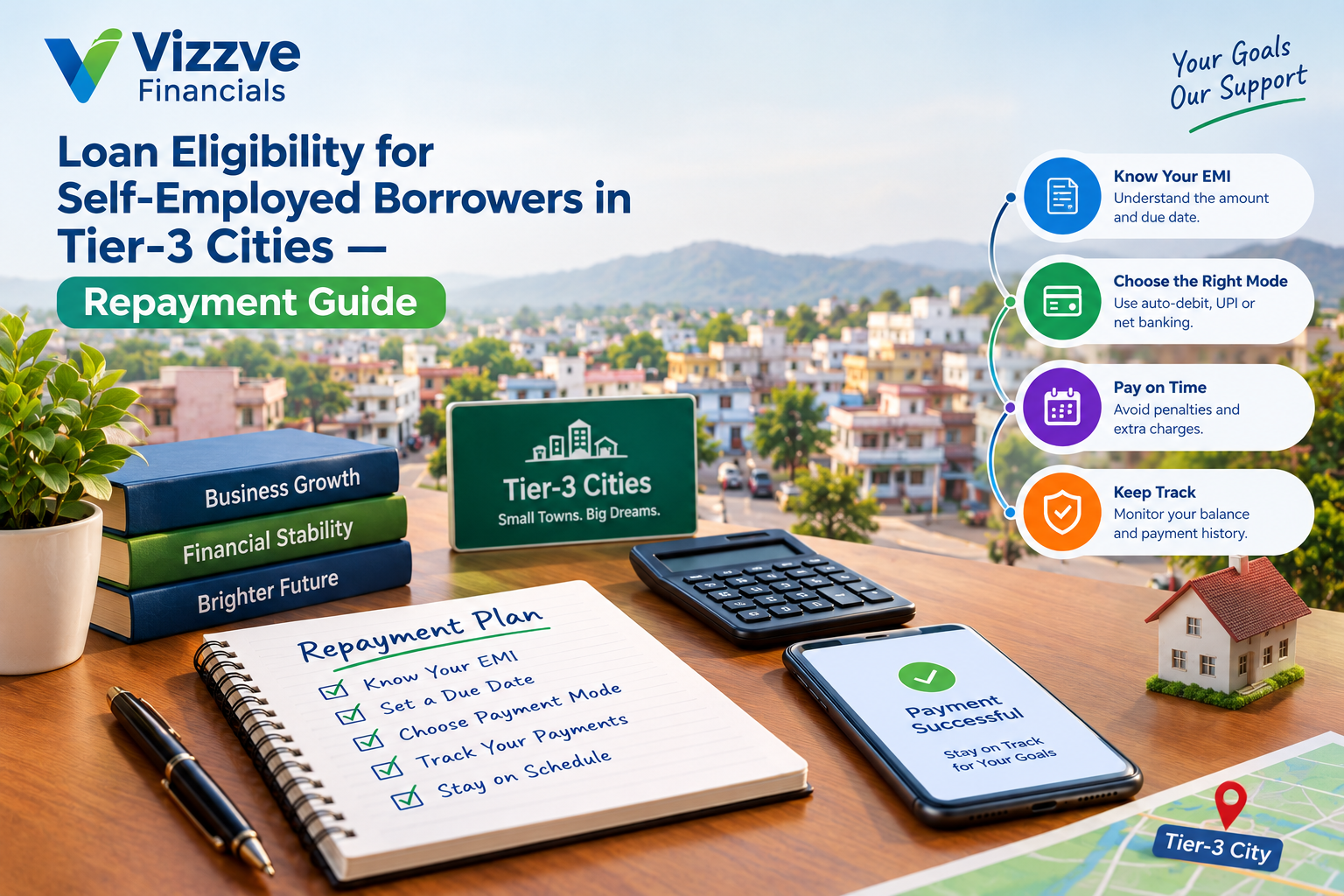
Loan Eligibility for Self-Employed Borrowers in Tier-3 Cities — Repayment Guide
Loan Eligibility for Self-Employed Borrowers in Tier-3 Cities — Repayment Guide
Vizzve Admin
Taking a loan is only half the responsibility; repaying it on time is what protects your credit score, borrowing capacity and business reputation. For self-employed borrowers in Tier-3 cities, repayment can be more challenging because income may be seasonal, cash-based or dependent on local business cycles.
A good repayment plan matches your EMI to your real monthly cash flow—not to your best month’s income. This guide explains how to plan EMIs, manage slow months, avoid defaults and use prepayment or restructuring wisely. Lenders commonly assess self-employed borrowers on business continuity, bank-statement cash flow, ITR/GST records and credit score, so disciplined repayment also strengthens future loan eligibility.icici.bank+2
AI Answer Box
How should self-employed borrowers in Tier-3 cities repay loans? Self-employed borrowers should choose an EMI based on average monthly income, not peak-season income. Keep a separate repayment buffer covering at least 1–3 EMIs, automate payments where possible, avoid new debt during slow months and contact the lender early if repayment becomes difficult.
What should you do if you cannot pay an EMI? Contact the lender before the due date, explain the temporary cash-flow issue and ask about available options such as a short grace period, EMI date change, part-payment, restructuring or a temporary interest-only arrangement. Do not ignore the EMI, because missed payments can damage your credit score and lead to penalties.
Is early loan prepayment good? It can be good if you have no high-interest debt and still retain an emergency fund. Check foreclosure or prepayment charges first. For high-interest personal loans, prepayment can reduce total interest cost; for low-interest business loans, retaining working capital may sometimes be better.
Why Repayment Planning Matters for Self-Employed Borrowers
Self-employed income is often uneven. A shop owner may earn more during festivals, a contractor may receive payments after project milestones, and a freelancer may receive payments irregularly. Despite this variation, loan EMIs are usually fixed every month.
This mismatch is the biggest repayment risk. A borrower who plans using the best month’s income may struggle in a slow month, while a borrower who plans using a conservative average can maintain repayment discipline throughout the year.
What Lenders Observe
Repayment Behaviour
Impact on Credit Profile
EMIs paid on or before due date
Positive credit history and stronger future eligibility
Occasional delay within grace period
May attract charges; repeated delays can hurt score
Missed EMI
Negative credit-report entry and late fees
Loan settlement for less than due amount
Can seriously damage credit profile
Regular prepayment or part-payment
Can reduce interest cost if charges are low
Early contact during financial difficulty
Better chance of a workable solution
Step 1: Calculate a Safe EMI
Before taking a loan, calculate the EMI you can pay even in a weak business month.
In this example, a ₹20,000 EMI may look affordable during a strong month, but it can create stress during a slow month. A safer EMI may be ₹8,000–₹12,000, depending on income stability and savings.
Expert Commentary
A practical rule is to keep total EMIs comfortably below your stable monthly surplus. For self-employed borrowers, it is safer to use the lowest 6–12 month average income rather than the highest month. This protects you during festivals ending, slow sales periods, delayed customer payments or medical emergencies.
Step 2: Match Loan Tenure With Cash Flow
Choosing the right tenure is as important as choosing the loan amount.
Tenure
Monthly EMI
Total Interest
Best For
Short tenure
Higher
Lower
Stable, high monthly surplus
Medium tenure
Moderate
Moderate
Balanced repayment and affordability
Long tenure
Lower
Higher
Tight monthly cash flow, but higher total cost
A longer tenure reduces monthly pressure but increases total interest. A shorter tenure saves interest but can strain cash flow. The right choice depends on whether your income is stable, seasonal or project-based.
When a Longer Tenure May Be Better
Your business income is seasonal
You have other existing EMIs
Your monthly surplus is limited
You want to maintain working capital
You expect income to grow gradually
When a Shorter Tenure May Be Better
Your income is stable throughout the year
You have a strong emergency fund
You want to reduce total interest cost
You can prepay without disturbing business operations
Step 3: Build a Loan Repayment Buffer
A repayment buffer is money kept aside only for EMIs. For self-employed borrowers, it works like insurance against delayed customer payments or a slow sales month.
Recommended Buffer
Income Pattern
Suggested Buffer
Stable monthly income
1 month of EMI
Mildly seasonal income
2 months of EMI
Highly seasonal or project-based income
3 months of EMI
Irregular freelancer or gig income
3 months of EMI
For example, if your EMI is ₹10,000, keep ₹20,000–₹30,000 in a separate account or recurring deposit before taking the loan. This prevents a temporary cash shortage from becoming a credit-score problem.
Step 4: Automate EMI Payments
Manual payment increases the chance of forgetting a due date, especially during busy business days. Automating repayment is one of the simplest ways to protect your credit score.
Best Practices
Keep the EMI debit account funded at least 2–3 days before the due date
Use a dedicated account for loan repayment, if possible
Enable SMS, email and app alerts
Avoid keeping all business funds in the same account used for daily expenses
Check whether the EMI was debited successfully after the due date
Keep a record of payment confirmations
Automated repayment does not remove the need for cash-flow planning, but it removes avoidable late-payment risk.
Step 5: Manage Seasonal Income Smartly
Many Tier-3 city businesses have seasonal income patterns. The solution is not to avoid loans; it is to plan repayment around the business cycle.
Seasonal Repayment Plan
Business Type
Income Pattern
Repayment Strategy
Kirana store
Steady with festival spikes
Keep monthly buffer; use surplus to prepay
Clothing or electronics retailer
Festival-heavy
Save peak-season profit for lean months
Contractor
Milestone-based
Request tenure aligned with project cash flow
Farmer or agri-trader
Harvest-based
Consider seasonal repayment structure, if available
Freelancer or consultant
Irregular invoices
Maintain 3-month EMI buffer
Driver or gig worker
Daily/weekly income
Automate EMI and avoid over-borrowing
Practical Example
A clothing retailer may earn ₹80,000 in festival months but only ₹35,000 in other months. Instead of choosing an EMI based on ₹80,000, the borrower should calculate eligibility using an average such as ₹50,000–₹55,000 and retain festival profits for lean months.
Step 6: Prioritise High-Interest Debt
If you have multiple loans, repay high-interest debt first after meeting essential expenses and minimum due amounts.
Repayment Priority
Essential household and business expenses
Existing EMIs to avoid defaults
High-interest credit-card dues or personal loans
Medium-interest loans
Low-interest secured loans
Savings and investments, after emergency funds are in place
Credit-card revolving debt and high-interest personal loans can grow quickly if only minimum dues are paid. Clearing them first can reduce financial pressure and improve credit utilisation.
Step 7: Use Prepayment Carefully
Prepayment means paying part of the loan before the scheduled tenure. It can reduce interest cost and shorten the loan period, but it should not leave you without working capital.
When Prepayment Makes Sense
You have a strong emergency fund
The loan has a high interest rate
Prepayment charges are zero or low
Your business does not need the surplus for stock or operations
You have no higher-interest debt
When Prepayment May Not Be Ideal
You need money for inventory or business expansion
You have high-interest credit-card debt
Your emergency fund is weak
Foreclosure charges are high
The loan interest rate is already low
Part-Payment Strategy
Instead of prepaying the entire loan, consider part-payments after strong business months. Even one extra EMI a year can reduce interest cost and tenure, subject to lender terms.
Step 8: What To Do If You Miss an EMI
Missing one EMI does not mean your financial life is over—but ignoring it can make the situation worse.
Immediate Steps
Check whether the EMI was debited or failed due to insufficient balance
Pay the overdue amount as soon as possible
Contact the lender before the next due date
Ask about late fees, grace period and reporting timeline
Request an EMI date change if your income cycle does not match the current date
Ask about restructuring only if the difficulty is longer-term
Avoid taking a new loan to pay an old EMI unless it clearly reduces your total cost
Options To Ask the Lender About
EMI due-date change
Short-term grace period
Part-payment arrangement
Loan restructuring or tenure extension
Temporary interest-only repayment, if offered
Settlement only as a last resort, because it can harm credit history
Step 9: Protect Your Credit Score
Your repayment behaviour is recorded in your credit report. Timely EMIs help build a stronger profile, while missed payments can reduce your score and make future borrowing expensive.
Credit-Score Protection Tips
Pay every EMI before the due date
Keep credit-card utilisation below 30–40%
Avoid multiple loan applications within a short period
Do not close old credit cards suddenly if they have a good repayment record
Check your credit report periodically for errors
Maintain a healthy mix of secured and unsecured credit, if already available
Keep existing EMIs within a manageable share of income
Many lenders prefer a credit score of 700 or above, while 750+ is generally viewed as strong and can support better loan terms.icici.bank+1
Loan Repayment Options Compared
Option
Best For
Benefit
Risk
Regular EMI
Stable income
Builds strong credit history
Needs consistent cash flow
Part-prepayment
Strong business months
Reduces interest and tenure
May reduce working capital
Full foreclosure
Surplus funds and low charges
Closes debt early
May weaken emergency fund
EMI date change
Mismatched income cycle
Improves repayment convenience
Does not reduce debt
Restructuring
Long-term cash-flow difficulty
Makes EMI manageable
May increase total interest
Settlement
Extreme financial distress
Reduces outstanding amount
Can severely affect credit profile
Common Repayment Mistakes
Choosing an EMI based on peak-season income
Keeping no repayment buffer
Using business working capital for personal expenses
Ignoring a missed EMI
Taking a new loan to pay an old EMI
Paying only credit-card minimum dues
Not checking prepayment charges
Applying for restructuring too late
Mixing personal and business expenses without records
Pros and Cons of Early Repayment
Pros
Reduces total interest cost
Improves debt-free timeline
Can improve future borrowing capacity
Reduces monthly financial stress
Helps maintain a cleaner credit profile
Cons
May reduce business working capital
Can attract foreclosure or prepayment charges
May weaken emergency savings
May not be worthwhile for low-interest loans
Could be less beneficial than clearing high-interest debt first
Key Takeaways
Plan your EMI using average or conservative income, not your best business month.
Keep a repayment buffer of 1–3 EMIs, depending on how seasonal your income is.
Automate EMI payments and keep the repayment account funded before the due date.
Use festival-season or project-completion surplus for part-prepayment only after maintaining working capital.
Contact the lender early if you expect difficulty; restructuring is usually better than default.
Timely repayment protects your credit score and improves future loan eligibility.icici.bank+1
Frequently Asked Questions
1. How much EMI can a self-employed borrower safely pay?
A safe EMI is one you can pay even in a slow month. Calculate it after deducting business expenses, household expenses, existing EMIs and an emergency buffer from average monthly income.
2. Should I choose a long or short loan tenure?
Choose a longer tenure if your income is seasonal or your monthly surplus is limited. Choose a shorter tenure if you have stable income and want to reduce total interest cost.
3. What happens if I miss one EMI?
You may be charged a late fee, and the delay can be reported to credit bureaus. Pay the overdue amount quickly and contact the lender before the next due date.
4. Can I change my EMI due date?
Many lenders allow a due-date change, especially if your income cycle does not match the current EMI date. Check the lender’s policy and any applicable charges.
5. Is loan restructuring a good idea?
Restructuring can help if your income has reduced for a longer period and you cannot manage the current EMI. It may lower the EMI by extending tenure, but it can increase total interest.
6. Should I prepay my loan early?
Prepay if you have an emergency fund, no higher-interest debt and low prepayment charges. Avoid prepayment if the money is needed for business working capital.
7. How much emergency fund should I keep before taking a loan?
Self-employed borrowers should ideally keep 3–6 months of essential expenses, plus 1–3 months of EMI as a repayment buffer, depending on income stability.
8. Can I use business profits to prepay a personal loan?
Yes, but first ensure the business has enough working capital for stock, rent, salaries and emergencies. Do not weaken business operations only to close a loan early.
9. Does paying EMIs on time improve my credit score?
Yes. Consistent on-time repayment builds positive credit history and can improve your credit score over time.
10. What is worse: missing an EMI or settling a loan?
A settlement is usually more damaging because it indicates the borrower did not repay the full agreed amount. A missed EMI is serious, but it can often be corrected faster.
11. Can I take a new loan to repay an old EMI?
Avoid this unless the new loan has a clearly lower interest rate and improves your repayment position. Borrowing to pay EMIs can create a debt cycle.
12. How do freelancers manage irregular income?
Freelancers should maintain a 3-month EMI buffer, invoice clients promptly, avoid borrowing against expected payments and use a separate account for EMI savings.
13. Should I use credit cards for emergency expenses?
Use credit cards only for short-term, planned expenses that you can repay in full. Revolving credit-card balances can become more expensive than a personal loan.
14. What should I do before applying for loan restructuring?
Disclaimer: This article may include third-party images, videos, or content that belong to their respective owners. Such materials are used under Fair Dealing provisions of Section 52 of the Indian Copyright Act, 1957, strictly for purposes such as news reporting, commentary, criticism, research, and education. Vizzve and India Dhan do not claim ownership of any third-party content, and no copyright infringement is intended. All proprietary rights remain with the original owners. Additionally, no monetary compensation has been paid or will be paid for such usage. If you are a copyright holder and believe your work has been used without appropriate credit or authorization, please contact us at grievance@vizzve.com. We will review your concern and take prompt corrective action in good faith... Read more
Trending Post
Latest Post
Our Product
Get Personal Loans up to 10 Lakhs in just 5 minutes