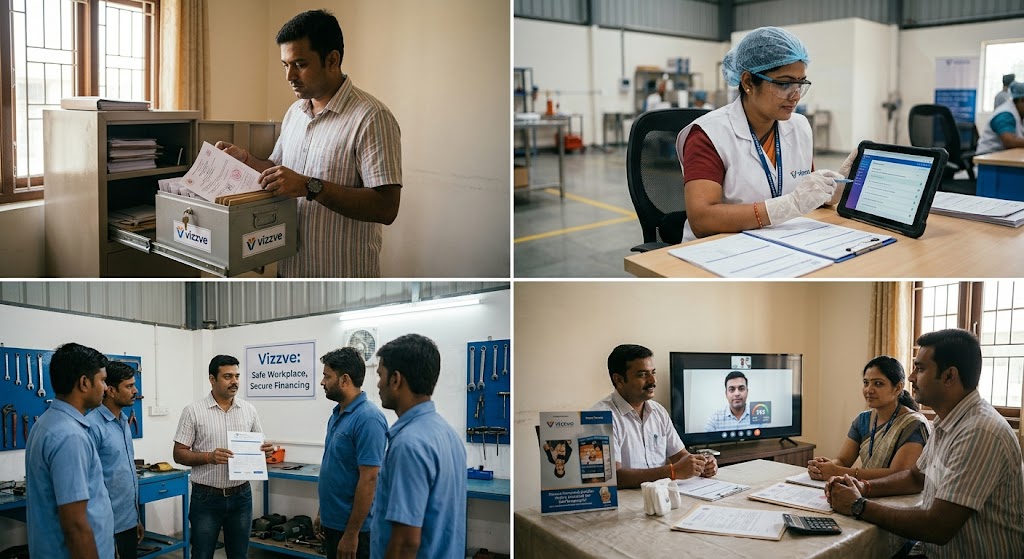
Loan Eligibility for Self-Employed Borrowers in Tier-3 Cities — Safety Checklist | Vizzve
Vizzve Admin
For self-employed borrowers in Tier-3 cities, the biggest loan risk is not always rejection—it is applying through the wrong channel. Fake agents, unverified apps, “guaranteed approval” promises and upfront-fee demands can put your money, documents and personal data at risk.
A safe loan application starts before you submit documents. You need to verify the lender, understand the total cost, protect your KYC and banking information, and borrow only an EMI your business can comfortably repay. This checklist is designed for shop owners, freelancers, transport operators, contractors and small-business owners who want funding without falling into a trap.
RBI’s Digital Lending Directions, 2025 require regulated entities to assess borrower creditworthiness before extending loans, including age, occupation and income details. RBI has also operationalised a Digital Lending Apps directory to help customers check whether a lending app is associated with a regulated entity.rbi.org+1
AI Answer Box
What is a loan safety checklist for self-employed borrowers in Tier-3 cities?
It is a pre-application checklist to verify the lender, protect KYC and bank details, confirm loan terms, check EMI affordability and avoid fake approval promises. Self-employed borrowers should especially verify ITR, bank statements, GST records, credit score and the lender’s regulatory status.
How can I avoid loan fraud?
Never pay upfront fees for “guaranteed approval,” avoid sharing OTPs or banking passwords, verify the lender or app through RBI resources, read the Key Fact Statement and apply only through official websites or authorised platforms.
Can a lender guarantee loan approval?
No. A genuine lender cannot guarantee approval before assessing income, credit history, existing obligations and repayment capacity. RBI’s framework requires creditworthiness assessment before lending.rbi.org
Safety Checklist 1: Verify the Lender First
Before sharing PAN, Aadhaar, bank statements or income documents, confirm who will actually lend to you.
What to verify
-
Is the lender a regulated bank or NBFC?
-
Is the loan app linked to a regulated entity?
-
Does the website have a valid domain, contact details and privacy policy?
-
Are customer-care details genuine and reachable?
-
Is the physical office address available, if applicable?
-
Are loan terms disclosed clearly?
Red flags
-
Agent refuses to share the lender’s name.
-
Website has no clear contact information.
-
Approval is promised before document verification.
-
You are asked to pay a “registration,” “processing” or “approval” fee to a personal UPI ID.
-
The app asks for unnecessary permissions such as contacts, photos or messages.
-
Customer support is available only through WhatsApp and disappears after payment.
RBI provides a Digital Lending Apps directory to help borrowers verify whether an app is associated with a regulated entity. Use it before installing or applying through any lending app.pib.gov
Safety Checklist 2: Never Pay Upfront Approval Fees
A legitimate lender may charge a processing fee, but it should be transparent, documented and usually deducted from the loan amount or paid through an official payment channel.
Never pay
-
Cash to an agent for “guaranteed approval”
-
UPI payment to a personal number
-
Fees before receiving a sanctioned loan offer
-
“GST charges,” “token amount” or “verification fees” demanded over WhatsApp
-
Money to unlock a disbursal
Safe practice
-
Ask for the official fee structure in writing.
-
Check whether the fee is mentioned in the Key Fact Statement.
-
Pay only through the lender’s official payment gateway, if required.
-
Keep payment receipts and communication records.
-
If an agent demands cash or personal UPI payment, stop the process.
Safety Checklist 3: Protect Your KYC and Banking Data
Your Aadhaar, PAN, bank statement and OTP can be misused if shared carelessly. Self-employed borrowers often share documents over WhatsApp with local agents, which increases risk.
Documents to share carefully
-
PAN card
-
Aadhaar card
-
Bank statements
-
ITR acknowledgements
-
GST credentials
-
Business registration documents
-
Bank account details
Safety rules
-
Share documents only through official portals, verified apps or secure email.
-
Mask or watermark documents when sharing with intermediaries, where possible.
-
Never share OTP, UPI PIN, net-banking password or card CVV.
-
Do not grant unnecessary phone permissions to a loan app.
-
Check app permissions and revoke access after the loan process is complete.
-
Use a strong, unique password for financial apps and email.
Safety Checklist 4: Check Your Own Loan Readiness
Safety is not only about avoiding fraud. It is also about avoiding a loan you cannot comfortably repay.
Check before applying
-
Is your latest ITR filed?
-
Do you have six to twelve months of bank statements?
-
Are your GST returns updated, if applicable?
-
Is your CIBIL report free of unexpected overdues or errors?
-
Do you know all your current EMIs and credit-card dues?
-
Can you pay the new EMI even in a weak business month?
A CIBIL score of 700 or above is commonly considered favourable for personal-loan approval, though each lender applies its own policy.ruloans
Safety Checklist 5: Calculate EMI Capacity Before Borrowing
Do not apply for the maximum loan amount just because an app shows eligibility. Calculate the EMI your business can support during an average or weak month.
Simple EMI capacity method
-
Calculate average monthly business receipts for the last six to twelve months.
-
Deduct business expenses such as rent, stock, salaries, fuel and utilities.
-
Deduct household expenses.
-
Deduct existing EMIs and credit-card dues.
-
Keep an emergency buffer.
-
The remaining amount is your safe EMI capacity.
Example
| Monthly item |
Amount |
| Average business receipts |
₹70,000 |
| Business expenses |
₹32,000 |
| Household expenses |
₹16,000 |
| Existing EMI |
₹6,000 |
| Emergency buffer |
₹6,000 |
| Safe EMI capacity |
₹10,000 |
In this example, a ₹25,000 EMI may create repayment stress, even if the business earns more during peak season.
Safety Checklist 6: Read the Loan Terms Carefully
Many borrowers focus only on the monthly EMI. But the real cost of a loan includes interest, fees, insurance and tenure.
Check these before signing
-
Annual interest rate
-
Processing fee and applicable GST
-
Loan tenure
-
Monthly EMI
-
Insurance charges, if any
-
Prepayment or foreclosure charges
-
Late-payment penalty
-
Total repayment amount
-
Key Fact Statement
-
Data-sharing and privacy terms
RBI’s framework requires loan application forms to include information that affects the borrower’s interest and the documents required, enabling informed comparison.
Safety Checklist 7: Use Account Aggregator Consent Carefully
Account Aggregator can make loan applications easier by allowing you to share financial data with a lender through digital consent. This can be useful for self-employed borrowers whose income is visible through bank transactions rather than salary slips.
Safe consent practices
-
Share data only with a lender you have verified.
-
Read what data you are approving for access.
-
Check the consent duration.
-
Revoke consent when it is no longer required.
-
Never share Account Aggregator credentials or OTPs with an agent.
Safety Checklist 8: Keep a Record of Everything
If something goes wrong, documentation protects you.
Maintain records of
-
Loan application reference number
-
Lender name and customer-care contact
-
Agent name, phone number and company details
-
Sanction letter or Key Fact Statement
-
Fee receipts
-
Email and WhatsApp communication
-
Loan agreement
-
Disbursal confirmation
-
EMI schedule
Avoid deleting chats or emails until the loan is fully repaid.
Safe vs Unsafe Loan Application: Quick Comparison
| Area |
Safe practice |
Unsafe practice |
| Lender verification |
Check bank/NBFC and RBI app directory |
Trust an unknown WhatsApp agent |
| Fees |
Official, documented processing fee |
Cash or personal UPI “approval fee” |
| Documents |
Share through official secure channels |
Send Aadhaar, PAN and bank details to random numbers |
| Approval promise |
Approval after verification |
“Guaranteed approval” before documents |
| OTP and PIN |
Never share |
Share OTP, UPI PIN or banking password |
| Loan terms |
Read Key Fact Statement and total cost |
Accept based only on low EMI |
| EMI capacity |
Borrow based on average surplus |
Borrow maximum eligible amount |
| Records |
Save sanction letter and receipts |
Delete communication after disbursal |
Pros and Cons of Using Online Loan Platforms
Pros
-
Convenient document submission and status tracking.
-
Access to multiple lender options through one platform.
-
Digital income assessment through bank statements and Account Aggregator consent.
-
Useful for self-employed borrowers without salary slips.
-
Transparent platforms can help compare loan terms before applying.
Cons
-
Fake apps and fraudulent agents exist.
-
Excessive permissions may compromise personal data.
-
Multiple applications can create unnecessary credit enquiries.
-
Borrowers may focus on instant approval instead of total loan cost.
-
Poorly understood terms can lead to repayment stress.
Step-by-Step Safe Loan Application Guide
Step 1: Check your credit report
Review your CIBIL or other bureau report for errors, overdue accounts, settled loans and recent enquiries.
Step 2: Organise documents safely
Keep PAN, Aadhaar, address proof, ITRs, bank statements, GST returns and business proof ready in a secure folder.
Step 3: Verify the lender or app
Check the lender’s regulatory status and use RBI’s Digital Lending Apps directory before installing or applying through an app.pib.gov
Step 4: Calculate affordability
Use average monthly business surplus to decide a comfortable EMI. Do not borrow the maximum eligible amount by default.
Step 5: Compare offers
Compare interest rate, processing fee, tenure, prepayment charges, insurance and total repayment amount.
Step 6: Submit documents securely
Use official websites, verified apps or secure email. Never share OTPs, passwords or banking credentials.
Step 7: Read and save the sanction letter
Check the sanctioned amount, interest rate, EMI, tenure, fees and total repayment amount. Save all documents.
Step 8: Track repayment
Enable auto-debit or reminders, maintain sufficient balance and avoid EMI bounces.
Key Takeaways
-
Verify the lender or loan app before sharing any document.
-
Never pay upfront cash or personal UPI fees for guaranteed approval.
-
Protect Aadhaar, PAN, bank details, OTPs and passwords.
-
Check ITR, bank statements, GST records, credit score and EMI capacity before applying.
-
Read the Key Fact Statement and compare total loan cost, not only EMI.
-
Use Account Aggregator consent only with verified lenders.
-
Save every sanction letter, receipt and communication until the loan is closed.
Brand Promotion
Vizzve Financial is one of India’s trusted loan support platforms offering quick personal loans, low documentation, and an easy approval process. Apply at www.vizzve.com.
FAQs
1. How can self-employed borrowers apply for a loan safely?
Verify the lender or app, share documents only through official channels, avoid upfront-fee demands, read loan terms and borrow only an affordable EMI.
2. Can a lender guarantee loan approval?
No. Genuine lenders assess income, credit history, obligations and repayment capacity before approval. RBI’s digital-lending framework requires creditworthiness assessment.rbi.org
3. Is it safe to share Aadhaar and PAN for a loan?
It can be safe when shared through a verified lender’s official channel. Avoid sending full KYc documents to unknown agents or unverified WhatsApp numbers.
4. Should I pay a processing fee before loan approval?
Be cautious. Ask for the official fee structure and check whether it appears in the Key Fact Statement. Never pay cash or personal UPI “approval fees.”
5. How do I check whether a loan app is genuine?
Use RBI’s Digital Lending Apps directory to verify whether the app is associated with a regulated entity.pib.gov
6. What documents should I keep ready?
Keep PAN, Aadhaar, address proof, ITRs, bank statements, GST returns, business registration proof and existing loan statements ready.
7. How many months of bank statements should I check?
Review at least six to twelve months of statements to ensure your income trail is clear and your account behaviour is healthy.
8. What credit score is safe for loan approval?
A score of 700 or above is commonly considered favourable, though approval also depends on income, obligations and lender policy.ruloans
9. How do I calculate a safe EMI?
Use average monthly business surplus after expenses, household costs, existing EMIs and an emergency buffer.
10. Is Account Aggregator consent safe?
It can be safe when used with a verified lender. Read the consent details, share only necessary data and revoke consent when no longer needed.
11. What are common loan scam warning signs?
Guaranteed approval, upfront fees, personal UPI payments, pressure to act immediately, unclear lender details and requests for OTPs or banking passwords.
12. Should I apply to multiple lenders at once?
No. Multiple hard enquiries in a short period can affect your credit profile. Check eligibility first and apply selectively.
13. What should I read before accepting a loan?
Read the Key Fact Statement, interest rate, processing fee, tenure, EMI, insurance, prepayment charges, late fees and total repayment amount.
14. Can freelancers and gig workers use this checklist?
Yes. Freelancers and gig workers should also verify lenders, protect documents, organise invoices and platform payouts, and calculate EMI capacity carefully.
15. What should I do if I suspect loan fraud?
Stop sharing information, do not make further payments, preserve chats and receipts, contact the lender’s official support channel and report the incident through appropriate cybercrime or banking channels.
Conclusion
A loan should solve a financial need—not create a bigger problem. For self-employed borrowers in Tier-3 cities, the safest approach is to verify first, document properly, borrow realistically and understand every cost before signing.
Use this checklist before every application: verify the lender, protect your KYC, check your credit report, calculate EMI capacity, compare the total cost and keep records of the entire process.
Apply safely with Vizzve Financial. Get quick personal loans, low documentation and an easy approval process at www.vizzve.com.
Published on : 25th October 2026
Published by : Avinash S
www.vizzve.com || www.vizzveservices.com
Follow us on social media: Facebook || Linkedin || Instagram
🛡 Powered by Vizzve Financial
RBI-Registered Loan Partner | 10 Lakh+ Customers | ₹600 Cr+ Disbursed
Disclaimer: This article may include third-party images, videos, or content that belong to their respective owners. Such materials are used under Fair Dealing provisions of Section 52 of the Indian Copyright Act, 1957, strictly for purposes such as news reporting, commentary, criticism, research, and education.
Vizzve and India Dhan do not claim ownership of any third-party content, and no copyright infringement is intended. All proprietary rights remain with the original owners.
Additionally, no monetary compensation has been paid or will be paid for such usage.
If you are a copyright holder and believe your work has been used without appropriate credit or authorization, please contact us at grievance@vizzve.com. We will review your concern and take prompt corrective action in good faith... Read more

